Skip to content
KitploitKITPLOIT
ToolsExploitsBlog
Log in
Submit
ToolsExploitsBlog
Submit

Hacking, PenTest, and Cybersecurity Tools for Your Security Arsenal!

Kitploit is a directory of hacking, cybersecurity, and pentesting tools. Discover the latest project updates to find vulnerabilities, analyze systems, automate testing, and strengthen your security.

FeedsContactPrivacy© 2026 Kitploit

Tool Directory

Categories

View all categories
Loading categories
CVE-2026-22812 — CVE-2026-22812 | Kitploit
Tools/GitHubGitHub/0xblackash/cve-2026-22812
Vulnerability AnalysisExploitationWeb SecurityThreat IntelligenceLearning & EducationIncident Response
GitHub0xblackash/cve-2026-22812

CVE-2026-22812

CVE-2026-22812

View Repository
1427 months agoNot yet reviewed
Share

🔐 CVE-2026-22812 - OpenCode Unauthenticated HTTP Server → Remote Code Execution (RCE)

bda545bb-f57e-4905-be5d-42c67ba41d04_1280x721

CVE Severity CVSS Status License


Security advisory, technical analysis, detection guidance, and mitigation notes for CVE-2026-22812


📌 Overview

CVE-2026-22812 is a high-severity Remote Code Execution (RCE) vulnerability affecting OpenCode versions prior to 1.0.216.

The issue exists because OpenCode automatically starts an unauthenticated local HTTP server that can be accessed by:

  • local malicious processes
  • browser tabs through permissive CORS
  • injected web content
  • localhost cross-origin requests

This allows attackers to execute arbitrary shell commands with the privileges of the current user


🚨 Severity

MetricValue
CVE IDCVE-2026-22812
SeverityHigh
CVSS8.8
CWECWE-306, CWE-749, CWE-942
Attack TypeRemote Code Execution
Fixed Version1.0.216+

Source: NVD / GitHub Advisory


🧠 Technical Root Cause

The vulnerable versions automatically expose a localhost HTTP service without authentication.

Because the service also accepts requests from permissive cross-origin sources, any malicious webpage can trigger requests such as:

POST /session/:id/shell

This can lead to:

  • arbitrary command execution
  • credential theft
  • source code exfiltration
  • SSH key exposure
  • cloud token compromise
  • local persistence

💥 Impact

Successful exploitation may result in:

  • 🔓 Full developer workstation compromise
  • 🗝️ Secret leakage (.env, SSH, API tokens)
  • 📂 Unauthorized source code access
  • ☁️ Cloud CLI session hijacking
  • 🧪 Supply-chain compromise risks
  • 🖥️ Arbitrary shell execution as logged-in user

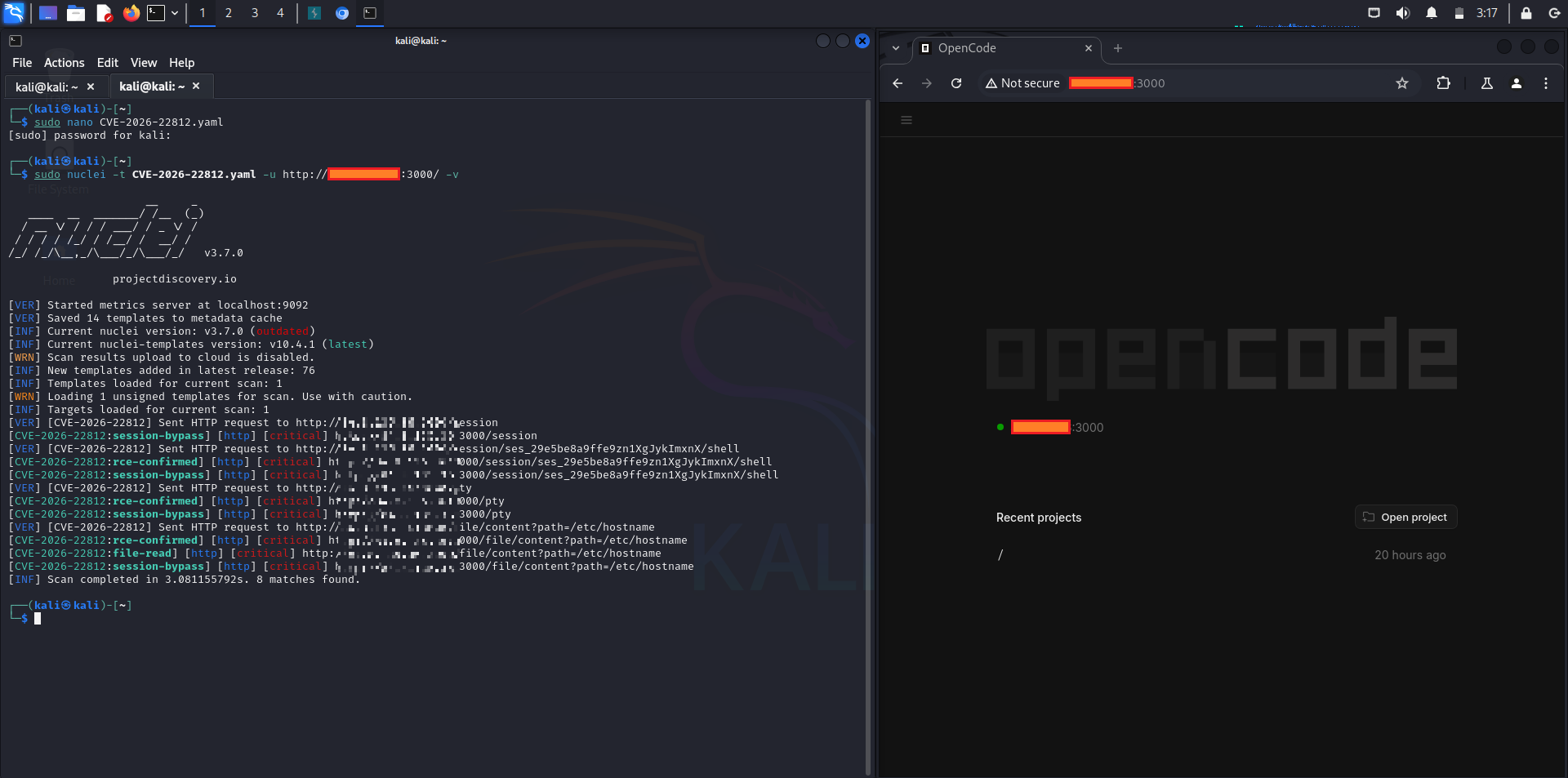
📸 Screenshot

cve-2026-22812 1 cve-2026-22812

📦 Affected Versions

Vulnerable: < 1.0.216
Safe:       >= 1.0.216

🛠️ Mitigation

✅ Recommended Fix

Upgrade immediately:

npm update opencode

or install a safe version:

npm install [email protected]

🧱 Temporary Workarounds

If upgrading is not immediately possible:

  • restrict localhost port access
  • isolate OpenCode inside a container
  • block suspicious localhost requests
  • close untrusted browser tabs
  • rotate exposed credentials
  • disable permissive CORS if configurable

🔍 Detection Tips

Indicators of possible exploitation:

  • unusual shell commands spawned by OpenCode
  • suspicious localhost POST requests
  • browser-originated requests to OpenCode ports
  • unexpected file access in project directories
  • abnormal terminal child processes

Recommended telemetry:

  • EDR process tree monitoring
  • localhost HTTP access logs
  • shell execution auditing
  • browser security telemetry

🧪 Proof of Concept Status

⚠️ Public exploitation details exist in advisory discussions.

For responsible disclosure and safety, avoid publishing weaponized PoCs in public production repositories.


📚 References

  • NVD Advisory NVD CVE Entry
  • OSV Database OSV Entry
  • Vendor Advisory GitHub Security Advisory

⚖️ Disclaimer

This repository is intended for:

  • defensive security research
  • blue-team awareness
  • patch validation
  • vulnerability management
  • secure development education

Do not use this information on systems you do not own or have permission to test.


🛡️ Secure your AI developer tools before they secure your code

Download Tool

Most Popular

View all →

Discover the most used tools by our community.

  • 1

    OsintHunter

    letox4/osinthunter

    🎯 The ultimate OSINT toolkit: investigation graph, confidence scoring, alias families, map, timeline and reports. 49 modules, 400+ sites, no API keys required.

    772
  • 2

    ghostlock-app

    yukonga/ghostlock-app

    GhostLock One-Tap Execution App (CVE-2026-43499)

    505
  • 3

    ARTEX

    baarai/artex

    LLM multi-agent autonomous penetration testing platform with planner/worker agents, asset and exploration graphs, MITM traffic recording, and vulnerability retesting.

    420
  • 4

    redforge

    cybersecurity91/redforge

    Browser-side red team toolkit with 102 offline tools for recon, payload generation, credential attacks, crypto, encoding and engagement reporting.

    345
  • 5

    CyberStrikeAI

    ed1s0nz/cyberstrikeai

    The system of action for AI-native cybersecurity—where intent becomes governed execution, evidence becomes operational memory, and every operation improves the next.

    260
  • 6

    antifox

    antifox-ai/antifox

    AI multi-agent autonomous penetration testing platform that runs recon, attack-surface discovery, exploitation validation and evidence-backed report delivery.

    251

Explore all tools

Browse our collection of tools

View all tools →