

New releaseJul 14, 2026
KubeArmor v1.7.5-rc1
Runtime Security Enforcement System. Workload hardening/sandboxing and implementing least-permissive policies made easy leveraging LSMs (LSM-BPF, AppArmor).










KubeArmor is a cloud-native runtime security enforcement system that restricts the behavior (such as process execution, file access, and networking operations) of pods, containers, and nodes (VMs) at the system level.
KubeArmor leverages Linux security modules (LSMs) such as AppArmor, SELinux, or BPF-LSM to enforce the user-specified policies. KubeArmor generates rich alerts/telemetry events with container/pod/namespace identities by leveraging eBPF.
| 💪 Harden Infrastructure ⛓️ Protect critical paths such as cert bundles 📋 MITRE, STIGs, CIS based rules 🛅 Restrict access to raw DB table | 💍 Least Permissive Access 🚥 Process Whitelisting 🚥 Network Whitelisting 🎛️ Control access to sensitive assets |
| 🔭 Application Behavior 🧬 Process execs, File System accesses 🧭 Service binds, Ingress, Egress connections 🔬 Sensitive system call profiling | ❄️ Deployment Models ☸️ Kubernetes Deployment 🐋 Containerized Deployment 💻 VM/Bare-Metal Deployment |
Architecture Overview
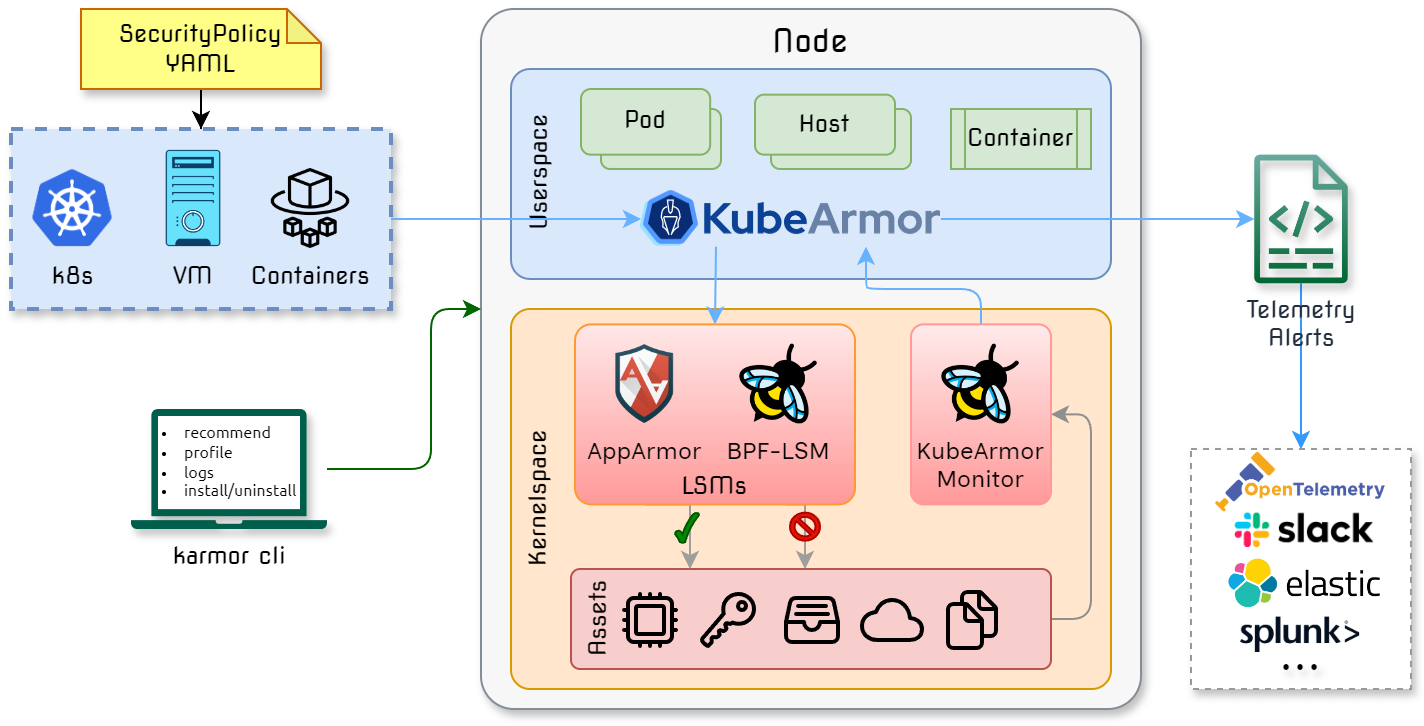
Documentation 📓
- 👉 Getting Started
- 🎯 Use Cases
- ✔️ KubeArmor Support Matrix
- ♟️ How is KubeArmor different?
- 📜 Security Policy for Pods/Containers [Spec] [Examples]
- 📜 Cluster level security Policy for Pods/Containers [Spec] [Examples]
- 📜 Security Policy for Hosts/Nodes [Spec] [Examples]
- 📜 Network Security Policy for Hosts/Nodes [Spec] [Examples]
... detailed documentation
Contributors 👥
Biweekly Meeting
- 🗣️ Zoom Link
- 📄 Minutes: Document
- 📆 Calendar invite: Google Calendar, ICS file
Community & Governance
KubeArmor is a community-governed project. The following documents describe how the project is run: