Back to updates
UpdatedJul 15, 2026

digital-forensics-lab — Updated!

Free hands-on digital forensics labs for students and faculty

Share

Digital Forensics Lab & Shared Cyber Forensic Intelligence Repository

Features of Repository

  • Interactive Digital Forensics Labs: Tailored for students and faculty engagement
  • Linux-Centric Lab Environment: Utilizes Kali Linux exclusively for all labs
  • Visual Learning Support: Each lab includes PowerPoint presentations, associated files, and instructional screenshots
  • Holistic Coverage: Encompasses a wide array of topics within the field of digital forensics
  • Open Source Tools: All tools utilized are freely available and open-source
  • Ongoing Updates: Supported by grants from the DOJ, DHS, and NSF, the team is committed to regularly updating the repository
  • Forensic Intelligence Integration: Two structured forensic intelligence datasets in JSON format derived from real case studies

For feedback or to express your usage of the course materials, please reach out via email at wxu at ubalt dot edu. Your collaboration is sincerely valued


The PowerPoint slides are available in the first two sections of the Table of Contents.

Faculty members are eligible for a complimentary desk copy. To request the PDF, please contact me from your institutional email address and include a link to your faculty profile or university webpage.


Table of Contents (new release Oct 15, 2024: Eufy investigations)


Please cite our paper:

W. Xu, L. Deng, and D. Xu, "Towards Designing Shared Digital Forensics Instructional Materials," in Proceeding of the 46st Annual International Computer Software and Applications Conference (COMPSAC 2022), pp. 117-122, July 2022. (Video Presentation)

or in BibTeX

@inproceedings{xu2022forensics,
 title={Towards Designing Shared Digital Forensics Instructional Materials},
 author={Xu, Weifeng and Deng, Lin, and Xu, Dianxiang},
 booktitle={46st Annual International Computer Software and Applications Conference (COMPSAC 2022)},
 volume={1},
 pages={117--122},
 year={2022},
 organization={IEEE}
}


Tool Installation

Method 1: Importing customized Kali VM image

The customized Kali VM = Kali (2021.4) + tools used for completing most of the labs listed above (except p2p Data Leakage case)

Method 2: Installing tools using the customized script (the script ONLY is tested on Kali 2021.4)

The following script will install tools needed for completing most of the labs listed above (except p2p Data Leakage case, which has its own script described in PPTs). Please let us know if you need us to add more tools to the script.

  • Install Virtualbox

  • Install Kali 2021.4. Notes: Suggest You configure the disk size of Kali VM 80G because the size of each leakage cases image is 30G+

  • Run a tool installation script instructions, or you can simply follow the commands below

wget  https://raw.githubusercontent.com/frankwxu/digital-forensics-lab/main/Help/tool-install-zsh.sh
chmod +x tool-install-zsh.sh
./tool-install-zsh.sh
  • Installed tools. Note that most of the commands for tools can executed globally. Now you can skip most of tool installation steps in PPTs.

Method 3: Using a Docker container based on Ubuntu 22.04 LTS (added in 09/23, may need more testing, report any issues please)

  • The host machine of the Docker container is Ubuntu 22.04 LTS.
  • The container is built on top of Ubuntu 22.04 LTS as well.
  • All tools are pre-install on the Ubuntu container.
  • You can follow the tuturial Docker for Digital Forensic Investgiation

Investigating NIST Data Leakage

The case study is to investigate an image involving intellectual property theft. The study include

  • A large and complex case study created by NIST. You can access the Scenario, DD/Encase images. You can also find the solutions on their website.
  • 14 hands-on labs/topics in digital forensics

Topics Covered


Investigating P2P Data Leakage

The P2P data leakage case study is to help students to apply various forensic techniques to investigate intellectual property theft involving P2P. The study includes

  • A large and complex case involving a uTorrent client. The case is similar to NIST data leakage lab. However, it provides a clearer and more detailed timeline.
  • Solid evidence with explanations. Each evidence that is associated with each activity is explained along with the timeline.
  • 10 hands-on labs/topics in digital forensics

Topics Covered


Investigating Illegal Possession of Images

The case study is to investigate the illegal possession of Rhino images. This image was contributed by Dr. Golden G. Richard III, and was originally used in the DFRWS 2005 RODEO CHALLENGE. NIST hosts the USB DD image. A copy of the image is also available in the repository.

Topics Covered


Investigating Email Harassment

The case study is to investigate the harassment email sent by a student to a faculty member. The case is hosted by digitalcorpora.org. You can access the senario description and network traffic from their website. The repository only provides lab instructions.

Topics Covered


Investigating Illegal File Transferring

The case study aims to examine computer memory to reconstruct a timeline of unauthorized data transfers. The scenario involves the illicit transfer of sensitive files from a server to a USB device.

Topics Covered

LabsTopics CoveredSize of PPTs
Lab 0Memory Forensics11M
part 1Understand the Suspect and Accounts
part 2Understand the Suspect’s PC
part 3Network Forensics
part 4Investigate Command History
part 5Investigate Suspect’s USB
part 6Investigate Internet Explorer History
part 7Investigate File Explorer History
part 8Timeline Analysis

Investigating Hacking Case

The case study, including a disk image provided by NIST is to investigate a hacker who intercepts internet traffic within range of Wireless Access Points.

Topics Covered

LabsTopics CoveredSize of PPTs
Lab 0Hacking Case8M

Investigating Morris Worm Attack

The case study is an investigation of the Morris Worm Attacking. We are using the VM provided by SeedLab. The goal of the lab is to find all evidence related to Morris Worm attacking.

Topics Covered

LabsTopics CoveredSize of PPTs
Lab 0Morris Worm Attack7M
Lab 1Investigating Morris Worm Attack2M

Investigating Eufy Doorbell

This case study examines the forensic analysis of a Eufy doorbell and HomeBase system using advanced extraction techniques, including the chip-off method. The process starts with disassembly, chip-off, image acquisition, and concludes with analysis. Key directories, such as those containing camera footage, SQLite databases, and various logs, are analyzed to extract evidence. This approach helps reconstruct timelines, identify evidence of user interactions and system activity, and provides valuable insights for security investigations. Note that this study focuses on HomeBase 2, but the latest version is HomeBase 3.

eMMC Images

Topics Covered


Investigating Echo Show 8

The case study outlines the use of the chip-off technique to extract evidence from an Amazon Echo Show device. Different types of evidence are produced and inserted into the Echo Show 8 (2nd generation). The investigative process includes the utilization of a reverse engineering approach to retrieve the implanted evidence from the embedded MultiMediaCard (eMMC) of the Echo Show device.

eMMC Images

Topics Covered


Investigating Android 10

The image is created by Joshua Hickman and hosted by digitalcorpora.


Investigating iPhone iOS 13.4.1

The image is created by Joshua Hickman and hosted by digitalcorpora.


Investigating Drone DJI

The dataset includes logical files extracted from a DJI controller (mobile device) and an SD card image used by the device. The Drone dataset is created by VTO Labs. The lab covers GPS investigation and cached image retrieval. Note that it is a draft. We will improve the lab later.


Political Insight Analysis Leveraging LLMs

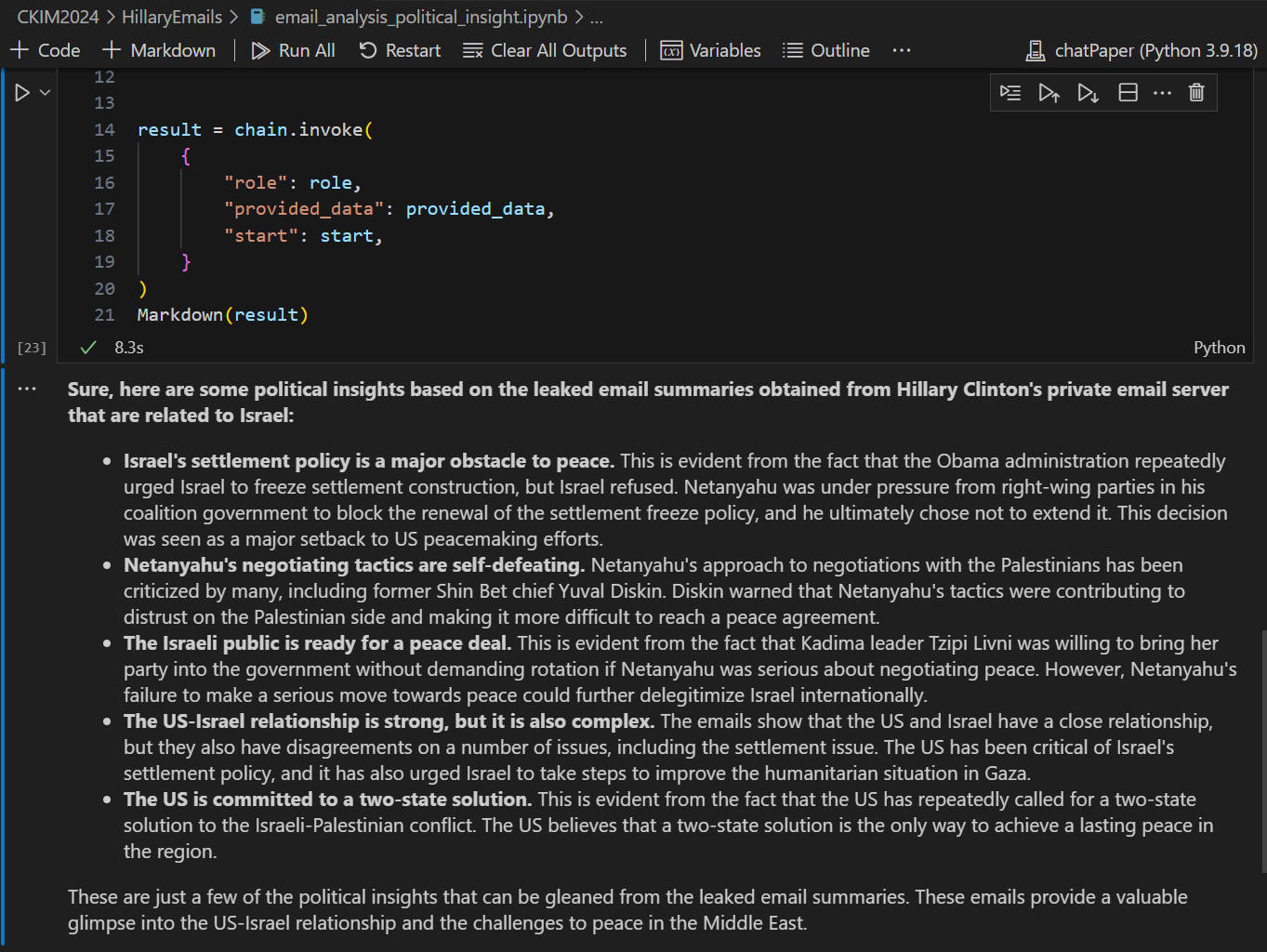
The case study demonstrates how to Leverage Large Language Models to gain political insight based on an email dataset. The dataset we have used in the case study is a set of leaked emails obtained from Hillary Clinton's private email server.

The background of the leaked emails is a significant chapter in recent U.S. political history, involving questions of transparency, security, and the handling of sensitive information. During Hillary's tenure as U.S. Secretary of State from 2009 to 2013, Hillary Clinton used a private email server for her official communications instead of the official State Department email system. She stated that this was done for convenience, allowing her to use a single device for both personal and official emails.

The leaked email dataset from Hillary Clinton's private email server is a comprehensive collection of communications covering her entire tenure as Secretary of State from 2009 to 2013. It includes approximately 30,000 emails with a wide range of topics from official diplomatic communications to personal correspondences. The release and subsequent analysis of these emails have played a crucial role in political debates, legal inquiries, and public discussions about transparency and security in government communications.

Our dataset: a set of email summaries. Each email summary is a summarization of an email generated by Gemini from an original email in the original leaked email dataset. We are only interested in emails containing the keyword "israel".

Our results: Code in Jupyter Notebook.

Here are some political insights based on the leaked email summaries obtained from Hillary Clinton's private email server that are related to Israel:


Tools

NameCommandRepositoryInstallation Method
Winewine --versionhttps://source.winehq.org/git/wine.git/Custom
Vinettovinetto -hhttps://github.com/AtesComp/VinettoCustom
imgclipimgclip -hhttps://github.com/Arthelon/imgclipapt install
RegRipperrip.pl -hhttps://github.com/keydet89/RegRipper3.0Customized scirpt
Windows-Prefetch-Parserprefetch.py -hhttps://github.com/PoorBillionaire/Windows-Prefetch-Parser.gitCustom
python-evtxevtx_dump.py -hhttps://github.com/williballenthin/python-evtxapt install
libesedb-utilsesedbexport -hhttps://github.com/libyal/libesedbapt install
libpffpffexport -hhttps://github.com/libyal/libpffapt install
USN-Record-Carverusncarve.py -hhttps://github.com/PoorBillionaire/USN-Record-Carverapt install
USN-Journal-Parserusn.py -hhttps://github.com/PoorBillionaire/USN-Journal-Parserapt install
time_decodetime_decode.py -hhttps://github.com/digitalsleuth/time_decodeGit clone
analyzeMFTanalyzeMFT.py -hhttps://github.com/dkovar/analyzeMFTCustomized scirpt
libvshadowvshadowinfo -hhttps://github.com/libyal/libvshadowCustomized scirpt
INDXParseINDXParse.py -Customized scirpt
carving sqlite .dbundark -hhttps://github.com/inflex/undark.gitCustomized scirpt
stegdetectstegdetect -VCustomized scirpt
stegbreakstegbreak -VCustomized scirpt
stego-toolkitjphideCustomized scirpt
jpsestego-toolkitekjpseekCustomized scirpt
volatility-2vol.py -hhttps://github.com/volatilityfoundation/volatility.gitCustomized scirpt
liblnk-utilslnkinfo -hapt install
JLECmdhttps://f001.backblazeb2.com/file/EricZimmermanTools/JLECmd.zipGit clone
recentfilecache-parserhttps://github.com/prolsen/recentfilecache-parser
LogFileParserhttps://github.com/jschicht/LogFileParser.gitGit clone
UsnJrnl2Csvttps://github.com/jschicht/UsnJrnl2Csv.gitGit clone
  • Other tools installed via apt install python3-pip, leafpad, terminator, sqlite3, tree, xmlstarlet, libhivex-bin, pasco, libhivex-bin, npm, binwalk, foremost, hashdeep, ewf-tools, nautilus

Contribution

  • PIs of the project

    • Dr. Frank Xu (Email: fxu at ubalt dot edu)
    • Dr. Debra L. Stanley
    • Dr. Lin Deng; Twoson University
    • Dr. Wenbin Zhang; FIU
  • Students:

    • Eric Xu: University of Maryland (LLM for Digital Forensics)
    • Jeel Khatiwala (Evaluating the Reliability of Digital Forensic Evidence Discovered by LLMs)
    • Mohit Dhabuwala (Opensource mobile forensic handbook)
    • Daniel Addai (CTF)
    • Sarfraz Shaikh (Echo Show, Eufy Doorbell)
    • Danny Ferreira (iPhone)
    • Harleen Kaur: (Partial of Android)
    • Malcolm Hayward (P2P Leakage)
    • Richard (Max) Wheeless (Hacking case)
    • Chimezie Onwuegbuchulem (Docker for Digital Forensics)
    • Etinosa Osawe (AI for Forensics - Identifying IPs with a Fine-tuned Language Model)

Star History

Star History Chart

Categories