
Skip to content
KitploitKITPLOIT
ToolsExploitsBlog
Log in
Einreichen
ToolsExploitsBlog
Einreichen

Hacking-, PenTest- und Cybersicherheits-Tools für Ihr Sicherheitsarsenal!

Kitploit ist ein Verzeichnis von Hacking-, Cybersicherheits- und Pentesting-Tools. Entdecken Sie die neuesten Projekt-Updates, um Schwachstellen zu finden, Systeme zu analysieren, Tests zu automatisieren und Ihre Sicherheit zu stärken.

FeedsKontaktDatenschutz© 2026 Kitploit

Tool-Verzeichnis

Kategorien

Alle Kategorien anzeigen
Loading categories
Tools/GitHubGitHub/9pings/fad-checker
Defensive ToolsStatic AnalysisVulnerability ScannersVulnerability AnalysisCode AnalysisConfiguration AuditingDevSecOpsSecret DetectionSupply Chain Security
GitHub9pings/fad-checker

fad-checker

Buildless dependency auditor that scans 10 ecosystems offline, reporting CVEs prioritized by CISA KEV and EPSS, EOL packages, licenses, committed keys, and binaries with SBOM and SARIF exports.


4186vor 3 TagenNoch nicht geprüft
Teilen
Repository anzeigen
Inhalt in der angeforderten Sprache nicht verfügbar. Englische Version wird angezeigt.

VigieVuln

npm version npm downloads license node CI

VigieVuln 1.3.3 is a polyglot dependency auditor for code audits.

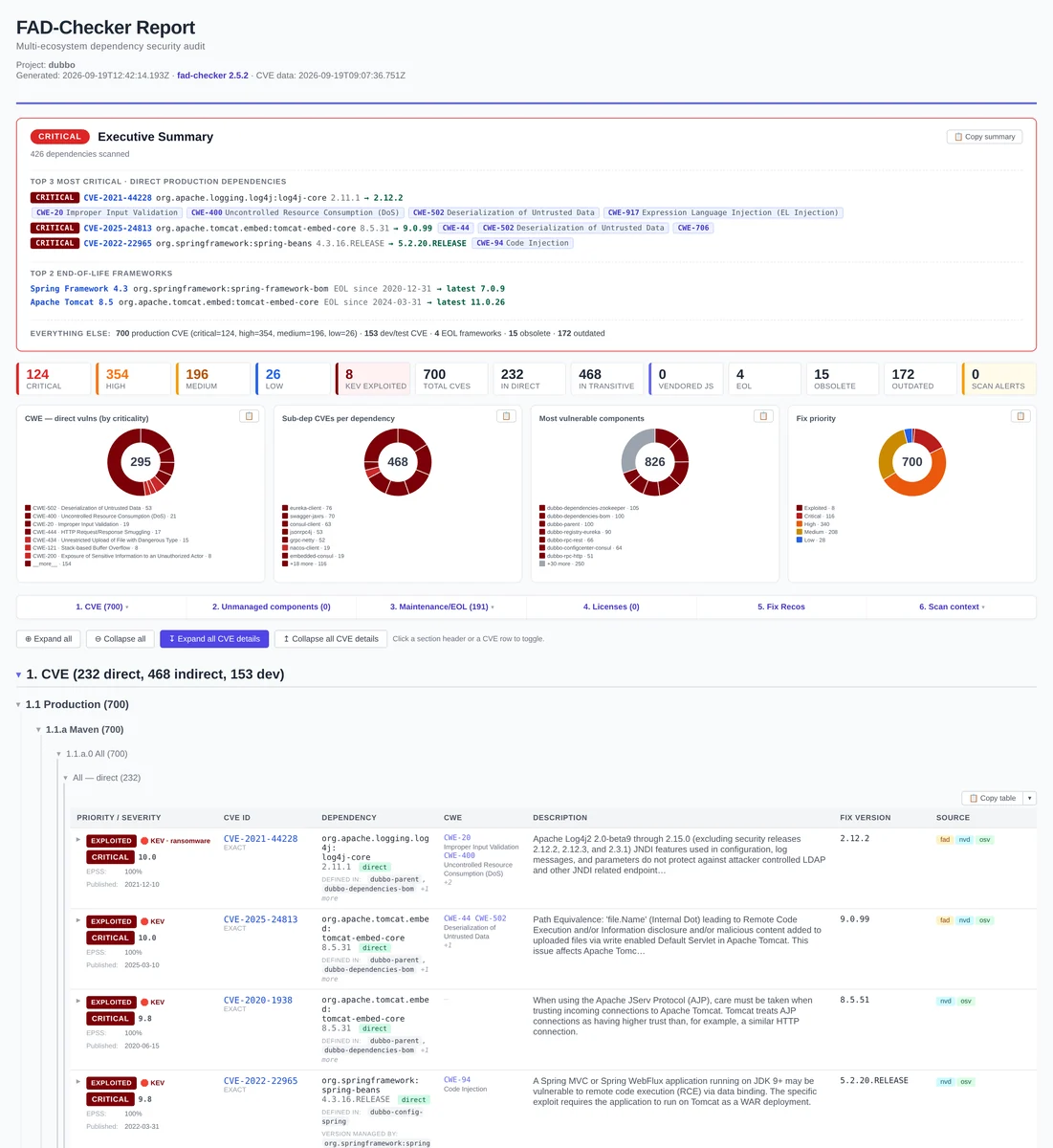
It scans dependencies and 9 CMS/frameworks in one pass without build tools, supports air-gapped workflows, detects private packages, binaries and certificates, and produces HTML, JSON and other reports.

🌐 Project site & docs →

Terminal demo recorded with VigieVuln 1.2.1.
vigievuln animated terminal demo: an offline Maven audit — dependencies absent from Maven Central flagged as private/internal, the compact single-line vulnerability-database progress, then findings coloured by severity

Features

  • Multiple ecosystems in one pass: Maven and Gradle, npm/Yarn/pnpm, Composer, PyPI, NuGet, Go and Ruby — plus vendored JS, committed native binaries and embedded JARs.
  • No build tools; No mvn/gradle/npm/pip/dotnet/go, no node_modules/ → how
  • CVE from multiple sources, merged & prioritised; CVEProject + OSV.dev + Packagist security advisories + NVD, ranked CISA KEV → EPSS → CVSS.
  • European vulnerability references: ENISA EUVD id + ENISA's exploited flag, GCVE id, and the CERT-FR advisories citing it. Hosted proxy lookups send relevant CVE identifiers to the proxy.
  • Beyond CVEs; Report EOL and out-of-active-support frameworks, deprecated/abandoned/yanked, outdated, SPDX licenses, and private/internal packages
  • CMS & frameworks audited as instances; Symfony, Laravel, WordPress, Drupal, Joomla, PrestaShop, TYPO3, Magento/Adobe Commerce and SPIP with per-instance inventory (core, plugins, themes, bundles, components) → the dedicated guide
  • Crypto material; committed certificates, private vs public keys across PEM/OpenSSH/PuTTY/PGP and JKS/PKCS#12 keystores.
  • Air-gapped flow; zero network under --offline → Benchmark · Air-gapped
  • Native image audits; Docker/OCI archives, registries and rootfs inventories without Docker; Linux packages, ELF/Go metadata and publisher SBOMs, with explicit coverage. Image analysis in source scans is off by default; use --images or the separate vigievuln image command → image guide
  • Hosted proxy with a verified account; --set-proxy-cache vigievuln → hosted proxy
  • Project monitoring; vigievuln watch ./project --name 'My Project' — one free project with up to 100 distinct direct dependency coordinates → monitoring guide
  • Shared cache for a scanner fleet; vigievuln serve-cache + --proxy-cache → cache usage
  • Supply-chain risk; known-malicious advisories and suspected typosquats (--typosquat).
  • Audit-grade; every report carries a provenance manifest and a Methodology & limitations chapter; a SHA256SUMS;
  • Differential audits diff against a prior run (--baseline) and CI can gate on new findings only.
  • Reports in English or French (--lang fr)
  • Outputs & CI; Pro HTML report + JSON baseline by default + Word, Excel, CycloneDX 1.6 SBOM, CSAF 2.0 VEX, SARIF 2.1.0, JSON; gate with --fail-on, triage with --ignore/--vex.
  • Report made for productivity; every table / chart has a Copy for word button.

📖 Usage & all flags · Architecture · Comparison vs other tools · Data sources

[!IMPORTANT] Although VigieVuln is an excellent tool—comprehensive, rigorously tested, and regularly updated—it is still relatively new, and like any other scanner, it may occasionally produce errors. Whenever possible, cross-check important findings with another analysis tool — though, among the tools we compared, none offers reports as comprehensive as VigieVuln.

Quick start

npm install -g vigievuln
vigievuln scan ./code             # → ./vigievuln-report/cve-report.html

Faster scans using personal NVD API key

A free NVD API key (instant) gives 10× faster enrichment: vigievuln --set-nvd-key YOUR_KEY. A few common runs; full list via vigievuln --help or docs/USAGE.md

Faster scans using the VigieVuln DB European hosted cache

Use Vigie Vuln DB as a European-hosted source for scans, including reviewed VigieVuln advisories for Maven and npm.

vigievuln login                 # sign in and select the official proxy if none is configured
vigievuln scan ./code           # scan using the saved proxy and key
vigievuln setup --mode direct --sources all  # switch back to direct sources

The proxy receives package coordinates and CVE identifiers, not source code. Cached advisories remain usable offline; partial version evidence leaves other versions unknown. Proxy guide.

Include container images

Add --images to scan supported container images referenced by the project alongside its dependencies, without Docker; this option is off by default.

vigievuln scan ./code --images

The report keeps source and image findings in separate summaries and charts, highlighting vulnerable images and their most critical CVEs. Image inputs, options and coverage.

Why use vigievuln ?

An author-maintained comparison of audit workflows; see docs/COMPARISON.md for versions, sources and limitations. ⚠️ indicates partial or conditional support.

Tool herunterladen

Beliebteste

Alle anzeigen →

Entdecken Sie die meistgenutzten Tools unserer Community.

  • 1

    ghostlock-app

    yukonga/ghostlock-app

    GhostLock One-Tap Execution App (CVE-2026-43499)

    980
  • 2

    OsintHunter

    letox4/osinthunter

    🎯 Das ultimative OSINT-Toolkit: Untersuchungsgraph, Konfidenzbewertung, Alias-Familien, Karte, Zeitleiste und Berichte. 49 Module, 400+ Websites, keine API-Schlüssel erforderlich.

    737
  • 3

    wifit3

    derv82/wifit3

    Wifite, aber nur USB & plattformübergreifend.

    735
  • 4

    jumpserver

    jumpserver/jumpserver

    JumpServer ist eine Open-Source-Plattform für Privileged Access Management (PAM), die DevOps- und IT-Teams bedarfsgesteuerten und sicheren Zugriff auf SSH-, RDP-, Kubernetes-, Datenbank- und RemoteApp-Endpunkte über einen Webbrowser bietet.

    485
  • 5

    SafeLine

    chaitin/safeline

    Selbst gehosteter WAF und Reverse Proxy, der bösartigen HTTP-Verkehr filtert, SQL-Injection, XSS und Bot-Angriffe blockiert, mit Ratenbegrenzung und dynamischer HTML/JS-Verschlüsselung.

    439
  • 6

    CyberStrikeAI

    ed1s0nz/cyberstrikeai

    Das System der Handlung für KI-native Cybersicherheit – wo Absicht zu gesteuerter Ausführung wird, Beweise zu operativem Gedächtnis werden und jeder Einsatz den nächsten verbessert.

    397

Alle Tools erkunden

Durchsuchen Sie unsere Tool-Sammlung

Alle Tools anzeigen →