
Skip to content
KitploitKITPLOIT
工具漏洞利用博客
Log in
提交
工具漏洞利用博客
提交

黑客、渗透测试和网络安全工具,武装您的安全武器库!

Kitploit 是一个黑客、网络安全和渗透测试工具的目录。发现最新的项目更新,查找漏洞、分析系统、自动化测试并加强你的安全。

订阅源联系隐私© 2026 Kitploit

工具目录

分类

查看所有分类
Loading categories
TornadoC2 — Pull-based C2 framework with ten native transports, concurrent multi-profile handlers, ECDSA-signed tasking, and a multi-operator team server with RBAC and Qt/CLI consoles. | Kitploit
工具/GitHubGitHub/kamalx06/tornadoc2
Penetration Testing FrameworksPersistence MechanismsIDS/IPS EvasionLateral MovementPost-ExploitationWireless SecurityCryptographyPenetration TestingCommand and ControlRed TeamingPayload DevelopmentRemote Access Trojan
341013115天前Kitploit 审核通过
GitHubkamalx06/tornadoc2

TornadoC2

Pull-based C2 framework with ten native transports, concurrent multi-profile handlers, ECDSA-signed tasking, and a multi-operator team server with RBAC and Qt/CLI consoles.

查看仓库
分享
内容在请求的语言中不可用。显示英文版本。

TornadoC2

A pull-based C2 with ten native transports, concurrent multi-profile handlers, and an honest threat model. The agent is a single Go binary with every behavioural property baked in at build time — no runtime config file, no environment variable, no command-line arguments. Tasks and results are ECDSA-signed end to end. The transports are HTTPS, QUIC/HTTP/3, WebSocket, DNS TXT, DNS-over-HTTPS, ICMP, WireGuard, SMB-pivot, TCP-bind, and TCP-reverse.


Legal Notice

Use this software only on systems you own or on systems where you hold explicit written authorization. You are solely responsible for compliance with applicable laws and organizational policies. The authors and contributors accept no liability for misuse, data loss, or legal consequences arising from the use of this project.


Table of Contents
  • Introduction
  • Why TornadoC2 Exists
    • What that shaped
    • What it is not
    • What comes next
  • Capability summary
  • Key Features
  • Design Philosophy
    • Compile-time configuration
    • Startup-time configuration
    • Queue-based execution
    • Artifact discipline on the target
    • Graceful degradation
    • Encryption without loss of auditability
    • Contribution paths with no core coupling
    • Concurrent multi-profile handlers
    • Profile paths as first-class routing
  • Operational Security
  • Threat Model
  • Architecture
  • Transports
  • Pivot Transports
  • Requirements & Installation
    • Go build bootstrap
    • Dependency installers
  • Quick Start
  • Deployment Playbook
  • Build Config File
  • Staged Payloads
  • Remote Build
  • Operator Reference
  • GUI Operator Console
  • AI Operator Console and MCP Server
  • In-Memory Execution
  • BOF Registry
  • C2 Profile Catalogue
  • Profile Validation (shapecheck)
  • SOCKS5 Pivoting
  • Migration
  • Scheduled Tasks
  • Task Queue Introspection
  • Bulk Operations
  • Beacon Aliases and Tags
  • Beacon Viewers
  • Credential Vault
  • Engagement and Per-Beacon Notes
  • Webhook Notifications
  • Session Graph
  • Desktop Notifications
  • Wire Protocol
  • Native Commands
  • Cryptography
  • Key Management
  • Backup and Recovery
  • Self-Update
  • OPSEC Profiles
  • C2 Profiles
    • Concurrent multi-profile handlers
    • Placeholders
    • Encoding
    • Placement
    • Status codes
    • Cookie name
    • Response headers
    • DNS label shaping
    • Stager path
  • Extending TornadoC2
    • Adding a transport
    • Adding a C2 profile
    • Adding a WASM extension
    • The contribution-path summary
  • Beacon Extensions
  • Server Hardening
  • Team Chat
  • Loot Store
  • Dead-man's Switch
  • Session Logging
  • Troubleshooting
  • TLS & mTLS Configuration
  • License

Introduction

TornadoC2 is a pull-based C2. The agent does not hold a live socket; it wakes on its own schedule, checks in with the server, retrieves queued work, executes it, and goes back to sleep. The operator queues commands; the beacon picks them up on its next check-in.

This design trades immediacy for resilience. A live shell dies when the network flaps; a beacon reconnects on its next wake-up and resumes. A live shell leaves a persistent footprint on the wire; a beacon's traffic pattern is bounded by its sleep interval. The framework is built for long-haul engagements where the implant has to survive reboots, retry on failure, and self-destruct on a schedule.

The implant is a single Go binary, cross-compiled from the operator machine. There is no runtime configuration file, no environment variable, no registry key. The callback URL, sleep interval, kill date, C2 profile, and evasion set are all baked in at build time. A captured binary contains everything it needs to run, and nothing the operator did not put there.

The framework is compiled for Linux and Windows today, on amd64 and arm64. macOS support is on the near-term list, along with additional native commands and additional evasion primitives. The Capability summary below lists what is available in the current version.
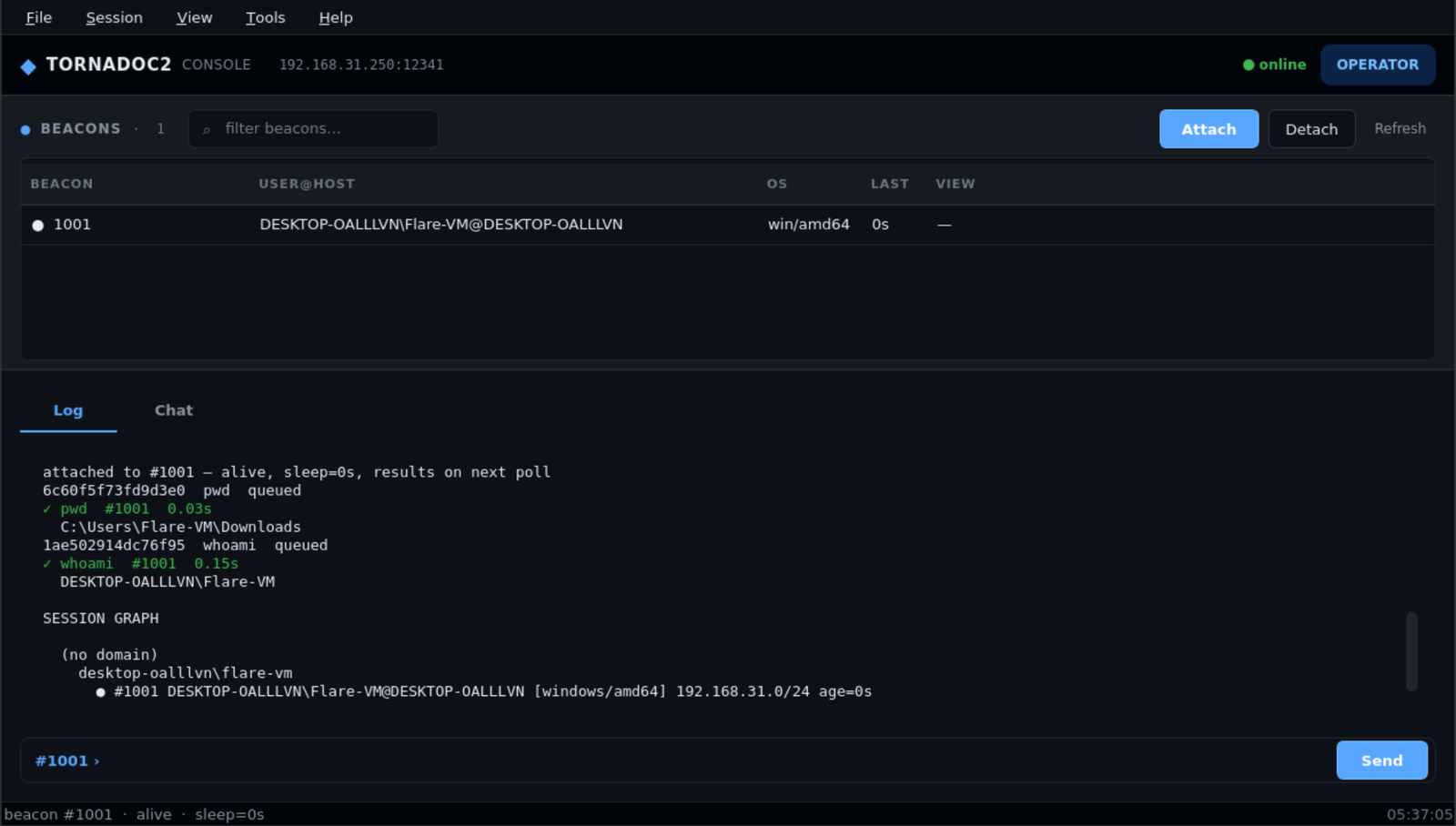

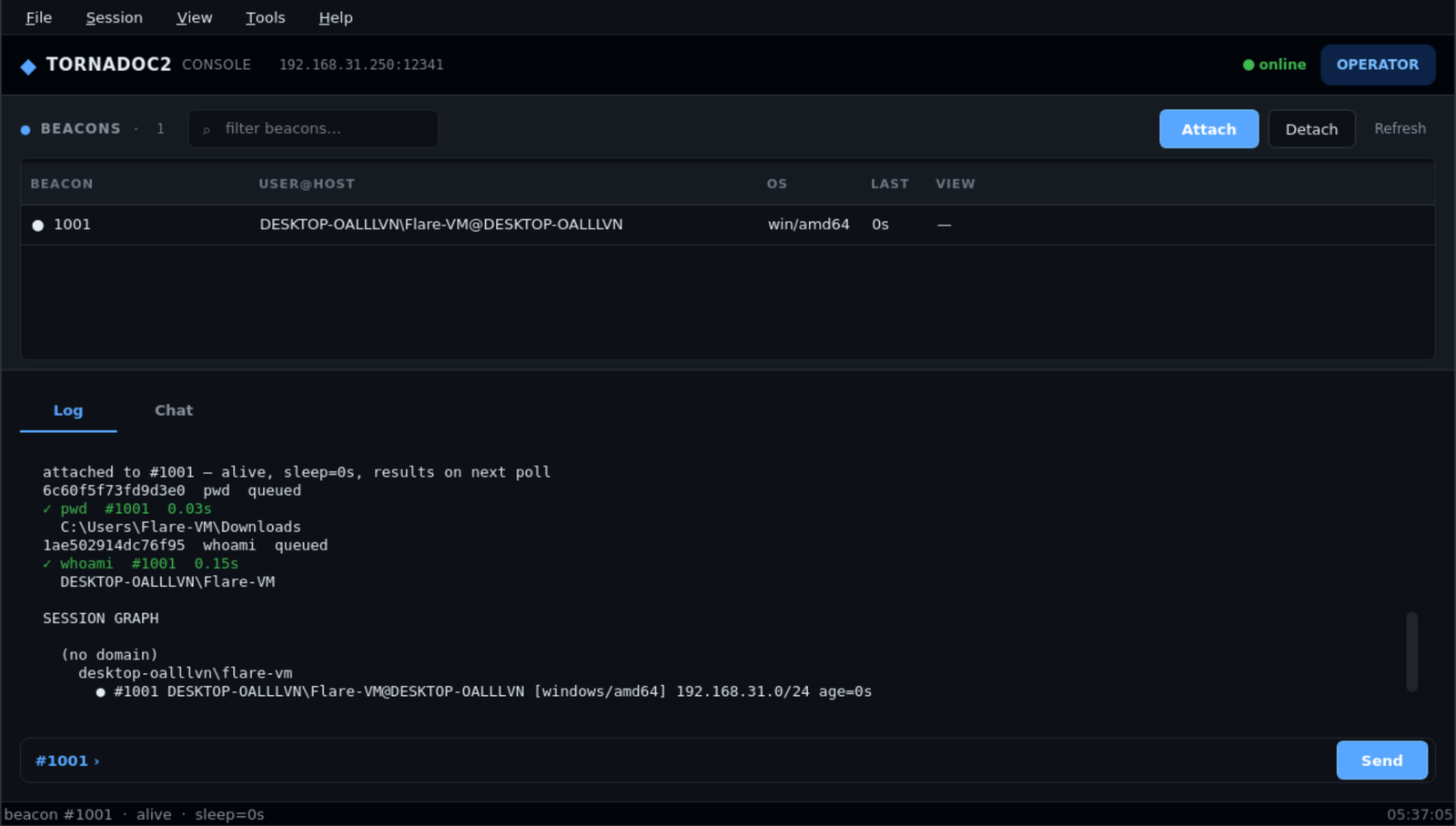
TornadoC2 operator console — beacon table above, log and chat tabs below

The PySide6 operator console. Beacon table on top, log and chat on the bottom, one command bar for both. The terminal REPL is the reference implementation; the GUI is a presentation layer over the same Client methods.


Why TornadoC2 Exists

I used Sliver for a year. It is a good tool — that needs saying before anything else, because what follows is not a criticism of it. The problem was that I could not change the agent's shape. A Sliver beacon looks like a Sliver beacon: one fingerprint, one polling schedule, one protocol family, one runtime configuration that sits on disk. I could point it at a different URL. I could not make it something else. That is the right trade for engagements where a generalist shape is fine. It was the wrong trade for the networks I was working on.

I tried Mythic. The modularity is genuine and the community work behind it is impressive. I could not work in it. Every interaction went through a browser tab. I spend eight hours a day in a console, and the tool was not in the console. I stopped after a week.

I looked at Cobalt Strike and Brute Ratel. Both are excellent and both are priced for teams and institutions. I am one person. I do not have a team budget.

下载工具

最受欢迎

查看全部 →

发现我们社区最常用的工具。

  • 1

    OsintHunter

    letox4/osinthunter

    🎯 终极 OSINT 工具包:调查图谱、置信度评分、别名家族、地图、时间线和报告。49 个模块、400+ 个站点,无需 API 密钥。

    786
  • 2

    ghostlock-app

    yukonga/ghostlock-app

    GhostLock 一键执行应用(CVE-2026-43499)

    506
  • 3

    ARTEX

    baarai/artex

    基于LLM的多智能体自主渗透测试平台,具备规划器/执行器智能体、资产与探索图谱、MITM流量记录以及漏洞复测功能。

    429
  • 4

    redforge

    cybersecurity91/redforge

    浏览器端红队工具包,包含 102 个离线工具,用于侦察、载荷生成、凭据攻击、加密、编码和交战报告。

    345
  • 5

    CyberStrikeAI

    ed1s0nz/cyberstrikeai

    AI原生网络安全的行动系统——在这里,意图转化为受治理的执行,证据沉淀为运营记忆,每一次操作都让下一次更出色。

    262
  • 6

    looking-glass

    anonghosty/looking-glass

    CSIRT 平台,可将 Shadowserver 报告导入 MongoDB,并将其重放为交互式地图、分析、发现、公告和高管仪表板。

    256

探索所有工具

浏览我们的工具集合

查看所有工具 →






