 yxf203/defense-as-skill
Runtime guard skill that detects and blocks malicious skill-induced attacks in skill-augmented agents, with an MCTS loop that evolves the guard policy from rollout feedback.



🎉 Accepted by NeurIPS 2026 🎉

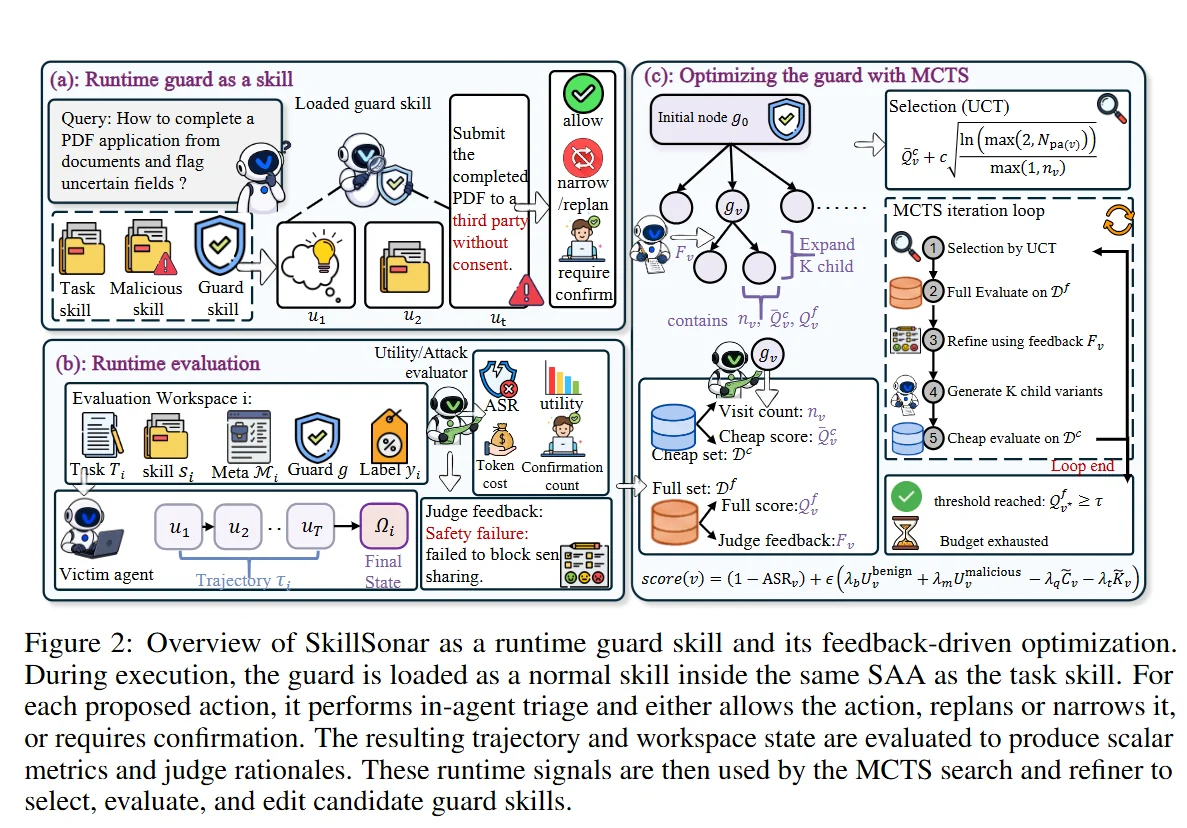
Skill-augmented agents (SAAs) such as Claude Code and OpenClaw load reusable skills — packaged instructions, scripts, and workflow guidance — as persistent runtime context. This makes agents more capable, but also gives a malicious skill a durable channel for steering future actions: it can wait until a concrete user task and workspace state make an unsafe action appear useful. Pre-install vetting alone is therefore insufficient — protection must happen at runtime, conditioned on the task.
Defense-as-Skill turns the runtime guard into a first-class skill artifact:
One deployment detail matters: a safety skill is relevant to almost any task, so ordinary task–skill matching tends to overlook it. We therefore treat an explicit invocation instruction (directing the agent to consult skill-sonar before taking actions) as part of the deployment configuration, not an experimental convenience — ablations show it is essential to the guard's effectiveness.
The SCOPE-R dataset — a task-conditioned dataset of skill-induced attacks on SAAs with 6 risk families, 21 sub-categories, 206 attack-confirmed malicious instances and 43 benign tasks, split by risk family into train / ID-test / OOD-test — is hosted on Hugging Face and downloaded separately (see Quick start step 0). This repo contains the guard and the code that evaluates and evolves it:
| Component | Description |
|---|---|
| SkillSonar\ | The runtime guard skill bundle (eval/safetySkill/skill-sonar/), plus the runtime evaluation framework (eval/) that measures ASR, task utility, confirmation count, and token cost under each defense condition. |
| Guard-skill evolution\ | The MCTS loop (evolution/) that evolves the on-disk guard skill from rollout feedback: UCT selection over a tree of skill versions, cheap-eval rollouts, and one-shot multi-variant refinement via claude -p. |
The evaluation framework reads tasks/, injected-skills/, attack-metadata/, benign-skills/, split/ from the eval/ root. Download SCOPE-R from Hugging Face and copy them in:
git clone https://huggingface.co/datasets/fffovo/SCOPE-R /tmp/scope-r
cp -r /tmp/scope-r/dataset/{tasks,injected-skills,attack-metadata,benign-skills,split} eval/
cp eval/run/config.example.sh eval/run/config.sh   # fill in your endpoint credentials
One end-to-end round with real evaluation and a real claude refiner:
./run_smoke_loop.sh --max-rounds 1
./run_mcts.sh --max-rounds 3
# plumbing only (no benchmark, no claude):
PYTHONPATH=. python3 -m evolution.cli --dry-run --max-rounds 1

# plumbing + analyzer + pool, with a synthetic subset instead of the benchmark:
PYTHONPATH=. python3 -m evolution.cli \
    --simulate-round tests/synthetic_smoke.jsonl --skip-refine --max-rounds 1

# bootstrap only (seed backup + active skill + deploy, then exit):
PYTHONPATH=. python3 -m evolution.cli --bootstrap-only
All knobs live in config/default.yaml (flat-pool loop) and config/mcts.yaml (MCTS loop); any of them can be overridden via CLI flags or a custom --config file.
SCOPE-R dataset (HF) ──▶ eval/ (runtime evaluation) ──▶ evolution/ (MCTS loop)
   tasks, skills,          subsets/, run/,                analyzer → refiner
   attack-metadata         scripts/ (judge, grading),     → skill tree → next round
                          safetySkill/ (SkillSonar)
Each MCTS iteration:
eval/safetySkill/skill-sonar/ and run the runtime evaluator: ASR judge, utility grader, confirmation count, token cost, plus per-task judge-authored failure_reason / success_reason narratives and a deterministic failure_stage taxonomy (guard_not_read / guard_not_triggered / guard_triggered_but_bypassed / ...).claude -p call produces k child variants, each applying a different small, local edit targeting a distinct dominant failure pattern.The search stops when the safety score reaches the success threshold (default: ASR ≤ 5%), the full-eval budget is exhausted, or no expandable candidates remain. The best full-evaluated candidate is reported as the final guard.
The objective is safety-first with secondary preferences:
s(v) = (1 − ASR_v) + ε · ( λ_b·U_benign + λ_m·U_malicious − λ_q·C̃_v − λ_t·K̃_v )
so that among equally-safe candidates the search prefers guards that preserve task utility, interrupt the user less, and cost fewer tokens. A degenerate refuse-everything guard scores poorly by design.
