
chisel v1.13.0
SSH 암호화를 사용하는 HTTP 기반의 빠른 TCP/UDP 터널로, 역방향 포트 포워딩, SOCKS5 프록시, 클라이언트 인증을 지원하여 안전한 네트워크 통과 및 방화벽 우회를 가능하게 합니다.
Chisel


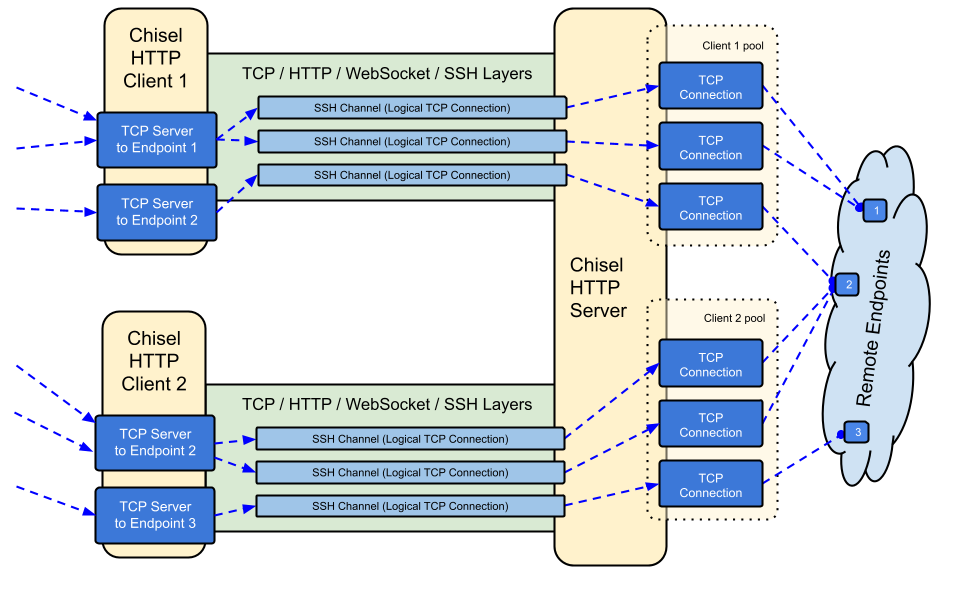
Chisel은 HTTP를 통해 전송되고 SSH로 보안이 강화된 빠른 TCP/UDP 터널입니다. 클라이언트와 서버를 모두 포함하는 단일 실행 파일입니다. Go(golang)로 작성되었습니다. Chisel은 주로 방화벽을 통과하는 데 유용하지만, 네트워크에 대한 보안 엔드포인트를 제공하는 데에도 사용할 수 있습니다.
목차
기능
- 사용하기 쉬움
- 고성능*
- SSH 프로토콜을 사용한 암호화된 연결 (
crypto/ssh사용) - 인증된 연결; 사용자 구성 파일을 통한 인증된 클라이언트 연결, 지문 매칭을 통한 인증된 서버 연결.
- 클라이언트는 지수 백오프를 통해 자동으로 재연결합니다 (
--min/max-retry-interval로 조정 가능); keepalive 핑이 타임아웃되므로, 조용히 끊긴 연결(절전/복귀, NAT 타임아웃, 서버 재시작)이 감지되고 재설정됩니다 - 클라이언트는 하나의 TCP 연결을 통해 여러 터널 엔드포인트를 생성할 수 있습니다
- 클라이언트는 선택적으로 SOCKS 또는 HTTP CONNECT 프록시를 통과할 수 있습니다
- 역방향 포트 포워딩 (연결이 서버를 거쳐 클라이언트로 나갑니다)
- 서버는 선택적으로 역방향 프록시 역할을 겸할 수 있습니다
- 서버는 선택적으로 SOCKS5 연결을 허용할 수 있습니다 (아래 가이드 참조)
- 클라이언트는 선택적으로 역방향 포트 포워딩으로부터 SOCKS5 연결을 허용할 수 있습니다
ssh -o ProxyCommand를 지원하는 stdio를 통한 클라이언트 연결로 HTTP를 통한 SSH 제공
설치
바이너리


최신 릴리스를 참조하거나 curl https://i.jpillora.com/chisel! | bash로 지금 다운로드하여 설치하세요
바이너리는 최신 Go 릴리스로 빌드되며, 이는 최소 OS 버전을 설정합니다: Windows 10 / Server 2016, macOS 12, Linux kernel 3.2, FreeBSD 12.2. 구형 시스템(예: Windows 7)의 경우 릴리스 v1.8.1 또는 그 이전 버전을 사용하세요.
Docker


docker run --rm -it jpillora/chisel --help
이미지는 멀티 아키텍처이며 Docker Hub(jpillora/chisel)와 GitHub Container Registry(ghcr.io/jpillora/chisel) 모두에 게시됩니다.
Fedora
이 패키지는 Fedora 커뮤니티에서 유지 관리합니다. RPM 사용과 관련된 문제가 발생하면 이 이슈 트래커를 이용해 주세요.
sudo dnf -y install chisel
소스
$ go install github.com/jpillora/chisel@latest
데모
몇 분 만에 자신만의 데모 서버를 실행할 수 있습니다(예전 Heroku 데모는 Heroku의 무료 티어와 함께 사라졌습니다). example/fly.toml은 이 chisel server를 fly.io의 무료 허용량에 배포합니다:
$ chisel server --port $PORT --backend http://example.com
# listens on $PORT, proxies normal web requests to http://example.com
example/ 디렉터리에서 fly launch --copy-config로 배포한 다음, 서버 옆에서 실행 중인 모든 서비스로 터널링합니다. 예를 들어:
$ chisel client https://<your-app>.fly.dev 3000
# connects to your chisel server,
# tunnels your localhost:3000 to the server's localhost:3000
브라우저에서 앱의 URL을 방문하면 서버의 기본 백엔드 프록시로 연결되어 example.com의 복사본이 표시됩니다.
사용법
$ chisel --help

  Usage: chisel [command] [--help]

  Version: X.Y.Z

  Commands:
    server - runs chisel in server mode
    client - runs chisel in client mode

  Read more:
    https://github.com/jpillora/chisel
$ chisel server --help

  Usage: chisel server [options]

  Options:

    --host, Defines the HTTP listening host – the network interface
    (defaults the environment variable HOST and falls back to 0.0.0.0).

    --port, -p, Defines the HTTP listening port (defaults to the environment
    variable PORT and falls back to port 8080).

    --key, (deprecated use --keygen and --keyfile instead)
    An optional string to seed the generation of a ECDSA public
    and private key pair. All communications will be secured using this
    key pair. Share the subsequent fingerprint with clients to enable detection
    of man-in-the-middle attacks (defaults to the CHISEL_KEY environment
    variable, otherwise a new key is generate each run).

    --keygen, A path to write a newly generated PEM-encoded SSH private key file.
    If users depend on your --key fingerprint, you may also include your --key to
    output your existing key. Use - (dash) to output the generated key to stdout.

    --keyfile, An optional path to a PEM-encoded SSH private key. When
    this flag is set, the --key option is ignored, and the provided private key
    is used to secure all communications. (defaults to the CHISEL_KEY_FILE
    environment variable). Since ECDSA keys are short, you may also set keyfile
    to the inline key string itself, exactly as printed by --keygen (a base64
    string with a "ck-" prefix); no extra base64 encoding is needed.

    --authfile, An optional path to a users.json file. This file should
    be an object with users defined like:
      {
        "<user:pass>": ["<addr-regex>","<addr-regex>"]
      }
    when <user> connects, their <pass> will be verified and then
    each of the remote addresses will be compared against the list
    of address regular expressions for a match. Patterns are NOT
    anchored by default: "10.0.0.1:80" also matches
    "210.0.0.1:8080", and "." matches any character. Anchor your
    patterns, e.g. "^10\.0\.0\.1:80$". The empty string ""
    matches every address. Addresses will
    always come in the form "<remote-host>:<remote-port>" for normal remotes,
    "R:<local-interface>:<local-port>" for reverse port forwarding
    remotes, and "socks" for SOCKS5 proxy access. Note that SOCKS5
    access previously bypassed this list; existing authfiles which
    should allow SOCKS5 must add an entry matching "socks" (the
    empty wildcard "" matches everything, including "socks"). This
    file will be automatically reloaded on change. Reloads apply
    to new connections and to new tunnels of connected clients;
    established tunnels are not interrupted.

    --auth, An optional string representing a single user with full
    access, in the form of <user:pass>. It is equivalent to creating an
    authfile with {"<user:pass>": [""]}. If unset, it will use the
    environment variable AUTH.

    --keepalive, An optional keepalive interval. Since the underlying
    transport is HTTP, in many instances we'll be traversing through
    proxies, often these proxies will close idle connections. You must
    specify a time with a unit, for example '5s' or '2m'. Defaults
    to '25s' (set to 0s to disable).

    --backend, Specifies another HTTP server to proxy requests to when
    chisel receives a normal HTTP request. Useful for hiding chisel in
    plain sight. --proxy is accepted as an alias for this flag.

    --socks5, Allow clients to access the internal SOCKS5 proxy. See
    chisel client --help for more information.

    --reverse, Allow clients to specify reverse port forwarding remotes
    in addition to normal remotes.