Torna agli aggiornamenti
New releaseAug 29, 2026

chisel v1.12.0

Tunnel TCP/UDP veloce su HTTP con crittografia SSH, supporta reverse port forwarding, proxy SOCKS5 e autenticazione client per un attraversamento sicuro della rete e l'elusione dei firewall.

Condividi

Chisel

GoDoc CI

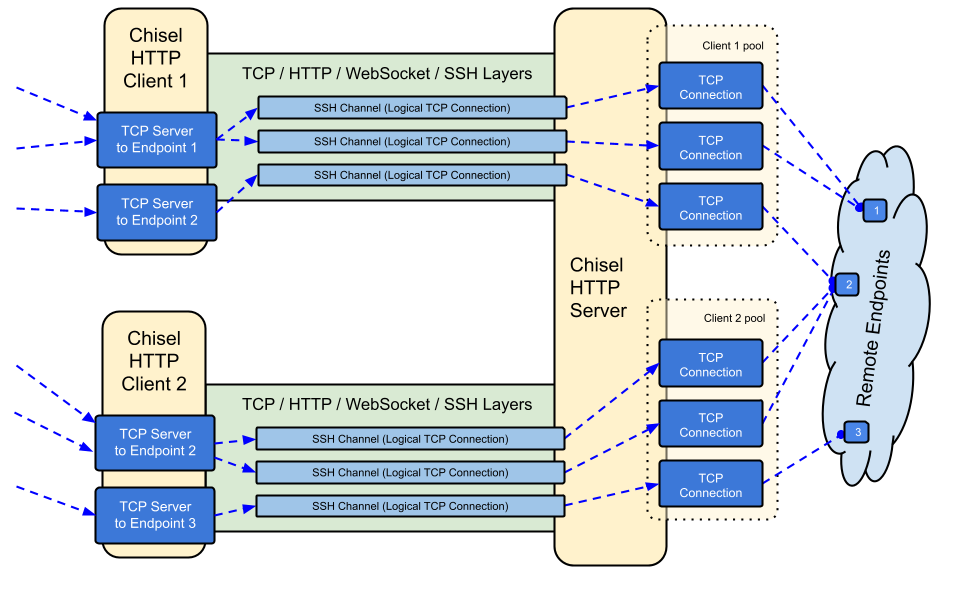
Chisel è un tunnel TCP/UDP veloce, trasportato su HTTP e protetto tramite SSH. Un singolo eseguibile che include sia client che server. Scritto in Go (golang). Chisel è utile principalmente per attraversare firewall, ma può anche essere utilizzato per fornire un endpoint sicuro verso la tua rete.
overview

Indice dei contenuti

Funzionalità

  • Facile da usare
  • Performante*
  • Connessioni crittografate tramite il protocollo SSH (via crypto/ssh)
  • Connessioni autenticate; connessioni client autenticate con un file di configurazione utenti, connessioni server autenticate tramite corrispondenza delle impronte digitali.
  • Il client si riconnette automaticamente con backoff esponenziale (regolabile tramite --min/max-retry-interval); i ping keepalive scadono, quindi le connessioni morte silenziosamente (sleep/wake, timeout NAT, riavvii del server) vengono rilevate e ristabilite
  • I client possono creare più endpoint tunnel su una singola connessione TCP
  • I client possono opzionalmente passare attraverso proxy SOCKS o HTTP CONNECT
  • Port forwarding inverso (le connessioni passano attraverso il server ed escono dal client)
  • Il server funziona opzionalmente anche come reverse proxy
  • Il server consente opzionalmente connessioni SOCKS5 (vedi guida sotto)
  • I client consentono opzionalmente connessioni SOCKS5 da un port forward inverso
  • Connessioni client su stdio che supportano ssh -o ProxyCommand fornendo SSH su HTTP

Installazione

Binari

Releases Releases

Vedi l'ultima release oppure scaricala e installala subito con curl https://i.jpillora.com/chisel! | bash

I binari sono compilati con l'ultima versione di Go, che imposta le versioni minime dei sistemi operativi: Windows 10 / Server 2016, macOS 12, kernel Linux 3.2, FreeBSD 12.2. Per sistemi più vecchi (ad es. Windows 7), usa la release v1.8.1 o precedenti.

Docker

Docker Pulls Image Size```sh docker run --rm -it jpillora/chisel --help

Le immagini sono multi-architettura e pubblicate sia su Docker Hub (`jpillora/chisel`) che su GitHub Container Registry (`ghcr.io/jpillora/chisel`).

### Fedora

Il pacchetto è mantenuto dalla community di Fedora. Se incontri problemi relativi all'uso dell'RPM, utilizza questo [issue tracker](https://bugzilla.redhat.com/buglist.cgi?bug_status=NEW&bug_status=ASSIGNED&classification=Fedora&component=chisel&list_id=11614537&product=Fedora&product=Fedora%20EPEL).```sh
sudo dnf -y install chisel

Source

Traduzione```sh

$ go install github.com/jpillora/chisel@latest

## Demo

Puoi eseguire il tuo server demo in pochi minuti (la vecchia demo su Heroku è sparita con il piano gratuito di Heroku). [`example/fly.toml`](https://github.com/jpillora/chisel/blob/HEAD/example/fly.toml) distribuisce questo `chisel server` sull'allocazione gratuita di [fly.io](https://fly.io):```sh
$ chisel server --port $PORT --backend http://example.com
# listens on $PORT, proxies normal web requests to http://example.com

Distribuiscilo con fly launch --copy-config dalla directory example/, quindi crea un tunnel verso qualsiasi servizio in esecuzione accanto al server, ad esempio:```sh $ chisel client https://.fly.dev 3000

connects to your chisel server,

tunnels your localhost:3000 to the server's localhost:3000

Visitando l'URL della tua app in un browser si raggiunge il proxy backend predefinito del server e viene mostrata una copia di [example.com](http://example.com).

## Utilizzo

<!-- render these help texts by hand,
  or use https://github.com/jpillora/md-tmpl
    with $ md-tmpl -w README.md -->

<!--tmpl,code=plain:echo "$ chisel --help" && go run main.go --help | sed 's#0.0.0-src (go1\..*)#X.Y.Z#' -->``` plain 
$ chisel --help

  Usage: chisel [command] [--help]

  Version: X.Y.Z

  Commands:
    server - runs chisel in server mode
    client - runs chisel in client mode

  Read more:
    https://github.com/jpillora/chisel

``` plain

$ chisel server --help

Usage: chisel server [options]

Options:

--host, Defines the HTTP listening host – the network interface
(defaults the environment variable HOST and falls back to 0.0.0.0).

--port, -p, Defines the HTTP listening port (defaults to the environment
variable PORT and falls back to port 8080).

--key, (deprecated use --keygen and --keyfile instead)
An optional string to seed the generation of a ECDSA public
and private key pair. All communications will be secured using this
key pair. Share the subsequent fingerprint with clients to enable detection
of man-in-the-middle attacks (defaults to the CHISEL_KEY environment
variable, otherwise a new key is generate each run).

--keygen, A path to write a newly generated PEM-encoded SSH private key file.
If users depend on your --key fingerprint, you may also include your --key to
output your existing key. Use - (dash) to output the generated key to stdout.

--keyfile, An optional path to a PEM-encoded SSH private key. When
this flag is set, the --key option is ignored, and the provided private key
is used to secure all communications. (defaults to the CHISEL_KEY_FILE
environment variable). Since ECDSA keys are short, you may also set keyfile
to the inline key string itself, exactly as printed by --keygen (a base64
string with a "ck-" prefix); no extra base64 encoding is needed.

--authfile, An optional path to a users.json file. This file should
be an object with users defined like:
  {
    "<user:pass>": ["<addr-regex>","<addr-regex>"]
  }
when <user> connects, their <pass> will be verified and then
each of the remote addresses will be compared against the list
of address regular expressions for a match. Patterns are NOT
anchored by default: "10.0.0.1:80" also matches
"210.0.0.1:8080", and "." matches any character. Anchor your
patterns, e.g. "^10\.0\.0\.1:80$". The empty string ""
matches every address. Addresses will
always come in the form "<remote-host>:<remote-port>" for normal remotes,
"R:<local-interface>:<local-port>" for reverse port forwarding
remotes, and "socks" for SOCKS5 proxy access. Note that SOCKS5
access previously bypassed this list; existing authfiles which
should allow SOCKS5 must add an entry matching "socks" (the
empty wildcard "" matches everything, including "socks"). This
file will be automatically reloaded on change. Reloads apply
to new connections and to new tunnels of connected clients;
established tunnels are not interrupted.

--auth, An optional string representing a single user with full
access, in the form of <user:pass>. It is equivalent to creating an
authfile with {"<user:pass>": [""]}. If unset, it will use the
environment variable AUTH.

--keepalive, An optional keepalive interval. Since the underlying
transport is HTTP, in many instances we'll be traversing through
proxies, often these proxies will close idle connections. You must
specify a time with a unit, for example '5s' or '2m'. Defaults
to '25s' (set to 0s to disable).

--backend, Specifies another HTTP server to proxy requests to when
chisel receives a normal HTTP request. Useful for hiding chisel in
plain sight. --proxy is accepted as an alias for this flag.

--socks5, Allow clients to access the internal SOCKS5 proxy. See
chisel client --help for more information.

--reverse, Allow clients to specify reverse port forwarding remotes
in addition to normal remotes.

--tls-key, Enables TLS and provides optional path to a PEM-encoded
TLS private key. When this flag is set, you must also set --tls-cert,
and you cannot set --tls-domain.

--tls-cert, Enables TLS and provides optional path to a PEM-encoded
TLS certificate. When this flag is set, you must also set --tls-key,
and you cannot set --tls-domain.

--tls-domain, Enables TLS and automatically acquires a TLS key and
certificate using LetsEncrypt. Setting --tls-domain requires port 443.
You may specify multiple --tls-domain flags to serve multiple domains.
The resulting files are cached in the "$HOME/.cache/chisel" directory.
You can modify this path by setting the CHISEL_LE_CACHE variable,
or disable caching by setting this variable to "-". You can optionally
provide a certificate notification email by setting CHISEL_LE_EMAIL.

--tls-ca, a path to a PEM encoded CA certificate bundle or a directory
holding multiple PEM encode CA certificate bundle files, which is used to 
validate client connections. The provided CA certificates will be used 
instead of the system roots. This is commonly used to implement mutual-TLS. 

--pid Generate pid file in current working directory

-v, Enable verbose logging

--help, This help text

Signals: The chisel process is listening for: a SIGINT or SIGTERM to begin a graceful shutdown (a second signal forces an immediate exit), a SIGUSR2 to print process stats, and a SIGHUP to short-circuit the client reconnect timer

Version: X.Y.Z

Read more: https://github.com/jpillora/chisel

<!--/tmpl-->


<!--tmpl,code=plain:echo "$ chisel client --help" && go run main.go client --help | sed 's#0.0.0-src (go1\..*)#X.Y.Z#' -->``` plain 
$ chisel client --help

  Usage: chisel client [options] <server> <remote> [remote] [remote] ...

  <server> is the URL to the chisel server.

  <remote>s are remote connections tunneled through the server, each of
  which come in the form:

    <local-host>:<local-port>:<remote-host>:<remote-port>/<protocol>

    ■ local-host defaults to 0.0.0.0 (all interfaces).
    ■ local-port defaults to remote-port.
    ■ remote-port is required*.
    ■ remote-host defaults to 127.0.0.1 (server localhost).
    ■ protocol defaults to tcp.

  which shares <remote-host>:<remote-port> from the server to the client
  as <local-host>:<local-port>, or:

    R:<local-interface>:<local-port>:<remote-host>:<remote-port>/<protocol>

  which does reverse port forwarding, sharing <remote-host>:<remote-port>
  from the client to the server's <local-interface>:<local-port>.

    example remotes

      3000
      example.com:3000
      3000:google.com:80
      192.168.0.5:3000:google.com:80
      socks
      5000:socks
      R:2222:localhost:22
      R:socks
      R:5000:socks
      stdio:example.com:22
      1.1.1.1:53/udp

    When the chisel server has --socks5 enabled, remotes can
    specify "socks" in place of remote-host and remote-port.
    The default local host and port for a "socks" remote is
    127.0.0.1:1080. Connections to this remote will terminate
    at the server's internal SOCKS5 proxy. When the server also
    has --authfile set, SOCKS5 access requires an entry matching
    the token "socks" in the user's address list.

    When the chisel server has --reverse enabled, remotes can
    be prefixed with R to denote that they are reversed. That
    is, the server will listen and accept connections, and they
    will be proxied through the client which specified the remote.
    Reverse remotes specifying "R:socks" will listen on the server's
    default socks port (1080) and terminate the connection at the
    client's internal SOCKS5 proxy.

    When stdio is used as local-host, the tunnel will connect standard
    input/output of this program with the remote. This is useful when 
    combined with ssh ProxyCommand. You can use
      ssh -o ProxyCommand='chisel client chiselserver stdio:%h:%p' \
          [email protected]
    to connect to an SSH server through the tunnel.

  Options:

    --fingerprint, A *strongly recommended* fingerprint string
    to perform host-key validation against the server's public key.
    Fingerprint mismatches will close the connection.
    Fingerprints are generated by hashing the ECDSA public key using
    SHA256 and encoding the result in base64.
    Fingerprints must be 44 characters containing a trailing equals (=).
    Legacy MD5 colon fingerprints (deprecated) are still accepted,
    but only in their full 16-octet form; truncated prefixes are
    rejected.

    --auth, An optional username and password (client authentication)
    in the form: "<user>:<pass>". These credentials are compared to
    the credentials inside the server's --authfile. defaults to the
    AUTH environment variable.

    --keepalive, An optional keepalive interval. Since the underlying
    transport is HTTP, in many instances we'll be traversing through
    proxies, often these proxies will close idle connections. You must
    specify a time with a unit, for example '5s' or '2m'. Defaults
    to '25s' (set to 0s to disable).

    --max-retry-count, Maximum number of times to retry before exiting.
    Defaults to unlimited.

    --min-retry-interval, Minimum wait time before retrying after a
    disconnection. Defaults to 1 second.

    --max-retry-interval, Maximum wait time before retrying after a
    disconnection. Defaults to 5 minutes.

    --proxy, An optional HTTP CONNECT or SOCKS5 proxy which will be
    used to reach the chisel server. Authentication can be specified
    inside the URL. Credentials must be URL-encoded; for example a
    "#" in the password must be written as "%23".
    For example, http://admin:[email protected]:8081
            or: socks://admin:[email protected]:1080
    The socks://, socks5:// and socks5h:// schemes are equivalent:
    DNS is always resolved by the proxy.

    --header, Set a custom header in the form "HeaderName: HeaderContent".
    Can be used multiple times. (e.g --header "Foo: Bar" --header "Hello: World")

    --hostname, Optionally set the 'Host' header (defaults to the host
    found in the server url).

    --sni, Override the ServerName when using TLS (defaults to the 
    hostname).

    --tls-ca, An optional root certificate bundle used to verify the
    chisel server. Only valid when connecting to the server with
    "https" or "wss". By default, the operating system CAs will be used.

    --tls-skip-verify, Skip server TLS certificate verification of
    chain and host name (if TLS is used for transport connections to
    server). If set, client accepts any TLS certificate presented by
    the server and any host name in that certificate. This only affects
    transport https (wss) connection. Chisel server's public key
    may be still verified (see --fingerprint) after inner connection
    is established.

    --tls-key, a path to a PEM encoded private key used for client 
    authentication (mutual-TLS).

    --tls-cert, a path to a PEM encoded certificate matching the provided 
    private key. The certificate must have client authentication 
    enabled (mutual-TLS).

    --pid Generate pid file in current working directory

    -v, Enable verbose logging

    --help, This help text

  Signals:
    The chisel process is listening for:
      a SIGINT or SIGTERM to begin a graceful shutdown
        (a second signal forces an immediate exit),
      a SIGUSR2 to print process stats, and
      a SIGHUP to short-circuit the client reconnect timer

  Version:
    X.Y.Z

  Read more:
    https://github.com/jpillora/chisel

Sicurezza

La crittografia è sempre abilitata. Quando avvii un server chisel, questo genera una coppia di chiavi ECDSA pubblica/privata in memoria. L'impronta della chiave pubblica (SHA256 codificato in base64) viene mostrata all'avvio del server. Invece di generare una chiave casuale, il server può opzionalmente specificare un file di chiave usando l'opzione --keyfile. Quando i client si connettono, mostrano anch'essi l'impronta della chiave pubblica del server. Il client può forzare un'impronta specifica usando l'opzione --fingerprint. Le impronte MD5 legacy sono ancora accettate ma devono essere nella forma completa a 16 ottetti con i due punti — i prefissi troncati vengono rifiutati. Consulta l'opzione --help sopra per maggiori informazioni.

Il server limita inoltre la dimensione dei messaggi websocket in ingresso prima dell'autenticazione (CHISEL_WS_READ_LIMIT, default 512 KiB), così i peer non autenticati non possono esaurire la memoria con messaggi sovradimensionati. Il default si colloca comodamente al di sopra del massimo pacchetto di trasporto di 256 KiB di x/crypto/ssh, quindi nessun pacchetto SSH valido viene mai rifiutato. Solo 0 disabilita il limite; i valori negativi ricadono sul default sicuro.

Autenticazione

Usando l'opzione --authfile, il server può opzionalmente fornire un file di configurazione user.json per creare un elenco di utenti accettati. Il client si autentica quindi usando l'opzione --auth. Vedi users.json per un esempio di file di configurazione di autenticazione. Consulta l'opzione --help sopra per maggiori informazioni.

Note sul comportamento di authfile:

  • Il file viene monitorato e ricaricato a caldo — inclusi i salvataggi dell'editor tramite rinomina (vim) e gli aggiornamenti dei configmap di kubernetes. I ricaricamenti si applicano alle nuove connessioni e ai nuovi tunnel dei client già connessi; gli utenti rimossi perdono immediatamente l'accesso ai nuovi tunnel, anche se i tunnel già stabiliti non vengono interrotti.
  • I pattern degli indirizzi sono espressioni regolari e non sono ancorati — ancoralo con ^ e $ (il server avvisa sui pattern non ancorati al caricamento). La stringa vuota "" corrisponde a tutto.
  • L'accesso SOCKS5 è controllato da una voce che corrisponde al token socks. Modifica sostanziale: SOCKS5 in precedenza bypassava completamente l'authfile; i server che eseguono --socks5 con --authfile devono concedere socks agli utenti che devono mantenere l'accesso proxy (le voci con carattere jolly "" continuano a funzionare).
  • Le stringhe di autenticazione senza due punti (user:pass) ora sono un errore fatale all'avvio sia sul server che sul client — in precedenza disabilitavano silenziosamente l'autenticazione.
  • L'utente --auth sopravvive ai ricaricamenti dell'authfile e vince nei conflitti di nome con gli utenti del file.

Internamente, questo viene fatto usando il metodo di autenticazione Password fornito da SSH. Scopri di più su crypto/ssh qui http://blog.gopheracademy.com/go-and-ssh/. Le aperture/chiusure di sessione (con utente, indirizzo sorgente e remote) e i tentativi di accesso falliti vengono registrati a livello info.

Guida TLS

La configurazione sicura più semplice è --tls-domain, che fornisce automaticamente un certificato LetsEncrypt (richiede la porta 443 e un record DNS che punti al server):```sh chisel server --port 443 --tls-domain chisel.example.com --auth user:pass chisel client --auth user:pass https://chisel.example.com R:2222:localhost:22

Per utilizzare il proprio certificato (self-signed o CA interna), genera una coppia chiave/certificato e punta entrambe le parti ai file corretti:```sh
chisel server --port 443 --tls-key key.pem --tls-cert cert.pem
chisel client --tls-ca ca.pem https://chisel.example.com 3000

Per il mutual TLS, passa anche --tls-ca al server e --tls-cert/--tls-key a ciascun client. Nota che TLS avvolge il trasporto di chisel dall'esterno; il livello SSH interno continua comunque a cifrare e autenticare, quindi la validazione di --fingerprint funziona con o senza TLS.

Guida SOCKS5 con Docker

  1. Stampa una nuova chiave privata sul terminale

    chisel server --keygen -
    # oppure salvala su disco --keygen /path/to/mykey
    
  2. Avvia il tuo server chisel

    jpillora/chisel server --keyfile '<stringa ck-base64 o percorso file>' -p 9312 --socks5
    
  3. Connetti il tuo client chisel (usando il fingerprint del server)

    chisel client --fingerprint '<vedi output del server>' <indirizzo-server>:9312 socks
    
  4. Punta i tuoi client SOCKS5 (es. OS/Browser) a:

    <indirizzo-client>:1080
    
  5. Ora hai una connessione SOCKS5 cifrata e autenticata su HTTP

Nota: se il server usa anche --authfile, gli utenti devono avere una voce corrispondente al token socks per usare il proxy (vedi Autenticazione).

SOCKS inverso con un Authfile

Per consentire a un client specifico di agire come nodo di uscita SOCKS, concedigli l'indirizzo di ascolto del reverse-socks (R:socks ascolta su 127.0.0.1:1080 del server):```json { "exituser:password": ["^R:127\.0\.0\.1:1080$"] }

🛠️ Utilizzo

Installazione

git clone https://github.com/example/tool.git
cd tool
pip install -r requirements.txt

Avvio rapido

python tool.py --target example.com

Opzioni

OpzioneDescrizione
--targetSpecifica l'host di destinazione
--portPorta da scansionare (predefinita: 80)
--verboseAbilita l'output dettagliato

Esempi

# Scansione di base
python tool.py --target example.com

# Scansione con porta personalizzata
python tool.py --target example.com --port 8080

# Modalità verbosa
python tool.py --target example.com --verbose

📄 Licenza

Questo progetto è concesso in licenza sotto la MIT License.

🙏 Ringraziamenti

  • Grazie a tutti i contributori
  • Strumenti e librerie open source utilizzati in questo progetto

📬 Contatti

Per domande o feedback, apri un problema su GitHub Issues.


Disclaimer: Questo strumento è destinato esclusivamente a test di sicurezza autorizzati. L'uso non autorizzato è vietato.

chisel server --reverse --authfile users.json
chisel client --auth exituser:password <server-address> R:socks
# server-side consumers point SOCKS5 clients at 127.0.0.1:1080,
# and their traffic exits via the chisel client's network
```
Vedi anche l'esempio passo-passo di [reverse tunneling](https://github.com/jpillora/chisel/blob/HEAD/example/reverse-tunneling-authenticated.md).

### Esecuzione dietro una CDN (Cloudflare)

chisel funziona attraverso CDN che supportano WebSockets. Per Cloudflare: abilita WebSockets, in proxy (nuvola arancione) il record DNS e connetti i client con `https://`. La CDN termina TLS, ma il livello SSH interno significa che la validazione `--fingerprint` autentica comunque il tuo server chisel end-to-end — la CDN non può leggere o modificare il traffico in tunnel. Mantieni `--keepalive` al suo default di `25s` per restare sotto i timeout di inattività della CDN, e nota che i proxy che rimuovono gli header `Upgrade` non possono trasportare affatto chisel.

### Ottimizzazione con variabili d'ambiente

Le manopole meno comuni sono variabili d'ambiente, tutte lette con un prefisso `CHISEL_` (es. `CHISEL_WS_TIMEOUT=10s`):

| Variabile        | Lato        | Default            | Scopo                                            |
| --------------- | ----------- | ------------------ | -------------------------------------------------- |
| `WS_TIMEOUT`    | client      | `45s`              | timeout handshake websocket                        |
| `SSH_TIMEOUT`   | client      | `30s`              | timeout handshake ssh                              |
| `CONFIG_TIMEOUT`| server      | `10s`              | attesa della richiesta di configurazione del client               |
| `SSH_WAIT`      | entrambi        | `35s`              | per quanto tempo i nuovi tunnel attendono una connessione attiva |
| `PING_TIMEOUT`  | entrambi        | intervallo keepalive | timeout di risposta al ping keepalive (nessun ping se `--keepalive 0`) |
| `DIAL_TIMEOUT`  | nodo di uscita   | `30s`              | timeout dial tcp per i target del tunnel                |
| `WS_READ_LIMIT` | entrambi        | `524288`           | byte massimi dei messaggi websocket in ingresso (0 = nessun limite; negativo = default) |
| `WS_BUFF_SIZE`  | entrambi        | default go         | dimensioni buffer lettura/scrittura websocket                  |
| `UDP_MAX_SIZE`  | entrambi        | `9012`             | byte massimi dei pacchetti udp                               |
| `UDP_DEADLINE`  | nodo di uscita   | `15s`              | scadenza lettura flusso udp ed età di sweep inattività          |
| `UDP_MAX_CONNS` | nodo di uscita   | `100`              | flussi udp concorrenti massimi per tunnel                |
| `SHUTDOWN_GRACE`| server      | `5s`               | tempo di drenaggio richieste http allo spegnimento                |

`HOST`, `PORT`, `AUTH` e `CHISEL_KEY`/`CHISEL_KEY_FILE` sono documentati nei testi `--help` sopra.

#### Avvertenze

Poiché è richiesto il supporto WebSockets:

- I provider IaaS supportano tutti WebSockets (a meno che non sia stato forzato davanti a te un proxy HTTP non supportante, nel qual caso direi che sei stato declassato a PaaS)
- I provider PaaS variano nel supporto WebSockets
  - Heroku ha supporto completo
  - Openshift ha supporto completo anche se le connessioni sono accettate solo sulle porte 8443 e 8080
  - Google App Engine standard **non** ha supporto (l'ambiente flessibile sì)

## Contribuire

- http://golang.org/doc/code.html
- http://golang.org/doc/effective_go.html
- `github.com/jpillora/chisel/share` contiene il pacchetto condiviso
- `github.com/jpillora/chisel/server` contiene il pacchetto server
- `github.com/jpillora/chisel/client` contiene il pacchetto client

## Changelog

- `1.0` - Rilascio iniziale
- `1.1` - Sostituita la semplice crittografia simmetrica con ECDSA SSH
- `1.2` - Aggiunto supporto SOCKS5 (server) e HTTP CONNECT (client)
- `1.3` - Aggiunto supporto reverse tunnelling
- `1.4` - Aggiunto supporto header HTTP arbitrari
- `1.5` - Aggiunto supporto reverse SOCKS (di @aus)
- `1.6` - Aggiunto supporto stdio client (di @BoleynSu)
- `1.7` - Aggiunto supporto UDP
- `1.8` - Passaggio a un'immagine Docker `scratch`
- `1.9` - Aggiornamento a Go 1.21. Passaggio dal seed `--key` a stringhe chiave P256 con `--key{gen,file}` (di @cmenginnz)
- `1.10` - Aggiornamento a Go 1.22. Aggiunti `.rpm` `.deb` e `.apk` ai rilasci. Corretto confronto versioni errato.
- `1.11` - Aggiornamento a Go 1.25.1. Aggiornate tutte le dipendenze.
- `1.12` - Passaggio di affidabilità e sicurezza:
  - i ping keepalive ora scadono (`CHISEL_PING_TIMEOUT`), quindi le connessioni morte si riconnettono prontamente dopo sleep/wake, timeout NAT e riavvii del server
  - i ricaricamenti authfile sopravvivono a rinomine dell'editor e swap configmap kubernetes, e si applicano in tempo reale ai client connessi (nuovi tunnel; i tunnel stabiliti non vengono interrotti)
  - **breaking**: con `--socks5` + `--authfile`, l'accesso SOCKS5 ora richiede una voce authfile corrispondente a `socks` (le voci wildcard `""` continuano a funzionare)
  - **breaking**: le impronte MD5 legacy troncate vengono rifiutate — `--fingerprint` deve essere l'impronta SHA256 completa (o la forma MD5 completa a 16 ottetti con due punti)
  - **breaking**: le stringhe auth senza due punti (es. `--auth user`) sono un errore fatale all'avvio invece di disabilitare silenziosamente l'autenticazione
  - la mezza chiusura TCP viene propagata attraverso i tunnel, e i target irraggiungibili rifiutano il tunnel invece di presentare una connessione morta (`CHISEL_DIAL_TIMEOUT`, default 30s)
  - spegnimento graduale su SIGTERM con drenaggio richieste HTTP (`CHISEL_SHUTDOWN_GRACE`); un secondo segnale forza l'uscita
  - i nodi di uscita UDP non si rompono né perdono oltre 100 flussi concorrenti (`CHISEL_UDP_MAX_CONNS`)
  - i messaggi websocket in ingresso sono limitati in dimensione pre-auth (`CHISEL_WS_READ_LIMIT`)
  - il server non va più in panico quando un client si disconnette tra l'handshake SSH e la sua richiesta di configurazione (#608)
  - il client esce con codice non zero quando `--max-retry-count` è esaurito; nuovo `--min-retry-interval` (default 1s); `socks5://` accettato per `--proxy`
  - le build `go install` riportano la versione reale; sessioni e login falliti sono registrati a livello info
  - i binari di rilascio sono compilati con Go 1.27.0; `x/crypto/ssh` è aggiornato a v0.55.0 per affrontare GO-2026-6303
  - i rilasci ora includono immagini multi-arch basate su scratch costruite con ko, con root CA, su GHCR e Docker Hub; il rilascio è in due fasi — il tagging costruisce una release GitHub draft più immagini con tag di versione, e la pubblicazione della draft promuove i tag Docker `latest` / `X` / `X.Y`

### Aggiornamento alla 1.12

Quattro modifiche potrebbero richiedere azioni quando si aggiorna da 1.11.x o precedenti:

1. **SOCKS5 + `--authfile`** (applicato dalla v1.11.7): gli utenti che devono mantenere l'accesso proxy necessitano di una voce authfile corrispondente al token `socks` (il wildcard `""` continua a funzionare). Vedi [Autenticazione](#authentication). Le richieste negate sono registrate lato server come `Denied connection to socks (ACL)`.
2. **`--fingerprint`**: le impronte MD5 legacy troncate vengono rifiutate. Usa l'impronta SHA256 completa stampata dal server e dal client (la forma MD5 completa a 16 ottetti con due punti è ancora accettata, ma deprecata).
3. **`--auth`** i valori devono essere `<user>:<pass>` — le stringhe senza due punti ora falliscono all'avvio invece di disabilitare silenziosamente l'autenticazione.
4. **Codici di uscita**: `chisel client` con `--max-retry-count` ora esce con codice non zero quando i tentativi di connessione sono esauriti; gli script che controllano `$?` e le unità systemd `Restart=on-failure` lo noteranno.

## Licenza

[MIT](https://github.com/jpillora/chisel/blob/master/LICENSE) © Jaime Pillora

Categorie

