
Skip to content
KitploitKITPLOIT
OutilsExploitsBlog
Log in
Soumettre
OutilsExploitsBlog
Soumettre

Outils de Hacking, PenTest et Cybersécurité pour votre Arsenal de Sécurité !

Kitploit est un répertoire d'outils de hacking, de cybersécurité et de pentesting. Découvrez les dernières mises à jour des projets pour trouver des vulnérabilités, analyser des systèmes, automatiser les tests et renforcer votre sécurité.

FluxContactConfidentialité© 2026 Kitploit

Répertoire d'outils

Catégories

Voir toutes les catégories
Loading categories
cartography — Pulls infrastructure assets and their relationships from 30+ cloud, identity, and SaaS platforms into a Neo4j graph for security queries and rule-based analysis. | Kitploit
Outils/GitHubGitHub/cartography-cncf/cartography
Cloud Infrastructure SecurityContainer SecurityNetwork MappingVulnerability AnalysisConfiguration AuditingInformation GatheringCloud SecurityDevSecOpsThreat IntelligenceIdentity & Access Management (IAM)Supply Chain Security
4.2k609140il y a 9h 6mVérifié par Kitploit
GitHubcartography-cncf/cartography

cartography

Pulls infrastructure assets and their relationships from 30+ cloud, identity, and SaaS platforms into a Neo4j graph for security queries and rule-based analysis.

Voir le dépôtSite web
Partager
Contenu non disponible dans la langue demandée. Affichage de la version anglaise.
Cartography

OpenSSF Scorecard OpenSSF Best Practices build

Documentation

Cartography is a Python tool that pulls infrastructure assets and their relationships into a Neo4j graph database.

What it connects: AWS, GCP, Azure, Kubernetes, GitHub, Okta, Entra ID, CrowdStrike, and 30+ more platforms.

Questions it answers:
  • Which identities have access to which datastores? How about across multiple tenants, or providers?
  • Am I affected by any critical vulnerabilities or compromised software packages?
  • What are the network paths in and out of my environment?
  • Which compute instances are exposed to the internet?
  • What AI agents are running in production, and what permissions do they have?

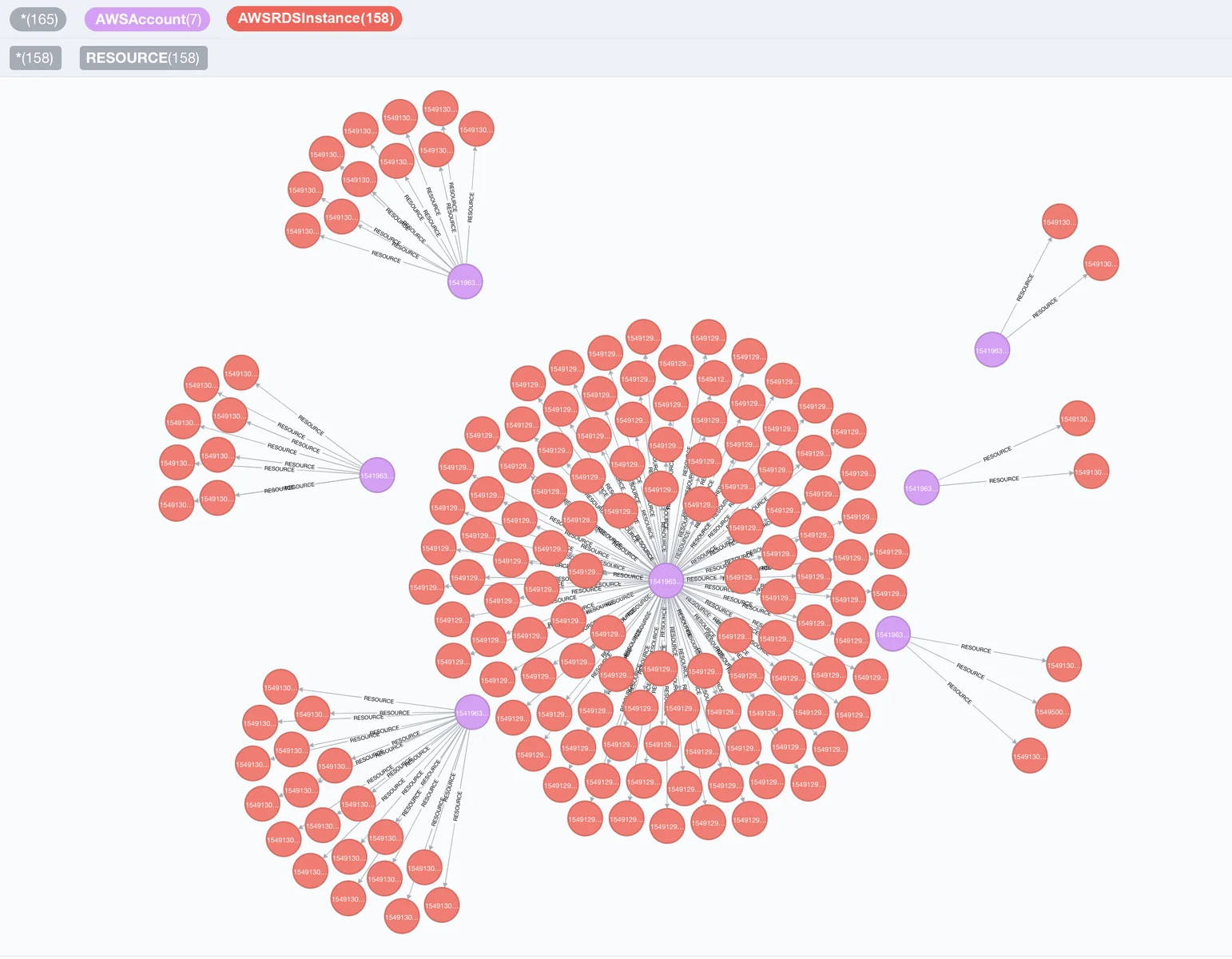
Visualization of RDS nodes and AWS nodes

Quick Start

Install Cartography

pip install cartography

Install cartography[neo4j-rust] instead to swap in Neo4j's Rust Bolt codec, which cuts sync time by roughly 20-30%. See Faster Neo4j driver.

Start Neo4j database

docker run -d --publish=7474:7474 --publish=7687:7687 -v data:/data --env=NEO4J_AUTH=none neo4j:5-community

Confirm that http://localhost:7474 is up.

Sync your first data source (AWS example)

Ensure your AWS credentials and default region are configured (e.g. via AWS_PROFILE, AWS_DEFAULT_REGION, or ~/.aws/config). See AWS credentials docs for reference.

Run Cartography:

cartography --neo4j-uri bolt://localhost:7687 --selected-modules aws

See the full install guide for other platforms.

Query the graph

Open http://localhost:7474 and try:

// Find unencrypted RDS instances by account
MATCH (a:AWSAccount)-[:RESOURCE]->(rds:AWSRDSInstance{storage_encrypted:false})
RETURN a.name, rds.id
// Find EC2 instances exposed to the internet
MATCH (instance:AWSEC2Instance{exposed_internet: true})
RETURN instance.instanceid, instance.publicdnsname

See the querying tutorial and data schema for more use-cases.

Run security rules

Once Cartography has populated the reachable Neo4j graph, list, inspect, and run security rules. This quickstart uses the no-auth Neo4j container started above, so no password is required:

cartography-rules list
cartography-rules list object_storage_public
cartography-rules run object_storage_public

For authenticated Neo4j, set NEO4J_PASSWORD or use one of the other secure password options in the rules docs.

Supported platforms

Click to expand full list of 30+ supported platforms
Télécharger l’outil

Populaires

Voir tout →

Découvrez les outils les plus utilisés par notre communauté.

  • 1

    OsintHunter

    letox4/osinthunter

    🎯 La boîte à outils OSINT ultime : graphe d'enquête, notation de confiance, familles d'alias, carte, chronologie et rapports. 49 modules, plus de 400 sites, aucune clé API requise.

    530
  • 2

    ghostlock-app

    yukonga/ghostlock-app

    # Application d'exécution en un clic GhostLock (CVE-2026-43499)

    479
  • 3

    ARTEX

    baarai/artex

    Plateforme autonome de tests d'intrusion multi-agents basée sur des LLM, avec agents planificateur/ouvrier, graphes d'actifs et d'exploration, enregistrement du trafic MITM et retest des vulnérabilités.

    369
  • 4

    redforge

    cybersecurity91/redforge

    Boîte à outils red team côté navigateur avec 102 outils hors ligne pour la reconnaissance, la génération de payloads, les attaques par identifiants, la cryptographie, l'encodage et le reporting d'engagement.

    319
  • 5

    estorides

    grisuno/estorides

    Agrège plus de 99 sources OSINT gratuites en parallèle, résout les entités dans un graphe de connaissances et exporte en STIX 2.1, MISP ou GraphML avec une analyse assistée par LLM.

    294
  • 6

    opencti

    opencti-platform/opencti

    Plateforme ouverte de renseignement sur les cybermenaces

    266

Explorer tous les outils

Parcourez notre collection d'outils

Voir tous les outils →







