zegl/kube-score
Análisis de objetos Kubernetes con recomendaciones para mejorar la fiabilidad y la seguridad. kube-score previene activamente el tiempo de inactividad y los errores en tus YAML y Charts de Kubernetes. Análisis estático de código para Kubernetes.






kube-score es una herramienta que realiza análisis estático de código de sus definiciones de objetos de Kubernetes.
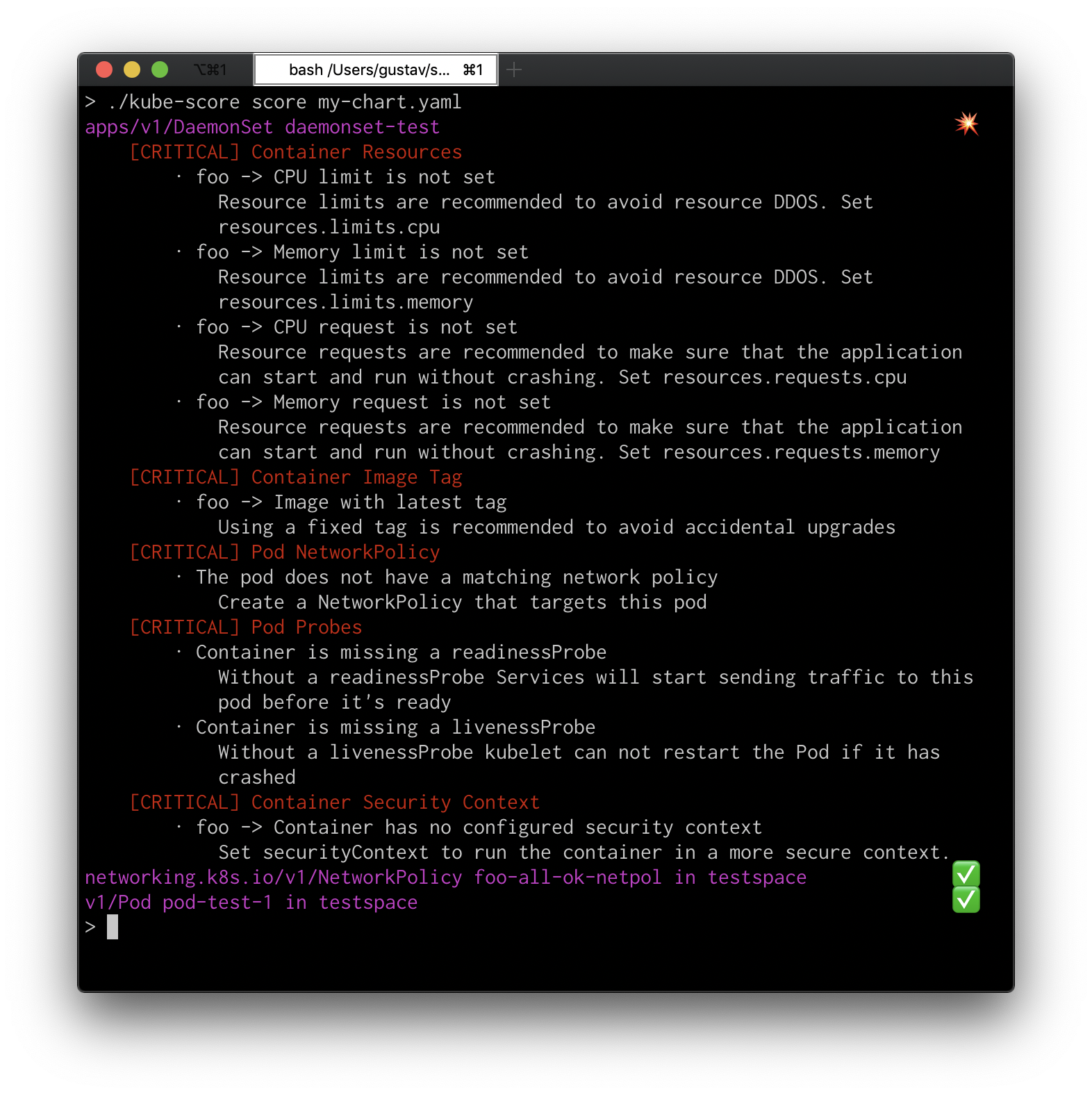
La salida es una lista de recomendaciones sobre lo que puede mejorar para hacer su aplicación más segura y resistente.
Puede probar kube-score en el navegador con la demo en línea (código fuente).
kube-score es fácil de instalar y está disponible desde las siguientes fuentes:
| Distribución | Comando / Enlace |
|---|---|
| Binarios precompilados para macOS, Linux y Windows | GitHub releases |
| Docker | docker pull zegl/kube-score (Docker Hub) |
| Homebrew (macOS y Linux) | brew install kube-score |
| Krew (macOS y Linux) | kubectl krew install score |
Para una lista completa de verificaciones, consulte README_CHECKS.md.
NetworkPolicy, se recomiendan reglas de salida y entradaPodDisruptionPolicy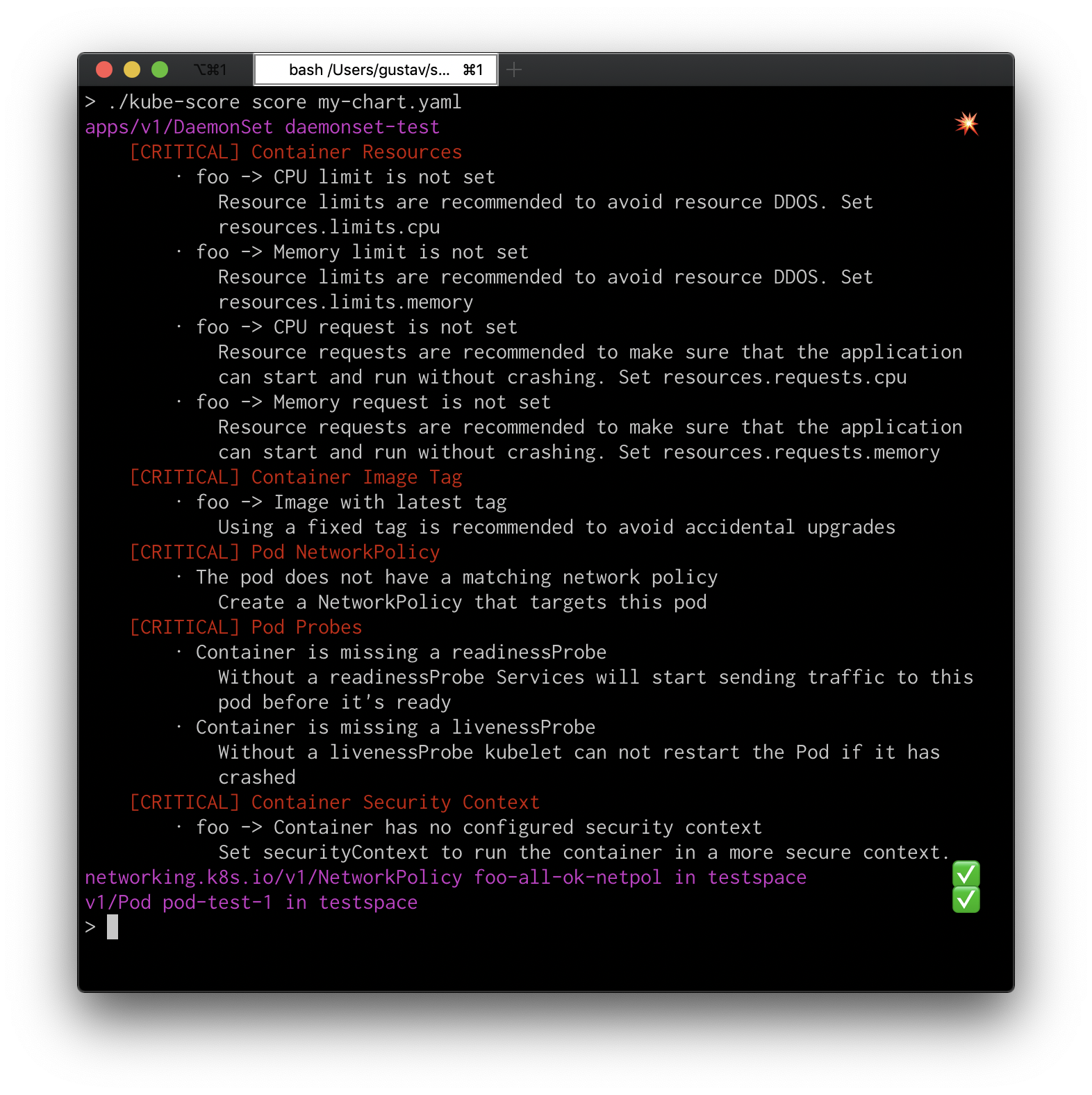
kube-score puede ejecutarse en su entorno CI/CD y saldrá con código de salida 1 si se ha encontrado un error crítico. El nivel de disparo se puede cambiar a advertencia con el argumento --exit-one-on-warning.
La entrada a kube-score debe ser todas las aplicaciones que implemente en el mismo namespace para obtener el mejor resultado.
helm template my-app | kube-score score -
kustomize build . | kube-score score -
kube-score score my-app/*.yaml
kube-score score my-app/deployment.yaml my-app/service.yaml
kubectl api-resources --verbs=list --namespaced -o name \
  | xargs -n1 -I{} bash -c "kubectl get {} --all-namespaces -oyaml && echo ---" \
  | kube-score score -
docker run -v $(pwd):/project zegl/kube-score:latest score my-app/*.yaml
Usage of kube-score:
kube-score [action] --flags

Actions:
	score	Checks all files in the input, and gives them a score and recommendations
	list	Prints a CSV list of all available score checks
	version	Print the version of kube-score
	help	Print this message

Flags for score:
      --disable-ignore-checks-annotations   Set to true to disable the effect of the 'kube-score/ignore' annotations
      --disable-optional-checks-annotations Set to true to disable the effect of the 'kube-score/enable' annotations
      --enable-optional-test strings        Enable an optional test, can be set multiple times
      --exit-one-on-warning                 Exit with code 1 in case of warnings
      --help                                Print help
      --ignore-container-cpu-limit          Disables the requirement of setting a container CPU limit
      --ignore-container-memory-limit       Disables the requirement of setting a container memory limit
      --ignore-test strings                 Disable a test, can be set multiple times
      --kubernetes-version string           Setting the kubernetes-version will affect the checks ran against the manifests. Set this to the version of Kubernetes that you're using in production for the best results. (default "v1.18")
  -o, --output-format string                Set to 'human', 'json', 'ci' or 'sarif'. If set to ci, kube-score will output the program in a format that is easier to parse by other programs. Sarif output allows for easier integration with CI platforms. (default "human")
      --output-version string               Changes the version of the --output-format. The 'json' format has version 'v2' (default) and 'v1' (deprecated, will be removed in v1.7.0). The 'human' and 'ci' formats has only version 'v1' (default). If not explicitly set, the default version for that particular output format will be used.
  -v, --verbose count                       Enable verbose output, can be set multiple times for increased verbosity.
Las pruebas se pueden ignorar en toda la ejecución del programa, con la bandera --ignore-test.
Una prueba también se puede ignorar por objeto, agregando la anotación kube-score/ignore al objeto. El valor debe ser una cadena separada por comas de los IDs de prueba.
Ejemplo:
Probar este objeto deshabilitará temporalmente la prueba service-type, que advierte contra el uso de servicios de tipo NodePort.
apiVersion: v1
kind: Service
metadata:
  name: node-port-service-with-ignore
  namespace: foospace
  annotations:
    kube-score/ignore: service-type
spec:
  selector:
    app: my-app
  ports:
  - protocol: TCP
    port: 80
    targetPort: 8080
  type: NodePort
Las pruebas opcionales se pueden habilitar en toda la ejecución del programa, con la bandera --enable-optional-test.
Una prueba también se puede habilitar por objeto, agregando la anotación kube-score/enable al objeto. El valor debe ser una cadena separada por comas de los IDs de prueba.
Ejemplo:
Probar este objeto habilitará la prueba container-seccomp-profile. Además, múltiples pruebas definidas por kube-score/ignore también se ignoran al mismo tiempo.