
Skip to content
KitploitKITPLOIT
HerramientasExploitsBlog
Log in
Enviar
HerramientasExploitsBlog
Enviar

¡Herramientas de Hacking, PenTest y Ciberseguridad para tu Arsenal de Seguridad!

Kitploit es un directorio de herramientas de hacking, ciberseguridad y pentesting. Descubre las últimas actualizaciones de proyectos para encontrar vulnerabilidades, analizar sistemas, automatizar pruebas y fortalecer tu seguridad.

FeedsContactoPrivacidad© 2026 Kitploit

Directorio de Herramientas

Categorías

Ver todas las categorías
Loading categories
TransparentTorProxy — A Linux CLI utility that transparently routes all system traffic through the Tor network using nftables. It enables rapid IP rotation and easy toggling of global proxy settings for privacy tasks. | Kitploit
Herramientas/GitHubGitHub/onyks-os/transparenttorproxy
Defensive ToolsPacket Sniffing & AnalysisScripting & AutomationNetwork SecurityPenetration TestingPrivacyCommand and ControlUtilities & FrameworksDNS Analysis
GitHubonyks-os/transparenttorproxy

TransparentTorProxy

517179hace 8h 54mRevisado por Kitploit
Compartir

A Linux CLI utility that transparently routes all system traffic through the Tor network using nftables. It enables rapid IP rotation and easy toggling of global proxy settings for privacy tasks.


Ver RepositorioSitio web
Contenido no disponible en el idioma solicitado. Mostrando versión en inglés.

TTP - Transparent Tor Proxy

A Linux CLI tool that transparently routes all system traffic through the Tor network using nftables.

Sponsor Linux Python CI Status Documentation PyPI - Downloads OpenSSF Best Practices License

Features • Requirements • Installation • Usage • How It Works • Verification • Contribute


TTP Demo


No per-application setup needed - just sudo ttp start and every connection goes through Tor.

[!CAUTION] TTP is a tool designed to aid privacy by routing traffic through Tor. However, no tool can guarantee 100% anonymity. Your safety also depends on your behavior (e.g., using a regular browser vs. Tor Browser, signing into accounts, etc.). Always use TTP as part of a multi-layered security strategy.

[!WARNING] If you are a whistleblower or are engaging in high-risk activities, DO NOT use TTP. Instead, use officially audited and reliable tools like TailsOS or the Tor Browser directly. The authors and contributors of TTP assume no responsibility for your safety or the consequences of using this software.

0.5.0 development: required watchdog readiness, typed session evidence and optional desktop notifications are implemented on the development branch. Read the operator guide for independent --watchdog / --notifications selection, configurable deadlines, exit codes and explicit emergency termination. These changes are not in released 0.4.11.

VPN before Tor (0.5.0 development): see the VPN guide before using --require-vpn UUID. It requires an already active native NetworkManager WireGuard tunnel, watchdog and no bypass. Supported profiles, limitations, deliberate stop/recovery and pending release qualification are documented together; this is not a general VPN-manager integration.

Why TTP?

Legacy transparent proxy scripts (TorGhost, Anonsurf) overwrite configuration files and build iptables rulesets that fail open: when they break, traffic leaves in cleartext. TTP is built the other way round - it fails closed, and keeps nothing on disk.

Fail-closed by constructionAn isolated inet ttp nftables table with a catch-all reject and policy drop on forwarding. On a crash, a watchdog trigger or an unclean exit, traffic is either routed through Tor or blocked - never released.
Nothing persistsSession state, torrc, lock file and logs live only in tmpfs (/run/ttp/, /run/tor/ttp/). A reboot leaves no residue and no stale lock - and no session either: see Known Behavior & Limitations.
No per-application setupTCP and DNS are intercepted at the network layer. No SOCKS5 settings, no proxy environment variables, no application support required.
DNS without rewriting your systemA mount --bind overlay on /etc/resolv.conf rather than an edit, plus a volatile drop-in that neutralises systemd-resolved, backed by a kernel-level drop on any non-loopback resolver traffic.
The leak claim is measuredEvery containment rule is tested in an isolated network namespace against the real generated ruleset, and each test first proves it can see a leak before asserting there is none. See Verification.

Features

  • Continuous integrity protection (--watchdog) - a watchdog governed by a formal FSM (transitions) compares the live inet ttp table, rule for rule, with the one the session applied, and watches Tor and the DNS overlay. It is woken by nftables and inotify events rather than polling, so a flushed or altered table reaches the killswitch in tens of milliseconds (31-48 ms measured). A failed Tor is restarted once; a changed table or DNS overlay is treated as tampering. Either way, if the session is not intact the watchdog applies an emergency killswitch and holds it until ttp stop, re-applying it if something removes or alters it.
  • Split tunnelling - exempt users or groups (--bypass-user, --bypass-group) with native nftables UID/GID matching, or run a single command outside Tor with ttp bypass <cmd> via a cgroups v2 slice.
  • LAN preserved - private and link-local subnets stay reachable, except the reserved Tor virtual ranges. Onion mappings take precedence over LAN bypass; ordinary fd00::/8 ULA networks remain available.
  • Dual-stack, or no stack - IPv6 is routed through Tor when loopback routing is available, and dropped outright when it is not. There is no third option where it leaks.
  • DoH and DoT contained by construction - all TCP goes to Tor, DNS on port 53 goes to Tor's DNSPort, everything else is rejected. A browser's DoH or DoT query therefore leaves through a Tor exit like any other connection, whoever the resolver is; no blocklist is involved (ADR 0012).
  • AppArmor confinement (0.5.0 development) - on AppArmor kernels, managed Tor must have a verified ttp-tor (enforce) label. See requirements, diagnosis and limits; the watchdog contains loss of confinement.
  • Coexists with your system Tor - runs its own volatile ttp-tor.service on non-standard ports, leaving an existing Tor instance untouched.


  • Bridges - obfs4 and snowflake, with BYOD (bring your own daemon) mode.

Requirements

Descargar herramienta

Más Populares

Ver todos →

Descubre las herramientas más usadas por nuestra comunidad.

  • 1

    OsintHunter

    letox4/osinthunter

    🎯 El kit de herramientas OSINT definitivo: grafo de investigación, puntuación de confianza, familias de alias, mapa, línea de tiempo e informes. 49 módulos, más de 400 sitios, sin necesidad de claves API.

    732
  • 2

    ghostlock-app

    yukonga/ghostlock-app

    # Aplicación de Ejecución con un Solo Toque GhostLock (CVE-2026-43499)

    506
  • 3

    ARTEX

    baarai/artex

    Plataforma de pruebas de penetración autónoma multiagente basada en LLM con agentes planificadores/trabajadores, grafos de activos y de exploración, registro de tráfico MITM y reevaluación de vulnerabilidades.

    405
  • 4

    redforge

    cybersecurity91/redforge

    Kit de herramientas de red team del lado del navegador con 102 herramientas offline para reconocimiento, generación de payloads, ataques de credenciales, criptografía, codificación y elaboración de informes de compromiso.

    342
  • 5

    CyberStrikeAI

    ed1s0nz/cyberstrikeai

    El sistema de acción para la ciberseguridad nativa de IA—donde la intención se convierte en ejecución gobernada, la evidencia se convierte en memoria operativa y cada operación mejora la siguiente.

    261
  • 6

    antifox

    antifox-ai/antifox

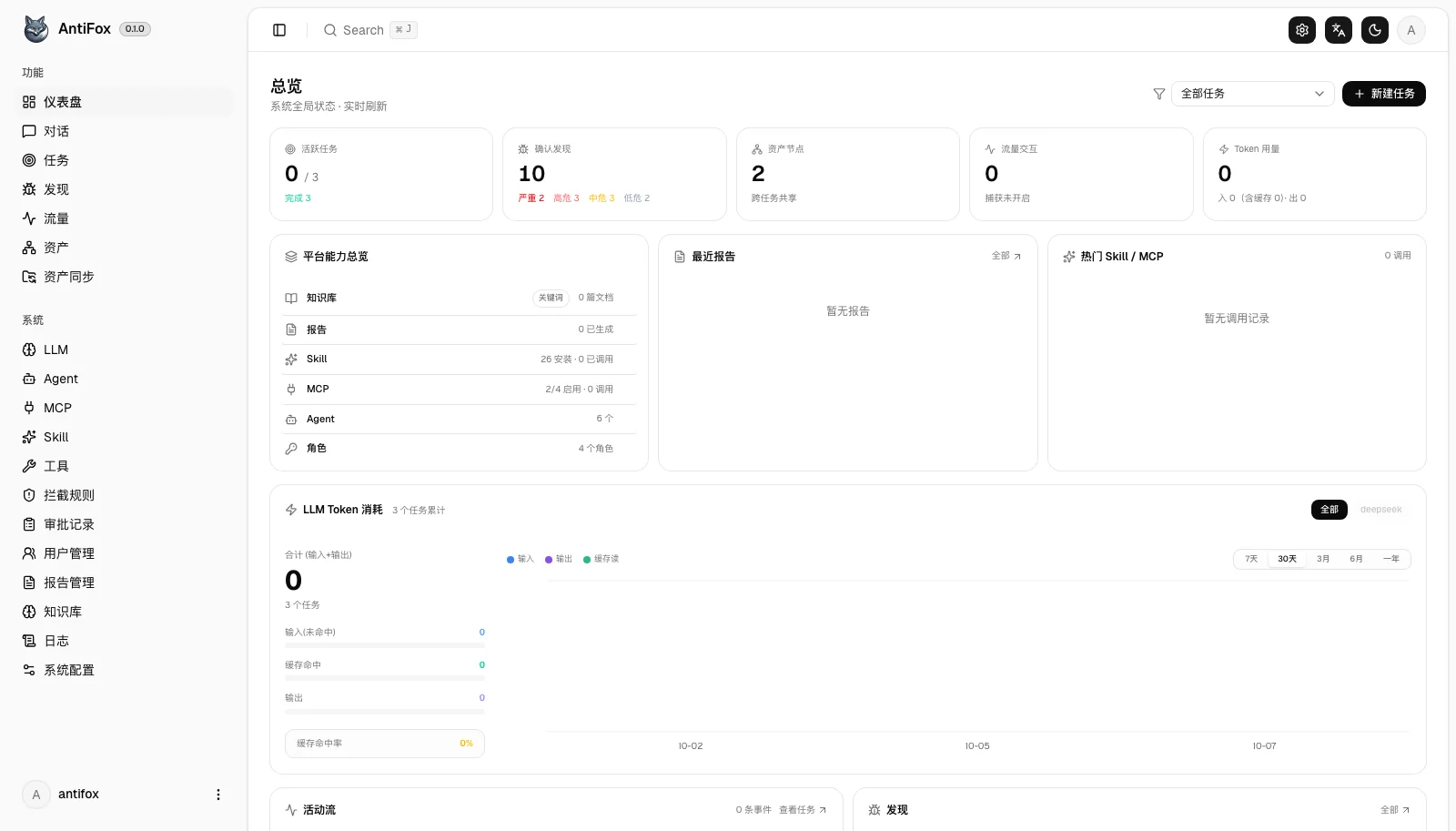
    Plataforma de pruebas de penetración autónoma con múltiples agentes de IA que ejecuta reconocimiento, descubrimiento de superficie de ataque, validación de explotación y entrega de informes respaldados por evidencia.

    259

Explora todas las herramientas

Explora nuestra colección de herramientas

Ver todas las herramientas →