mahgal/nginx-http2-rce-check
Responde '¿estoy expuesto al RCE de Nginx HTTP/2?' con un solo comando — comprueba tu versión de nginx y la configuración de HTTP/2 frente a CVE-2026-123007 / CVE-2026-123633 (divulgado el 2026-11-18, CVSS 9.2).

Responde "¿está mi nginx expuesto al par de RCE de HTTP/2?" en 0,06 segundos — un comando, cero llamadas de red, cero dependencias.
Una CLI de Python que solo usa la biblioteca estándar y comprueba las dos cosas que determinan si un host está expuesto a CVE-2026-123007 y CVE-2026-123633: la versión de nginx y si HTTP/2 está habilitado en la configuración. Una comprobación real tarda una mediana de 0,062 s (7 ejecuciones, medidas el 2026-11-19 en esta máquina) — más rápido que abrir la página del aviso. Sin payloads, sin escaneo de red, sin código de exploit: solo un comprobador defensivo.
El 2026-11-18, Wiz, Ikotas Labs, Metnir, Rapid7 y Xint divulgaron dos fallos de ejecución remota de código sin autenticación en el manejo de HTTP/2 de nginx — CVE-2026-123007 (desbordamiento negativo de entero en el control de flujo de HTTP/2) y CVE-2026-123633 (use-after-free de HTTP/2 en conexiones de proxy). Ambos son CVSS 4.0 9.2 (CVSS 3.1 8.1); nginx.org califica 123007 como "major" y 123633 como "medium". La noticia llegó al #1 de Hacker News el 2026-11-19 (~1.152 puntos), y nginx impulsa más de 225M de sitios web — así que la ventana de parcheo se mide en horas, no en semanas.
Lo que se verificó a partir de las fuentes siguientes:
http2 off es una medida provisional para estos dos, no un sustituto de actualizar.Fuentes: Wiz write-up · deploybase explainer · IFIN advisory summary · avisos de seguridad de nginx.org
git clone https://github.com/Mahgal/nginx-http2-rce-check.git
cd nginx-http2-rce-check
python3 nginx_http2_check.py              # check this machine
Sin instalaciones de pip, sin dependencias — solo Python 3. Pruébalo sin nginx instalado:
python3 nginx_http2_check.py --demo      # labelled fixtures: 1 vulnerable, 1 patched
python3 nginx_http2_check.py --version 1.31.8 --config examples/nginx-http2-on.conf
python3 nginx_http2_check.py --version 1.30.7 --config examples/nginx-http2-on.conf
python3 nginx_http2_check.py --nginx-path examples/fake-nginx-vulnerable.sh --config examples/nginx-http2-on.conf
python3 nginx_http2_check.py --json      # machine-readable output for CI
Verificado desde una copia limpia (checkout nuevo en /tmp, 2026-11-19): --demo se ejecuta y toda la suite de pruebas pasa, 40/40, salida 0.
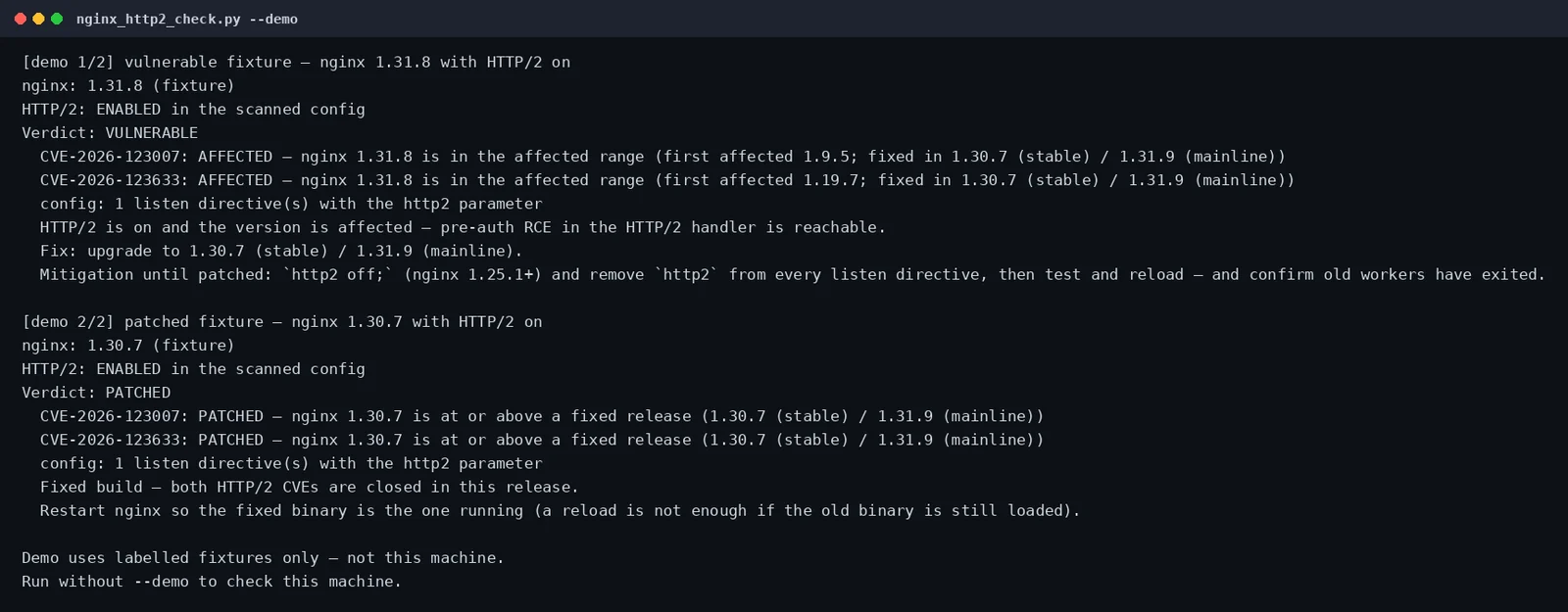
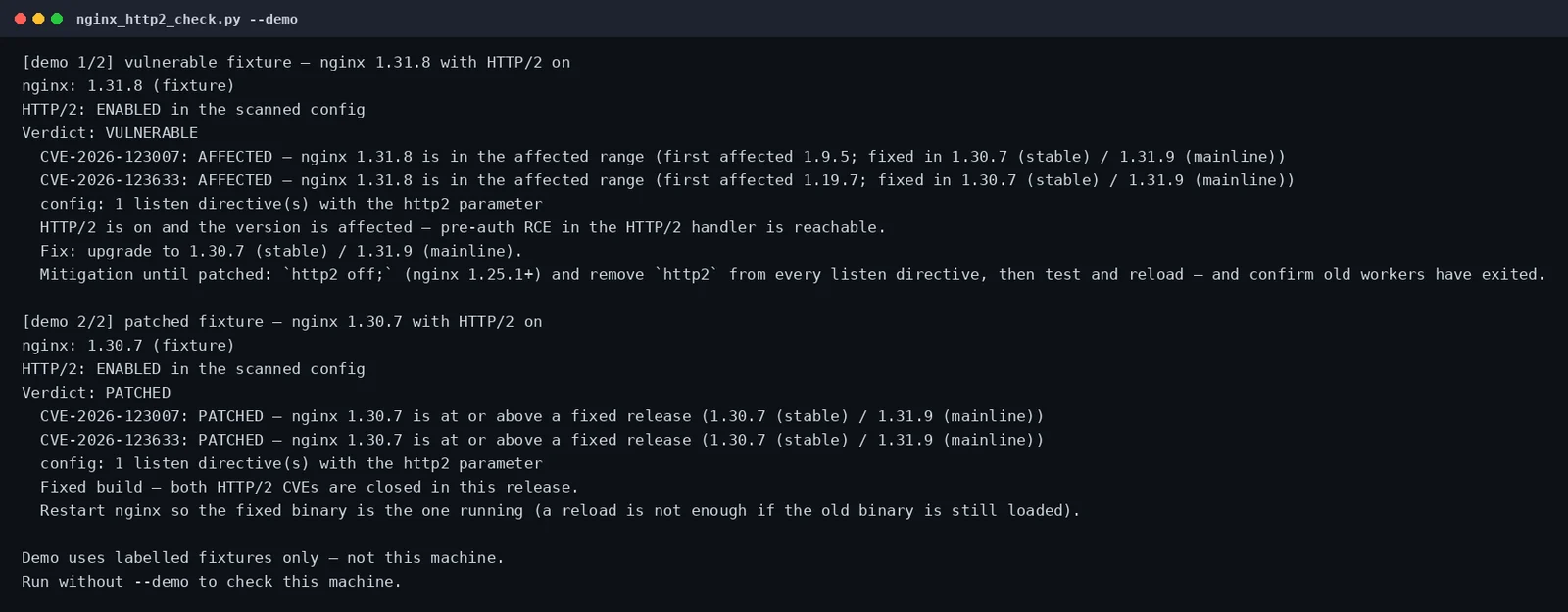
Salida real de python3 nginx_http2_check.py --demo (capturada literalmente en demo.txt; las reejecuciones la reproducen byte a byte, sha256 e6a50babb87a98a704b802b3bbab6d5db6da256b45a45b9628ab1a930eae7f27):
[demo 1/2] vulnerable fixture — nginx 1.31.8 with HTTP/2 on
nginx: 1.31.8 (fixture)
HTTP/2: ENABLED in the scanned config
Verdict: VULNERABLE
  CVE-2026-123007: AFFECTED — nginx 1.31.8 is in the affected range (first affected 1.9.5; fixed in 1.30.7 (stable) / 1.31.9 (mainline))
  CVE-2026-123633: AFFECTED — nginx 1.31.8 is in the affected range (first affected 1.19.7; fixed in 1.30.7 (stable) / 1.31.9 (mainline))
  config: 1 listen directive(s) with the http2 parameter
  HTTP/2 is on and the version is affected — pre-auth RCE in the HTTP/2 handler is reachable.
  Fix: upgrade to 1.30.7 (stable) / 1.31.9 (mainline).
  Mitigation until patched: `http2 off;` (nginx 1.25.1+) and remove `http2` from every listen directive, then test and reload — and confirm old workers have exited.

[demo 2/2] patched fixture — nginx 1.30.7 with HTTP/2 on
nginx: 1.30.7 (fixture)
HTTP/2: ENABLED in the scanned config
Verdict: PATCHED
  CVE-2026-123007: PATCHED — nginx 1.30.7 is at or above a fixed release (1.30.7 (stable) / 1.31.9 (mainline))
  CVE-2026-123633: PATCHED — nginx 1.30.7 is at or above a fixed release (1.30.7 (stable) / 1.31.9 (mainline))
  config: 1 listen directive(s) with the http2 parameter
  Fixed build — both HTTP/2 CVEs are closed in this release.
  Restart nginx so the fixed binary is the one running (a reload is not enough if the old binary is still loaded).

Demo uses labelled fixtures only — not this machine.
Run without --demo to check this machine.
Los mismos casos contra flags reales:
$ python3 nginx_http2_check.py --version 1.31.8 --config examples/nginx-http2-on.conf
Verdict: VULNERABLE        # exit 1 — HTTP/2 on, version affected
$ python3 nginx_http2_check.py --version 1.30.7 --config examples/nginx-http2-on.conf
Verdict: PATCHED           # exit 0 — same config, fixed build
$ python3 nginx_http2_check.py --version 1.31.8 --config examples/nginx-http2-off.conf
Verdict: NOT_AFFECTED      # exit 0 — HTTP/2 off closes both flaws
$ python3 nginx_http2_check.py --version 1.24.0-0ubuntu1 --config examples/nginx-http2-on.conf
Verdict: UNKNOWN           # exit 3 — distro package: version string says nothing
1.30.7 está corregida, pero 1.31.0–1.31.8 siguen siendo vulnerables. Una comprobación ingenua — "versión ≥ 1.30.7 significa segura" — declararía segura a 1.31.8. No lo es. Esta herramienta compara con rangos explícitos por rama, nunca con un umbral numérico simple:
| Versión | CVE-2026-123007 | CVE-2026-123633 |
|---|---|---|
| < 1.9.5 | no afectada | no afectada |
| 1.9.5 – 1.19.6 | afectada | no afectada |
| 1.19.7 – 1.30.6 | afectada | afectada |
| 1.30.7 (corrección estable) | corregida | corregida |
| 1.31.0 – 1.31.8 | afectada | afectada |
| 1.31.9+ / 1.32.0+ (corrección de mainline) | corregida | corregida |