 alejandro-llanes/http_bridge
Puente proxy SOCKS5 a HTTP que tuneliza flujos TCP arbitrarios (SSH, SMTP, TLS) a través de solicitudes HTTP estándar, permitiendo la ofuscación del tráfico de red y la evasión de cortafuegos.

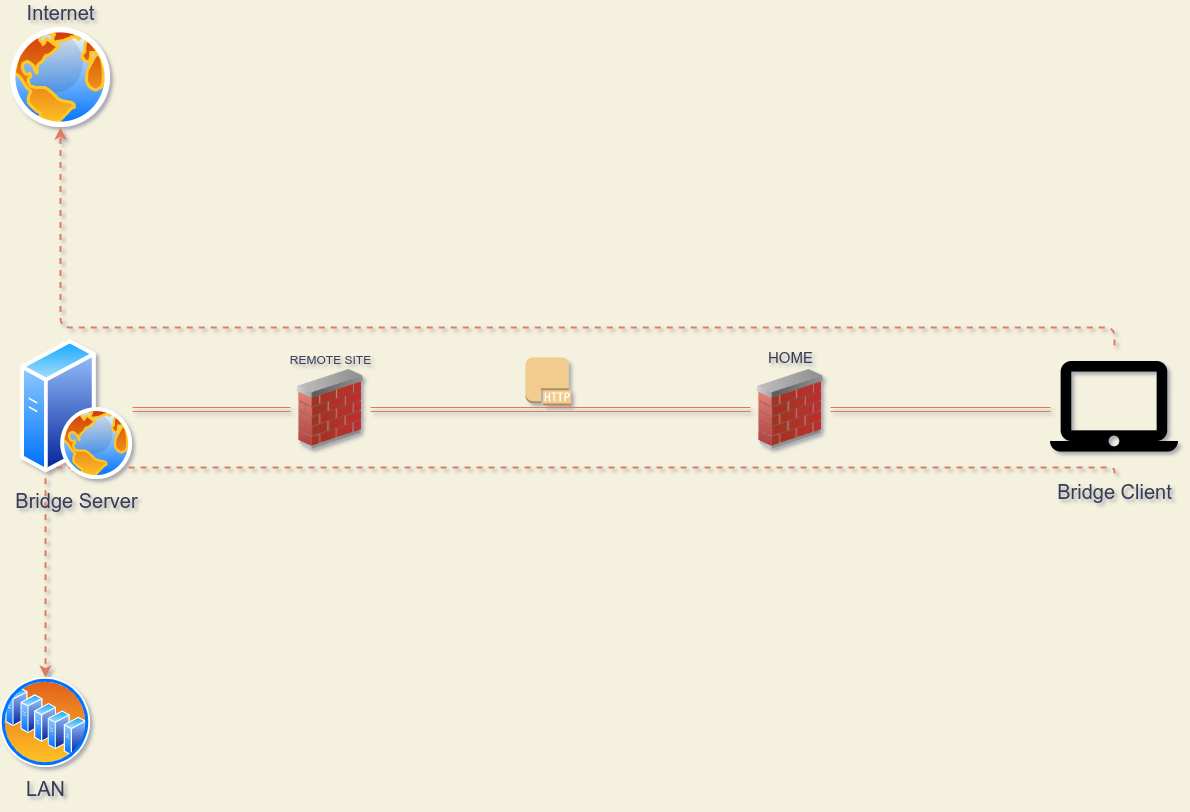
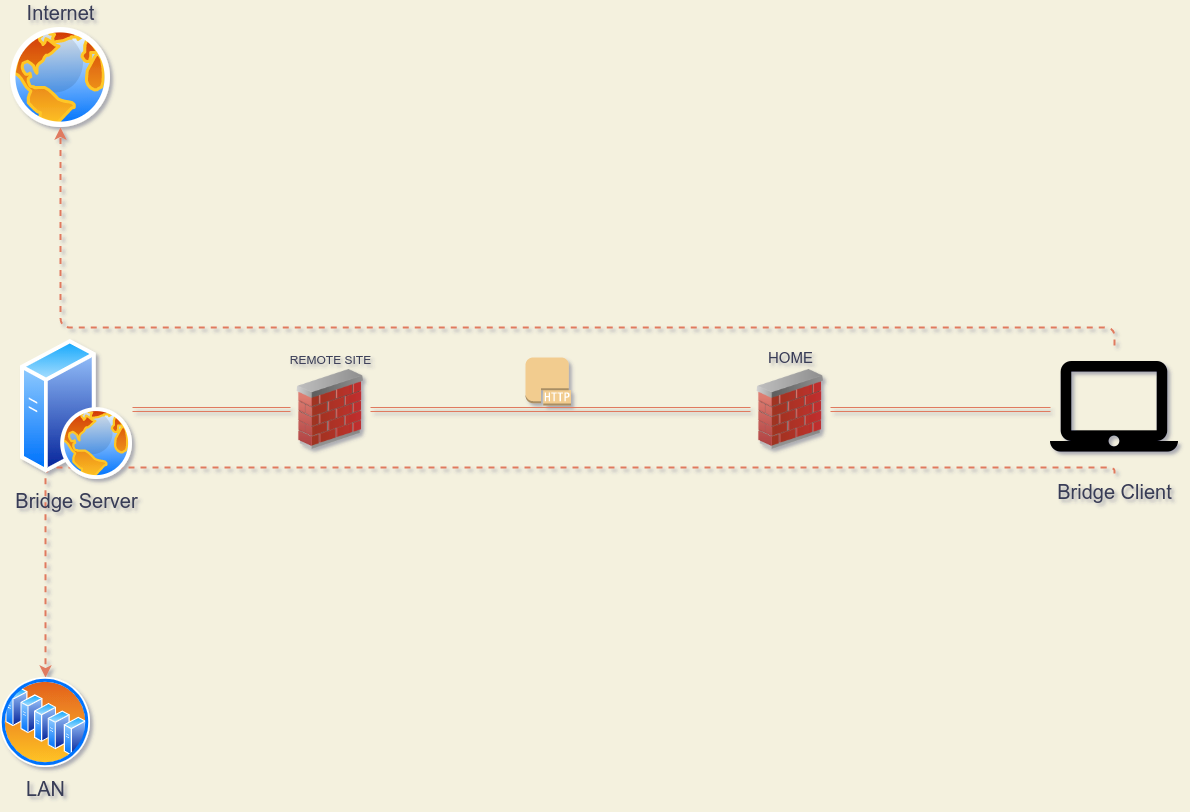
Escribí este programa como una prueba de concepto para probar la idea de poder enviar paquetes de flujo TCP a través de solicitudes HTTP simples como PUT, PATCH, POST, GET, sin usar un método de proxy como CONNECT. También como ejercicio de práctica para entrenar mi novata habilidad en el lenguaje Rust.
Esta herramienta se compone de dos partes: el servidor y un cliente.
El servidor es simplemente un archivo PHP con algo de lógica para mantener conexiones con estado utilizando sockets TCP y manejar las solicitudes HTTP entrantes. Por ahora, esta lógica solo funciona en servidores Linux.
Lo he probado con Apache+mod_php, nginx+php-fpm y el servidor PHP integrado (php -S).
El cliente es un servidor Socks5 que escucha conexiones entrantes de clientes, empaqueta las cadenas de bytes y envía la solicitud HTTP al servidor; una vez que recibe la respuesta, la escribe de vuelta al cliente.
Este cliente está escrito en Rust. Tomé prestada la implementación de Socks5 de este proyecto v2socks, así que gracias a ylxdzsw.
Se requiere Proxychains para ejecutar este ejemplo.
Suba el archivo del servidor hbserver/hbserver.php a un servidor web en funcionamiento con soporte PHP, o ejecute uno local como se indica a continuación; esto generará un contenedor Docker escuchando en el puerto 8080.
docker run --rm -it --net host --name apache-webserver -v "$PWD/hbserver:/app -v "$PWD/tools/ports.conf:/etc/apache2/ports.conf" webdevops/php-apache:7.3
El cliente necesita ser compilado, por lo que debe tener un compilador de Rust instalado u obtener uno desde aquí rustup
cd client &&\
cargo build &&\
./target/debug/hbsc
Configure proxychains para que apunte al puerto local de Socks5:
echo "socks5 127.0.0.1 1986" >> $HOME/.proxychains/proxychains.conf
Con todo en su lugar, algunas pruebas:
icanhazip.com
alejandro@0x2e ~ $ proxychains curl -v icanhazip.com
[proxychains] config file found: /home/alejandro/.proxychains/proxychains.conf
[proxychains] preloading /usr/lib64/libproxychains.so.4.14
*   Trying 224.0.0.1:80...
* Connected to icanhazip.com (127.0.0.1) port 80 (#0)
> GET / HTTP/1.1
> Host: icanhazip.com
> User-Agent: curl/7.72.0
> Accept: */*
>
* Mark bundle as not supporting multiuse
< HTTP/1.1 200 OK
< Date: Thu, 25 Feb 2021 18:08:04 GMT
< Content-Type: text/plain
< Content-Length: 15
< Connection: close
< Set-Cookie: __cfduid=dd994605ef1b77d0aa6dc46b6fdbb4c8d1614276484; expires=Sat, 27-Mar-21 18:08:04 GMT; path=/; domain=.icanhazip.com; HttpOnly; SameSite=Lax
< Access-Control-Allow-Origin: *
< Access-Control-Allow-Methods: GET
< X-RTFM: Learn about this site at http://bit.ly/icanhazip-faq
< X-THANK-YOU: Many thanks to the fine people at Cloudflare for keeping this site afloat!
< cf-request-id: 087bf977730000e790d13c4000000001
< Server: cloudflare
< CF-RAY: 62735e9f1ec9e790-MDE
< alt-svc: h3-27=":443"; ma=86400, h3-28=":443"; ma=86400, h3-29=":443"; ma=86400
<
XXX.33.235.XXX
* Closing connection 0
http://httpbin.org/headers
alejandro@0x2e ~ $ proxychains curl -v http://httpbin.org/headers
[proxychains] config file found: /home/alejandro/.proxychains/proxychains.conf
[proxychains] preloading /usr/lib64/libproxychains.so.4.14
*   Trying 224.0.0.1:80...
* Connected to httpbin.org (127.0.0.1) port 80 (#0)
> GET /headers HTTP/1.1
> Host: httpbin.org
> User-Agent: curl/7.72.0
> Accept: */*
>
* Mark bundle as not supporting multiuse
< HTTP/1.1 200 OK
< Date: Thu, 25 Feb 2021 18:05:51 GMT
< Content-Type: application/json
< Content-Length: 173
< Connection: keep-alive
< Server: gunicorn/19.9.0
< Access-Control-Allow-Origin: *
< Access-Control-Allow-Credentials: true
<
{
  "headers": {
    "Accept": "*/*",
    "Host": "httpbin.org",
    "User-Agent": "curl/7.72.0",
    "X-Amzn-Trace-Id": "Root=1-6037e6ff-06059b933c2d8c495ecee43a"
  }
}
* Connection #0 to host httpbin.org left intact
https://mozilla.org
alejandro@0x2e ~ $ proxychains curl -v https://mozilla.org
[proxychains] config file found: /home/alejandro/.proxychains/proxychains.conf
[proxychains] preloading /usr/lib64/libproxychains.so.4.14
*   Trying 224.0.0.1:443...
* Connected to mozilla.org (127.0.0.1) port 443 (#0)
* ALPN, offering h2
* ALPN, offering http/1.1
* successfully set certificate verify locations:
*   CAfile: /etc/ssl/certs/ca-certificates.crt
  CApath: /etc/ssl/certs
* TLSv1.3 (OUT), TLS handshake, Client hello (1):
* TLSv1.3 (IN), TLS handshake, Server hello (2):
* TLSv1.3 (IN), TLS handshake, Encrypted Extensions (8):
* TLSv1.3 (IN), TLS handshake, Certificate (11):
* TLSv1.3 (IN), TLS handshake, CERT verify (15):
* TLSv1.3 (IN), TLS handshake, Finished (20):
* TLSv1.3 (OUT), TLS change cipher, Change cipher spec (1):
* TLSv1.3 (OUT), TLS handshake, Finished (20):
* SSL connection using TLSv1.3 / TLS_AES_256_GCM_SHA384
* ALPN, server accepted to use h2
* Server certificate:
*  subject: CN=mozilla.org
*  start date: Jan  1 19:11:54 2021 GMT
*  expire date: Apr  1 19:11:54 2021 GMT
*  subjectAltName: host "mozilla.org" matched cert's "mozilla.org"
*  issuer: C=US; O=Let's Encrypt; CN=R3
*  SSL certificate verify ok.
* Using HTTP2, server supports multi-use
* Connection state changed (HTTP/2 confirmed)
* Copying HTTP/2 data in stream buffer to connection buffer after upgrade: len=0
* Using Stream ID: 1 (easy handle 0x562758dbab60)
> GET / HTTP/2
> Host: mozilla.org
> user-agent: curl/7.72.0
> accept: */*
>
* TLSv1.3 (IN), TLS handshake, Newsession Ticket (4):
* TLSv1.3 (IN), TLS handshake, Newsession Ticket (4):
* old SSL session ID is stale, removing
* Connection state changed (MAX_CONCURRENT_STREAMS == 128)!
< HTTP/2 301
< date: Thu, 25 Feb 2021 18:03:56 GMT
< content-type: text/html
< content-length: 162
< location: https://www.mozilla.org/
< strict-transport-security: max-age=60; includeSubDomains
< x-backend-server: TS
< cache-control: max-age=3600
< x-frame-options: SAMEORIGIN
< content-security-policy: frame-ancestors 'none'
<
<html>
<head><title>301 Moved Permanently</title></head>
<body>
<center><h1>301 Moved Permanently</h1></center>
<hr><center>nginx</center>
</body>
</html>
* Connection #0 to host mozilla.org left intact
smtp.gmail.com
alejandro@0x2e ~ $ proxychains nc -v smtp.gmail.com 25
[proxychains] config file found: /home/alejandro/.proxychains/proxychains.conf
[proxychains] preloading /usr/lib64/libproxychains.so.4.14
Connection to smtp.gmail.com 25 port [tcp/smtp] succeeded!
220 smtp.gmail.com ESMTP z1sm4022921qtu.83 - gsmtp
EHLO smtp.gmail.com
250-smtp.gmail.com at your service, [XXX.33.235.XXX]
250-SIZE 35882577
250-8BITMIME
250-STARTTLS
250-ENHANCEDSTATUSCODES
250-PIPELINING
250-CHUNKING
250 SMTPUTF8
^C
alejandro@0x2e ~ $ proxychains ssh  localhost 'ps axl --sort=-pcpu|tail -n 5'
[proxychains] config file found: /home/alejandro/.proxychains/proxychains.conf
[proxychains] preloading /usr/lib64/libproxychains.so.4.14
Password:
4     0  65375   1242  20   0   9516  6988 -      Ss   ?          0:00 sshd: alejandro [priv]
5  1000  65420  65375  20   0   9516  4320 -      S    ?          0:00 sshd: alejandro@notty
0  1000  65421  65420  20   0 218168  3260 -      Ss   ?          0:00 bash -c ps axl --sort=-pcpu|tail -n 5
4  1000  65422  65421  20   0 220568  3484 -      R    ?          0:00 ps axl --sort=-pcpu
0  1000  65423  65421  20   0 216756   748 -      S    ?          0:00 tail -n 5
alejandro@0x2e ~ $
