 vihaaninnovations/autonoma
Detects and auto-fixes hardcoded secrets in Python repos — refuses when the fix could break your code




Autonoma detects hardcoded secrets and replaces them with os.environ[...] references using AST rewrites. Changes are applied only when the rewrite is deterministic and semantically-preserving.
Rewrites use the parsed syntax tree — not regex on raw text. Runs locally with no network calls. Works in CI with idempotent, minimal diffs.
Hardcoded secrets in codebases:
Most tools detect them.
Autonoma only touches what it can prove is safe to change.
autonoma scan .
autonoma fix .
git diff
pip install autonoma-cli
Add this to your .pre-commit-config.yaml to prevent secrets from entering your history:
- repo: local
  hooks:
    - id: autonoma
      name: Autonoma Scan
      entry: autonoma scan
      language: system
      types: [python]
# 1. Create a test file with hardcoded secrets
cat > test_secrets.py << 'EOF'
SENDGRID_API_KEY = "sg-live-abc123xyz789"
DB_PASSWORD = "Pr0dAccess2024!"
EOF

# Also create the env contract file (required for safe remediation)
printf 'SENDGRID_API_KEY=\nDB_PASSWORD=\n' > .env.example

# 2. Scan — emits JSON findings to stdout
autonoma scan test_secrets.py

# 3. Fix — rewrites the file in place
autonoma fix test_secrets.py

# 4. Scan again — should now be clean (exit 0)
autonoma scan test_secrets.py

# 5. Inspect the result
cat test_secrets.py
Expected output after fix:
import os
SENDGRID_API_KEY = os.environ["SENDGRID_API_KEY"]
DB_PASSWORD = os.environ["DB_PASSWORD"]
Detection mode. Outputs JSON to stdout and a human-readable summary to stderr. Non-mutating — never modifies files.
# Scan a directory (JSON findings to stdout)
autonoma scan src/

# Save JSON results to a file
autonoma scan src/ > findings.json
Exit codes for scan:
| Code | Meaning |
|---|---|
0 | No findings |
1 | Findings detected |
3 | Tool error |
Remediates hardcoded secrets using AST rewrites. Mutates files in place.
# Apply fixes
autonoma fix src/

# Preview patches before writing
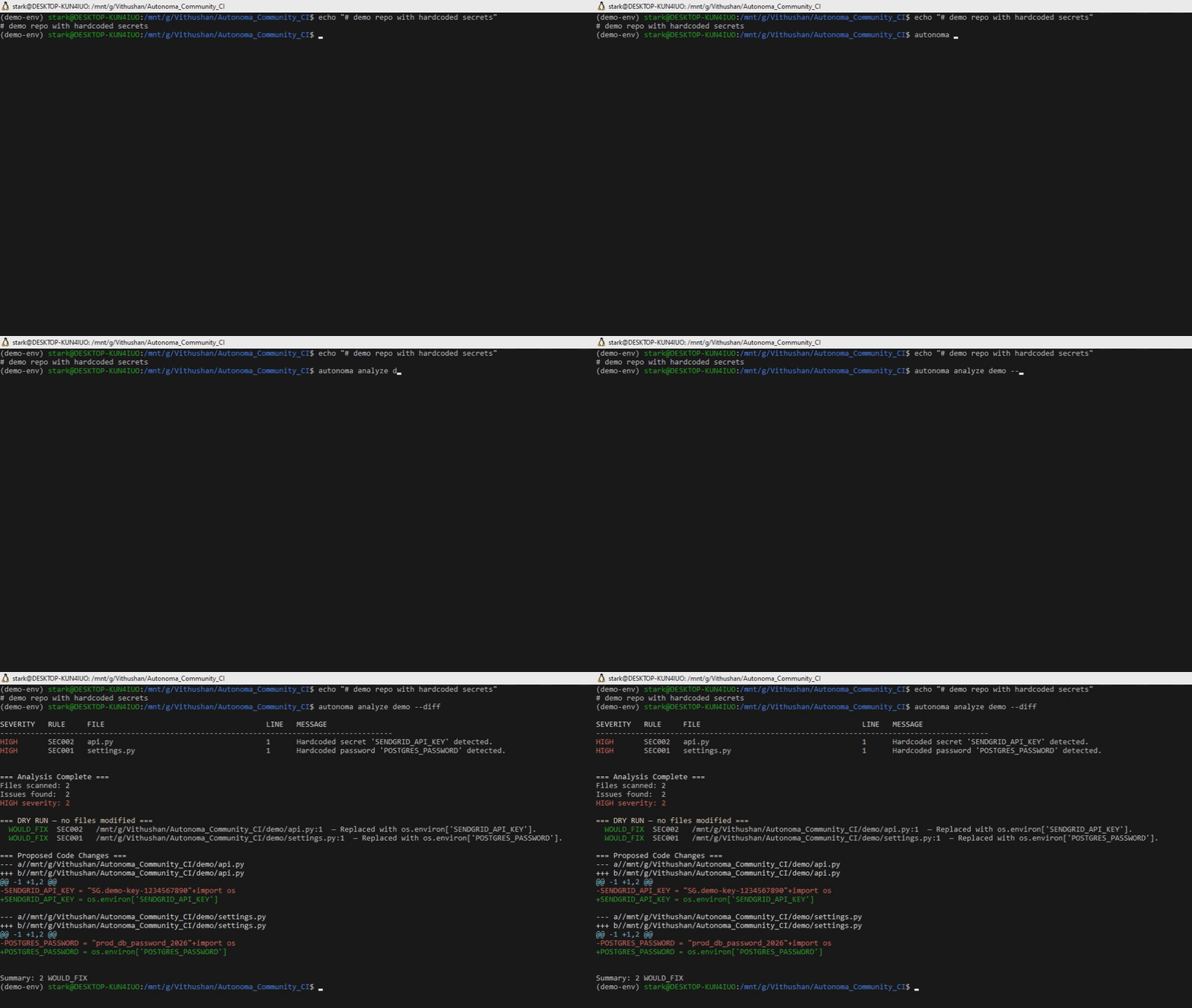
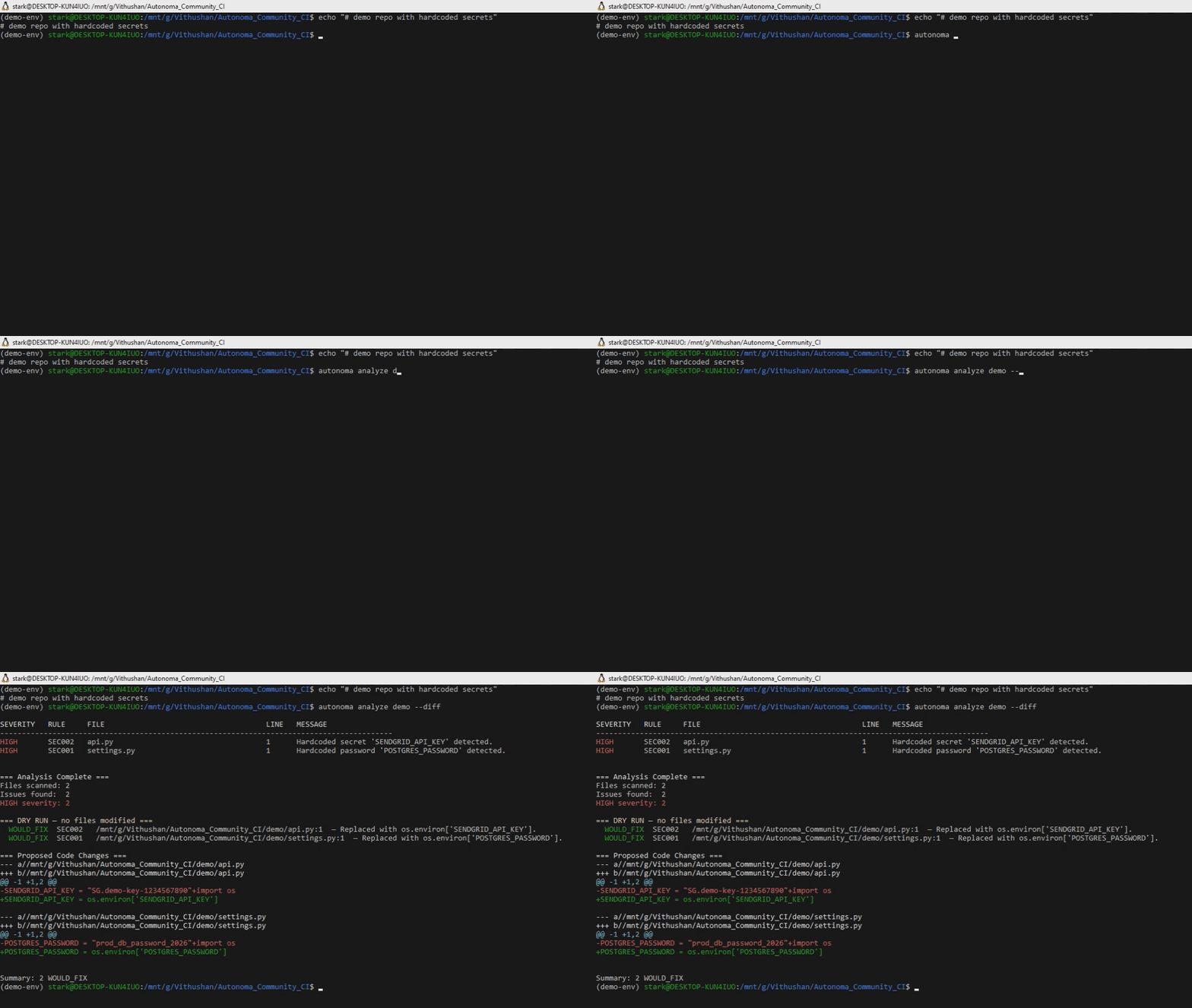
autonoma fix src/ --diff

# Write remediation audit log
autonoma fix src/ --report-out audit.json
Exit codes for fix:
| Code | Meaning |
|---|---|
0 | No findings — repo was already clean |
1 | Findings existed before remediation (remediation may have succeeded — check output for FIXED/REFUSED counts) |
3 | Tool error |
The
fixcommand exits1whenever it found secrets before attempting remediation, regardless of whether the rewrite succeeded. This is intentional: CI pipelines should flag the commit where secrets were introduced, even after auto-fix. Runautonoma scanafterward to confirm the repo is clean.
Scans git history for secrets that were committed and later removed or changed.
[!NOTE] Detection only. This command does not rewrite git history or modify commits.
autonoma history-scan .
These are the patterns Autonoma actually fixes today.
# settings.py
SENDGRID_API_KEY = "sg-live-abc123xyz789"
DB_PASSWORD = "Pr0dAccess2024!"
autonoma fix .)# settings.py
import os
SENDGRID_API_KEY = os.environ["SENDGRID_API_KEY"]
DB_PASSWORD = os.environ["DB_PASSWORD"]
# f-string — refused because the rewrite would change semantics
api_key = f"prefix_{BASE_KEY}"
# → REFUSED: refuse_fstring_mixed_expression

# Dict/nested value — refused because the target is not a simple assignment
DATABASES = {
    "default": {"PASSWORD": "Pr0d@ccess2024!"}
}
# → REFUSED: unsupported assignment target type
Refused findings are reported in the JSON output and cause a non-zero exit in CI. Files with refused findings are never modified.
| Pattern | Example | Behavior | Why |
|---|---|---|---|
| Simple assignment | api_key = "sk-abc123" | Fixed | Deterministic AST rewrite |
| Class attribute | class C: SECRET = "abc" | Fixed | Deterministic AST rewrite |
| Keyword argument | connect(password="abc") | Fixed | Deterministic AST rewrite |
| f-string | key = f"prefix_{v}" | Refused | Rewrite would change runtime behavior |
| Concatenation | key = "sk-" + suffix | Refused | Rewrite would change runtime behavior |
| Dict/nested value | cfg = {"pass": "abc"} | Refused | Not a simple assignment target |
| Multiple assignment | A = B = "secret" | Refused | Ambiguous target |
| Already safe | key = os.getenv("KEY") | Skipped | No change needed |
Missing .env.example | any pattern | Refused | No env contract to derive variable name |
Re-running on a clean file makes no changes. Rewrites keep original indentation and comments. import os is added only if it's missing.
To fail your build if any secrets are detected:
- name: Scan for secrets
  run: autonoma scan .
analyze is retained for backwards compatibility. Migrate to scan or fix.
# Equivalent to 'autonoma scan'
autonoma analyze src/ --detect-only

# Equivalent to 'autonoma fix'
autonoma analyze src/ --auto-fix
API_KEY = "secret"class Config: PASS = "secret"connect(password="secret")A = B = "secret") or tuple unpacking..env.example or environment contract is found in the repo.Refused cases are reported in JSON output and will cause non-zero exit codes in CI. The file is never modified if any issue in it is refused.
<file>.bak before modification.SEC002 currently combines credential value patterns with keyword-conditioned routing logic. Credentials assigned to highly atypical variable names may not currently be detected.
Autonoma intentionally avoids broad entropy-only secret detection unless precision impact can be measured against a labeled false-positive corpus.
autonoma scan outputs a detect-only report to stdout:







