tc4dy/cve-2026-21589-poc-exploit
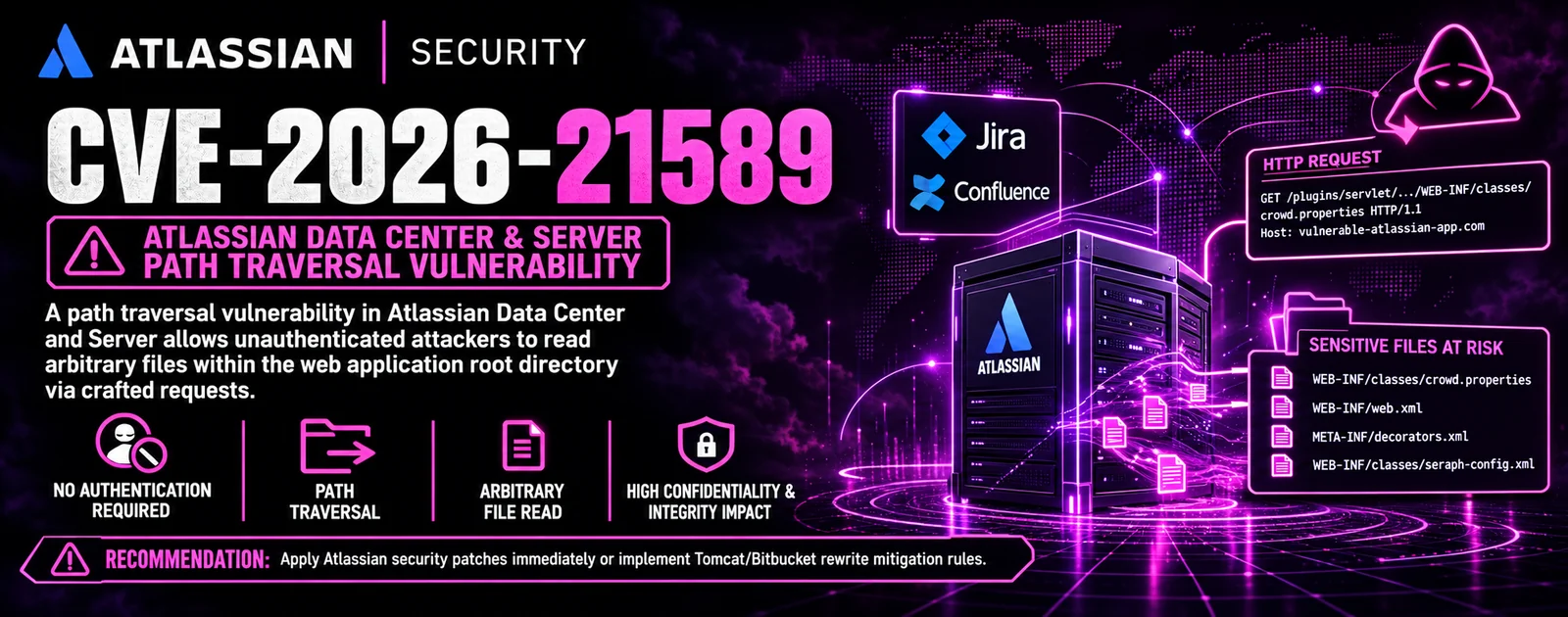
Exploit and safe-check toolkit for CVE-2026-21589, an unauthenticated path traversal in Atlassian Data Center: WEB-INF file read, credential harvesting, and non-intrusive version auditing.




ETHICAL USE ONLY - AUTHORIZED SECURITY TESTING This repository provides tools for authorized security professionals, blue teams, and penetration testers only. Unauthorized access to computer systems is illegal under CFAA (US), Computer Misuse Act (UK), TCK 243/244 (Turkey), and similar laws worldwide.
CVE-2026-21589 is a critical unauthenticated path traversal and arbitrary file read vulnerability in Atlassian Data Center products (Bitbucket, Confluence, Jira Software, Jira Service Management, Bamboo, Crowd, Crucible, Fisheye). It allows an unauthenticated attacker to read arbitrary files inside the web application root (including WEB-INF/) via the /download/* webresource router. CVSS score: 9.3 (Critical). Disclosed by watchTowr Labs in September 2026. Patched by Atlassian in the September 2026 Data Center security advisory.
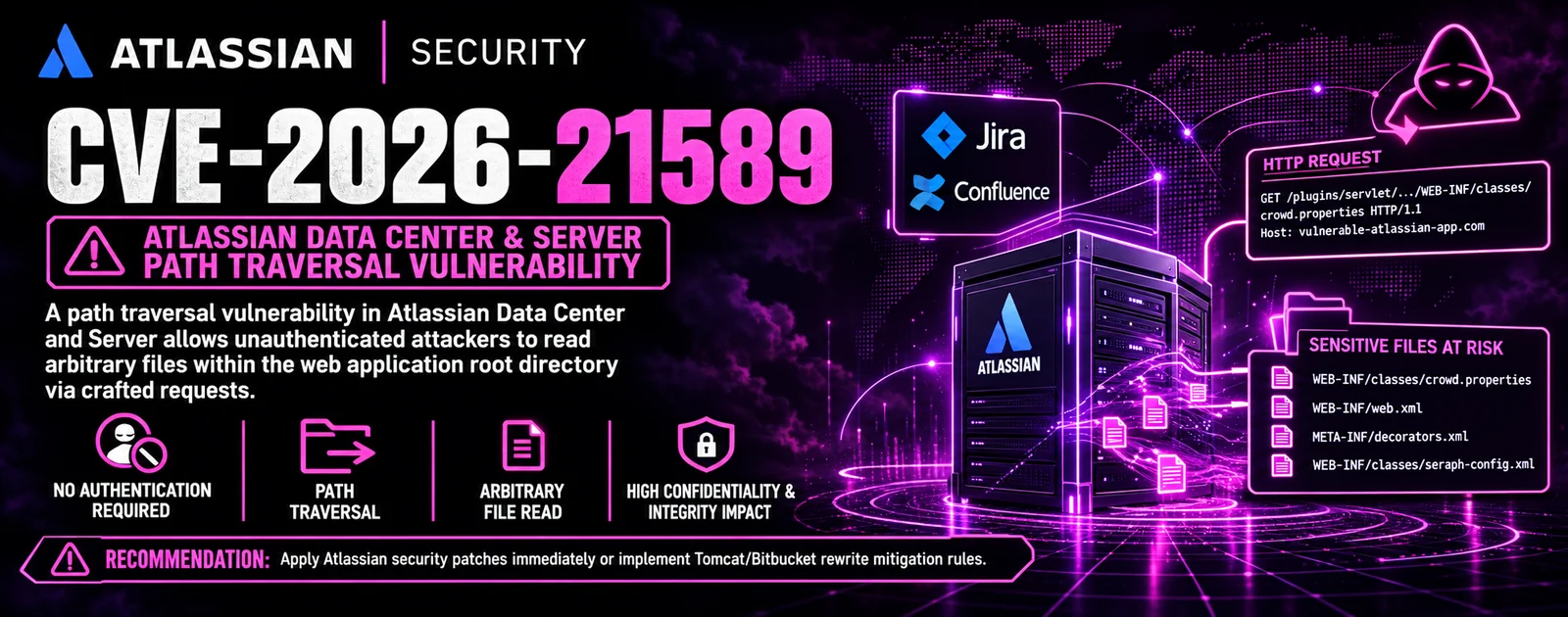
The flaw affects eight self-hosted Atlassian products across multiple version branches. The root cause is a double URL-decode and :: to / unescaping bug in the webresource router that bypasses Tomcat's URI normalizer.
Double URL-decode in router - The /download/* webresource router calls URLDecoder.decode(request.getRequestURI()) a second time. Tomcat only decodes the URI once, so ..%3a%3a sequences survive Tomcat's normalizer and are then resolved inside the application.
:: to / unescaping - After the second decode, Router.unescapeSlashes converts the :: sequence into /, completing the ../ traversal primitive inside the application layer.
Path concatenation into ServletContext - The constructed path is appended to a resource path and passed to ServletContext.getResourceAsStream. This function performs no containment check and resolves files relative to the web application root.
Unauthenticated access - The webresource router is not gated by Seraph authentication, so the read happens pre-auth. No credentials, no session, no CSRF token required.
WEB-INF disclosure - Because getResourceAsStream allows WEB-INF/ access, the attacker can read web.xml, urlrewrite.xml, seraph-config.xml, atlassian-init.xml, and any other file under the web application root whose exact path is known.
Arbitrary file read constraint - Directory listing is not possible. The attacker must know the exact filename and path. However, well-known file names (e.g. WEB-INF/web.xml) are predictable across installations.
Impact - Information disclosure of configuration files, potential credential leakage (JDBC URLs, passwords, API tokens, private keys), application fingerprinting for follow-up attacks, and lateral movement preparation. No direct RCE.
The patch - Atlassian fixed the double-decode and the :: unescaping in the webresource router. Fixed versions were shipped across all affected branches (see Affected Versions).
Active exploitation in the wild - Public PoCs appeared within days of disclosure. WatchTowr published a Detection Artifact Generator (DAG) that fingerprints vulnerable Jira, Confluence, and Bitbucket instances. Mass scanning activity has been observed targeting internet-exposed Atlassian Data Center deployments.
Affected surface - Internet-exposed self-hosted Atlassian Data Center and Server instances. Atlassian Cloud customers are not affected (auto-patched).
%3a%3a or :: in the path at the WAF / reverse-proxy layer.urlrewrite.xml rule (for Bitbucket) published by Atlassian.| Tool | Purpose | Intended User |
|---|---|---|
exploit.py | Full red team toolkit with unauthenticated file read across 8 Atlassian products, credential harvesting from WEB-INF config files, interactive shell, mass scanning, stealth mode, proxy/Tor, WAF detection, and JSON/CSV reporting. | Red teams / authorized pentesters (ethical only) |
safechecker.py | Non-intrusive exposure scanner that detects Atlassian product and version via public REST endpoints, validates against the affected range, identifies WAF presence, and produces JSON/CSV/JSONL reports. Never sends a traversal payload. | Blue teams / security auditors |
| Feature | exploit.py | safechecker.py |
|---|---|---|
| Product detection | [+] | [+] |
| Version detection | [+] | [+] |
| Path traversal probe | [+] | [-] |
| Arbitrary file read (WEB-INF) | [+] | [-] |
| Credential extraction | [+] | [-] |
| Interactive shell | [+] | [-] |
| Account plant via shell | [+] | [-] |
| Session report export | [+] | [-] |
| WAF detection | [+] | [+] |
| WAF status classification | [+] | [+] |
| Mass scanning (multi-thread) | [+] | [+] |
| CIDR / file / single target | [+] | [+] |
| CIDR truncation warning | [+] | [+] |
| Proxy support (SOCKS5/HTTP) | [+] | [+] |
| Tor support | [+] | [+] |
| Rate limiter | [+] | [+] |
| Connection pool | [-] | [+] |
| Jitter (OPSEC) | [+] | [+] |
| User-Agent rotation | [+] | [+] |
| Retry with backoff | [+] | [+] |
| Non-intrusive (safe) mode | [-] | [+] |
| Show-safe summary option | [-] | [+] |
| Quiet / no-banner modes | [-] | [+] |
| IoC recommendations | [-] | [+] |
| JSON report | [+] | [+] |
| CSV report | [+] | [+] |
| JSONL streaming report | [-] | [+] |
| HTML report | [-] | [-] |
| SSL verification control | [+] | [+] |
| Custom timeout / retries | [+] | [+] |
| Log rotation | [+] | [+] |
| DNS caching | [+] | [+] |
| Scenario | Recommended Tool |
|---|---|
| Blue Team - verifying if your Atlassian DC is exposed | safechecker.py |
| Security Audit - non-intrusive exposure assessment | safechecker.py |
| Compliance / Reporting - version and WAF inventory | safechecker.py |
| Red Team - authorized penetration testing with file read | exploit.py |
| Bug Bounty - responsible disclosure testing | safechecker.py |
| Mass Scanning - checking many instances for exposure | safechecker.py (read-only) or exploit.py (with --files minimal) |
| Incident Response - checking if systems are compromised | safechecker.py |
| Post-Exploitation - interactive file review and credential harvest | exploit.py --shell |