
Skip to content
KitploitKITPLOIT
ToolsExploitsBlog
Log in
Submit
ToolsExploitsBlog
Submit

Hacking, PenTest, and Cybersecurity Tools for Your Security Arsenal!

Kitploit is a directory of hacking, cybersecurity, and pentesting tools. Discover the latest project updates to find vulnerabilities, analyze systems, automate testing, and strengthen your security.

FeedsContactPrivacy© 2026 Kitploit

Tool Directory

Categories

View all categories
Loading categories
GalaxyCrash — Ephemeral root for Samsung Galaxy devices via CVE-2026-43284 — stability fork of DirtyFrag. Reboot to undo. | Kitploit
Tools/GitHubGitHub/remipelloux/galaxycrash
Android SecurityPrivilege EscalationPersistence MechanismsExploitationShellcodePenetration TestingMobile SecurityPayload DevelopmentBinary Exploitation
GitHubremipelloux/galaxycrash

GalaxyCrash

Ephemeral root for Samsung Galaxy devices via CVE-2026-43284 — stability fork of DirtyFrag. Reboot to undo.

5129 days agoNot yet reviewed
Share
View Repository

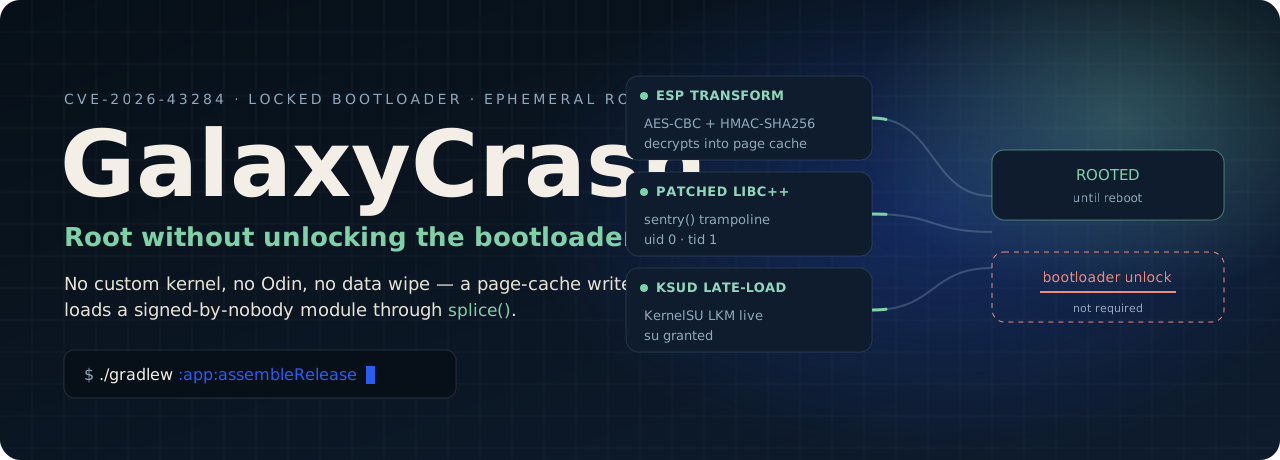
GalaxyCrash — an ESP transform writes the page cache, a patched libc++ runs shellcode as uid 0, a kernel module loads and ksud starts. Root on a locked bootloader, until reboot.

GalaxyCrash

Root on a locked bootloader. No custom kernel, no Odin, no data wipe — and gone on reboot.

Latest release Android 12 to 17 arm64-v8a Ephemeral root License: MIT for this fork's changes; inherited code unlicensed

Quick start  ·  What this fork changes  ·  How it works  ·  Build  ·  Troubleshooting  ·  Credits


GalaxyCrash exploits CVE-2026-43284, a page-cache write in the Android kernel's IPsec ESP path, to load a kernel module and start an SU daemon on a device whose bootloader is still locked and whose kernel is still stock. Nothing is flashed. Nothing survives a reboot.
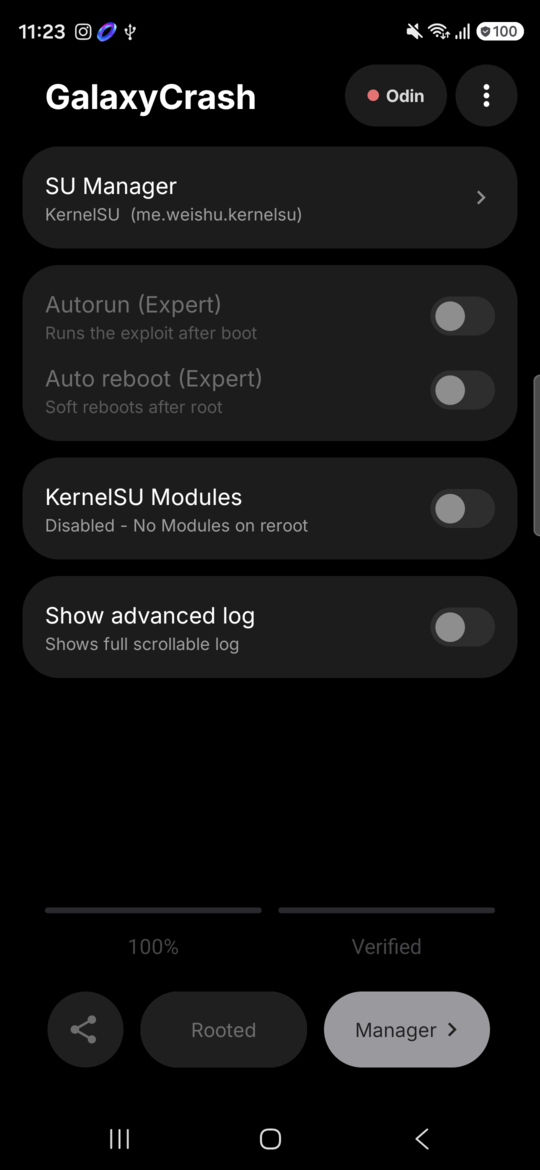
GalaxyCrash running on a Samsung Galaxy S26 Ultra: the SU Manager card shows KernelSU, KernelSU Modules is set to Disabled, and the status pill reads Rooted.

Actual app on a Galaxy S26 Ultra (SM-S948B), Android 17, September 2026 patch.
KernelSU in LKM mode, all eight markers through dfm6, SELinux back to Enforcing after the run.

[!IMPORTANT] Root is ephemeral by design. The kernel module, su, and every module you load are gone the moment the device reboots. A reboot is also the recovery path: it always returns the phone to a clean, unrooted state. This is not a persistence tool.

✦ What this fork changes

This fork of mitschud/DirtyFrag (renamed GalaxyCrash) is a stability pass, built and verified on real hardware rather than read from source. Two defects were found, fixed, and each proven with a failing test first.

Fixed: modules toggle aborted the run

Setting KernelSU Modules → Disabled on a fresh KernelSU install — where /data/adb/modules does not exist yet — made bootstrap.c return -1 from opendir(). The run aborted after the kernel hook was in place but before ksud started, leaving:

  • no working root, and
  • SELinux left Permissive.

That is the worst possible partial state, and it is the same failure as upstream issue #42. A missing modules directory now means "nothing to disable" — success, which is what the user asked for. Real errors (EACCES) still fail loudly.

Fixed: a failed run displayed as Rooted

Every "is this rooted" check trusted the existence of /dev/df, which is created early in the run. Any later failure therefore left a marker that read as success on the next launch — the app showed Rooted / 100% / Verified while KernelSU correctly said not installed. BootReceiver's "already hooked" guard was fooled the same way, silently suppressing autorun.

Root now requires /dev/df and /dev/dfm6, the marker bootstrap touches only once ksud has started. A failed run also sets the failed-run interlock immediately.

The full diff, and why /proc/modules was rejected as the check
FileChange
app/src/main/jni/bootstrap.cdisable_modules(): return errno == ENOENT ? 0 : -1;
app/src/main/java/df/root/RootState.javanew — one definition of "rooted", used by both callers
app/src/main/java/df/root/MainActivity.java5 root checks routed through RootState, failedRun set on failure
app/src/main/java/df/root/BootReceiver.javaroot check routed through RootState

The first attempt at the root check read /proc/modules for the kernelsu entry. It worked from adb shell and always failed from inside the app, because SELinux hides /proc/modules from untrusted_app. A check that silently always fails is worse than no check, so it was replaced with the /dev/df + /dev/dfm6 pair — both created mode 0666, both stat-able from the app's own domain.

Both fixes were verified with a forced-failure negative test, not just a happy path.

✦ Quick start

Requirements

  • A 64-bit ARM device (arm64-v8a) on Android 12–17, bootloader locked or unlocked.
  • An SU manager that ships libksud.so:
    • Samsung: diabl0w's KernelSU — required.
    • Other: KernelSU.
  • adb if you want to drive it from a PC. Shizuku is not needed.

Steps

  1. Install the SU manager first, then the GalaxyCrash APK from Releases.
  2. Open GalaxyCrash, tap the SU Manager card and pick the manager you installed.
  3. Tap the Run pill. It asks twice — that is the confirmation, not a bug.
  4. Watch the log. Success ends at bootstrap: starting SU daemon; the pill then reads Rooted and your manager shows the module as live.

To undo: reboot. To undo permanently, uninstall the app.
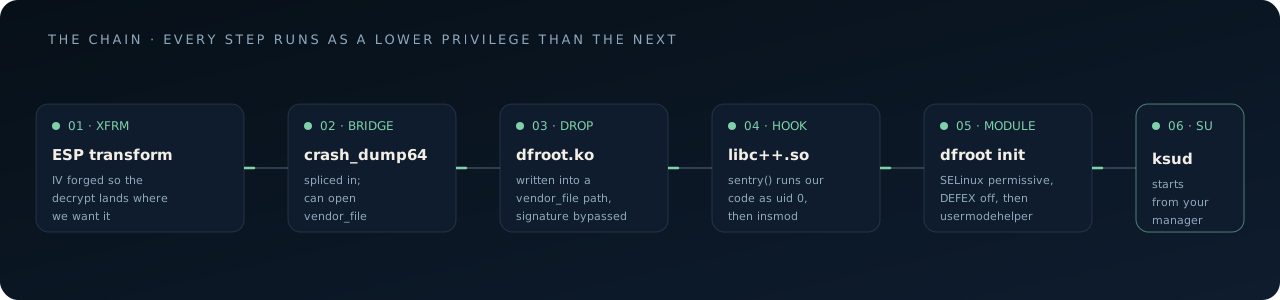
✦ The chain

Six steps: an ESP transform, the crash_dump64 bridge, dropping dfroot.ko into a vendor_file path, the libc++ sentry hook running as uid 0, the module's init, and ksud starting.

The vulnerability

The kernel decrypts AES-CBC ESP packets directly into the page cache of files opened for splice(). By crafting

IV = AES_ECB_DEC(key, current_content) XOR desired_content

any 16-byte-aligned block of any mapped shared library can be overwritten — without write permission, and without triggering copy-on-write. The file on disk is untouched; only the cached page changes, so it lasts until the page is evicted or the device reboots.


The steps

Download Tool

Most Popular

View all →

Discover the most used tools by our community.

  • 1

    OsintHunter

    letox4/osinthunter

    🎯 The ultimate OSINT toolkit: investigation graph, confidence scoring, alias families, map, timeline and reports. 49 modules, 400+ sites, no API keys required.

    565
  • 2

    ghostlock-app

    yukonga/ghostlock-app

    GhostLock One-Tap Execution App (CVE-2026-43499)

    478
  • 3

    ARTEX

    baarai/artex

    LLM multi-agent autonomous penetration testing platform with planner/worker agents, asset and exploration graphs, MITM traffic recording, and vulnerability retesting.

    383
  • 4

    redforge

    cybersecurity91/redforge

    Browser-side red team toolkit with 102 offline tools for recon, payload generation, credential attacks, crypto, encoding and engagement reporting.

    327
  • 5

    estorides

    grisuno/estorides

    Aggregates 99+ free OSINT sources in parallel, resolves entities into a knowledge graph, and exports STIX 2.1, MISP, or GraphML with LLM-assisted analysis.

    258
  • 6

    CyberStrikeAI

    ed1s0nz/cyberstrikeai

    The system of action for AI-native cybersecurity—where intent becomes governed execution, evidence becomes operational memory, and every operation improves the next.

    256

Explore all tools

Browse our collection of tools

View all tools →