
Skip to content
KitploitKITPLOIT
ToolsExploitsBlog
Log in
Submit
ToolsExploitsBlog
Submit

Hacking, PenTest, and Cybersecurity Tools for Your Security Arsenal!

Kitploit is a directory of hacking, cybersecurity, and pentesting tools. Discover the latest project updates to find vulnerabilities, analyze systems, automate testing, and strengthen your security.

FeedsContactPrivacy© 2026 Kitploit

Tool Directory

Categories

View all categories
Loading categories
Tools/GitHubGitHub/jankammerath/bogusmips
Android SecurityPacket Sniffing & AnalysisStatic AnalysisDynamic Analysis (Sandboxing)Web Proxies & InterceptionMobile App PentestingReverse EngineeringForensicsMobile SecurityBinary AnalysisAI-Assisted Reversing
4352 days agoNot yet reviewed

Most Popular

View all →

Discover the most used tools by our community.

Explore all tools

Browse our collection of tools

View all tools →
Share
GitHubjankammerath/bogusmips

BogusMips

Forensic analytics for disassembly, reassembly, reverse engineering and auditing of Android apps

View Repository

BogusMips

GitHub Sponsor

BogusMips is written in Rust and allows performing analyses on how far your Android app can be disassembled. It allows you to open the *.apk or *.xapk file of your app to see how far your app can be disassembled.


Download BogusMips for Windows x64
Download BogusMips for Windows ARM64
Download BogusMips for macOS
All releases and changelogs

Source Code and Resources extracted with BogusMips Disassembler

Features

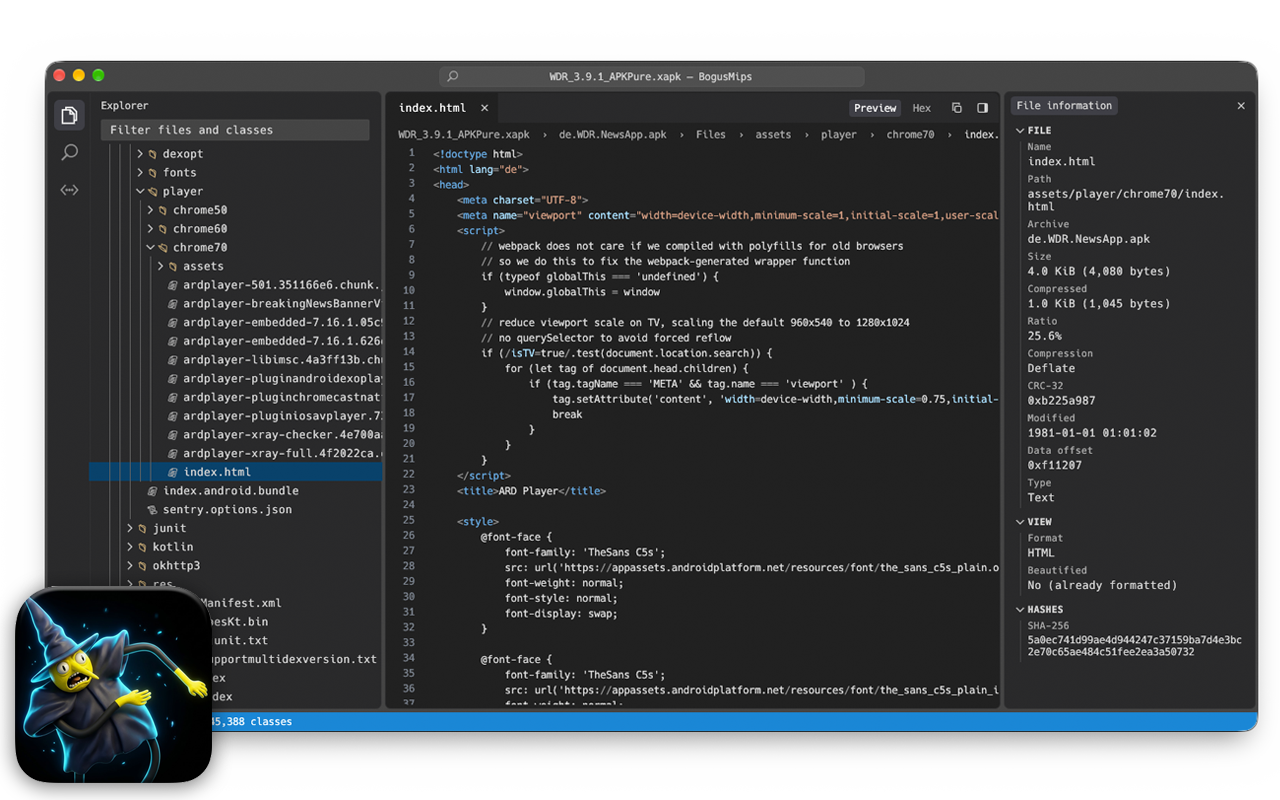
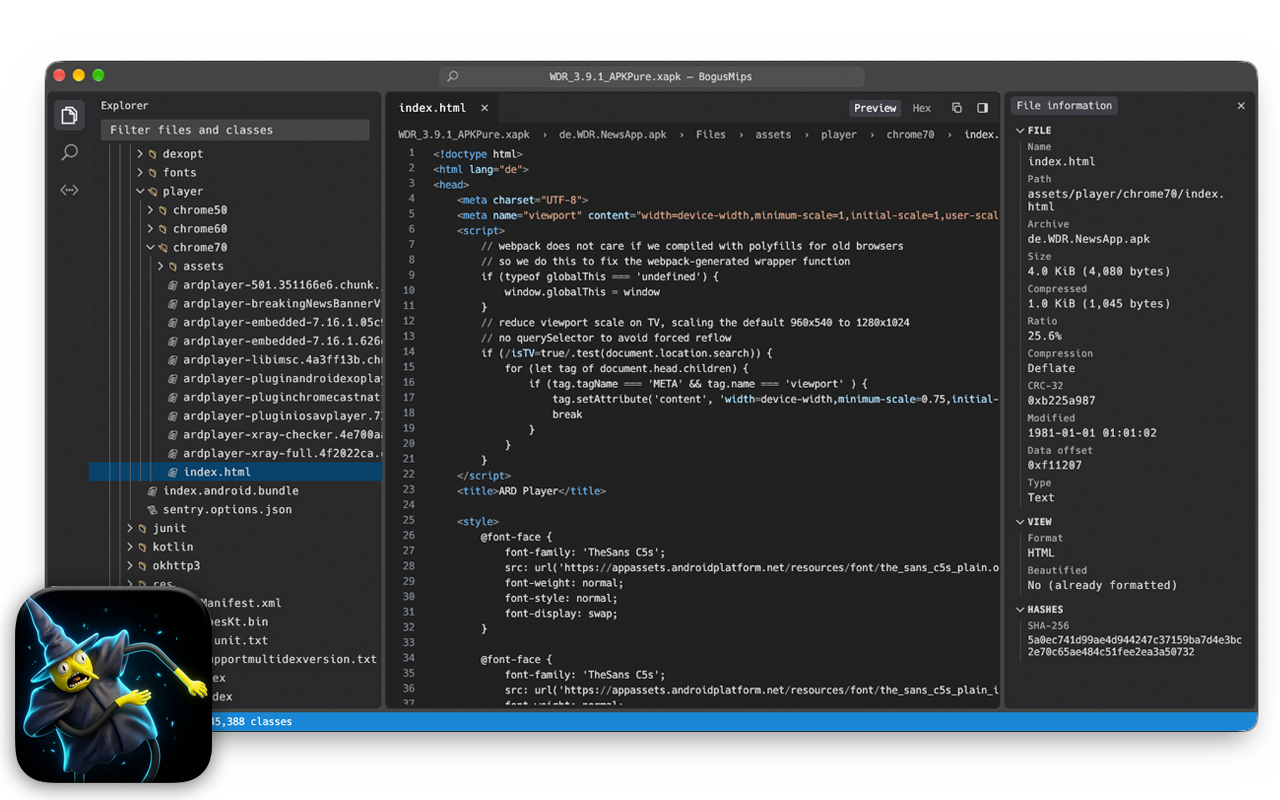
  • VS Code style interface (Dark+ colors): a sidebar card with Explorer and Search views, an editor with tab and breadcrumbs, a file information panel and a status bar. The File and View menus are in the macOS menu bar, and in the window's menu bar on Windows.
  • Open an *.apk or *.xapk with File → Open… (⌘O / Ctrl+O), by dropping it onto the window, or as a command-line argument.
  • Left: package tree
    • Source code: every class from all classes*.dex files, grouped by Java package and disassembled to smali.
    • Resources: resources.arsc decoded into the res/values*/*.xml files it was compiled from (strings, colors, dimens, styles, attrs, arrays, plurals, …) plus public.xml with every resource ID.
    • Files: every entry in the archive.
    • XAPK bundles show each contained APK (base and split APKs) separately.
    • Filter box (⌘F) and keyboard navigation with the arrow keys.
    • Right-click an item (or File → Export…, ⌘E) to export it: files as stored in the package, or as shown (decoded binary XML, beautified text); classes as .smali; generated resource files as XML; APKs contained in an XAPK as .apk.
  • Search (⇧⌘F): searches the contents of all classes (smali), text files, decoded XML and generated resource files, with match case / whole word / regular expression options. Clicking a result opens it in the editor at the highlighted match. The search index is built in the background on the first search.
  • Center: content of the selected item
    • Classes are shown as smali (baksmali-compatible output).
    • Binary XML (AndroidManifest.xml, res/**/*.xml) is decoded. Resource references are resolved to names (@string/app_name, @android:style/Theme), and attribute values to their symbolic names (protectionLevel="signature").
    • Images are previewed, text is shown as text, and everything else as a hex dump.
    • Minified JSON, JavaScript (incl. React Native bundles), CSS, HTML and XML are beautified automatically, with syntax highlighting. Only whitespace is changed; Original shows the file as stored.
    • A hex view is available for any file.
  • Right: AI Agent (⇧⌘A) and collapsible file information (⌘I):
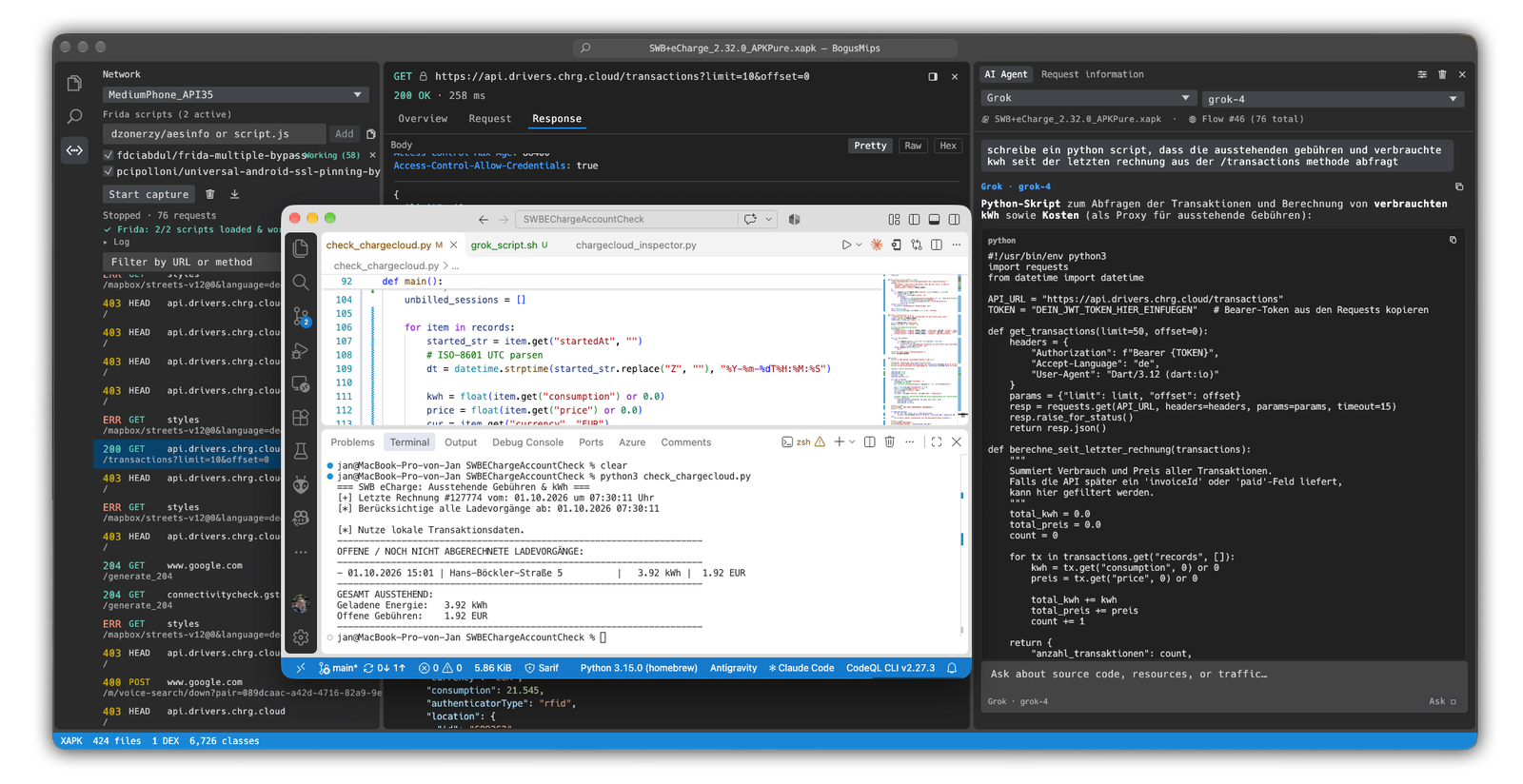
    • AI Agent: prompt an AI agent about the disassembled smali source code, decoded resource files (AndroidManifest.xml, resources.arsc values), and captured HTTP/HTTPS network traffic. Configurable with Grok (xAI), Gemini (Google), Claude (Anthropic), OpenAI (ChatGPT), or any custom OpenAI-compatible endpoint (e.g. Ollama, OpenRouter). The agent has built-in tools (search_package, list_nodes, read_node, list_network_flows, inspect_network_flow) to autonomously search and read classes, resources, and captured network flows.
    • File / Request information: size, compression, CRC, SHA-256, DEX header details, class details, manifest summary, permissions, and any anomalies found.

Grok writing Python script based on network capture

Network

The Network view (⇧⌘N) is a stripped-down, Postman-like traffic sniffer. It starts an Android emulator (AVD), routes the guest's traffic through a built-in man-in-the-middle proxy, installs the open APK/XAPK, launches it, and captures its HTTP and HTTPS requests live. Captured requests appear in a list on the left; selecting one shows its full request/response (headers and body, pretty / raw / hex) in the editor, with timing and connection details in the information panel.
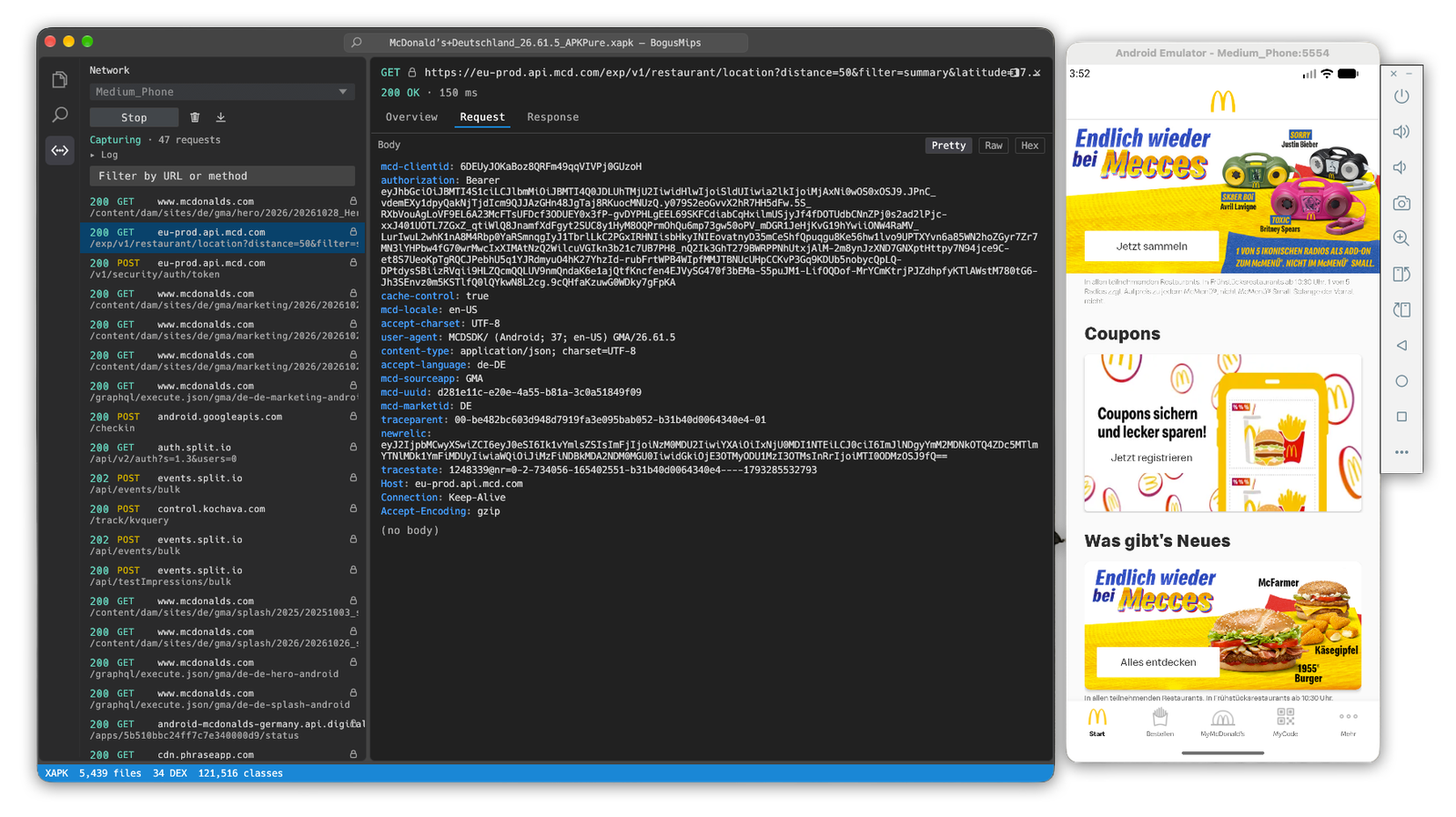
App network traffic analysis

Full HTTPS decryption requires a rootable emulator image (google_apis / aosp_atd, not google_apis_playstore), because the proxy's CA must be installed as a system trust anchor. On start, BogusMips enables adb root and installs its generated CA (a short-lived, per-session CA, as PEM) into the system and Conscrypt (APEX) trust stores. On Android 14+ (API 34+) those stores live in per-process mount namespaces, so the CA is placed in an overlay directory — relabelled with the system_security_cacerts_file SELinux context (both the files and the directory, or apps are denied access) — and bind-mounted over the stores in every process's mount namespace via nsenter. The target app is installed and launched after this, so it forks fresh and its system-trust-store HTTPS is decrypted. Per-host leaf certificates are short-lived and sent without the CA in the chain, to satisfy clients that enforce the 398-day maximum certificate validity.

Caveats — what cannot be decrypted:

  • Chrome and WebView / Chromium-based apps. Modern Chromium (the Chrome browser, Android System WebView, and the Cronet networking library) validates server certificates with the Chrome Root Store, which ignores user- or admin-installed system CAs. Such apps show ERR_CERT_AUTHORITY_INVALID; their traffic reaches the proxy but the TLS handshake is rejected. Many hybrid apps (Cordova/Capacitor/Ionic) render in a WebView and fall into this category.
  • Apps with certificate pinning, which only accept a specific known certificate.
  • Google's own services (Play Services / GMS traffic to *.google.com), which additionally require Certificate Transparency.

What is decrypted: apps using the Android system trust store — HttpURLConnection, OkHttp/Retrofit, Conscrypt and most native networking. (Already-running cached system processes are not re-forked, so they may keep showing trust-anchor errors until restarted; this does not affect the launched target app.)

Download Tool