Skip to content
KitploitKITPLOIT
ToolsExploitsBlog
Log in
Submit
ToolsExploitsBlog
Submit

Hacking, PenTest, and Cybersecurity Tools for Your Security Arsenal!

Kitploit is a directory of hacking, cybersecurity, and pentesting tools. Discover the latest project updates to find vulnerabilities, analyze systems, automate testing, and strengthen your security.

FeedsContactPrivacy© 2026 Kitploit

Tool Directory

Categories

View all categories
Loading categories
Tools/GitHubGitHub/dwisiswant0/ppfuzz
Vulnerability ScannersWeb SecurityFuzzing
GitHubdwisiswant0/ppfuzz

ppfuzz

A fast tool to scan client-side prototype pollution vulnerability written in Rust. 🦀

View Repository
67172383 years agoReviewed by Kitploit
Share

ppfuzz

Prototype Pollution Fuzzer

ppfuzz, Prototype Pollution Fuzzer

A fast tool to scan client-side prototype pollution vulnerability written in Rust. 🦀

  • Installation
    • Binary
    • Source
    • Dependencies
  • Demonstration
  • Usage
    • Basic
    • Options
  • Usage
  • Supporting Materials
  • Contributing
  • Attribution
  • Acknowledments
  • License

Installation

Binary

Simply, download a pre-built binary from releases page and run!

Source

NOTE: Rust should be installed!

Using cargo:

▶ cargo install ppfuzz

— or

Manual building executable from source code:

▶ git clone https://github.com/dwisiswant0/ppfuzz
▶ cd ppfuzz && cargo build --release
# binary file located at target/release/ppfuzz

Dependencies

ppfuzz uses chromiumoxide, which requires Chrome or Chromium browser to be installed. If the CHROME environment variable is set, then it'll use it as the default executable. Otherwise, the filenames google-chrome-stable, chromium, chromium-browser, chrome and chrome-browser are searched for in standard places. If that fails, /Applications/Google Chrome.app/... (on MacOS) or the registry (on Windows) is consulted.

Demonstration

ppfuzz-demonstration

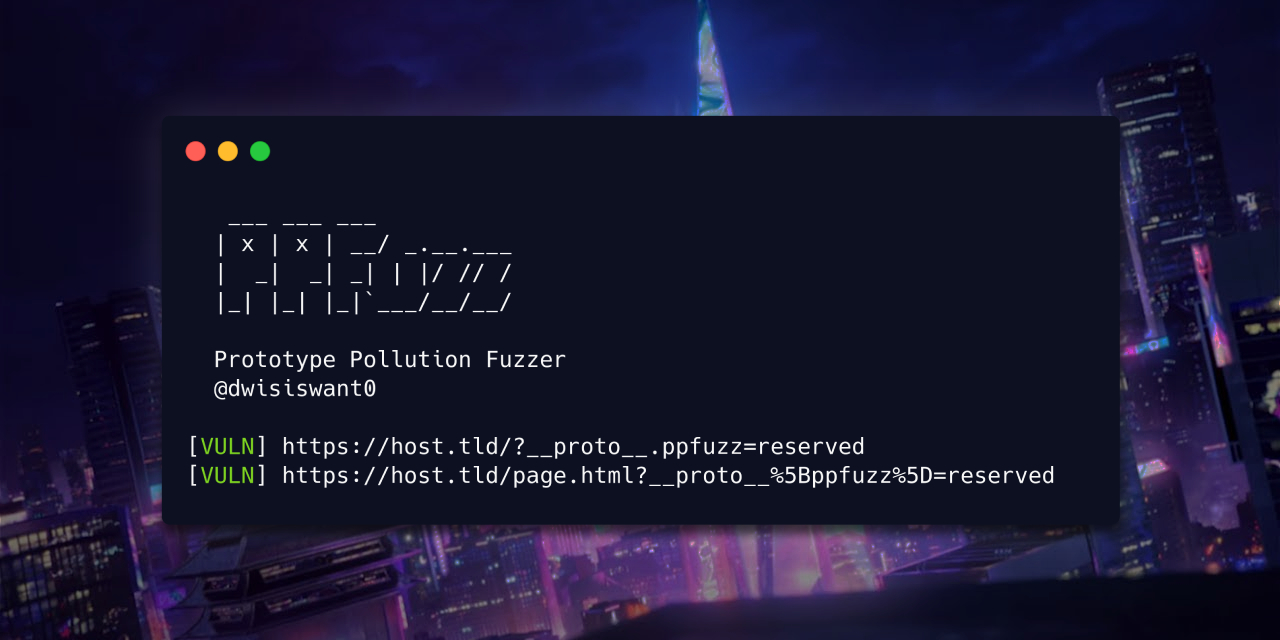
As you can see in the demo above (click to view in high-quality), ppfuzz attempts to check for prototype-pollution vulnerabilities by adding an object & pointer queries, if it's indeed vulnerable: it'll fingerprinting the script gadgets used and then display additional payload info that could potentially escalate its impact to XSS, bypass or cookie injection.

Usage

It's fairly simple to use ppfuzz!

▶ ppfuzz -l FILE [OPTIONS]

Basic

Use -l/--list to provide input list:

▶ ppfuzz -l FILE

You can also provide the list using I/O redirection:

▶ ppfuzz < FILE

— or chain it from another command output:

▶ cat FILE | ppfuzz

Only show vulnerable targets/suppress an errors:

▶ ppfuzz -l FILE 2>/dev/null

Options

Here are all the options it supports:

▶ ppfuzz -h
FlagDescriptionDefault value
-l, --listList of target URLs
-c, --concurrencySet the concurrency level5
-t, --timeoutMax. time allowed for connection (s)30
-h, --helpPrints help information
-V, --versionPrints version information

Supporting Materials

  • Nuclei templates
  • PPScan
  • Prototype Pollution and useful Script Gadgets
  • JavaScript prototype pollution attack in NodeJS
  • Prototype pollution – and bypassing client-side HTML sanitizers

Contributing

contributions

When I started ppfuzz, I had very little or no knowledge on Rust and I believe there may be a lot of drawbacks/security vulnerabilities. So all contributions are welcome, of course — any bug reports & suggestions are appreciated, some environment have not been tested yet.

Attribution

Besides being my learning medium, this tool was created because it was inspired by @R0X4R's tip on how to automate prototype pollution checking using page-fetch.

Cross-compile GitHub workflow inspired by crodjer's sysit.

Acknowledments

Since this tool includes some contributions, I'll publically thank the following users for their helps and resources:

  • @mattsse - for his awesome chromiumoxide & mentoring me which helped a lot to quickly adapt Rust!
  • Fourty2#4842 (Discord) - for helpful workaround.
  • All contributors.

License

ppfuzz is distributed under MIT. See LICENSE.

Download Tool

Most Popular

View all →

Discover the most used tools by our community.

  • 1

    OsintHunter

    letox4/osinthunter

    🎯 The ultimate OSINT toolkit: investigation graph, confidence scoring, alias families, map, timeline and reports. 49 modules, 400+ sites, no API keys required.

    668
  • 2

    ghostlock-app

    yukonga/ghostlock-app

    GhostLock One-Tap Execution App (CVE-2026-43499)

    496
  • 3

    ARTEX

    baarai/artex

    LLM multi-agent autonomous penetration testing platform with planner/worker agents, asset and exploration graphs, MITM traffic recording, and vulnerability retesting.

    394
  • 4

    redforge

    cybersecurity91/redforge

    Browser-side red team toolkit with 102 offline tools for recon, payload generation, credential attacks, crypto, encoding and engagement reporting.

    339
  • 5

    CyberStrikeAI

    ed1s0nz/cyberstrikeai

    The system of action for AI-native cybersecurity—where intent becomes governed execution, evidence becomes operational memory, and every operation improves the next.

    258
  • 6

    antifox

    antifox-ai/antifox

    AI multi-agent autonomous penetration testing platform that runs recon, attack-surface discovery, exploitation validation and evidence-backed report delivery.

    254

Explore all tools

Browse our collection of tools

View all tools →