
Skip to content
KitploitKITPLOIT
ToolsExploitsBlog
Log in
Submit
ToolsExploitsBlog
Submit

Hacking, PenTest, and Cybersecurity Tools for Your Security Arsenal!

Kitploit is a directory of hacking, cybersecurity, and pentesting tools. Discover the latest project updates to find vulnerabilities, analyze systems, automate testing, and strengthen your security.

FeedsContactPrivacy© 2026 Kitploit

Tool Directory

Categories

View all categories
Loading categories
totp-ssh-fluxer — Take security by obscurity to the next level (this is a bad idea, don't really use this please) | Kitploit
Tools/GitHubGitHub/benjojo/totp-ssh-fluxer
Network SecurityUtilities & FrameworksAuthenticationRed Teaming
GitHubbenjojo/totp-ssh-fluxer

totp-ssh-fluxer

Take security by obscurity to the next level (this is a bad idea, don't really use this please)

View Repository
948443410 years agoReviewed by Kitploit
Share

TOTP SSH port fluxing

Some people change their SSH port on their servers so that it is slightly harder to find for bots or other nasties, and while that is generally viewed as an action of security through obscurity it does work very well at killing a lot of the automated logins you always see in /var/log/auth.log

However what if we could go take this to a ridiculous level? What if we could use TOTP codes that are normally used as 2nd factor codes to login to websites to actually know what port the sshd server is listening on?

For this, I present totp-ssh-flux, a way to make sure your sshd port changes every 30 seconds, and possibly causing your adversaries a small period of frustration.

Demo:
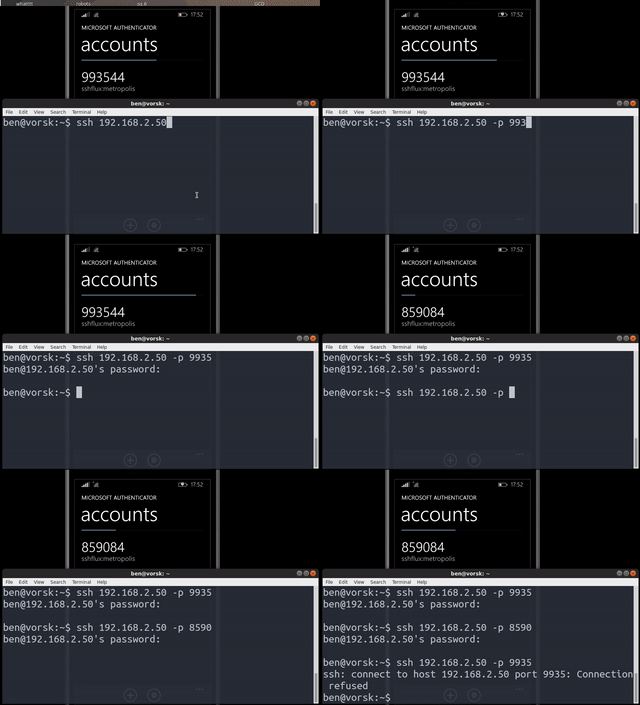
gif

What you can see here is my phone (using a generic TOTP client) generating codes, that I can then use as the port to SSH into on a server.

The software behind it is fairly simple, It runs in a loop that does the following

  • Generates a TOTP token
  • Takes the last digit, if the result is above 65536, do that again
  • Adds a iptables PREROUTING rule to redirect that number generated above
  • Waits 30 seconds, removes that rule, repeat.

The neat thing is, because this is done in PREROUTING, even if the code expires, established connections stay connected.

Installation

You will most likely find more up to date instructions on the totp-ssh-flux project readme

Beware, currently I would not really recommend running this software, it was only written as a joke.

At the time of writing the project is just a single file, You will need to install golang and then go get and go build

Run the program as root ( it needs to, sorry, it's editing iptables )

Upon first run, the program will generate a token for the host in /etc/ssh-flux-key ( you can use the -keypath option to change that ) and you can input that into your phone or other clients.

You can confirm it works by running watch iptables -vL -t nat and waiting for the iptables rules to be inserted and removed.


Want to see more insanity like this? Follow me on twitter @benjojo12

Download Tool

Most Popular

View all →

Discover the most used tools by our community.

  • 1

    OsintHunter

    letox4/osinthunter

    🎯 The ultimate OSINT toolkit: investigation graph, confidence scoring, alias families, map, timeline and reports. 49 modules, 400+ sites, no API keys required.

    540
  • 2

    ghostlock-app

    yukonga/ghostlock-app

    GhostLock One-Tap Execution App (CVE-2026-43499)

    476
  • 3

    ARTEX

    baarai/artex

    LLM multi-agent autonomous penetration testing platform with planner/worker agents, asset and exploration graphs, MITM traffic recording, and vulnerability retesting.

    373
  • 4

    redforge

    cybersecurity91/redforge

    Browser-side red team toolkit with 102 offline tools for recon, payload generation, credential attacks, crypto, encoding and engagement reporting.

    322
  • 5

    estorides

    grisuno/estorides

    Aggregates 99+ free OSINT sources in parallel, resolves entities into a knowledge graph, and exports STIX 2.1, MISP, or GraphML with LLM-assisted analysis.

    278
  • 6

    CyberStrikeAI

    ed1s0nz/cyberstrikeai

    The system of action for AI-native cybersecurity—where intent becomes governed execution, evidence becomes operational memory, and every operation improves the next.

    251

Explore all tools

Browse our collection of tools

View all tools →





