
Skip to content
KitploitKITPLOIT
ToolsExploitsBlog
Log in
Submit
ToolsExploitsBlog
Submit

Hacking, PenTest, and Cybersecurity Tools for Your Security Arsenal!

Kitploit is a directory of hacking, cybersecurity, and pentesting tools. Discover the latest project updates to find vulnerabilities, analyze systems, automate testing, and strengthen your security.

FeedsContactPrivacy© 2026 Kitploit

Tool Directory

Categories

View all categories
Loading categories
CVE-2026-33825 — Documentation and research on CVE-2026-33825 (BlueHammer), a Microsoft Defender TOCTOU local privilege escalation on Windows, covering exploit flow, indicators and mitigations. | Kitploit
Tools/GitHubGitHub/ashrafzaryouh/cve-2026-33825
Defensive ToolsPrivilege EscalationVulnerability AnalysisExploitationPapers & ResearchLearning & Education
GitHubashrafzaryouh/cve-2026-33825

CVE-2026-33825

Documentation and research on CVE-2026-33825 (BlueHammer), a Microsoft Defender TOCTOU local privilege escalation on Windows, covering exploit flow, indicators and mitigations.

Share
View Repository
956 months agoNot yet reviewed

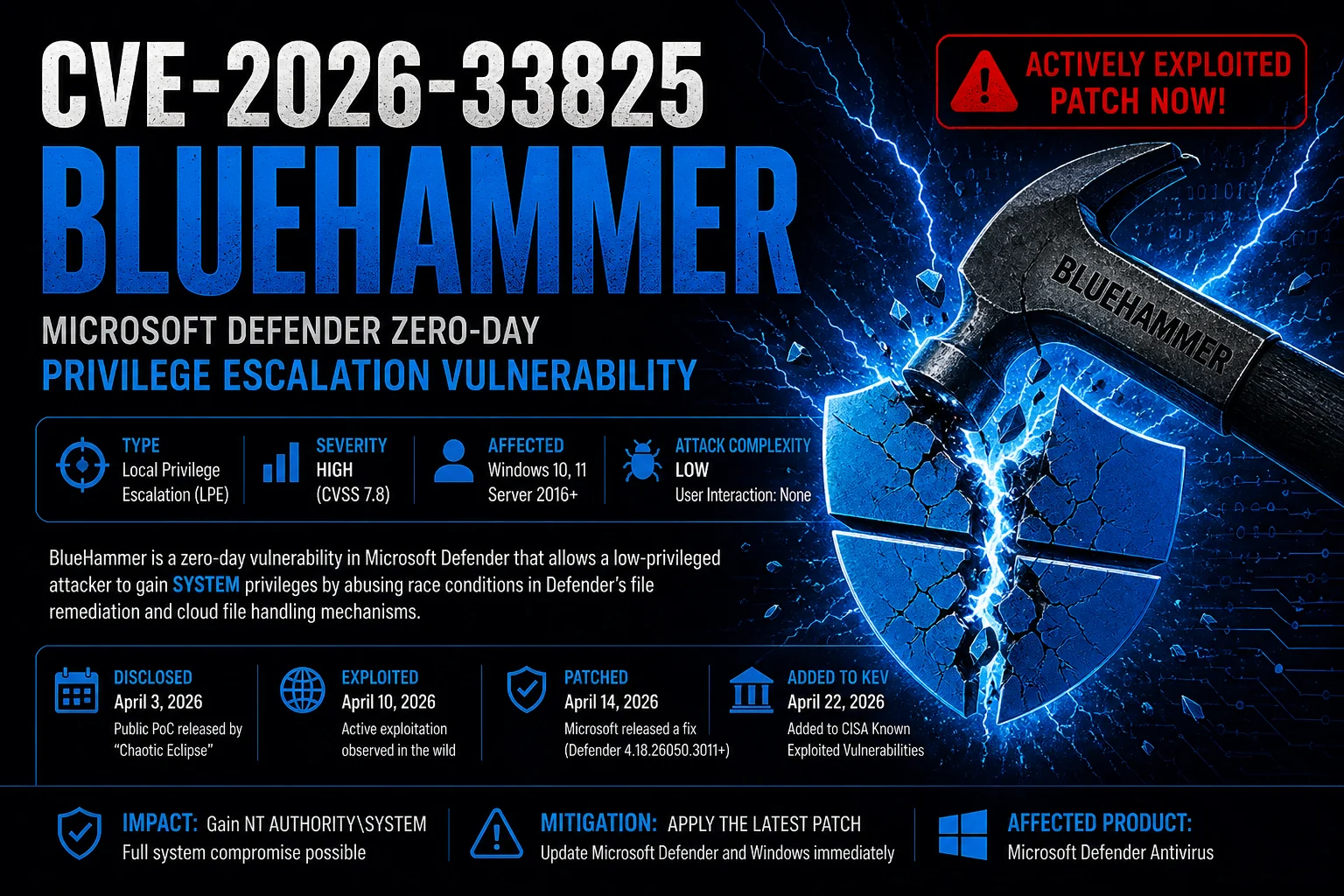
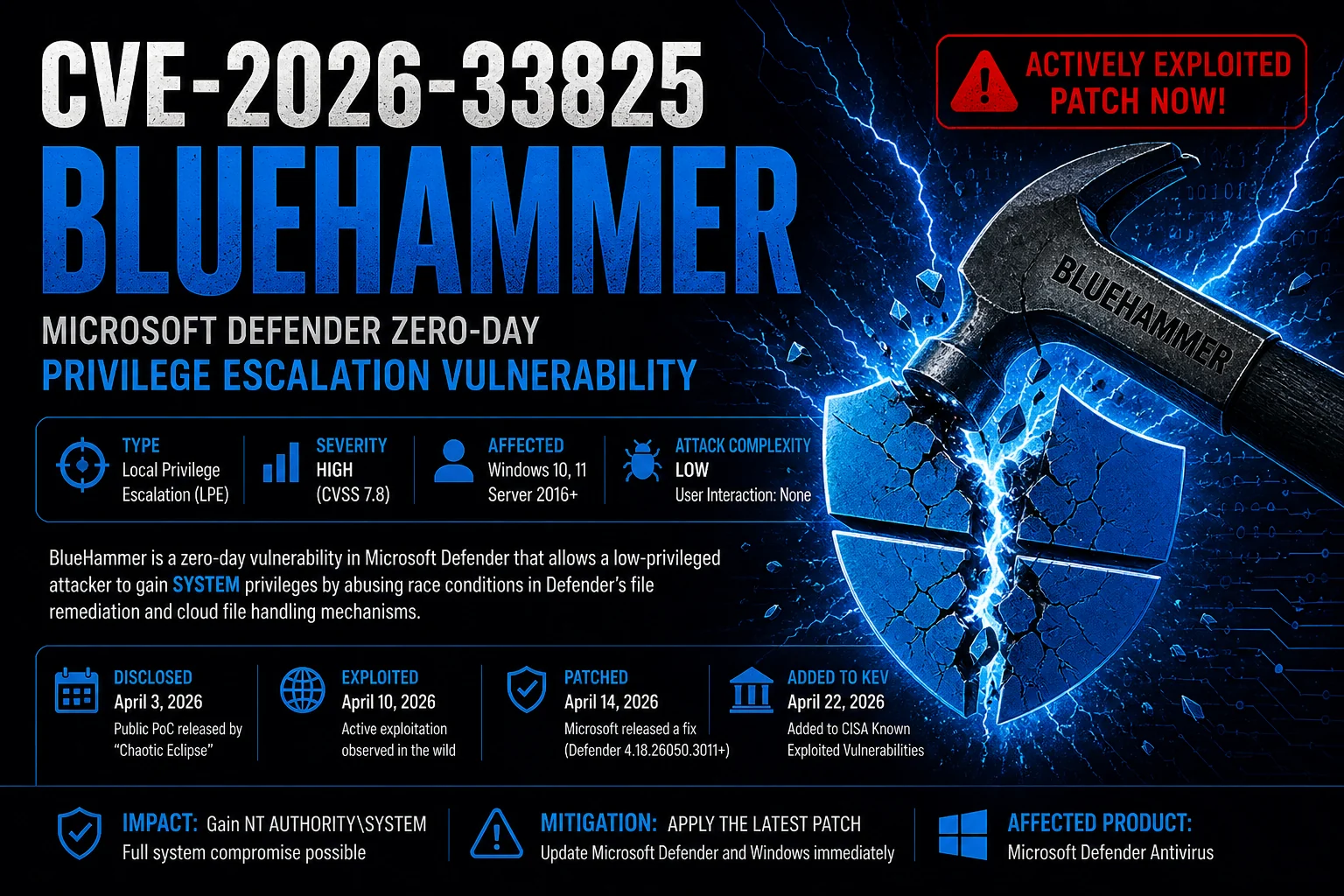
🔵 CVE-2026-33825 — “BlueHammer” 🔵

ChatGPT Image May 18, 2026, 01_04_48 PM

Microsoft Defender Local Privilege Escalation (LPE)


BlueHammer is a high-severity Local Privilege Escalation vulnerability affecting Microsoft Defender components on Windows systems.
The flaw allows a low-privileged attacker to escalate privileges to NT AUTHORITY\SYSTEM by abusing filesystem race conditions and privileged Defender operations.


📌 Overview

FieldValue
CVECVE-2026-33825
NicknameBlueHammer
SeverityHigh
CVSS~7.8
TypeLocal Privilege Escalation
AffectedWindows 10 / 11 / Server
ComponentMicrosoft Defender
ExploitationPublic PoC Reported
Privilege RequiredLow
ImpactSYSTEM Privilege Escalation

🧠 What is BlueHammer?

BlueHammer is a TOCTOU (Time-of-Check to Time-of-Use) race condition vulnerability inside privileged Microsoft Defender operations.

The vulnerability reportedly abuses:

  • NTFS symbolic links
  • Reparse points
  • Opportunistic locks (Oplocks)
  • Defender remediation/update workflows
  • Privileged file handling

The exploit manipulates Defender into performing privileged filesystem operations on attacker-controlled targets.


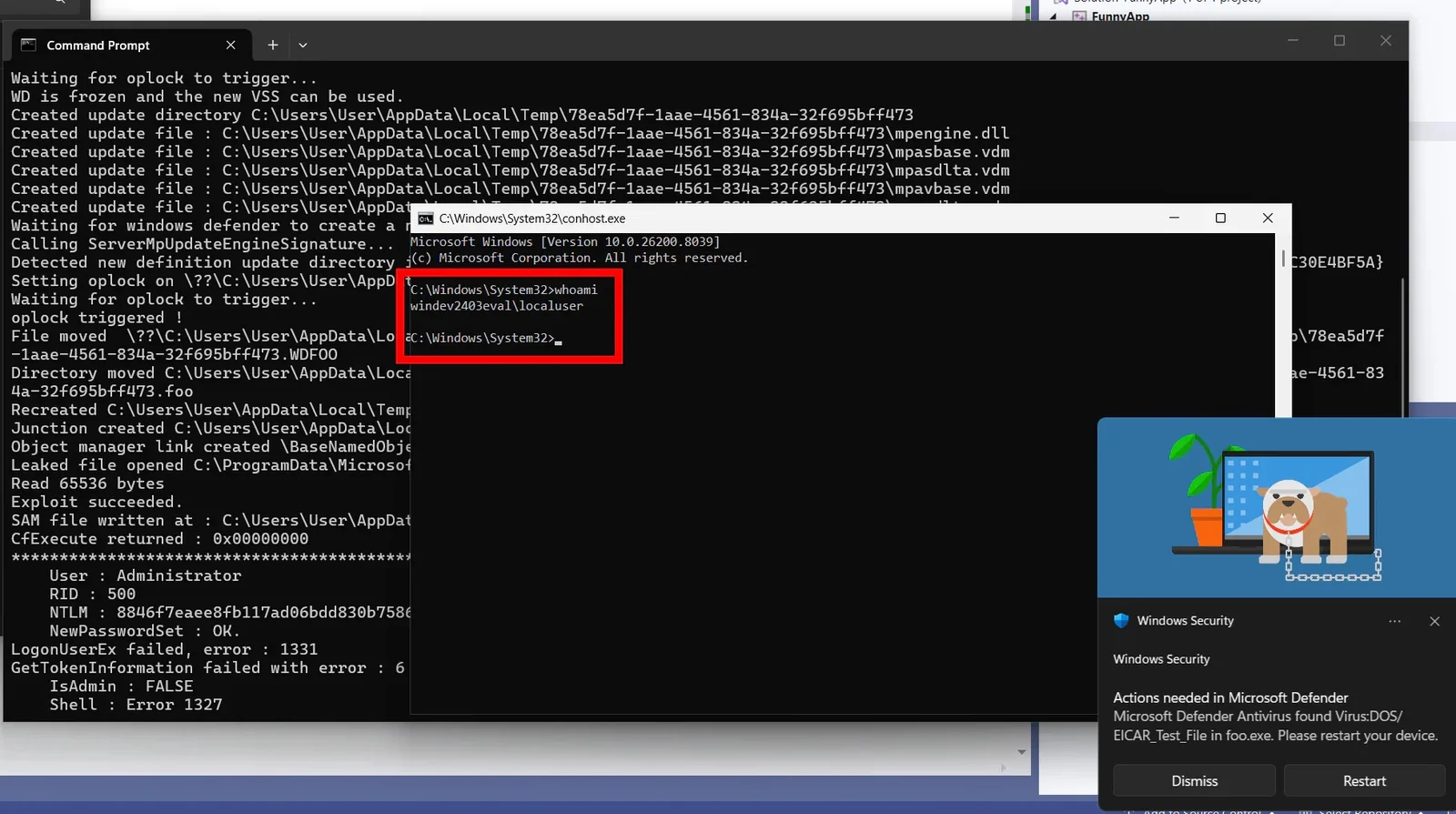
⚠️ Impact

Successful exploitation may allow attackers to:
exploit
  • Gain NT AUTHORITY\SYSTEM
  • Dump credentials
  • Access SAM/SYSTEM hives
  • Disable security products
  • Establish persistence
  • Deploy ransomware
  • Move laterally in enterprise environments

🏗️ High-Level Exploit Flow

Low Privileged User
        │
        ▼
Trigger Defender Operation
        │
        ▼
Exploit TOCTOU Race Condition
        │
        ▼
Redirect Privileged File Operation
        │
        ▼
Overwrite / Move Protected Files
        │
        ▼
Execute Code as SYSTEM

🔍 Technical Concepts

⏱️ TOCTOU Race Condition

BlueHammer abuses the gap between:

Time of Check
        ↓
Time of Use

Defender validates a file/path, but before the privileged operation completes, the attacker swaps the target.


🔗 NTFS Reparse Points & Symbolic Links

Attackers reportedly use:

  • junctions
  • symlinks
  • object manager links

to redirect privileged Defender operations.

Example conceptually:

Defender believes:
C:\Temp\safe.txt

Actually redirected to:
C:\Windows\System32\protected_file

🧊 Opportunistic Locks (Oplocks)

Oplocks help attackers freeze file operations temporarily:

Defender accesses file
        ↓
Attacker pauses operation
        ↓
Target gets swapped
        ↓
Defender resumes with SYSTEM privileges

This increases race-condition reliability.


🖥️ Affected Components

Reportedly impacted:

  • MsMpEng.exe
  • MpSigStub.exe
  • Defender remediation pipeline
  • Defender update workflows

🧨 Why It Matters

Security software:

  • runs with elevated privileges,
  • interacts with untrusted files,
  • performs automatic remediation.

That makes filesystem race vulnerabilities extremely dangerous.

BlueHammer demonstrated that:

defensive software itself can become the privilege escalation vector.


🛡️ Mitigation

Recommended Actions

✅ Update Microsoft Defender

Install the latest Defender platform updates.

✅ Apply Windows Security Updates

Ensure all Patch Tuesday updates are installed.

✅ Monitor Suspicious Activity

Look for:

  • unexpected SYSTEM shells,
  • Defender interacting with unusual paths,
  • abnormal VSS activity,
  • suspicious symlink creation.

✅ Restrict Local Execution

Limit execution for untrusted users and applications.


🧪 Indicators of Exploitation

Potential indicators may include:

Unexpected Defender file operations
SYSTEM-level cmd.exe / powershell.exe
Suspicious NTFS reparse points
Abnormal Defender remediation events
Oplock abuse patterns

🔬 Related Vulnerabilities

VulnerabilityDescription
PrintNightmareWindows Print Spooler RCE/LPE
HiveNightmareSAM exposure vulnerability
RedSunRelated Defender exploitation technique
unDefendDefender abuse technique family

📚 Key Concepts

ConceptDescription
LPELocal Privilege Escalation
TOCTOUTime-of-check vs time-of-use flaw
OplocksFilesystem operation synchronization
Reparse PointsFilesystem redirection feature
SYSTEMHighest local Windows privilege

⚖️ Disclaimer

This repository/documentation is provided for:

  • educational purposes,
  • defensive security research,
  • vulnerability awareness.

Do not use this information for unauthorized activities.

Download Tool

Most Popular

View all →

Discover the most used tools by our community.

  • 1

    OsintHunter

    letox4/osinthunter

    🎯 The ultimate OSINT toolkit: investigation graph, confidence scoring, alias families, map, timeline and reports. 49 modules, 400+ sites, no API keys required.

    772
  • 2

    ghostlock-app

    yukonga/ghostlock-app

    GhostLock One-Tap Execution App (CVE-2026-43499)

    505
  • 3

    ARTEX

    baarai/artex

    LLM multi-agent autonomous penetration testing platform with planner/worker agents, asset and exploration graphs, MITM traffic recording, and vulnerability retesting.

    420
  • 4

    redforge

    cybersecurity91/redforge

    Browser-side red team toolkit with 102 offline tools for recon, payload generation, credential attacks, crypto, encoding and engagement reporting.

    345
  • 5

    CyberStrikeAI

    ed1s0nz/cyberstrikeai

    The system of action for AI-native cybersecurity—where intent becomes governed execution, evidence becomes operational memory, and every operation improves the next.

    260
  • 6

    antifox

    antifox-ai/antifox

    AI multi-agent autonomous penetration testing platform that runs recon, attack-surface discovery, exploitation validation and evidence-backed report delivery.

    251

Explore all tools

Browse our collection of tools

View all tools →





