Skip to content
KitploitKITPLOIT
ToolsBlog
Submit
ToolsBlog
Submit

Hacking, PenTest, and Cybersecurity Tools for Your Security Arsenal!

Kitploit is a directory of hacking, cybersecurity, and pentesting tools. Discover the latest project updates to find vulnerabilities, analyze systems, automate testing, and strengthen your security.

··Feeds·Contact·Privacy·© 2026 Kitploit

Tool Directory

Categories

View all categories
Loading categories
ship-safe — CLI security scanner built for the agentic era. Detects CI/CD misconfigs, agent permission risks, MCP tool injection, hardcoded secrets, and DMCA-flagged AI dependencies. | Kitploit
Tools/GitHubGitHub/asamassekou10/ship-safe
Cloud Infrastructure SecurityStatic AnalysisContainer SecurityAPI Security TestingConfiguration AuditingDevSecOpsMobile SecuritySecret DetectionSupply Chain SecurityRed TeamingAI Security
785978 days agoReviewed by Kitploit

Most Popular

View all →

Discover the most used tools by our community.

Explore all tools

Browse our collection of tools

View all tools →
Share
GitHub
asamassekou10/ship-safe

ship-safe

CLI security scanner built for the agentic era. Detects CI/CD misconfigs, agent permission risks, MCP tool injection, hardcoded secrets, and DMCA-flagged AI dependencies.

View RepositoryWebsite

Ship Safe Logo

Find risky code, AI-agent vulnerabilities, and supply-chain issues before they ship.

Website · Docs · Security & Data Flow · Benchmark · Pricing · Blog · Contribute

npm version npm downloads CI License: MIT GitHub stars Sponsor

Ship Safe CLI

Ship Safe is an AI security scanner for modern software teams. It runs locally in your repo, finds issues across application code, AI agents, MCP configs, prompts, dependencies, CI/CD, secrets, and cloud-adjacent configuration, then helps you review and apply safe fixes.

Start a scan with one command:

root@kitploit:~
npx ship-safe

No signup. No API key required for scanning. Works offline for core checks. AI-backed red-team modes use your configured provider when available.

Use --no-ai to guarantee a fully local scan. Provider-backed classification, deep analysis, and GPT-Red send bounded context directly to your selected provider after best-effort credential masking. See Security & Data Flow for exact boundaries and context limits.
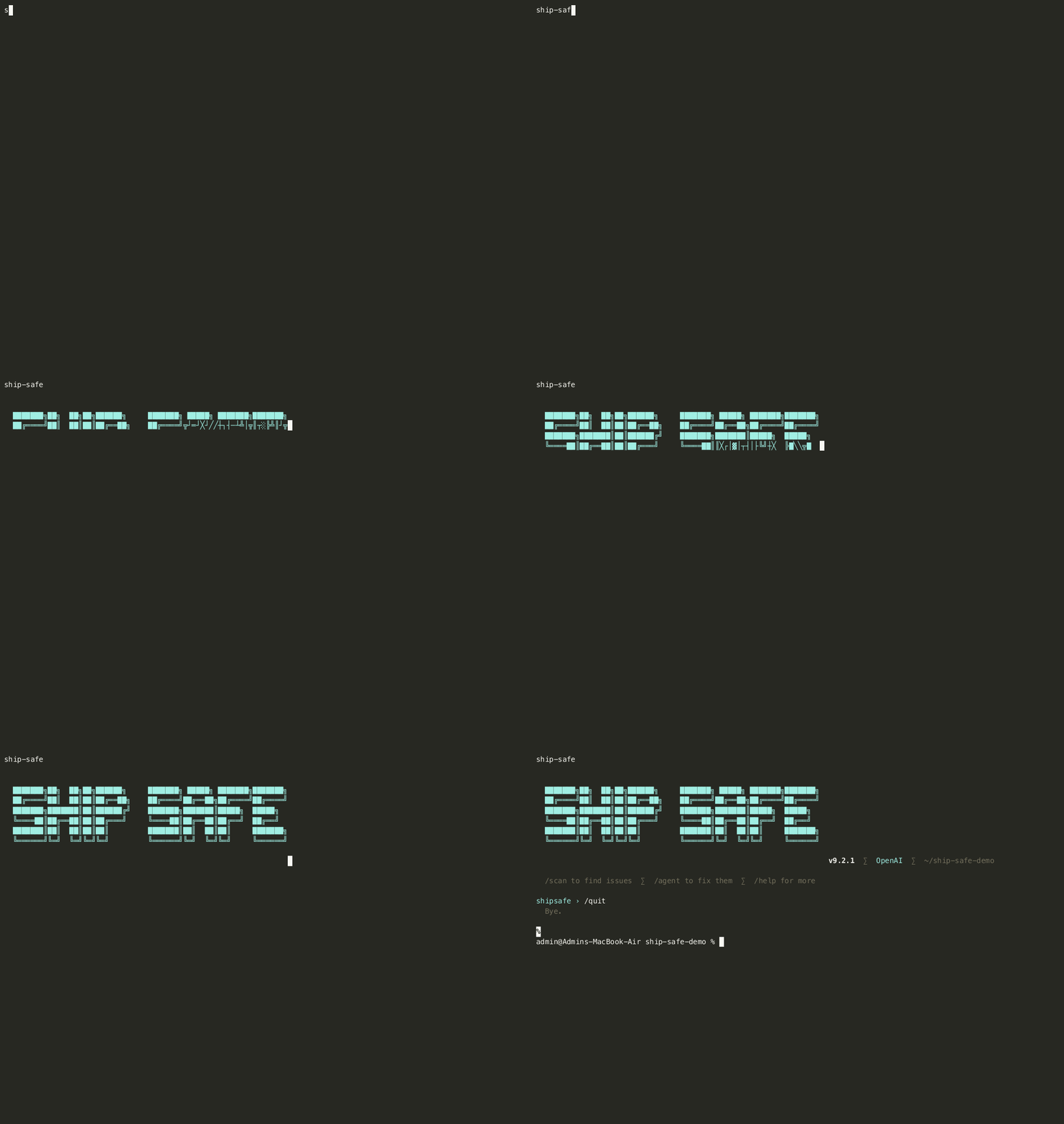
Ship Safe REPL demo


Quick Start

root@kitploit:~
# Interactive REPL: scan, fix, and ask questions in one session
npx ship-safe

# Full audit: secrets + 29 agents + deps + remediation plan
npx ship-safe audit .

# AI agent red-team scenarios for agent-readable content
npx ship-safe red-team . --gpt-red

# Interactive fix agent: plan, diff, approve, verify
npx ship-safe agent .
npx ship-safe agent . --severity critical   # critical findings only
npx ship-safe agent . --branch --pr         # fix on a branch + open a PR

# Undo the last fix
npx ship-safe undo

# CI/CD mode — fails on any critical finding
npx ship-safe ci . --sarif results.sarif
npx ship-safe ci . --fail-on high          # stricter: critical or high

What Ship Safe Finds

How It Works

  1. Scan locally - Ship Safe inspects your repo with targeted agents and skips checks that do not apply.
  2. Review findings - Findings include severity, file location, evidence, and recommended remediation.
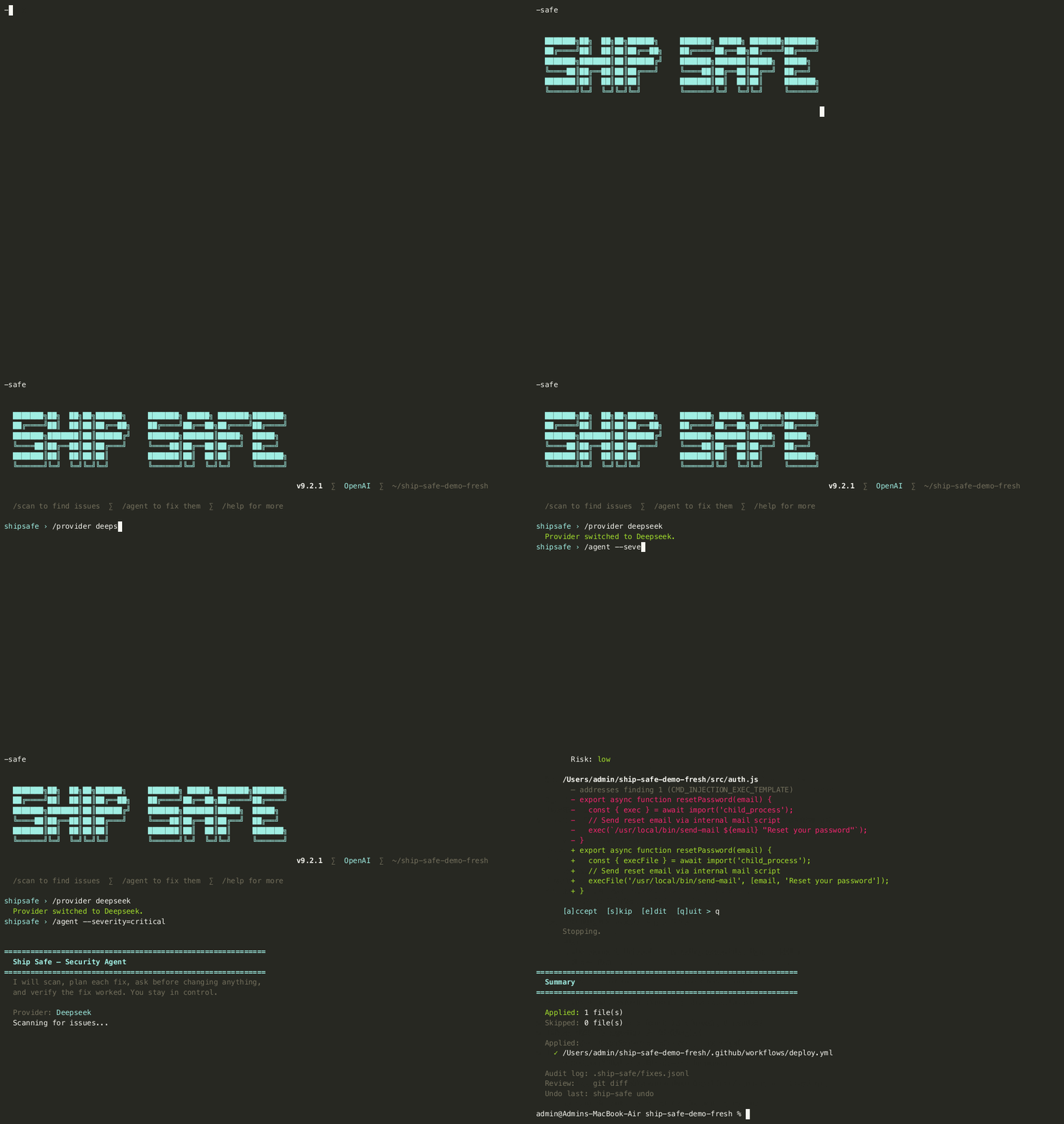
  3. Fix with control - The agent proposes a plan and diff, asks before writing, verifies the result, and keeps changes reversible.
  4. Gate in CI - Use ship-safe ci to fail risky builds and upload SARIF into GitHub code scanning.

Ship Safe agent demo


Why Developers Use It

  • Built for AI-native apps: catches risks in agents, MCP servers, prompts, RAG flows, managed-agent configs, and AI-powered CI.
  • Fast local feedback: run it before a PR, during review, or inside CI without sending code to a hosted scanner.
  • Fixes are reviewable: every suggested change is shown as a diff before it touches your files.
  • Works with your stack: JavaScript, TypeScript, Python, config files, infrastructure files, GitHub Actions, and more.
  • Open source core: MIT-licensed CLI with docs, examples, and a growing agent system.

Free CLI, Paid Team Workflows

The open-source CLI is the fastest way to scan any repo locally. Upgrade when you need a hosted workflow around the same scanner:

NeedUse
Local scans, audits, and agent-assisted fixesFree CLI
Scan history, cloud dashboard, and PDF reportsPro
Shared workspace, PR Guardian, team reports, and collaborationTeam

Compare plans at shipsafe.sh/pricing.

Ship Safe Cloud, the hosted dashboard for scan history, PR Guardian, billing, and team workflows, is developed in a private repository because it contains commercial product code and hosted infrastructure workflows. The public ship-safe repo remains focused on the MIT-licensed CLI, security agents, rules, fixtures, CI integrations, and documentation. See Ship Safe Cloud for the repo boundary.


Security Agents

All agents run in parallel. Each skips irrelevant projects automatically.

Post-processors: ScoringEngine · VerifierAgent (secrets liveness) · DeepAnalyzer (LLM taint analysis)


The REPL

root@kitploit:~
$ ship-safe

  ███████╗██╗  ██╗██╗██████╗     ███████╗ █████╗ ███████╗███████╗
  ...

  v9.4.1  ·  DeepSeek  ·  ~/my-project

  /scan to find issues  ·  /agent to fix them  ·  /help for more

shipsafe ›

Anything not starting with / is sent to the LLM as a free-form question, with your latest scan results as context.


CI/CD

root@kitploit:~
# .github/workflows/security.yml
name: Security Audit
on: [push, pull_request]
jobs:
  security:
    runs-on: ubuntu-latest
    steps:
      - uses: actions/checkout@v4
      - name: Security gate
        run: npx ship-safe ci . --sarif results.sarif
      - uses: github/codeql-action/upload-sarif@v3
        if: always()
        with:
          sarif_file: results.sarif

LLM Support

Works with any provider — auto-detected from environment variables. Use --provider <name> to override.

Anthropic · OpenAI · Google · DeepSeek · Kimi K3 / Moonshot · Groq · Together · Mistral · xAI · Perplexity · Ollama · LM Studio · any OpenAI-compatible endpoint

Kimi defaults to kimi-k3 through MOONSHOT_API_KEY or KIMI_API_KEY. Use --provider kimi --model kimi-k3 for long-context GPT-Red and deep-analysis runs.

For Kimi K3-specific long-context red teaming:

root@kitploit:~
npx ship-safe red-team . --gpt-red --provider kimi --model kimi-k3 --k3-long-context

Ship Safe also checks Kimi K3 / OpenAI-compatible tool-call implementations for dynamic tool loading from prompt context, missing tool allowlists, forced tool calls on untrusted input, and replayed tool results without the original assistant tool-call message.

No API key required for core scanning. AI classification and red-team --gpt-red use your configured provider when available, with deterministic offline fallback for GPT-Red checks.


Suppress False Positives

root@kitploit:~
password = get_password()  # ship-safe-ignore

critical findings are always reported. An inline comment cannot hide one, and an attempt to suppress one is recorded in the scan. The comment is meant for a human ruling out a false positive, and anything that can write a line of your source — including an AI agent — can write the comment too, so the highest severities do not honor it. Every suppression is counted, so a scan that silenced findings never reads like one that had none.

root@kitploit:~
# .ship-safeignore
tests/fixtures/
docs/

How noisy is it?

Recall is the easy half of a scanner. A tool that flags everything catches everything and is useless, so we measure the other half: what Ship Safe says about code that is almost certainly fine.

Down from 1031 findings across the same four projects before v9.6.3, verified against NodeGoat and DVWA so the drop is reduced noise rather than lost detection. The 1 remaining critical is a false positive and the benchmark says which and why.

Corpus pinned by commit, reproducible with one command, limits documented: benchmarks/false-positives/

How does it compare to Semgrep, Gitleaks, Trivy, CodeQL?

Run Ship Safe alongside them, not instead of them. CodeQL does interprocedural taint analysis Ship Safe does not attempt, Gitleaks is the specialist for secrets, and Trivy has a real CVE database behind it.

Ship Safe covers a narrower question: what an AI coding agent just did to your repository, your CI, and your local tool configuration. MCP client config, agent memory poisoning, hallucinated-package imports and AIBOM are the areas where we found no equivalent public rules in the other four.

Full coverage matrix, verified against their public registries, including where they beat us: docs/comparison.md


Add a Badge

root@kitploit:~
[![Ship Safe](https://img.shields.io/badge/Ship_Safe-A+-22c55e)](https://shipsafe.sh)

What's Next

10.0 is Hermes Agent coverage. Ship Safe already scans Hermes deployments, but against v0.13.0 while Hermes is on v0.20.0 — the ACP adapter, TUI gateway, serverless terminal backends, cron blueprints and plugin manifests all shipped in between with no coverage.

See the roadmap for what is planned and what is deliberately not, and the 10.0 milestone for claimable work. Everything in it is open to contributors.

Contributing

Ship Safe is open source, and the best contributions are small, focused improvements that make AI-assisted development safer.

Good first areas:

  • Add a focused security agent for an AI, MCP, CI, cloud, or supply-chain risk
  • Add a precise security rule to an existing agent
  • Add vulnerable fixtures and regression tests
  • Write examples for local scans, CI gates, red-team workflows, and MCP/agent setup

Start here:

  • Good first issues
  • Contributor guide
  • Add an agent
  • Add a security rule
  • Handle MCP environment variables safely
  • Release process

Sponsors

Ship Safe is MIT-licensed and free forever.

Sponsor Ship Safe


Star History

Star History Chart


Ship fast. Ship safe. — shipsafe.sh

Download Tool
AreaExamples
AI and LLM securityPrompt injection, agent hijacking, excessive agency, memory poisoning, RAG poisoning, unsafe tool calls
MCP and agent configsOver-broad tool permissions, poisoned registries, untrusted transports, dangerous allowlists
Application securitySQL/NoSQL injection, XSS, SSRF, auth bypass, path traversal, insecure API routes
Secrets and complianceAPI keys, tokens, credentials, PII, leaked secrets in git history
Supply chainTyposquatting, dependency confusion, risky install scripts, unpinned AI actions
CI/CDPipeline poisoning, unpinned GitHub Actions, secret logging, unsafe workflow triggers
AgentCategoryWhat It Detects
InjectionTesterCode VulnsSQL/NoSQL injection, command injection, XSS, path traversal, XXE, ReDoS, prototype pollution
AuthBypassAgentAuthJWT flaws (alg:none, weak secrets), CSRF, OAuth misconfig, BOLA/IDOR, TLS bypass
SSRFProberSSRFUser input in fetch/axios, cloud metadata endpoints, internal IPs
SupplyChainAuditSupply ChainTyposquatting, wildcard versions, suspicious install scripts, dependency confusion
ConfigAuditorConfigDocker (root user, :latest), Terraform, Kubernetes, CORS, CSP, Firebase, Nginx
SupabaseRLSAgentAuthservice_role key in client code, tables without RLS, anon key inserts
LLMRedTeamAI/LLMOWASP LLM Top 10: prompt injection, excessive agency, system prompt leakage
MCPSecurityAgentAI/LLMMCP server misuse, tool poisoning, typosquatting, unvalidated inputs
AgenticSecurityAgentAI/LLMOWASP Agentic AI Top 10: agent hijacking, privilege escalation, Kimi K3/OpenAI-compatible tool-call misuse
RAGSecurityAgentAI/LLMContext injection, document poisoning, vector DB access control
MemoryPoisoningAgentAI/LLMInstruction injection in agent memory files, hidden Unicode payloads (ASI-01, ASI-05)
PIIComplianceAgentComplianceSSNs, credit cards, emails, phone numbers in source code
VibeCodingAgentCode VulnsAI-generated code anti-patterns: no validation, empty catches, TODO-auth
ExceptionHandlerAgentCode VulnsEmpty catches, unhandled rejections, leaked stack traces (OWASP A10:2025)
AgentConfigScannerAI/LLMPrompt injection in .cursorrules, CLAUDE.md, malicious Claude Code hooks
MobileScannerMobileOWASP Mobile Top 10 2024: insecure storage, WebView injection, debug mode
GitHistoryScannerSecretsLeaked secrets in git commit history
CICDScannerCI/CDPipeline poisoning, unpinned actions, secret logging (OWASP CI/CD Top 10)
APIFuzzerAPIRoutes without auth, mass assignment, GraphQL introspection, debug endpoints
ManagedAgentScannerAI/LLMClaude Managed Agent misconfigs: always_allow policies, unrestricted networking (ASI-03–ASI-07)
HermesSecurityAgentAI/LLMTool registry poisoning, function-call injection, skill permission drift (ASI-01–ASI-10)
AgentAttestationAgentSupply ChainUnpinned agent versions, missing integrity hashes, unsigned manifests (ASI-10, SLSA L0)
AgenticSupplyChainAgentSupply ChainOver-privileged AI CI actions, OAuth scope creep, unsigned AI webhook receivers (ASI-02, ASI-06)
RobloxSecurityAgentSupply ChainMalicious Roblox/Luau Toolbox assets (runtime asset injection, rbxassetid:// loaders, HttpEnabled, payloads hidden in instance attributes)
ModelScanAgentSupply ChainCode-execution payloads in ML model weights (pickle opcodes in .pt/.pkl/.ckpt), torch.load without weights_only, scanner-evasion archives (CWE-502, CWE-506)
TrustBoundaryAgentAgenticGhostApproval symlink attacks (config-named links into ~/.ssh/~/.aws/.env), repo symlinks escaping the tree, and Friendly Fire run-on-review instructions in agent-read docs (CWE-59, CWE-61)
SlopSquatAgentSupply ChainHallucinated / phantom package imports (slopsquatting) — bare imports not declared, installed, or builtin, plus known AI-hallucinated names (CWE-1357)
ClickFixAgentSupply ChainClickFix / fake-CAPTCHA paste-and-run lures (fake error + Win+R/Ctrl+V/command-bar keystrokes, PowerShell cradles) and fake-installer npm lifecycle scripts (CWE-1357, CWE-506)
InstallGuardAgentSupply Chainnpm worm behaviors in lifecycle scripts (credential harvesting, env exfiltration, destructive rm -rf, obfuscated node -e) and weaponized binding.gyp node-gyp actions (CWE-506, CWE-829)
CommandWhat it does
/scanRe-scan the project
/agentRun the interactive fix loop
/findingsList findings from the last scan
/show <n>Full detail on finding n
/plan <n>Preview fix plan for finding n (no writes)
/undo [--all]Revert the last fix (or all fixes)
/sharePublish scan report as a public URL (7 days)
/diffShow git working-tree diff
/provider <name>Switch LLM provider mid-session
/quitExit (also Ctrl-D or Ctrl-C)
projectfindingscriticalgrade
express260C
requests151C
flask280D
chalk40B