eMudhra CA Compromise CVE-2026-111943 CVE-2026-114406 CVE-2026-91403 CVE-2026-113812
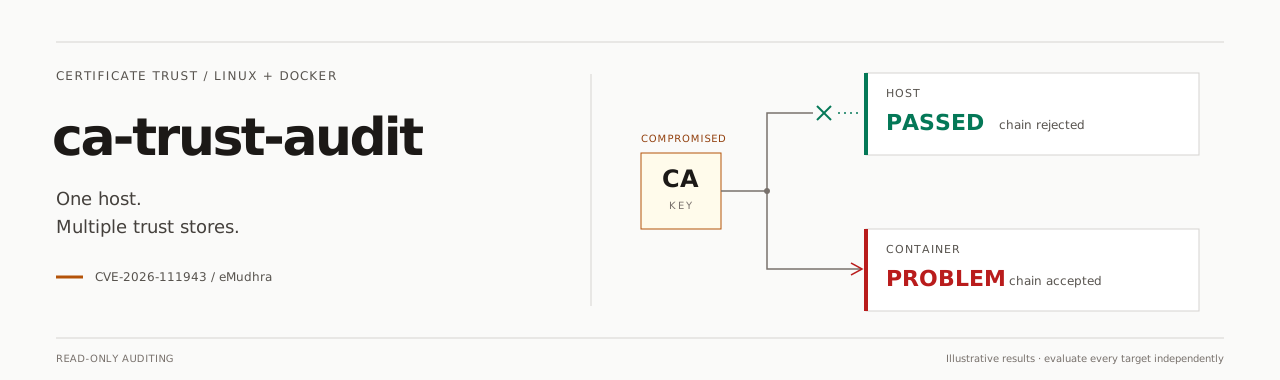


Read-only certificate trust auditing for Linux hosts and running Docker containers. One standalone Go binary for AMD64 / ARM64, including WSL; also available as a reusable Go library.
Install · Usage · Results · Coverage · Go API · Technical reference
[!IMPORTANT] eMudhra intermediate CA compromise — CVE-2026-111943 (October 2026). The incident advisory reports compromised signing keys for six TLS intermediate CAs and two code-signing CAs, including cross-signed chains. Systems that still accept an affected TLS chain may trust attacker-issued HTTPS certificates.
| Risk | Why act promptly? |
|---|---|
| HTTPS impersonation / MITM | An attacker able to intercept or redirect traffic could impersonate services, steal credentials/session tokens, or read and alter traffic. |
| Fresh fraudulent certificates | A compromised CA key can sign new certificates. Renewing your own website certificate does not remove that trust. |
| Stale container or application bundles | Updating the host does not replace CA bundles baked into existing images. PHP, curl, Python/certifi and Node.js can use different trust sources. |
Recommended response:
Incident keywords: CVE-2026-111943 · eMudhra · emSign · Sectigo cross-signing · compromised CA · intermediate CA · TLS/SSL certificate validation · trust store audit · Linux · Docker security.
Install the latest release with automatic AMD64/ARM64 selection:
curl -qfsSL https://github.com/andersundsehr/ca-trust-audit/releases/latest/download/install.sh | sh
Then scan the host and every running container:
ca-trust-audit
| Installation | Behavior |
|---|---|
| Destination | /usr/local/bin; sudo is used only when required. |
| Installer requirements | curl and common POSIX utilities; verified HTTPS, no checksum downloads. |
| Scanner requirements | No Go, Python, OpenSSL, curl or Java installation required to run the binary. Installed clients provide optional runtime evidence. |
| Failed update | Completed downloads are staged; replacement is atomic. |
curl -qfsSL https://github.com/andersundsehr/ca-trust-audit/releases/latest/download/install.sh | sh -s -- --install-dir "$HOME/.local/bin"
curl -qfsSL https://github.com/andersundsehr/ca-trust-audit/releases/latest/download/install.sh | sh -s -- --version v0.2.2
Add $HOME/.local/bin to PATH for a user-local installation. See installer details or inspect install.sh.
ca-trust-audit self-update --check    # check only
ca-trust-audit self-update            # update; use sudo if the directory requires it
ca-trust-audit self                   # short alias for self-update
self and selfupdate are aliases for self-update, with the same options (--check, --force, --timeout, --color). Suggested commands in permission errors are highlighted in cyan on terminals; NO_COLOR, redirection or --color never keep them plain. This explicit command replaces the executable; ordinary scans remain read-only. It selects the matching architecture, validates standalone Go/ELF metadata and installs atomically over verified HTTPS. No external tools or checksum file are required. Update options and trust boundary.
| Task | Command |
|---|---|
| Host + running containers | ca-trust-audit |
| Host only | ca-trust-audit --host (--host-only is equivalent) |
| Running containers only | ca-trust-audit --containers-only |
| One running container | ca-trust-audit --container webapp |
| Offline bundled-chain analysis | ca-trust-audit --offline |
| Additional public CA files/directories | --ca-file /opt/app/ca.pem / --ca-dir /opt/app/public-cas (repeatable) |
| Terminal + JSON file | ca-trust-audit --json report.json |
| JSON-only stdout | ca-trust-audit --json - |
| Require sufficient coverage | ca-trust-audit --strict |
| Detailed per-chain results | ca-trust-audit --verbose |
| Default / control | Meaning |
|---|---|
--workers | Available logical CPUs (nproc equivalent, using Go); override with any positive integer. Bounds concurrent containers and total simultaneous TLS checks across all targets. |
--timeout 10s | Per-operation deadline, range 1ms–5m; signals cancel the scan. |
--progress auto | Progress on terminal stderr; always enables plain CI logs, never disables it. |
--color auto | Meaningful terminal colors; NO_COLOR, redirection and TERM=dumb disable automatic colors. always / never override detection. |
Progress: counters and times stay first, the target stays last. Terminal redraws are limited to four per second and fitted to the terminal width.
[progress] 2/4 targets processed | elapsed 18s | ETA ~12s | checking PHP cURL | container webapp
Parallel checks: the host is scanned first, then running containers in parallel. Within each client, chain requests also run in parallel; their shared global limit is --workers, so a single target benefits too. Clients within a target are tested one after another, each with its own positive control.
Conservative ETA: uses twice the slowest completed container duration plus a 10-second buffer, worker concurrency and queued work. Before measurements, it starts with a generous budget (normally 1 minute per online target, 15 seconds offline). Long-running targets expand the estimate; it never gets stuck at ~1s. Before Docker discovery, target ETA covers only the active target. Estimates can increase and are not deadlines. JSON remains free of progress and color escapes.
Selection rules: stopped containers are excluded. --host conflicts with container-only selection. CA paths refer to paths inside each selected target. Missing Docker leaves host results available; inaccessible Docker is reported as incomplete coverage. All CLI semantics and limits.