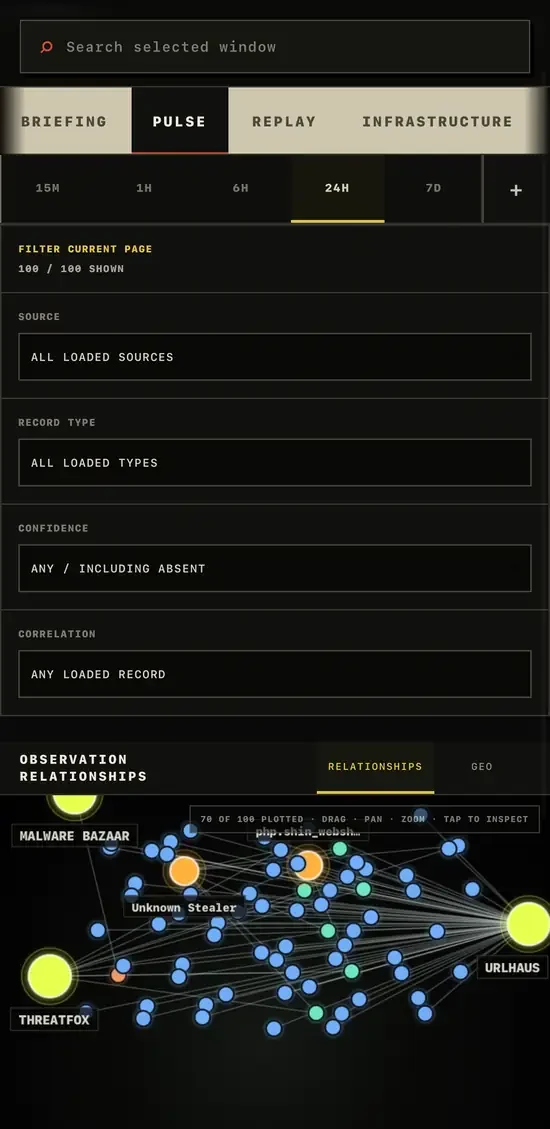
 gnomeman/badbanana-threat-observatory
Threat intel observatory aggregating CISA KEV, ThreatFox, URLhaus, and MalwareBazaar feeds with search, change tracking, and STIX/CSV/JSONL export.

Inspect exploited vulnerabilities and threat indicators, check their source evidence, and review retained changes.
Open the live Observatory · Try the KEV walkthrough · Source coverage · Run it yourself
The Observatory brings CISA KEV, ThreatFox, URLhaus, and MalwareBazaar into one analyst workspace. Use it to inspect source records, distinguish source dates from collection times, and export bounded current-state results. Missing, stale, disabled, or unavailable data stays visibly labeled.

If the seven-day view returns no matches, use CURRENT KEV CATALOG to inspect an existing entry. A successful empty result, a stale source, and an unavailable read have different meanings. None establishes that your systems are unaffected.
Result: a source-backed CVE record you can inspect and reference, with the date basis and collection limits visible. This workflow does not determine whether your own assets are vulnerable.
Export is a separate workflow. Start in Pulse, Infrastructure, URLs, or Malware, choose a time window, and apply the available search or filters. Then select Export, review the source selection and visible-page counts, choose JSONL, CSV, STIX 2.1, defanged text, or a manifest, and download the result.
Exports cover the loaded page after the selected policy is applied. Review emitted and unsupported counts. The dedicated Exploited workspace's KEV filters do not carry directly into Export.
Current source state, material-change events, and fetch telemetry remain separate. The interface never substitutes demo records or inferred attribution. Collection is demand-driven; this deployment does not claim continuous monitoring.
The implementation and limitations are documented below, including source coverage, retention, provenance, and export semantics.
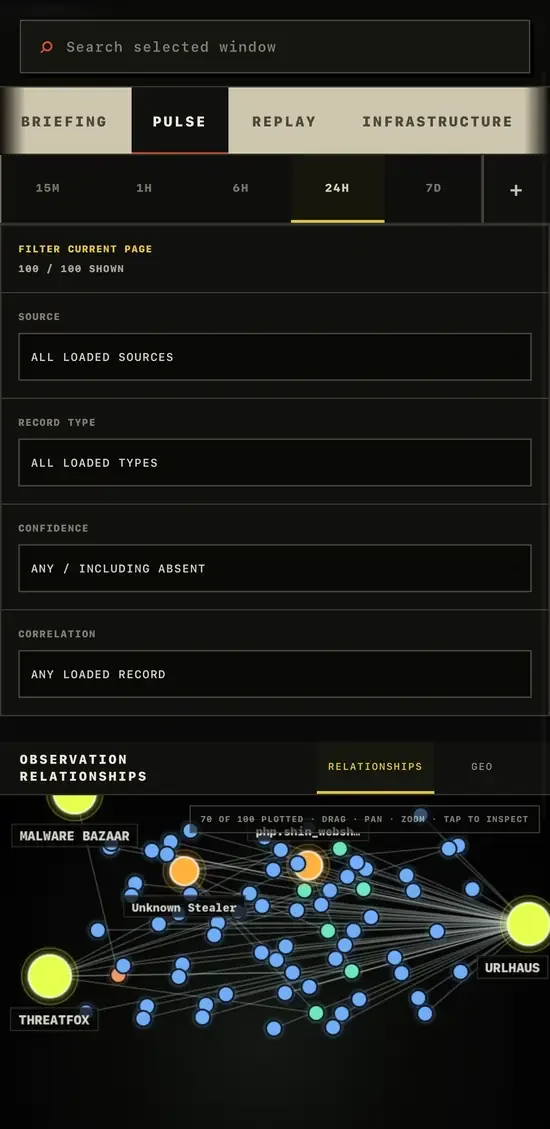
Pulse — cross-source relationships, source health, and current-state analysis.
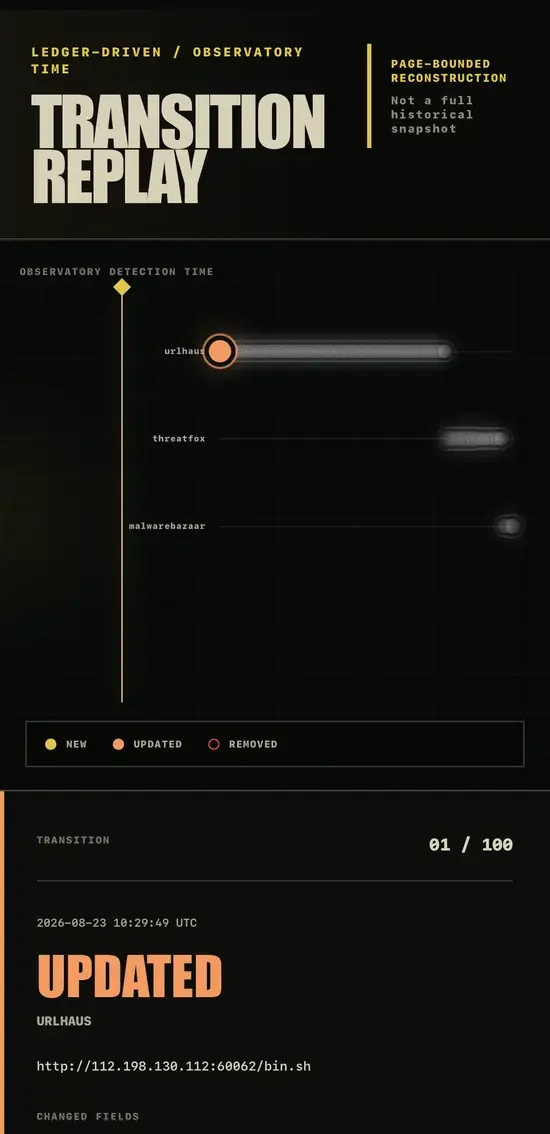
Replay — page-bounded reconstruction of retained NEW, UPDATED, and REMOVED transitions.
Additional live surfaces include approximate public-IP infrastructure geography and first-party URLhaus / MalwareBazaar evidence views. Those surfaces are intentionally not represented by placeholder or duplicated screenshots in this README.
Production captures are source-preserving screenshots from the live v1.2.0 Observatory. They are cropped and resized/compressed for presentation; displayed evidence, timestamps, counts, IOC values, and interface states are not regenerated or substituted.
The production Worker is backed by Cloudflare D1. Feed credentials remain server-only Cloudflare Worker secrets and are never required in the browser.
1.2.222.13.0 or newerThis deployment runs in demand-driven mode. The repository now targets standard Cloudflare Workers directly; scheduled triggers are intentionally not enabled in v1.2.2, so the application does not claim continuous collection. A future scheduler can call the same runIngestionCycle() operation after separate correctness and operational verification.
The browser makes an explicit bounded maintenance request on initial use and every five minutes while open:
POST /api/ingest
        ↓
runIngestionCycle()
        ↓
configuration → TTL → backoff → D1 lease → fetch → normalize → validate
        ↓
snapshot cache + current observations + material events + cycle statistics
Ordinary reads are separate and local:
GET /api/observations → D1 current state, scoped before pagination
GET /api/search       → D1 current state, scoped before pagination
GET /api/kev          → D1 current CISA catalog
GET /api/events       → D1 material change ledger
GET /api/geo          → local observations + bounded cached IP enrichment
None of those GET routes calls a source adapter. If this project later gains a genuinely supported scheduler, it can call the same runIngestionCycle() operation without creating a second refresh implementation.
| Source | Credential | TTL | Actual coverage |
|---|---|---|---|
| CISA KEV | None | 30 minutes | Full current validated catalog |
| ThreatFox | THREATFOX_AUTH_KEY | 15 minutes | Requested 24-hour IOC window |
| URLhaus | URLHAUS_AUTH_KEY | 15 minutes | Latest 500 records returned by the recent endpoint |
| MalwareBazaar | MALWAREBAZAAR_AUTH_KEY | 15 minutes | Latest 100 metadata records returned by the endpoint |
Coverage is displayed per source. Bounded APIs are never presented as complete catalogs.
The DB binding owns distinct datasets:
