
Skip to content
KitploitKITPLOIT
أدواتعمليات الاستغلالالمدونة
Log in
إرسال
أدواتعمليات الاستغلالالمدونة
إرسال

أدوات الاختراق واختبار الاختراق والأمن السيبراني لترسانتك الأمنية!

Kitploit هو دليل لأدوات الاختراق والأمن السيبراني واختبار الاختراق. اكتشف آخر تحديثات المشاريع للعثور على الثغرات وتحليل الأنظمة وأتمتة الاختبارات وتعزيز أمنك.

الخلاصاتاتصالالخصوصية© 2026 Kitploit

دليل الأدوات

الفئات

عرض جميع الفئات
Loading categories
fad-checker — Buildless dependency auditor that scans 10 ecosystems offline, reporting CVEs prioritized by CISA KEV and EPSS, EOL packages, licenses, committed keys, and binaries with SBOM and SARIF exports. | Kitploit
أدوات/GitHubGitHub/9pings/fad-checker
Defensive ToolsStatic AnalysisVulnerability ScannersVulnerability AnalysisCode AnalysisConfiguration AuditingDevSecOpsSecret DetectionSupply Chain Security
GitHub9pings/fad-checker

fad-checker

Buildless dependency auditor that scans 10 ecosystems offline, reporting CVEs prioritized by CISA KEV and EPSS, EOL packages, licenses, committed keys, and binaries with SBOM and SARIF exports.


4186منذ 4 أياملم تتم المراجعة بعد
مشاركة
عرض المستودع
المحتوى غير متوفر باللغة المطلوبة. عرض النسخة الإنجليزية.

VigieVuln

npm version npm downloads license node CI

VigieVuln 1.3.3 is a polyglot dependency auditor for code audits.

It scans dependencies and 9 CMS/frameworks in one pass without build tools, supports air-gapped workflows, detects private packages, binaries and certificates, and produces HTML, JSON and other reports.

🌐 Project site & docs →

Terminal demo recorded with VigieVuln 1.2.1.
vigievuln animated terminal demo: an offline Maven audit — dependencies absent from Maven Central flagged as private/internal, the compact single-line vulnerability-database progress, then findings coloured by severity

Features

  • Multiple ecosystems in one pass: Maven and Gradle, npm/Yarn/pnpm, Composer, PyPI, NuGet, Go and Ruby — plus vendored JS, committed native binaries and embedded JARs.
  • No build tools; No mvn/gradle/npm/pip/dotnet/go, no node_modules/ → how
  • CVE from multiple sources, merged & prioritised; CVEProject + OSV.dev + Packagist security advisories + NVD, ranked CISA KEV → EPSS → CVSS.
  • European vulnerability references: ENISA EUVD id + ENISA's exploited flag, GCVE id, and the CERT-FR advisories citing it. Hosted proxy lookups send relevant CVE identifiers to the proxy.
  • Beyond CVEs; Report EOL and out-of-active-support frameworks, deprecated/abandoned/yanked, outdated, SPDX licenses, and private/internal packages
  • CMS & frameworks audited as instances; Symfony, Laravel, WordPress, Drupal, Joomla, PrestaShop, TYPO3, Magento/Adobe Commerce and SPIP with per-instance inventory (core, plugins, themes, bundles, components) → the dedicated guide
  • Crypto material; committed certificates, private vs public keys across PEM/OpenSSH/PuTTY/PGP and JKS/PKCS#12 keystores.
  • Air-gapped flow; zero network under --offline → Benchmark · Air-gapped
  • Native image audits; Docker/OCI archives, registries and rootfs inventories without Docker; Linux packages, ELF/Go metadata and publisher SBOMs, with explicit coverage. Image analysis in source scans is off by default; use --images or the separate vigievuln image command → image guide
  • Hosted proxy with a verified account; --set-proxy-cache vigievuln → hosted proxy
  • Project monitoring; vigievuln watch ./project --name 'My Project' — one free project with up to 100 distinct direct dependency coordinates → monitoring guide
  • Shared cache for a scanner fleet; vigievuln serve-cache + --proxy-cache → cache usage
  • Supply-chain risk; known-malicious advisories and suspected typosquats (--typosquat).
  • Audit-grade; every report carries a provenance manifest and a Methodology & limitations chapter; a SHA256SUMS;
  • Differential audits diff against a prior run (--baseline) and CI can gate on new findings only.
  • Reports in English or French (--lang fr)
  • Outputs & CI; Pro HTML report + JSON baseline by default + Word, Excel, CycloneDX 1.6 SBOM, CSAF 2.0 VEX, SARIF 2.1.0, JSON; gate with --fail-on, triage with --ignore/--vex.
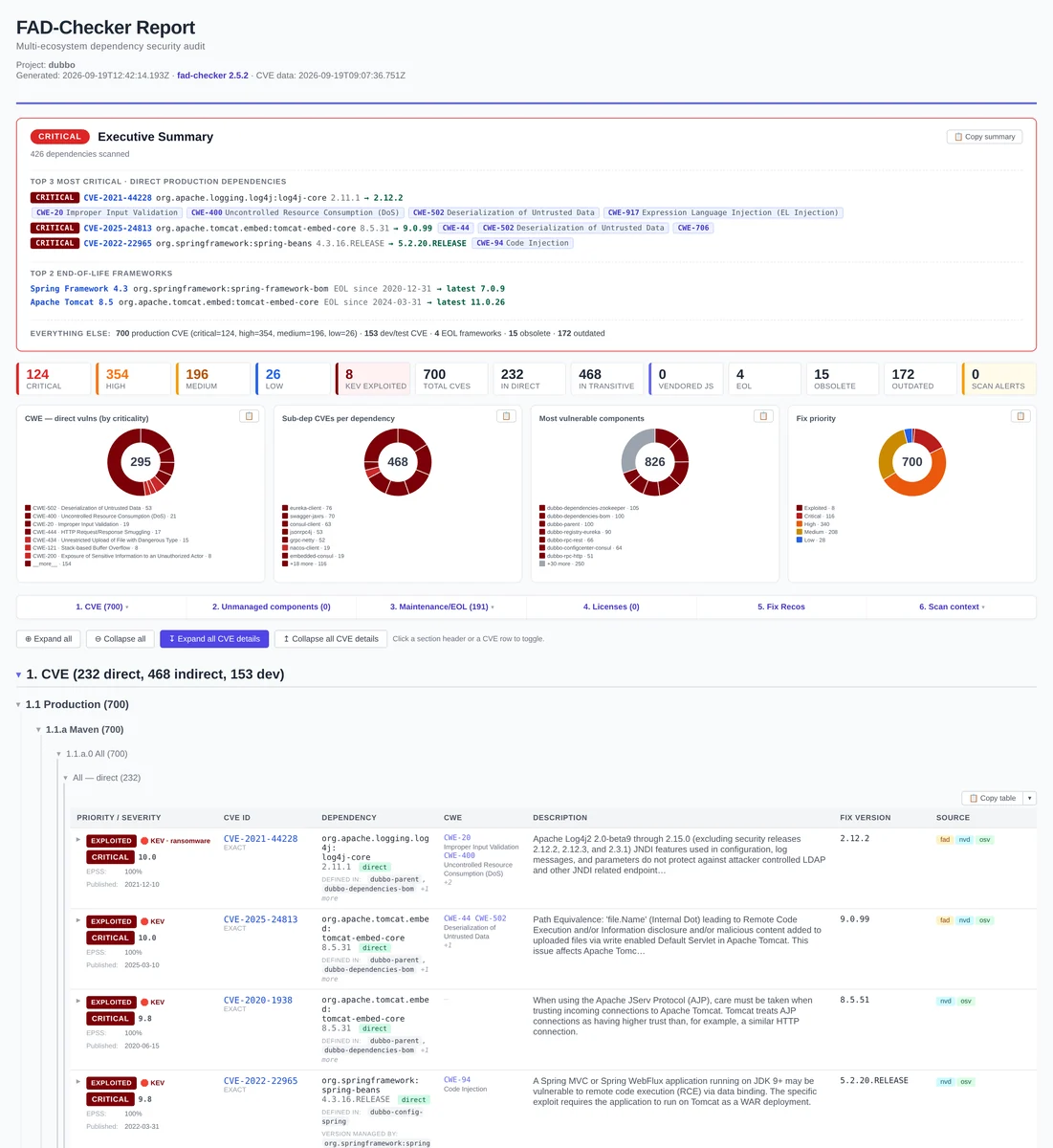
  • Report made for productivity; every table / chart has a Copy for word button.

📖 Usage & all flags · Architecture · Comparison vs other tools · Data sources

[!IMPORTANT] Although VigieVuln is an excellent tool—comprehensive, rigorously tested, and regularly updated—it is still relatively new, and like any other scanner, it may occasionally produce errors. Whenever possible, cross-check important findings with another analysis tool — though, among the tools we compared, none offers reports as comprehensive as VigieVuln.

Quick start

npm install -g vigievuln
vigievuln scan ./code             # → ./vigievuln-report/cve-report.html

Faster scans using personal NVD API key

A free NVD API key (instant) gives 10× faster enrichment: vigievuln --set-nvd-key YOUR_KEY. A few common runs; full list via vigievuln --help or docs/USAGE.md

Faster scans using the VigieVuln DB European hosted cache

Use Vigie Vuln DB as a European-hosted source for scans, including reviewed VigieVuln advisories for Maven and npm.

vigievuln login                 # sign in and select the official proxy if none is configured
vigievuln scan ./code           # scan using the saved proxy and key
vigievuln setup --mode direct --sources all  # switch back to direct sources

The proxy receives package coordinates and CVE identifiers, not source code. Cached advisories remain usable offline; partial version evidence leaves other versions unknown. Proxy guide.

Include container images

Add --images to scan supported container images referenced by the project alongside its dependencies, without Docker; this option is off by default.

vigievuln scan ./code --images

The report keeps source and image findings in separate summaries and charts, highlighting vulnerable images and their most critical CVEs. Image inputs, options and coverage.

Why use vigievuln ?

An author-maintained comparison of audit workflows; see docs/COMPARISON.md for versions, sources and limitations. ⚠️ indicates partial or conditional support.

تنزيل الأداة

الأكثر شعبية

عرض الكل →

اكتشف الأدوات الأكثر استخدامًا من قبل مجتمعنا.

  • 1

    ghostlock-app

    yukonga/ghostlock-app

    # تطبيق GhostLock للتنفيذ بنقرة واحدة (CVE-2026-43499)

    961
  • 2

    wifit3

    derv82/wifit3

    Wifite لكن عبر USB فقط ومتعدد المنصات.

    755
  • 3

    OsintHunter

    letox4/osinthunter

    🎯 مجموعة أدوات OSINT المثالية: رسم بياني للتحقيق، وتقييم الثقة، وعائلات الأسماء المستعارة، وخريطة، وخط زمني، وتقارير. 49 وحدة، وأكثر من 400 موقع، دون الحاجة إلى مفاتيح API.

    625
  • 4

    jumpserver

    jumpserver/jumpserver

    JumpServer هي منصة مفتوحة المصدر لإدارة الامتيازات (PAM) توفر لفرق DevOps وتكنولوجيا المعلومات وصولًا آمنًا عند الطلب إلى نقاط نهاية SSH وRDP وKubernetes وقواعد البيانات وRemoteApp عبر متصفح الويب.

    501
  • 5

    SafeLine

    chaitin/safeline

    WAF مستضافة ذاتيًا ووكيل عكسي يقوم بتصفية حركة المرور HTTP الضارة، ويمنع هجمات SQL injection و XSS وهجمات البوت، مع تحديد معدل الطلبات وتشفير HTML/JS الديناميكي.

    456
  • 6

    mcp-reverse

    1llu50ry/mcp-reverse

    خادم MCP يوفّر أكثر من 180 أداة لهندسة عكسية تجمع Ghidra وIDA وx64dbg وFrida و56 من الواجهات الخلفية الأخرى، مع محلّلات ثنائية أصلية وقاعدة معرفية تضم 4,200 مهارة.

    344

استكشف جميع الأدوات

تصفح مجموعتنا من الأدوات

عرض جميع الأدوات →








