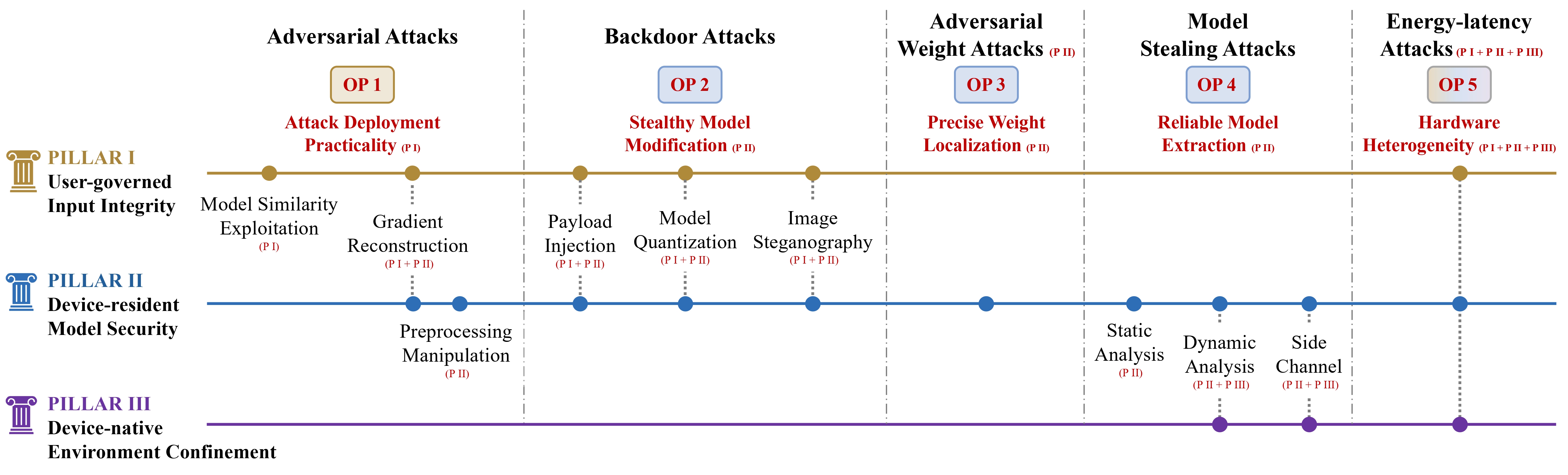
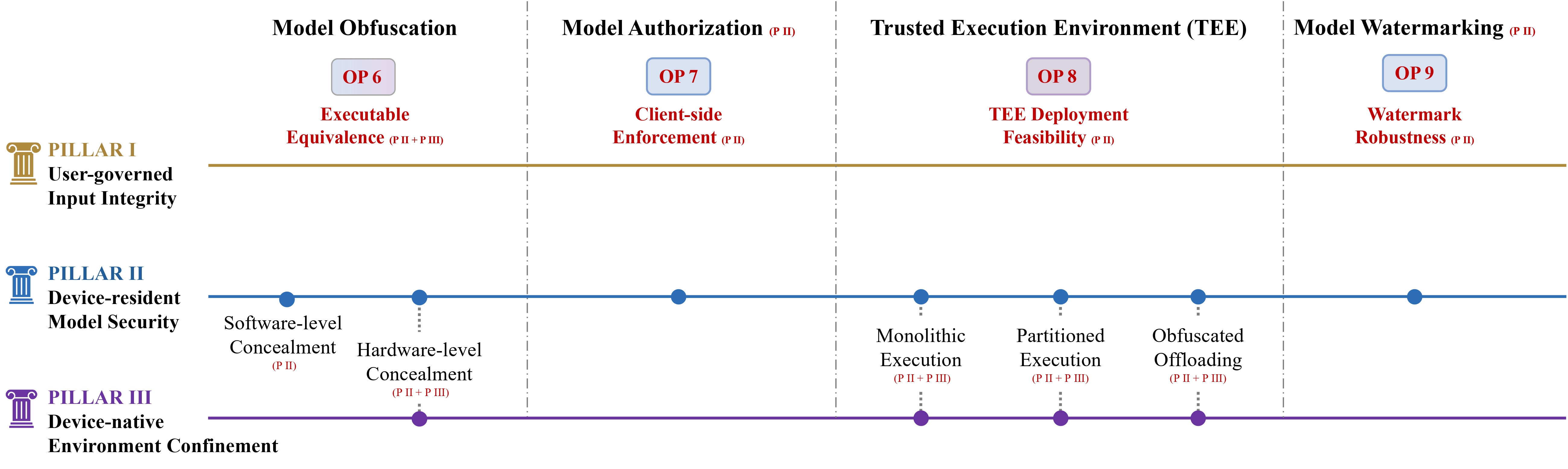
针对移动端设备上AI系统的攻击与防御研究精选阅读清单及分类体系,涵盖对抗攻击、后门攻击、模型窃取攻击及能耗-延迟攻击,同时涉及混淆、TEE与水印防御措施。

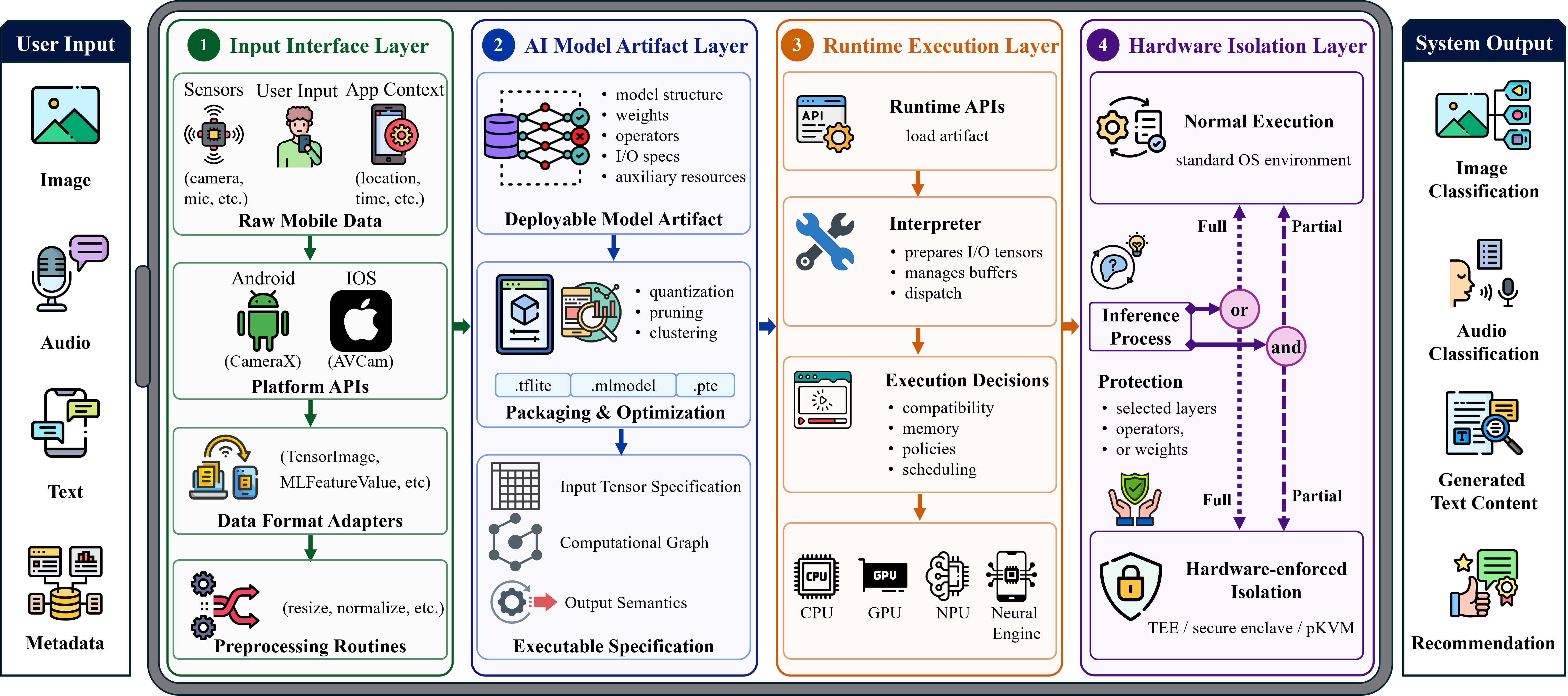
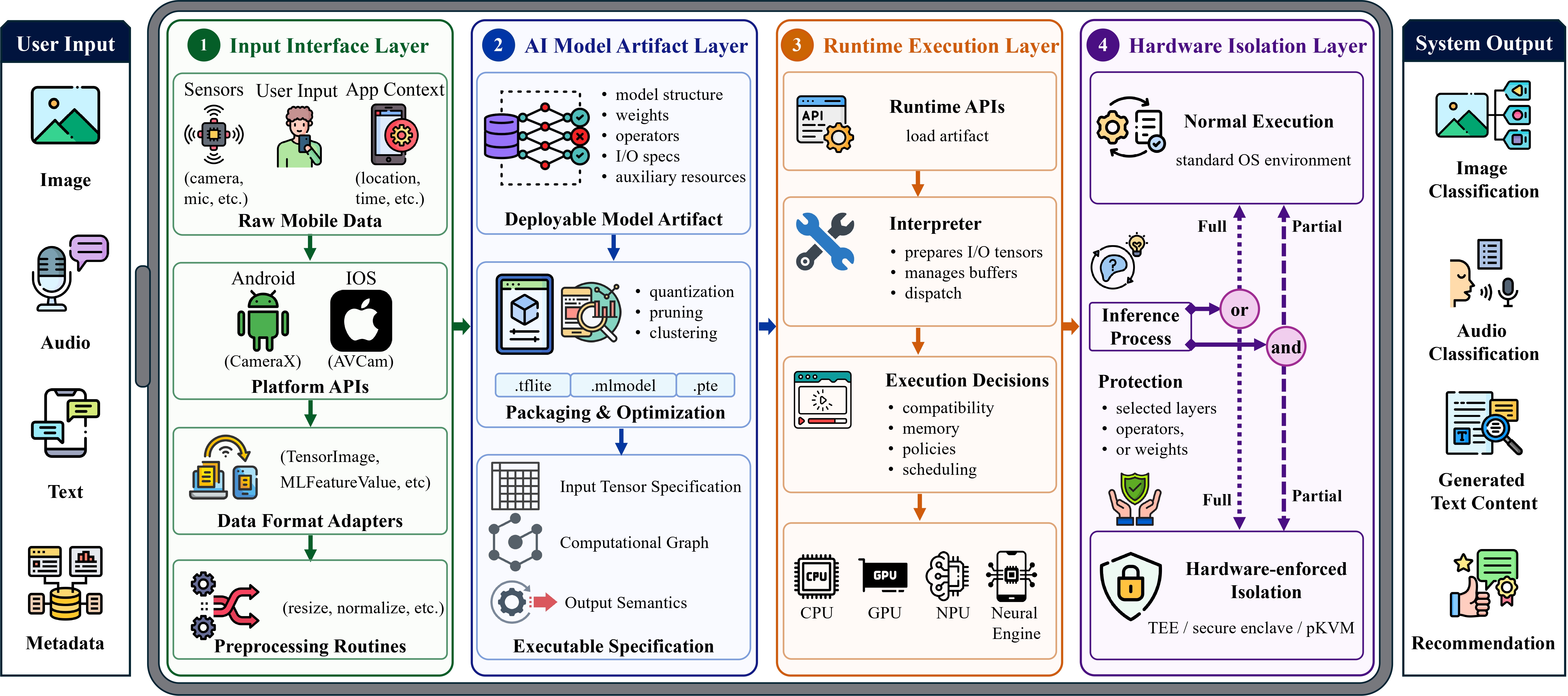
移动端设备端人工智能系统通过诸如 LiteRT/TFLite、Core ML、ExecuTorch、ONNX 等机器学习框架以及硬件加速器,在本地执行人工智能模型。本仓库追踪理解和保护此类系统所需的安全研究,因为设备端模型的本地存储引入了新的安全风险。
刚接触MoAI安全?从这里开始:
• A First Look at Deep Learning Apps on Smartphones
• A First Look at On-device Models in iOS Apps
• Mind Your Weight(s): A Large-scale Study on Insufficient ML Model Protection in Mobile Apps
• Robustness of On-device Models: Adversarial Attack to Deep Learning Models on Android Apps
• DeepPayload: Black-box Backdoor Attack on Deep Learning Models through Neural Payload Injection
• Typhon Unleashed: Practical Adversarial Weight Attacks Against On-Device Deep Learning Models
• Energy-Latency Attacks to On-Device Neural Networks via Sponge Poisoning
• ModelObfuscator: Obfuscating Model Information to Protect Deployed ML-based Systems
• ShadowNet: A Secure and Efficient On-device Model Inference System
• THEMIS: Towards Practical IP Protection for Post-Deployment On-Device DL Models
Robustness of On-device Models: Adversarial Attack to Deep Learning Models on Android Apps [Code]
IEEE/ACM International Conference on Software Engineering: Software Engineering in Practice (ICSE-SEIP 2021)
Smart App Attack: Hacking Deep Learning Models in Android Apps [Code]
IEEE Transactions on Information Forensics and Security (TIFS 2022)
Understanding Real-world Threats to Deep Learning Models in Android Apps [Code]
ACM SIGSAC Conference on Computer and Communications Security (CCS 2022)
Cheating Your Apps: Black-box Adversarial Attacks on Deep Learning Apps
Journal of Software: Evolution and Process (JSEP 2024)
A First Look at On-device Models in iOS Apps [Code]
ACM Transactions on Software Engineering and Methodology (TOSEM 2024)
Investigating White-Box Attacks for On-Device Models [Code]
IEEE/ACM International Conference on Software Engineering (ICSE 2024)
TIM: Enabling Large-Scale White-Box Testing on In-App Deep Learning Models [Code]
IEEE Transactions on Information Forensics and Security (TIFS 2024)
DeepPayload: Black-box Backdoor Attack on Deep Learning Models through Neural Payload Injection [Code]
IEEE/ACM International Conference on Software Engineering (ICSE 2021)
MalModel: Hiding Malicious Payload in Mobile Deep Learning Models with Black-box Backdoor Attack [Code]
Automated Software Engineering (ASEJ 2026)
A First Look at Deep Learning Apps on Smartphones [Code]
The World Wide Web Conference (WWW 2019)
A First Look at On-device Models in iOS Apps [Code]
ACM Transactions on Software Engineering and Methodology (TOSEM 2023)
Mind Your Weight(s): A Large-scale Study on Insufficient Machine Learning Model Protection in Mobile Apps [Code]
USENIX Security Symposium (USENIX Security 2021)
REDLC: Learning-Driven Reverse Engineering for Deep Learning Compilers
IEEE International Symposium on Software Reliability Engineering (ISSRE 2024)
Mind Your Weight(s): A Large-scale Study on Insufficient Machine Learning Model Protection in Mobile Apps [Code]
USENIX Security Symposium (USENIX Security 2021)
Understanding Real-world Threats to Deep Learning Models in Android Apps [Code]
ACM SIGSAC Conference on Computer and Communications Security (CCS 2022)
DeMistify: Identifying On-device Machine Learning Models Stealing and Reuse Vulnerabilities in Mobile Apps [Code]
IEEE/ACM International Conference on Software Engineering (ICSE 2024)
Game of Arrows: On the (In-)Security of Weight Obfuscation for On-Device TEE-Shielded LLM Partition Algorithms [Code]
USENIX Security Symposium (USENIX Security 2025)
Model Extraction Attack against On-Device Deep Learning with Power Side Channel
IEEE International Symposium on Quality Electronic Design (ISQED 2024)
DeepCache: Revisiting Cache Side-Channel Attacks in Deep Neural Networks Executables
ACM SIGSAC Conference on Computer and Communications Security (CCS 2024)
ModelObfuscator: Obfuscating Model Information to Protect Deployed ML-Based Systems [Code]
ACM SIGSOFT International Symposium on Software Testing and Analysis (ISSTA 2023)
DynaMO: Protecting Mobile DL Models through Coupling Obfuscated DL Operators [Code]
IEEE/ACM International Conference on Automated Software Engineering (ASE 2024)
Model-less Is the Best Model: Generating Pure Code Implementations to Replace On-Device DL Models [Code]
ACM SIGSOFT International Symposium on Software Testing and Analysis (ISSTA 2024)
NNSplitter: An Active Defense Solution for DNN Model via Automated Weight Obfuscation [Code]
International Conference on Machine Learning (ICML 2023)
A Novel Obfuscation Method Based on Majority Logic for Preventing Unauthorized Access to Binary Deep Neural Networks
Scientific Reports (Sci. Rep. 2025)
Securing On-device Transformer with Hardware Binding and Reversible Obfuscation [Code]
Annual Computer Security Applications Conference (ACSAC 2025)
MMGuard: Automatically Protecting On-Device Deep Learning Models in Android Apps [Code]
IEEE Security and Privacy Workshops (SPW 2021)
Securing On-device Transformer with Hardware Binding and Reversible Obfuscation [Code]
Annual Computer Security Applications Conference (ACSAC 2025)
Offline Model Guard: Secure and Private ML on Mobile Devices
Design, Automation and Test in Europe Conference (DATE 2020)
GuardiaNN: Fast and Secure On-Device Inference in TrustZone Using Embedded SRAM and Cryptographic Hardware
ACM/IFIP International Middleware Conference (Middleware 2022)
Secure and Efficient Mobile DNN Using Trusted Execution Environments
ACM Asia Conference on Computer and Communications Security (AsiaCCS 2023)
T-Slices: Confidential Execution of Deep Learning Inference at the Untrusted Edge with Arm TrustZone
ACM Conference on Data and Application Security and Privacy (CODASPY 2023)
LEAP: TrustZone Based Developer-Friendly TEE for Intelligent Mobile Apps
IEEE Transactions on Mobile Computing (TMC 2022)
ASGARD: Protecting On-Device Deep Neural Networks with Virtualization-Based Trusted Execution Environments [Code]
Network and Distributed System Security Symposium (NDSS 2025)
TZ-LLM: Protecting On-Device Large Language Models with Arm TrustZone [Code]
European Conference on Computer Systems (EuroSys 2026)
FlexServe: A Fast and Secure LLM Serving System for Mobile Devices with Flexible Resource Isolation
arXiv preprint (arXiv 2026)
DarkneTZ: Towards Model Privacy at the Edge Using Trusted Execution Environments [Code]
Annual International Conference on Mobile Systems, Applications, and Services (MobiSys 2020)
HybridTEE: Secure Mobile DNN Execution Using Hybrid Trusted Execution Environment [Code]
Asian Hardware Oriented Security and Trust Symposium (AsianHOST 2020)- SecDeep: Secure and Performant On-Device Deep Learning Inference Framework for Mobile and IoT Devices
国际物联网设计与实现会议 (IoTDI 2021)
ShadowNet: A Secure and Efficient On-Device Model Inference System for Convolutional Neural Networks [Code]
IEEE安全与隐私研讨会 (S&P 2023)
MirrorNet: A TEE-Friendly Framework for Secure On-Device DNN Inference
IEEE/ACM国际计算机辅助设计会议 (ICCAD 2023)
TSQP: Safeguarding Real-Time Inference for Quantization Neural Networks on Edge Devices [Code]
IEEE安全与隐私研讨会 (S&P 2025)
TEESlice: Protecting Sensitive Neural Network Models in Trusted Execution Environments When Attackers Have Pre-Trained Models
ACM软件工程与方法论汇刊 (TOSEM 2025)
TensorShield: Safeguarding On-Device Inference by Shielding Critical DNN Tensors with TEE [Code]
ACM SIGSAC计算机与通信安全会议 (CCS 2025)
GroupCover: A Secure, Efficient and Scalable Inference Framework for On-Device Model Protection Based on TEEs [Code]
国际机器学习会议 (ICML 2024)
Game of Arrows: On the (In-)Security of Weight Obfuscation for On-Device TEE-Shielded LLM Partition Algorithms [Code]
USENIX安全研讨会 (USENIX Security 2025)
MirageNet: A Secure, Efficient, and Scalable On-Device Model Protection in Heterogeneous TEE and GPU System
arXiv预印本 (arXiv 2026)
以下开放问题总结了我们系统知识综述(SoK)中识别的主要研究缺口。此处保持高层次描述以便读者使用本仓库。更详细的技术讨论请参见论文。
攻击部署的实用性。
针对设备端模型的对抗攻击在部署后仍然难以实现,因为通常需要控制模型输入、插入对抗扰动,或通过应用重打包修改预处理代码。这些步骤在实际最终用户部署中可能不切实际或容易被检测。
隐蔽的模型修改。
后门攻击需要在部署后找到除标准训练时投毒之外的新入口点,因为设备端模型通常是只读且仅推理的。关键挑战在于引入隐藏的恶意行为而不产生可观察的模型工件变化。
精确的权重定位。
对抗性权重攻击暴露了参数级别的完整性风险,但实际部署取决于在庞大的参数搜索空间中定位行为关键权重。这很困难,因为攻击者通常缺乏梯度指导,并且需要在仅修改选定参数的同时保持良性效用。
可靠的模型提取。
本地模型存储并不能使模型窃取变得简单。实际提取仍然依赖于在自定义加密算法、非标准AI框架和运行时特定加载行为存在的情况下,进行可靠的模型识别、解密和重构。
硬件异构性。
能量-延迟攻击依赖于中毒激活模式如何与特定设备的执行行为交互。它们可能放大对稀疏敏感的加速器上的延迟和能量消耗,但无法迁移到没有稀疏依赖执行的硬件上。
可执行等价性。
模型混淆仍需在授权推理期间保持原始预测函数。这种可执行等价性可能暴露可恢复的运行时状态、变换后的权重、算子语义或结构痕迹,从而促成语义、结构或参数恢复。
客户端强制执行。
模型授权将正确推理与凭证、完整性检查和打包权重恢复绑定。然而,这些检查需在移动堆栈内执行,使得强制执行依赖于可在部署后被逆向工程、重打包、挂钩或插桩的客户端代码。
TEE部署可行性。
TEE防御需要跨模型格式、AI框架、算子库、代理、加速器和CPU/GPU/NPU隔离接口的协调支持。当前移动生态系统仍缺乏广泛采用、对开发者透明的TEE支持推理栈。
水印鲁棒性。
模型水印支持部署后的所有权验证,但被窃取的模型可能通过框架转换、加密或应用级输入输出中介重新部署。这些变换可以保留良性推理,同时破坏用于验证的触发器响应、置信度模式或输出语义。
除了上述九个开放问题,我们的系统知识综述(SoK)还强调了移动设备端AI(MoAI)安全可能向何方扩展的三个新兴方向。这些方向超越静态、仅推理的设备端模型,转向自适应、生成式和行动导向的MoAI系统。我们在此进行高层次总结。配套论文提供了更详细的动机、威胁面和研究挑战。
当前MoAI安全研究主要侧重于已部署的只读、仅推理模型。设备端训练改变了这一假设,允许模型在本地更新,从而在训练过程中暴露梯度、参数更新和用户数据。这引发了关于本地微调、更新完整性、训练数据暴露、个性化投毒以及最终用户设备上训练时态防御的新问题。
现有MoAI安全研究仍主要集中在视觉基础任务如图像分类上。随着大语言模型(LLM)和生成式模型进入智能手机,MoAI安全必须扩展到提示驱动和内容生成系统。重要挑战包括提示注入、越狱、非预期信息泄露以及设备端LLM的本地上下文泄漏。
MoAI系统正从被动本地推理演变为代理式工作流,将模型与传感器、私有用户数据、应用上下文、操作系统服务和跨应用接口连接起来。这使安全焦点从保护模型工件转向治理上下文到动作的链。未来工作应研究移动上下文溯源、可信用户意图与不可信环境内容的分离、工具和API使用的任务范围权限、敏感动作的确认与回滚,以及代理计划、记忆和动作的审计。
| MoAI安全支柱 | 保护对象 | 代表性攻击 | 代表性防御 |
|---|
| 用户控制的输入完整性 | 从移动数据采集到模型输入交付的端到端用户输入完整性 | 对抗性攻击,后门攻击,能耗-延迟攻击 | - |
| 设备驻留模型安全 | 已部署的模型制品以及模型在设备上存储、加载、转换或实例化的所有部署后形式 | 对抗性攻击,后门攻击,对抗性权重攻击,模型窃取攻击,能耗-延迟攻击 | 模型混淆,模型授权,TEE,模型水印 |
| 设备原生环境隔离 | 跨移动操作系统、AI运行时、内存子系统和硬件支持执行环境的敏感推理计算和运行时状态 | 模型窃取攻击,能耗-延迟攻击 | 模型混淆,TEE |