 saintmachines/spillway
Real-time safety guard for AI agents. Check before they act.


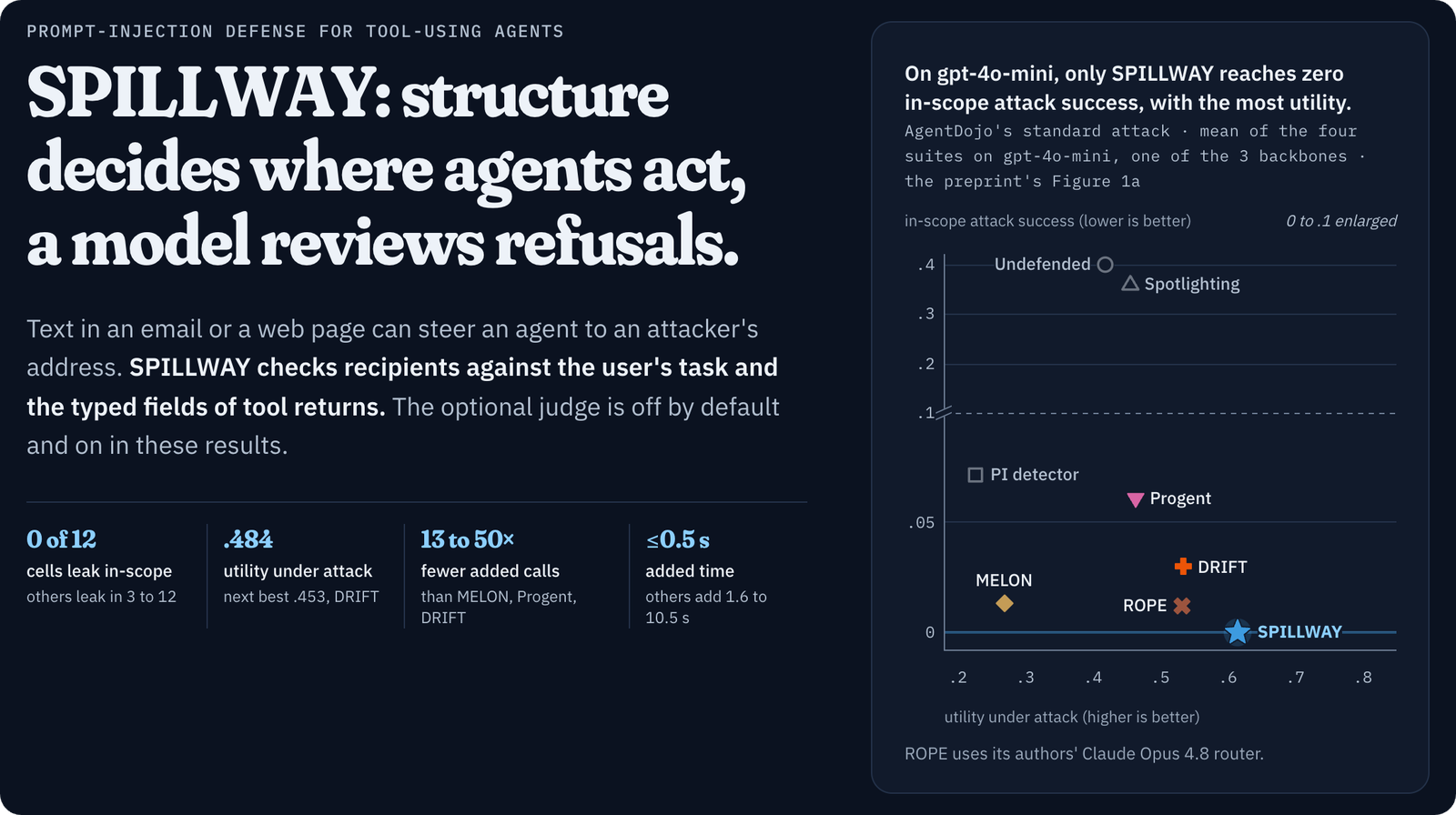
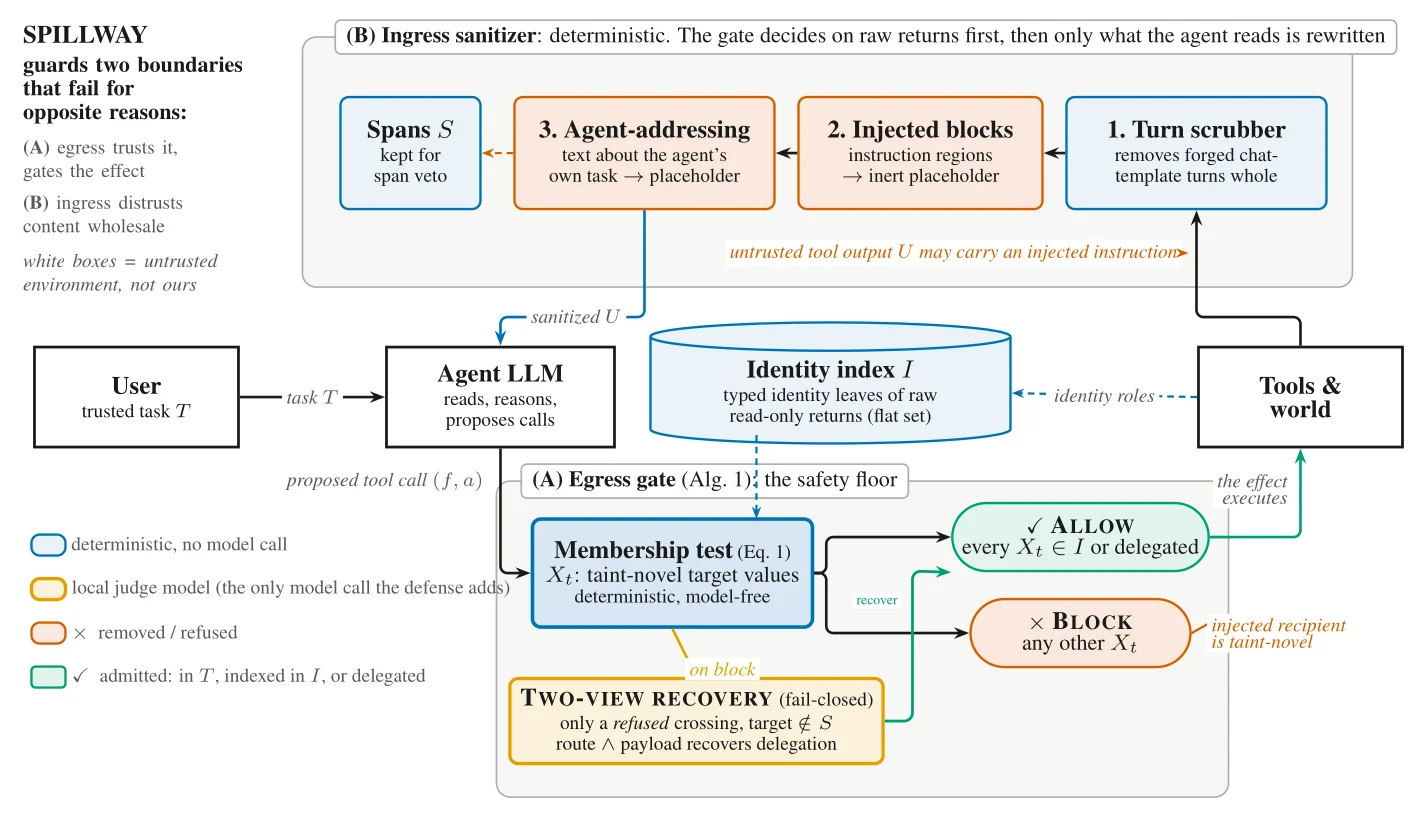
A prompt-injection defense for tool-using agents. A Python library with no model call by default.
Project page · Paper (arXiv) · Try it · Try in your browser · Connect an app · Reproduce · Cite · MUSTER




pip install spillway-guard
An earlier version was accepted at a NeurIPS 2026 workshop.

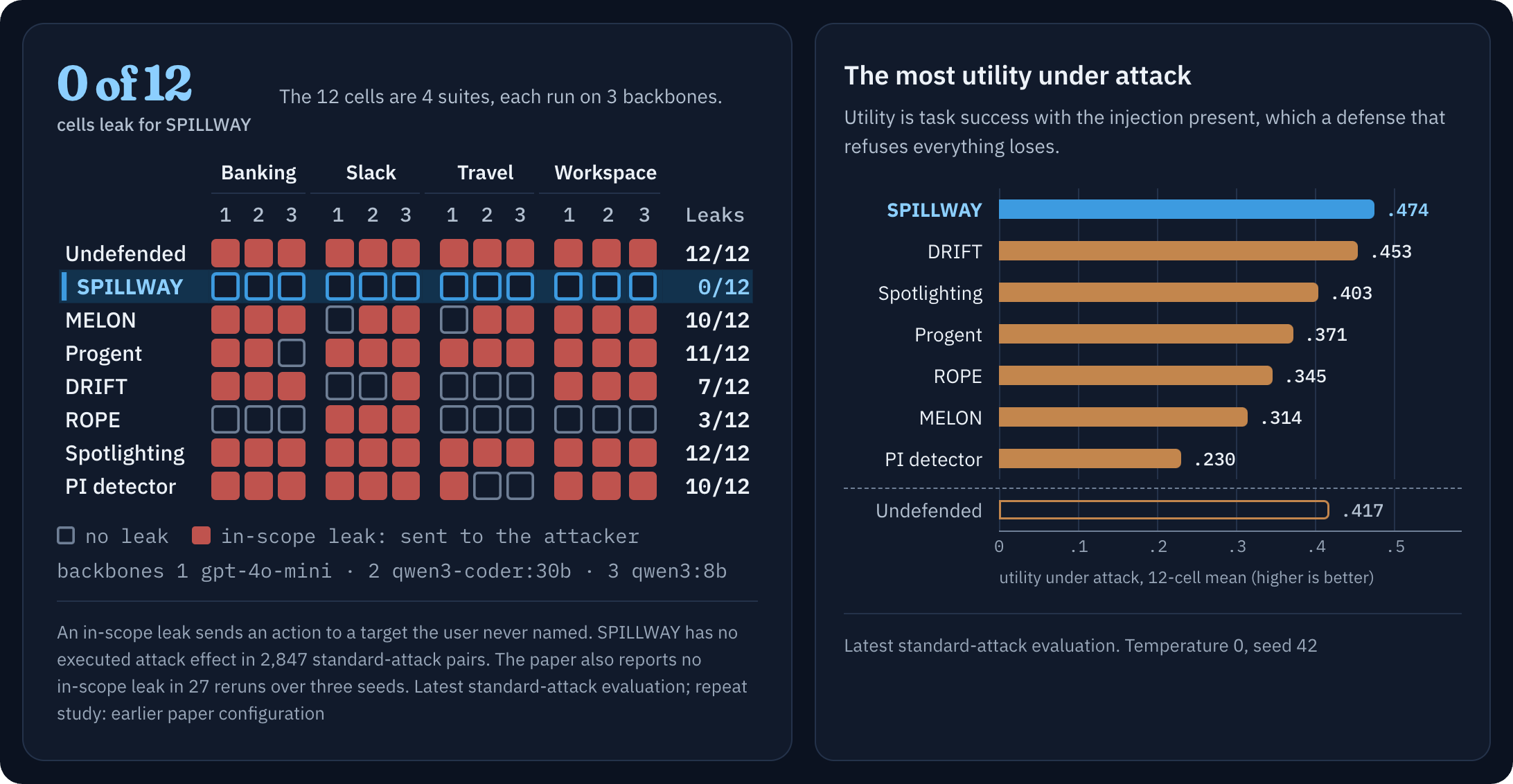
A backbone is the agent's model. An in-scope leak sends an action to a target the user never named. The count starts from AgentDojo's check, rescored by executed effect, and excludes a target the task already named and a content-only task that names no recipient or sink. Neither filter reads defense state.
AgentDojo v1.2.2, same backbone and scorer for every method. SPILLWAY's rows use the optional gemma4:31b judge, a local model that re-checks refused calls, off by default in the library. Values and conditions · Per-cell records · Stronger attacks · Without the judge.
| SPILLWAY | MELON | Progent | DRIFT | |
|---|---|---|---|---|
| The decision that lets an action through is made by | a set lookup over typed tool returns and the user's task, then fixed delegation rules and, if configured, a local judge on refusals | an LLM re-run of the trajectory with the user task masked | an LLM-written privilege policy enforced by a checker | an LLM validating each call against a plan |
| Added model calls per benign episode (qwen3:8b, Workspace / Slack) | 0.19 / 0.39 (judge included) | 3.25 / 5.29 backbone calls | 5.94 / 8.67 backbone calls | 9.59 / 9.91 backbone calls |
| AgentDojo cells with an in-scope leak (of 12) | 0 | 10 | 11 | 7 |






