mahgal/nginx-http2-rce-check
Responda 'estou exposto ao RCE do Nginx HTTP/2?' em um único comando — verifique sua versão do nginx e a configuração de HTTP/2 em relação a CVE-2026-123007 / CVE-2026-123633 (divulgado em 2026-11-18, CVSS 9.2).

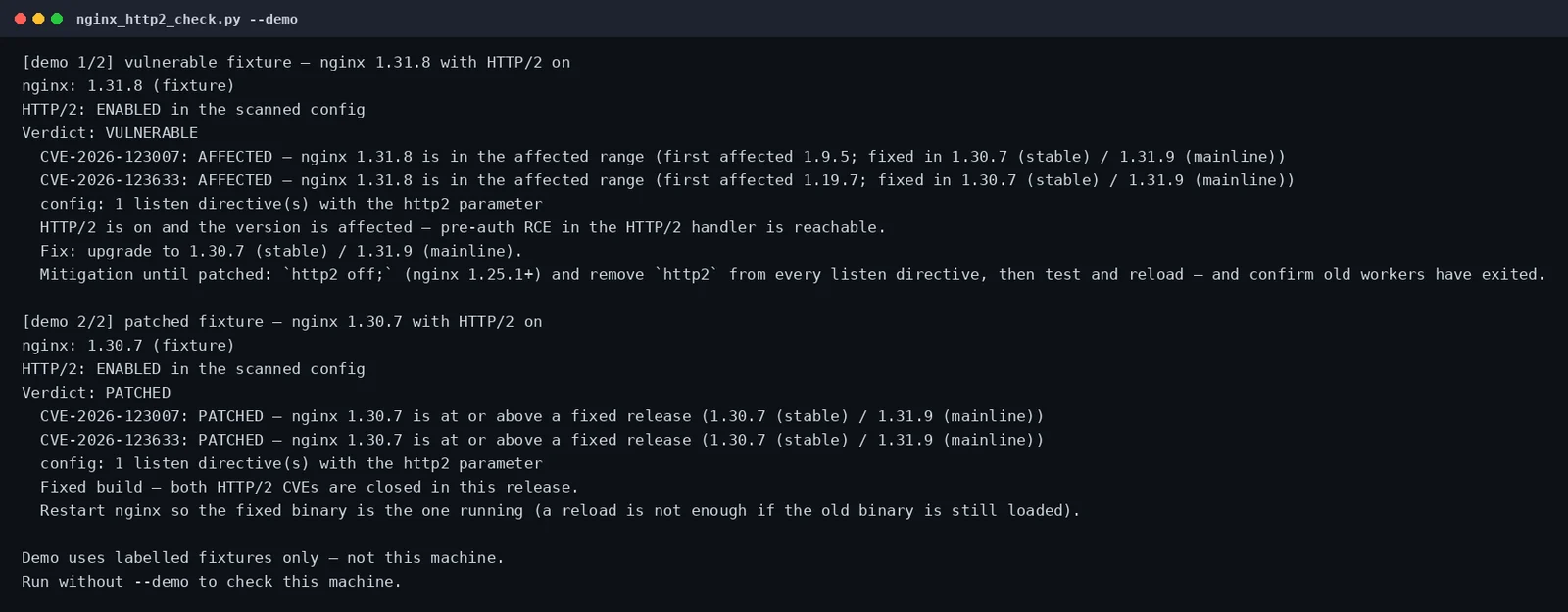
Responda "meu nginx está exposto ao par de RCEs de HTTP/2?" em 0,06 segundos — um comando, zero chamadas de rede, zero dependências.
Uma CLI em Python que usa apenas a biblioteca padrão e verifica as duas coisas que determinam se um host está exposto a CVE-2026-123007 e CVE-2026-123633: a versão do nginx e se o HTTP/2 está habilitado na configuração. Uma verificação real leva uma mediana de 0,062 s (7 execuções, medidas em 2026-11-19 nesta máquina) — mais rápido do que abrir a página do advisory. Sem payloads, sem varredura de rede, sem código de exploit: apenas um verificador defensivo.
Em 2026-11-18, Wiz, Ikotas Labs, Metnir, Rapid7 e Xint divulgaram duas falhas de execução remota de código não autenticada no tratamento de HTTP/2 do nginx — CVE-2026-123007 (underflow de inteiro no controle de fluxo do HTTP/2) e CVE-2026-123633 (use-after-free de HTTP/2 em conexões de proxy). Ambas são CVSS 4.0 9.2 (CVSS 3.1 8.1); o nginx.org classifica a 123007 como "major" e a 123633 como "medium". A notícia chegou ao #1 do Hacker News em 2026-11-19 (~1.152 pontos), e o nginx alimenta mais de 225 milhões de sites — então a janela de correção é medida em horas, não em semanas.
O que foi verificado a partir das fontes abaixo:
http2 off é uma medida paliativa para essas duas, não um substituto para a atualização.Fontes: Wiz write-up · deploybase explainer · IFIN advisory summary · nginx.org security advisories
git clone https://github.com/Mahgal/nginx-http2-rce-check.git
cd nginx-http2-rce-check
python3 nginx_http2_check.py              # check this machine
Sem instalações via pip, sem dependências — apenas Python 3. Experimente sem o nginx instalado:
python3 nginx_http2_check.py --demo      # labelled fixtures: 1 vulnerable, 1 patched
python3 nginx_http2_check.py --version 1.31.8 --config examples/nginx-http2-on.conf
python3 nginx_http2_check.py --version 1.30.7 --config examples/nginx-http2-on.conf
python3 nginx_http2_check.py --nginx-path examples/fake-nginx-vulnerable.sh --config examples/nginx-http2-on.conf
python3 nginx_http2_check.py --json      # machine-readable output for CI
Verificado a partir de uma cópia limpa (checkout novo em /tmp, 2026-11-19): --demo é executado e a suíte de testes completa passa, 40/40, saída 0.
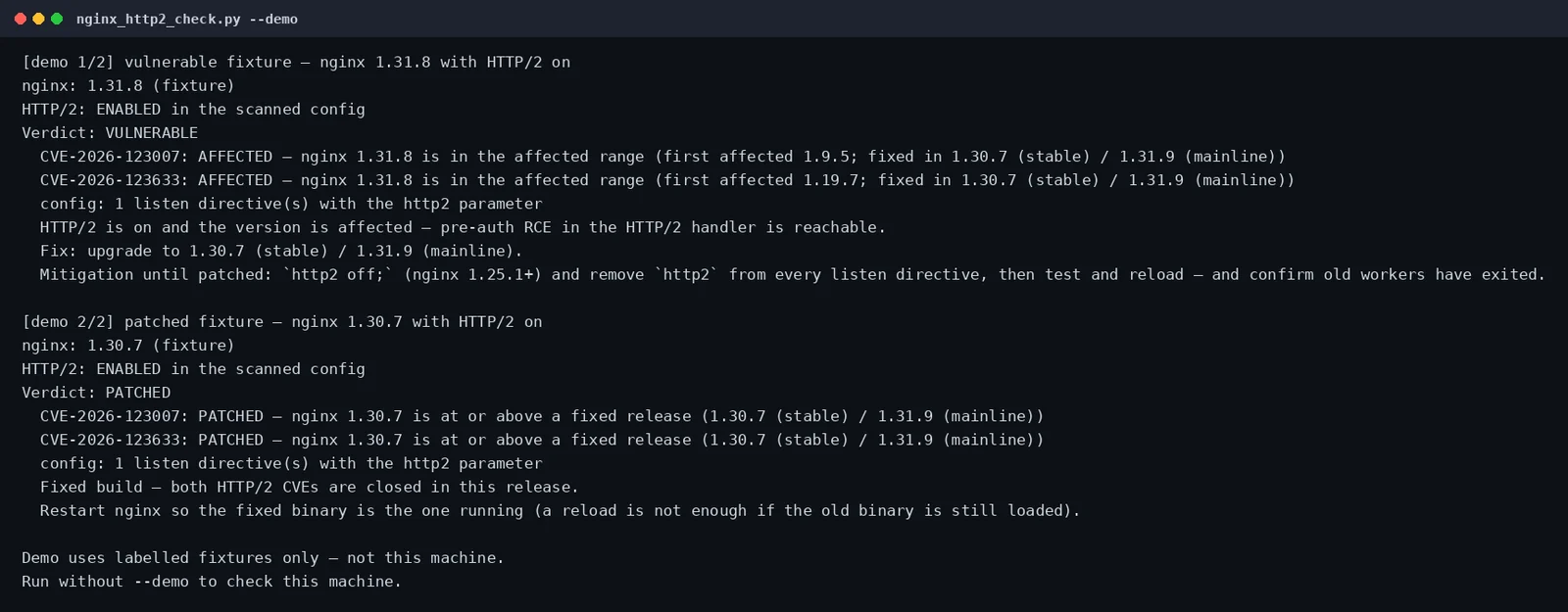
Saída real de python3 nginx_http2_check.py --demo (capturada literalmente em demo.txt; reexecuções a reproduzem byte a byte, sha256 e6a50babb87a98a704b802b3bbab6d5db6da256b45a45b9628ab1a930eae7f27):
[demo 1/2] vulnerable fixture — nginx 1.31.8 with HTTP/2 on
nginx: 1.31.8 (fixture)
HTTP/2: ENABLED in the scanned config
Verdict: VULNERABLE
  CVE-2026-123007: AFFECTED — nginx 1.31.8 is in the affected range (first affected 1.9.5; fixed in 1.30.7 (stable) / 1.31.9 (mainline))
  CVE-2026-123633: AFFECTED — nginx 1.31.8 is in the affected range (first affected 1.19.7; fixed in 1.30.7 (stable) / 1.31.9 (mainline))
  config: 1 listen directive(s) with the http2 parameter
  HTTP/2 is on and the version is affected — pre-auth RCE in the HTTP/2 handler is reachable.
  Fix: upgrade to 1.30.7 (stable) / 1.31.9 (mainline).
  Mitigation until patched: `http2 off;` (nginx 1.25.1+) and remove `http2` from every listen directive, then test and reload — and confirm old workers have exited.

[demo 2/2] patched fixture — nginx 1.30.7 with HTTP/2 on
nginx: 1.30.7 (fixture)
HTTP/2: ENABLED in the scanned config
Verdict: PATCHED
  CVE-2026-123007: PATCHED — nginx 1.30.7 is at or above a fixed release (1.30.7 (stable) / 1.31.9 (mainline))
  CVE-2026-123633: PATCHED — nginx 1.30.7 is at or above a fixed release (1.30.7 (stable) / 1.31.9 (mainline))
  config: 1 listen directive(s) with the http2 parameter
  Fixed build — both HTTP/2 CVEs are closed in this release.
  Restart nginx so the fixed binary is the one running (a reload is not enough if the old binary is still loaded).

Demo uses labelled fixtures only — not this machine.
Run without --demo to check this machine.
Os mesmos casos contra flags reais:
$ python3 nginx_http2_check.py --version 1.31.8 --config examples/nginx-http2-on.conf
Verdict: VULNERABLE        # exit 1 — HTTP/2 on, version affected
$ python3 nginx_http2_check.py --version 1.30.7 --config examples/nginx-http2-on.conf
Verdict: PATCHED           # exit 0 — same config, fixed build
$ python3 nginx_http2_check.py --version 1.31.8 --config examples/nginx-http2-off.conf
Verdict: NOT_AFFECTED      # exit 0 — HTTP/2 off closes both flaws
$ python3 nginx_http2_check.py --version 1.24.0-0ubuntu1 --config examples/nginx-http2-on.conf
Verdict: UNKNOWN           # exit 3 — distro package: version string says nothing
1.30.7 está corrigido, mas 1.31.0–1.31.8 ainda são vulneráveis. Uma verificação ingênua — "versão ≥ 1.30.7 significa segura" — consideraria a 1.31.8 segura. Ela não é. Esta ferramenta compara com intervalos explícitos por branch, nunca com um simples limite numérico:
| Versão | CVE-2026-123007 | CVE-2026-123633 |
|---|---|---|
| < 1.9.5 | não afetada | não afetada |
| 1.9.5 – 1.19.6 | afetada | não afetada |
| 1.19.7 – 1.30.6 | afetada | afetada |
| 1.30.7 (correção estável) | corrigida | corrigida |
| 1.31.0 – 1.31.8 | afetada | afetada |
| 1.31.9+ / 1.32.0+ (correção da mainline) | corrigida | corrigida |