 hahwul/urx
Extrai URLs de Arquivos de OSINT para Insights de Segurança


Extrai URLs de Arquivos OSINT para Insights de Segurança.




O Urx coleta URLs de um domínio a partir de arquivos OSINT, como o Wayback Machine e o Common Crawl. Ele consulta todas as fontes em paralelo e, em seguida, filtra, testa e formata os resultados para trabalhos de segurança.
--cdx-endpoint--from/--to, --archive-status, --archive-mime) executados dentro da consulta CDX--meta-*) por data de captura, tipo MIME e status, para todos os provedoresurx example.com/shop) e arquivos de escopo de bug bounty (--scope-file)--match-regex, --filter-regex) e presets (no-images, only-js, only-secrets, only-backup, only-config, only-api, only-tokens), além de presets próprios definidos no arquivo de configuração--normalize-url, --merge-endpoint, --dedup-similarwordlist; --stream grava as URLs conforme chegam--params, --params-by-endpoint, --fuzz-placeholder FUZZ para ffuf ou dalfoxfirst_seen, last_seen, mime, archive_status, digest--files) ou stdin--check-status, --check-title, --extract-links, --extract-js-endpoints--archive-body extrai links de páginas que não existem mais, uma requisição por corpo distinto; --archive-body-dir os mantém--expand-specs): OpenAPI 3.x, Swagger 2.0, introspecção GraphQL--archived-discovery)-H, --cookie, --user-agent), nunca enviadas aos arquivos--features redis-cache), varreduras --incremental, manutenção com urx cache e webhooks --notify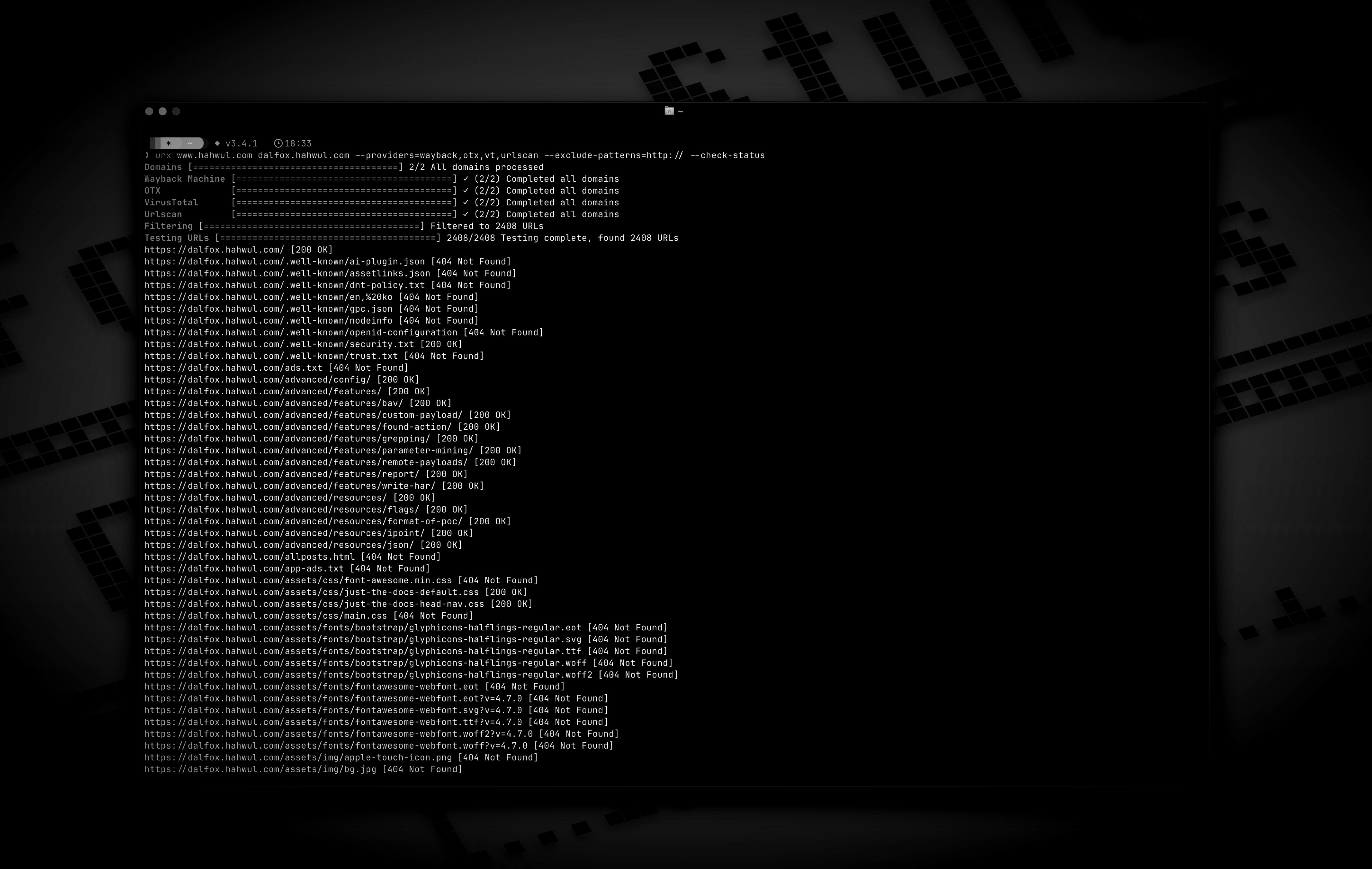
cargo install urx       # https://crates.io/crates/urx
brew install urx        # https://formulae.brew.sh/formula/urx
yay -S urx              # AUR
choco install urx       # Chocolatey (Windows)
Do código-fonte (binário em target/release/urx):
git clone https://github.com/hahwul/urx.git
cd urx
cargo build --release
Docker (ghcr.io/hahwul/urx). A imagem não possui entrypoint, então coloque ./urx após o nome da imagem:
docker run --rm ghcr.io/hahwul/urx:latest ./urx example.com
Binários pré-compilados para Linux, macOS e Windows, cada um com um .sha256, estão na página de releases.
Completions de shell (bash, zsh, fish, powershell, elvish) e a página de manual:
urx --completions zsh > ~/.zfunc/_urx        # ~/.zfunc must be on $fpath
urx --completions bash > ~/.local/share/bash-completion/completions/urx
urx --completions fish > ~/.config/fish/completions/urx.fish
urx --manpage > ~/.local/share/man/man1/urx.1
urx example.com                 # one domain
urx example.com example.org     # several domains
cat domains.txt | urx           # domains from stdin
Usage: urx [OPTIONS] [DOMAINS]... [COMMAND]

Commands:
  cache  Inspect and maintain the URL cache: stats, list, prune, drop <DOMAIN>..., clear

Arguments:
  [DOMAINS]...  Domains to fetch URLs for

Options:
  -c, --config <CONFIG>           Config file to load
      --provider-config <PATH>    Separate provider config file holding only API keys (default: ~/.config/urx/provider-config.toml; %APPDATA%\urx\ on Windows). CLI/env > provider-config > main config.
      --completions <SHELL>       Print a shell completion script (bash, zsh, fish, powershell, elvish) to stdout and exit
      --manpage                   Print the roff man page to stdout and exit
  -h, --help             Print help
  -V, --version          Print version

Input Options:
      --files <FILES>...        Read URLs directly from files (supports WARC, URLTeam compressed, and text files)
      --domain-list <PATH>      File of newline-separated domains to scan (repeatable; merged with positional DOMAINS; stdin is read only when they name no domains; `#` comments allowed) [alias: --dL]

Output Options:
  -o, --output <OUTPUT>          Output file to write results
      --output-dir <PATH>        Write one file per URL host into this directory (extension matches --format). Coexists with --output / stdout. [alias: --oD]
  -f, --format <FORMAT>          Output format: "plain", "json" (one array), "jsonl" (one JSON object per line), "csv", "wordlist" (path segments and parameter names, deduplicated and sorted); anything else is a usage error [default: plain]
      --stream           Write URLs as each provider reports them instead of once at the end (unsorted; bypasses cache; rejects options needing the full result set)
      --merge-endpoint   Merge endpoints with the same path and merge URL parameters
      --normalize-url    Normalize URLs for better deduplication (sorts query parameters, removes trailing slashes)
      --dedup-similar    Collapse URLs that differ only in variable data (numeric ids, UUIDs, hashes, dates, query values)
      --params           Replace the URL list with every query parameter name the run saw, once each
      --params-by-endpoint
                         One line per endpoint: the endpoint and the comma-separated union of the parameter names seen on it (id-looking path segments collapse to `{id}`)
      --fuzz-placeholder <VALUE>
                         Replace every query parameter value with VALUE, keeping one URL per parameter signature — output you can feed straight to ffuf or dalfox






