Skip to content
KitploitKITPLOIT
도구블로그
제출
도구블로그
제출

해킹, 침투 테스트 및 사이버 보안 도구를 당신의 보안 무기고에!

Kitploit은 해킹, 사이버 보안 및 침투 테스트 도구 디렉토리입니다. 최신 프로젝트 업데이트를 발견하여 취약점을 찾고, 시스템을 분석하고, 테스트를 자동화하고, 보안을 강화하세요.

··피드·문의·개인정보·© 2026 Kitploit

도구 디렉토리

카테고리

모든 카테고리 보기
Loading categories
chisel — SSH 암호화를 사용하는 HTTP 기반의 빠른 TCP/UDP 터널로, 역방향 포트 포워딩, SOCKS5 프록시, 클라이언트 인증을 지원하여 안전한 네트워크 통과 및 방화벽 우회를 가능하게 합니다. | Kitploit
도구/GitHubGitHub/jpillora/chisel
IDS/IPS EvasionNetwork SecurityPenetration TestingUtilities & FrameworksRed Teaming
GitHubjpillora/chisel

chisel

SSH 암호화를 사용하는 HTTP 기반의 빠른 TCP/UDP 터널로, 역방향 포트 포워딩, SOCKS5 프록시, 클라이언트 인증을 지원하여 안전한 네트워크 통과 및 방화벽 우회를 가능하게 합니다.

저장소 보기
16.4k1.6k12일 전Kitploit 검토 완료

인기

모두 보기 →

커뮤니티에서 가장 많이 사용되는 도구를 찾아보세요.

모든 도구 탐색

도구 컬렉션을 둘러보세요

모든 도구 보기 →
공유

Chisel

GoDoc CI

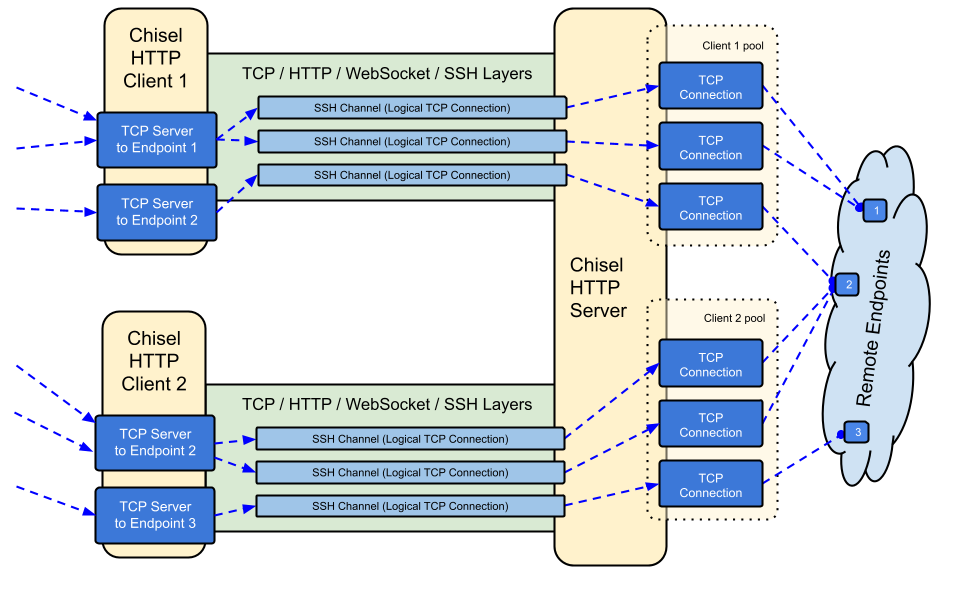
Chisel은 HTTP를 통해 전송되고 SSH로 보호되는 빠른 TCP/UDP 터널입니다. 클라이언트와 서버를 모두 포함하는 단일 실행 파일입니다. Go(golang)로 작성되었습니다. Chisel은 주로 방화벽을 우회하는 데 유용하며, 네트워크에 안전한 엔드포인트를 제공하는 데에도 사용할 수 있습니다.

overview

목차

  • 기능
  • 설치
  • 데모
  • 사용법
  • 기여
  • 변경 로그
  • 라이선스

기능

  • 사용하기 쉬움
  • 고성능*
  • SSH 프로토콜을 통한 암호화된 연결 (crypto/ssh 경유)
  • 인증된 연결; 사용자 구성 파일로 인증되는 클라이언트 연결, 지문 일치로 인증되는 서버 연결.
  • 클라이언트 자동 재연결 및 지수 백오프 (--min/max-retry-interval로 조정 가능); keepalive 핑이 타임아웃되므로 조용히 끊긴 연결(절전/재개, NAT 타임아웃, 서버 재시작)이 감지되어 다시 설정됩니다.
  • 클라이언트는 단일 TCP 연결을 통해 여러 터널 엔드포인트를 생성할 수 있습니다.
  • 클라이언트는 선택적으로 SOCKS 또는 HTTP CONNECT 프록시를 통과할 수 있습니다.
  • 역방향 포트 포워딩 (연결이 서버를 통과하여 클라이언트 밖으로 나갑니다)
  • 서버는 선택적으로 리버스 프록시 역할을 합니다.
  • 서버는 선택적으로 SOCKS5 연결을 허용합니다 (아래 가이드 참조)
  • 클라이언트는 선택적으로 역방향 포트 포워딩에서 SOCKS5 연결을 허용합니다.
  • ssh -o ProxyCommand를 지원하는 stdio를 통한 클라이언트 연결로 HTTP를 통한 SSH 제공


설치

바이너리

Releases Releases

최신 릴리스를 확인하거나 curl https://i.jpillora.com/chisel! | bash로 지금 바로 다운로드하여 설치하십시오.

바이너리는 최신 Go 릴리스로 빌드되며, 최소 OS 버전으로 Windows 10 / Server 2016, macOS 12, Linux 커널 3.2, FreeBSD 12.2가 설정됩니다. 이전 시스템(예: Windows 7)의 경우 릴리스 v1.8.1 이하를 사용하십시오.

Docker

Docker Pulls Image Size```sh docker run --rm -it jpillora/chisel --help

root@kitploit:~
Images are multi-arch and published to both Docker Hub (`jpillora/chisel`) and GitHub Container Registry (`ghcr.io/jpillora/chisel`).

### Fedora

The package is maintained by the Fedora community. If you encounter issues related to the usage of the RPM, please use this [issue tracker](https://bugzilla.redhat.com/buglist.cgi?bug_status=NEW&bug_status=ASSIGNED&classification=Fedora&component=chisel&list_id=11614537&product=Fedora&product=Fedora%20EPEL).```sh
sudo dnf -y install chisel

소스```sh

$ go install github.com/jpillora/chisel@latest

root@kitploit:~
## 데모

몇 분 안에 나만의 데모 서버를 실행할 수 있습니다 (기존 Heroku 데모는 Heroku의 무료 티어와 함께 사라졌습니다). [`example/fly.toml`](https://github.com/jpillora/chisel/blob/HEAD/example/fly.toml)는 이 `chisel server`를 [fly.io](https://fly.io)의 무료 허용량에 배포합니다:```sh
$ chisel server --port $PORT --backend http://example.com
# listens on $PORT, proxies normal web requests to http://example.com

example/ 디렉터리에서 fly launch --copy-config로 배포한 다음, 서버 옆에서 실행 중인 서비스로 터널링하세요, 예를 들어:```sh $ chisel client https://.fly.dev 3000

connects to your chisel server,

tunnels your localhost:3000 to the server's localhost:3000

root@kitploit:~
브라우저에서 앱의 URL을 방문하면 서버의 기본 백엔드 프록시를 거쳐 [example.com](http://example.com)의 복사본이 표시됩니다.

## 사용법

<!-- 이 도움말 텍스트를 직접 렌더링하거나,
  또는 https://github.com/jpillora/md-tmpl을
    $ md-tmpl -w README.md 와 함께 사용하세요. -->

<!--tmpl,code=plain:echo "$ chisel --help" && go run main.go --help | sed 's#0.0.0-src (go1\..*)#X.Y.Z#' -->``` plain 
$ chisel --help

  Usage: chisel [command] [--help]

  Version: X.Y.Z

  Commands:
    server - runs chisel in server mode
    client - runs chisel in client mode

  Read more:
    https://github.com/jpillora/chisel

``` plain

$ chisel server --help

Usage: chisel server [options]

Options:

root@kitploit:~
--host, Defines the HTTP listening host – the network interface
(defaults the environment variable HOST and falls back to 0.0.0.0).

--port, -p, Defines the HTTP listening port (defaults to the environment
variable PORT and falls back to port 8080).

--key, (deprecated use --keygen and --keyfile instead)
An optional string to seed the generation of a ECDSA public
and private key pair. All communications will be secured using this
key pair. Share the subsequent fingerprint with clients to enable detection
of man-in-the-middle attacks (defaults to the CHISEL_KEY environment
variable, otherwise a new key is generate each run).

--keygen, A path to write a newly generated PEM-encoded SSH private key file.
If users depend on your --key fingerprint, you may also include your --key to
output your existing key. Use - (dash) to output the generated key to stdout.

--keyfile, An optional path to a PEM-encoded SSH private key. When
this flag is set, the --key option is ignored, and the provided private key
is used to secure all communications. (defaults to the CHISEL_KEY_FILE
environment variable). Since ECDSA keys are short, you may also set keyfile
to the inline key string itself, exactly as printed by --keygen (a base64
string with a "ck-" prefix); no extra base64 encoding is needed.

--authfile, An optional path to a users.json file. This file should
be an object with users defined like:
  {
    "<user:pass>": ["<addr-regex>","<addr-regex>"]
  }
when <user> connects, their <pass> will be verified and then
each of the remote addresses will be compared against the list
of address regular expressions for a match. Patterns are NOT
anchored by default: "10.0.0.1:80" also matches
"210.0.0.1:8080", and "." matches any character. Anchor your
patterns, e.g. "^10\.0\.0\.1:80$". The empty string ""
matches every address. Addresses will
always come in the form "<remote-host>:<remote-port>" for normal remotes,
"R:<local-interface>:<local-port>" for reverse port forwarding
remotes, and "socks" for SOCKS5 proxy access. Note that SOCKS5
access previously bypassed this list; existing authfiles which
should allow SOCKS5 must add an entry matching "socks" (the
empty wildcard "" matches everything, including "socks"). This
file will be automatically reloaded on change. Reloads apply
to new connections and to new tunnels of connected clients;
established tunnels are not interrupted.

--auth, An optional string representing a single user with full
access, in the form of <user:pass>. It is equivalent to creating an
authfile with {"<user:pass>": [""]}. If unset, it will use the
environment variable AUTH.

--keepalive, An optional keepalive interval. Since the underlying
transport is HTTP, in many instances we'll be traversing through
proxies, often these proxies will close idle connections. You must
specify a time with a unit, for example '5s' or '2m'. Defaults
to '25s' (set to 0s to disable).

--backend, Specifies another HTTP server to proxy requests to when
chisel receives a normal HTTP request. Useful for hiding chisel in
plain sight. --proxy is accepted as an alias for this flag.

--socks5, Allow clients to access the internal SOCKS5 proxy. See
chisel client --help for more information.

--reverse, Allow clients to specify reverse port forwarding remotes
in addition to normal remotes.

--tls-key, Enables TLS and provides optional path to a PEM-encoded
TLS private key. When this flag is set, you must also set --tls-cert,
and you cannot set --tls-domain.

--tls-cert, Enables TLS and provides optional path to a PEM-encoded
TLS certificate. When this flag is set, you must also set --tls-key,
and you cannot set --tls-domain.

--tls-domain, Enables TLS and automatically acquires a TLS key and
certificate using LetsEncrypt. Setting --tls-domain requires port 443.
You may specify multiple --tls-domain flags to serve multiple domains.
The resulting files are cached in the "$HOME/.cache/chisel" directory.
You can modify this path by setting the CHISEL_LE_CACHE variable,
or disable caching by setting this variable to "-". You can optionally
provide a certificate notification email by setting CHISEL_LE_EMAIL.

--tls-ca, a path to a PEM encoded CA certificate bundle or a directory
holding multiple PEM encode CA certificate bundle files, which is used to 
validate client connections. The provided CA certificates will be used 
instead of the system roots. This is commonly used to implement mutual-TLS. 

--pid Generate pid file in current working directory

-v, Enable verbose logging

--help, This help text

Signals: The chisel process is listening for: a SIGINT or SIGTERM to begin a graceful shutdown (a second signal forces an immediate exit), a SIGUSR2 to print process stats, and a SIGHUP to short-circuit the client reconnect timer

Version: X.Y.Z

Read more: https://github.com/jpillora/chisel

root@kitploit:~
<!--/tmpl-->


<!--tmpl,code=plain:echo "$ chisel client --help" && go run main.go client --help | sed 's#0.0.0-src (go1\..*)#X.Y.Z#' -->``` plain 
$ chisel client --help

  Usage: chisel client [options] <server> <remote> [remote] [remote] ...

  <server> is the URL to the chisel server.

  <remote>s are remote connections tunneled through the server, each of
  which come in the form:

    <local-host>:<local-port>:<remote-host>:<remote-port>/<protocol>

    ■ local-host defaults to 0.0.0.0 (all interfaces).
    ■ local-port defaults to remote-port.
    ■ remote-port is required*.
    ■ remote-host defaults to 127.0.0.1 (server localhost).
    ■ protocol defaults to tcp.

  which shares <remote-host>:<remote-port> from the server to the client
  as <local-host>:<local-port>, or:

    R:<local-interface>:<local-port>:<remote-host>:<remote-port>/<protocol>

  which does reverse port forwarding, sharing <remote-host>:<remote-port>
  from the client to the server's <local-interface>:<local-port>.

    example remotes

      3000
      example.com:3000
      3000:google.com:80
      192.168.0.5:3000:google.com:80
      socks
      5000:socks
      R:2222:localhost:22
      R:socks
      R:5000:socks
      stdio:example.com:22
      1.1.1.1:53/udp

    When the chisel server has --socks5 enabled, remotes can
    specify "socks" in place of remote-host and remote-port.
    The default local host and port for a "socks" remote is
    127.0.0.1:1080. Connections to this remote will terminate
    at the server's internal SOCKS5 proxy. When the server also
    has --authfile set, SOCKS5 access requires an entry matching
    the token "socks" in the user's address list.

    When the chisel server has --reverse enabled, remotes can
    be prefixed with R to denote that they are reversed. That
    is, the server will listen and accept connections, and they
    will be proxied through the client which specified the remote.
    Reverse remotes specifying "R:socks" will listen on the server's
    default socks port (1080) and terminate the connection at the
    client's internal SOCKS5 proxy.

    When stdio is used as local-host, the tunnel will connect standard
    input/output of this program with the remote. This is useful when 
    combined with ssh ProxyCommand. You can use
      ssh -o ProxyCommand='chisel client chiselserver stdio:%h:%p' \
          [email protected]
    to connect to an SSH server through the tunnel.

  Options:

    --fingerprint, A *strongly recommended* fingerprint string
    to perform host-key validation against the server's public key.
    Fingerprint mismatches will close the connection.
    Fingerprints are generated by hashing the ECDSA public key using
    SHA256 and encoding the result in base64.
    Fingerprints must be 44 characters containing a trailing equals (=).
    Legacy MD5 colon fingerprints (deprecated) are still accepted,
    but only in their full 16-octet form; truncated prefixes are
    rejected.

    --auth, An optional username and password (client authentication)
    in the form: "<user>:<pass>". These credentials are compared to
    the credentials inside the server's --authfile. defaults to the
    AUTH environment variable.

    --keepalive, An optional keepalive interval. Since the underlying
    transport is HTTP, in many instances we'll be traversing through
    proxies, often these proxies will close idle connections. You must
    specify a time with a unit, for example '5s' or '2m'. Defaults
    to '25s' (set to 0s to disable).

    --max-retry-count, Maximum number of times to retry before exiting.
    Defaults to unlimited.

    --min-retry-interval, Minimum wait time before retrying after a
    disconnection. Defaults to 1 second.

    --max-retry-interval, Maximum wait time before retrying after a
    disconnection. Defaults to 5 minutes.

    --proxy, An optional HTTP CONNECT or SOCKS5 proxy which will be
    used to reach the chisel server. Authentication can be specified
    inside the URL. Credentials must be URL-encoded; for example a
    "#" in the password must be written as "%23".
    For example, http://admin:[email protected]:8081
            or: socks://admin:[email protected]:1080
    The socks://, socks5:// and socks5h:// schemes are equivalent:
    DNS is always resolved by the proxy.

    --header, Set a custom header in the form "HeaderName: HeaderContent".
    Can be used multiple times. (e.g --header "Foo: Bar" --header "Hello: World")

    --hostname, Optionally set the 'Host' header (defaults to the host
    found in the server url).

    --sni, Override the ServerName when using TLS (defaults to the 
    hostname).

    --tls-ca, An optional root certificate bundle used to verify the
    chisel server. Only valid when connecting to the server with
    "https" or "wss". By default, the operating system CAs will be used.

    --tls-skip-verify, Skip server TLS certificate verification of
    chain and host name (if TLS is used for transport connections to
    server). If set, client accepts any TLS certificate presented by
    the server and any host name in that certificate. This only affects
    transport https (wss) connection. Chisel server's public key
    may be still verified (see --fingerprint) after inner connection
    is established.

    --tls-key, a path to a PEM encoded private key used for client 
    authentication (mutual-TLS).

    --tls-cert, a path to a PEM encoded certificate matching the provided 
    private key. The certificate must have client authentication 
    enabled (mutual-TLS).

    --pid Generate pid file in current working directory

    -v, Enable verbose logging

    --help, This help text

  Signals:
    The chisel process is listening for:
      a SIGINT or SIGTERM to begin a graceful shutdown
        (a second signal forces an immediate exit),
      a SIGUSR2 to print process stats, and
      a SIGHUP to short-circuit the client reconnect timer

  Version:
    X.Y.Z

  Read more:
    https://github.com/jpillora/chisel

보안

암호화는 항상 활성화됩니다. chisel 서버를 시작하면 메모리 내 ECDSA 공개/개인 키 쌍이 생성됩니다. 공개 키 지문(base64로 인코딩된 SHA256)은 서버가 시작될 때 표시됩니다. 서버는 임의의 키를 생성하는 대신 --keyfile 옵션을 사용하여 키 파일을 지정할 수도 있습니다. 클라이언트가 연결되면 서버의 공개 키 지문도 표시됩니다. 클라이언트는 --fingerprint 옵션을 사용하여 특정 지문을 강제할 수 있습니다. 레거시 MD5 지문은 여전히 허용되지만 전체 16옥텟 콜론 형식이어야 하며, 잘린 접두사는 거부됩니다. 자세한 내용은 위의 --help를 참조하세요.

또한 서버는 인증 전에 인바운드 websocket 메시지 크기를 제한합니다(CHISEL_WS_READ_LIMIT, 기본값 512 KiB). 따라서 인증되지 않은 피어가 과도하게 큰 메시지로 메모리를 소진시킬 수 없습니다. 기본값은 x/crypto/ssh의 최대 전송 패킷 256 KiB보다 충분히 높게 설정되어 있어 유효한 SSH 패킷이 거부되지 않습니다. 0만이 제한을 비활성화하며, 음수 값은 안전한 기본값으로 대체됩니다.

인증

--authfile 옵션을 사용하여 서버는 허용된 사용자 목록을 생성하는 user.json 구성 파일을 선택적으로 제공할 수 있습니다. 클라이언트는 --auth 옵션을 사용하여 인증합니다. 인증 구성 파일의 예는 users.json을 참조하세요. 자세한 내용은 위의 --help를 참조하세요.

authfile 동작에 대한 참고 사항:

  • 파일은 모니터링되며 실시간으로 다시 로드됩니다 — vim의 이름 변경 저장 및 kubernetes configmap 업데이트를 포함합니다. 다시 로드는 새 연결과 이미 연결된 클라이언트의 새 터널에 적용됩니다. 제거된 사용자는 새 터널에 즉시 접근할 수 없지만, 기존 터널은 중단되지 않습니다.
  • 주소 패턴은 정규 표현식이며 앵커 처리되지 않습니다 — ^와 $로 앵커 처리하세요(서버는 로드 시 앵커 처리되지 않은 패턴에 대해 경고합니다). 빈 문자열 ""은 모든 것과 일치합니다.
  • SOCKS5 접근은 socks 토큰과 일치하는 항목에 의해 제어됩니다. 주요 변경 사항: SOCKS5는 이전에 authfile을 완전히 우회했습니다. --authfile과 함께 --socks5를 실행하는 서버는 프록시 접근 권한을 유지해야 하는 사용자에게 socks를 부여해야 합니다(와일드카드 "" 항목은 계속 작동합니다).
  • 콜론이 없는 인증 문자열(user:pass)은 이제 서버와 클라이언트 모두에서 치명적인 시작 오류입니다 — 이전에는 자동으로 인증을 비활성화했습니다.
  • --auth 사용자는 authfile 다시 로드 후에도 유지되며 파일 사용자와 이름이 충돌할 때 우선합니다.

내부적으로 이는 SSH에서 제공하는 Password 인증 방법을 사용하여 수행됩니다. crypto/ssh에 대해 자세히 알아보려면 http://blog.gopheracademy.com/go-and-ssh/를 참조하세요. 세션 열기/닫기(사용자, 소스 주소 및 원격지 포함)와 실패한 로그인 시도는 정보 수준으로 기록됩니다.

TLS 가이드

가장 간단한 보안 설정은 --tls-domain으로, LetsEncrypt 인증서를 자동으로 프로비저닝합니다(포트 443과 서버를 가리키는 DNS 레코드 필요).```sh chisel server --port 443 --tls-domain chisel.example.com --auth user:pass chisel client --auth user:pass https://chisel.example.com R:2222:localhost:22

root@kitploit:~
자체 서명 또는 내부 CA 인증서를 사용하려면 키/인증서 쌍을 생성하고 양쪽에서 올바른 파일을 가리키도록 하십시오:```sh
chisel server --port 443 --tls-key key.pem --tls-cert cert.pem
chisel client --tls-ca ca.pem https://chisel.example.com 3000

For mutual TLS, also pass --tls-ca to the server and --tls-cert/--tls-key to each client. Note that TLS wraps chisel's transport from the outside; the inner SSH layer still encrypts and authenticates, so --fingerprint validation works with or without TLS.

Docker를 이용한 SOCKS5 가이드

  1. 새 개인 키를 터미널에 출력합니다

    root@kitploit:~
    chisel server --keygen -
    # or save it to disk --keygen /path/to/mykey
    
  2. chisel 서버를 시작합니다

    root@kitploit:~
    jpillora/chisel server --keyfile '<ck-base64 string or file path>' -p 9312 --socks5
    
  3. chisel 클라이언트를 연결합니다(서버의 지문 사용)

    root@kitploit:~
    chisel client --fingerprint '<see server output>' <server-address>:9312 socks
    
  4. SOCKS5 클라이언트(예: OS/브라우저)를 다음 주소로 지정합니다:

    root@kitploit:~
    <client-address>:1080
    
  5. 이제 HTTP를 통한 암호화되고 인증된 SOCKS5 연결이 완성됩니다

참고: 서버가 --authfile도 사용하는 경우, 사용자가 프록시를 사용하려면 socks 토큰과 일치하는 항목이 필요합니다(인증 참조).

인증 파일을 사용한 역방향 SOCKS

특정 클라이언트가 SOCKS 종료 노드로 동작하게 하려면, 해당 클라이언트에 역방향 SOCKS 리스너 주소를 부여하세요(R:socks는 서버의 127.0.0.1:1080에서 수신 대기합니다):```json { "exituser:password": ["^R:127\.0\.0\.1:1080$"] }

root@kitploit:~
Input content is missing. Please provide the Markdown text for translation.```sh
chisel server --reverse --authfile users.json
chisel client --auth exituser:password <server-address> R:socks
# server-side consumers point SOCKS5 clients at 127.0.0.1:1080,
# and their traffic exits via the chisel client's network

단계별 역방향 터널링 예제도 참조하세요.

CDN(Cloudflare) 뒤에서 실행하기

chisel은 WebSockets을 지원하는 CDN을 통해 작동합니다. Cloudflare의 경우: WebSockets을 활성화하고, DNS 레코드를 프록시(주황색 구름)로 설정한 다음, 클라이언트를 https://로 연결하세요. CDN이 TLS를 종료하지만, 내부 SSH 계층 덕분에 --fingerprint 검증은 여전히 chisel 서버를 종단 간 인증합니다 — CDN은 터널링된 트래픽을 읽거나 수정할 수 없습니다. --keepalive를 기본값인 25s로 유지하여 CDN 유휴 시간 초과를 피하고, Upgrade 헤더를 제거하는 프록시는 chisel을 전혀 전달할 수 없다는 점에 유의하세요.

환경 변수로 튜닝하기

자주 쓰이지 않는 설정은 환경 변수로 제공되며, 모두 CHISEL_ 접두사로 읽습니다(예: CHISEL_WS_TIMEOUT=10s):

HOST, PORT, AUTH, CHISEL_KEY/CHISEL_KEY_FILE은 위의 --help 텍스트에 문서화되어 있습니다.

주의사항

WebSockets 지원이 필요하므로:

  • IaaS 제공업체는 모두 WebSockets을 지원합니다(단, 앞에 WebSockets을 지원하지 않는 HTTP 프록시가 강제로 배치된 경우는 예외입니다. 그런 경우에는 PaaS로 강등된 것이라고 볼 수 있습니다)
  • PaaS 제공업체는 WebSockets 지원이 제각각입니다
    • Heroku는 완전히 지원합니다
    • Openshift는 완전히 지원하지만 연결은 8443 및 8080 포트에서만 수락됩니다
    • Google App Engine 표준 환경은 지원하지 않습니다(유연한 환경은 지원함)

기여하기

  • http://golang.org/doc/code.html
  • http://golang.org/doc/effective_go.html
  • github.com/jpillora/chisel/share에는 공유 패키지가 포함되어 있습니다
  • github.com/jpillora/chisel/server에는 서버 패키지가 포함되어 있습니다
  • github.com/jpillora/chisel/client에는 클라이언트 패키지가 포함되어 있습니다

변경 로그

  • 1.0 - 최초 릴리스
  • 1.1 - 단순 대칭 암호화를 ECDSA SSH로 대체
  • 1.2 - SOCKS5(서버) 및 HTTP CONNECT(클라이언트) 지원 추가
  • 1.3 - 역방향 터널링 지원 추가
  • 1.4 - 임의 HTTP 헤더 지원 추가
  • 1.5 - 역방향 SOCKS 지원 추가(@aus 작성)
  • 1.6 - 클라이언트 stdio 지원 추가(@BoleynSu 작성)
  • 1.7 - UDP 지원 추가
  • 1.8 - scratch Docker 이미지로 전환
  • 1.9 - Go 1.21로 업그레이드. --key 시드에서 --key{gen,file}을 사용하는 P256 키 문자열로 전환(@cmenginnz 작성)
  • 1.10 - Go 1.22로 업그레이드. 릴리스에 , , 추가. 잘못된 버전 비교 수정.

1.12로 업그레이드하기

1.11.x 이하에서 업그레이드할 때 다음 네 가지 변경 사항에 대한 조치가 필요할 수 있습니다:

  1. SOCKS5 + --authfile (v1.11.7부터 적용): 프록시 액세스를 유지해야 하는 사용자는 socks 토큰과 일치하는 authfile 항목이 필요합니다(와일드카드 ""는 계속 작동). 인증을 참조하세요. 거부된 요청은 서버 측에 Denied connection to socks (ACL)로 기록됩니다.
  2. --fingerprint: 잘린 레거시 MD5 지문은 거부됩니다. 서버와 클라이언트가 출력하는 전체 SHA256 지문을 사용하세요(전체 16-옥텟 MD5 콜론 형식은 여전히 허용되지만 더 이상 권장되지 않습니다).
  3. --auth 값은 <user>:<pass> 형식이어야 합니다 — 콜론이 없는 문자열은 이제 조용히 인증을 비활성화하는 대신 시작 시 실패합니다.
  4. 종료 코드: --max-retry-count를 사용하는 chisel client는 연결 시도가 소진되면 이제 0이 아닌 코드로 종료합니다. $?를 확인하는 스크립트와 systemd Restart=on-failure 유닛은 이를 인지하게 됩니다.

라이선스

MIT © Jaime Pillora

도구 다운로드
변수측기본값용도
WS_TIMEOUT클라이언트45swebsocket 핸드셰이크 시간 초과
SSH_TIMEOUT클라이언트30sssh 핸드셰이크 시간 초과
CONFIG_TIMEOUT서버10s클라이언트의 구성 요청 대기 시간
SSH_WAIT양쪽35s새 터널이 활성 연결을 기다리는 시간
PING_TIMEOUT양쪽keepalive 간격keepalive ping 응답 시간 초과(--keepalive 0이면 ping 없음)
DIAL_TIMEOUT출구 노드30s터널 대상에 대한 tcp 다이얼 시간 초과
WS_READ_LIMIT양쪽524288최대 인바운드 websocket 메시지 바이트(0 = 제한 없음, 음수 = 기본값)
WS_BUFF_SIZE양쪽Go 기본값websocket 읽기/쓰기 버퍼 크기
UDP_MAX_SIZE양쪽9012최대 udp 패킷 바이트
UDP_DEADLINE출구 노드15sudp 흐름 읽기 마감 시간 및 유휴 정리 기간
UDP_MAX_CONNS출구 노드100터널당 최대 동시 udp 흐름 수
SHUTDOWN_GRACE서버5s종료 시 http 요청 드레이닝 시간
.rpm
.deb
.apk
  • 1.11 - Go 1.25.1로 업그레이드. 모든 의존성 업데이트.
  • 1.12 - (미출시) 안정성 및 보안 개선:
    • keepalive ping은 이제 시간 초과되므로(CHISEL_PING_TIMEOUT), 절전/복귀, NAT 시간 초과 및 서버 재시작 후 끊어진 연결이 즉시 재연결됩니다
    • authfile 리로드는 편집기의 파일명 변경과 kubernetes configmap 교체 후에도 유지되며, 연결된 클라이언트에 실시간으로 적용됩니다(새 터널에 적용되고 기존 터널은 중단되지 않습니다)
    • 호환성 변경: --socks5 + --authfile 사용 시 SOCKS5 액세스에는 이제 socks와 일치하는 authfile 항목이 필요합니다(와일드카드 "" 항목은 계속 작동)
    • 호환성 변경: 잘린 레거시 MD5 지문은 거부됩니다 — --fingerprint는 전체 SHA256 형식(또는 전체 16-옥텟 MD5 콜론 형식)이어야 합니다
    • 호환성 변경: 콜론이 없는 인증 문자열(예: --auth user)은 조용히 인증을 비활성화하는 대신 치명적인 시작 오류가 됩니다
    • TCP half-close는 터널을 통해 전파되며, 도달할 수 없는 대상은 죽은 연결을 제공하는 대신 터널을 거부합니다(CHISEL_DIAL_TIMEOUT, 기본값 30s)
    • SIGTERM 시 HTTP 요청 드레이닝과 함께 정상 종료합니다(CHISEL_SHUTDOWN_GRACE). 두 번째 신호는 강제 종료됩니다
    • UDP 출구 노드는 더 이상 100개가 넘는 동시 흐름에서 중단되거나 누출되지 않습니다(CHISEL_UDP_MAX_CONNS)
    • 인바운드 websocket 메시지는 인증 전에 크기가 제한됩니다(CHISEL_WS_READ_LIMIT)
    • 서버는 클라이언트가 SSH 핸드셰이크와 구성 요청 사이에 연결을 끊어도 더 이상 패닉하지 않습니다(#608)
    • 클라이언트는 --max-retry-count가 소진되면 0이 아닌 코드로 종료합니다. 새 --min-retry-interval(기본값 1s) 추가. --proxy에 socks5:// 허용
    • go install 빌드는 실제 버전을 보고합니다. 세션 및 실패한 로그인은 info 수준으로 기록됩니다
    • 이제 릴리스에는 올바른 버전이 기록된 goreleaser 빌드 멀티 아키텍처 Docker 이미지가 GHCR과 Docker Hub에 게시됩니다. 릴리스는 2단계로 진행됩니다 — 태그를 지정하면 초안 GitHub 릴리스와 버전 태그가 지정된 이미지가 빌드되고, 초안을 게시하면 Docker latest / X / X.Y 태그가 승격됩니다