
Skip to content
KitploitKITPLOIT
도구익스플로잇블로그
Log in
제출
도구익스플로잇블로그
제출

해킹, 침투 테스트 및 사이버 보안 도구를 당신의 보안 무기고에!

Kitploit은 해킹, 사이버 보안 및 침투 테스트 도구 디렉토리입니다. 최신 프로젝트 업데이트를 발견하여 취약점을 찾고, 시스템을 분석하고, 테스트를 자동화하고, 보안을 강화하세요.

피드문의개인정보© 2026 Kitploit

도구 디렉토리

카테고리

모든 카테고리 보기
Loading categories
offensive-ai-compilation — Offensive AI를 다루는 유용한 리소스의 선별된 목록 | Kitploit
도구/GitHubGitHub/jiep/offensive-ai-compilation
OSINT (Open Source Intelligence)PhishingPenetration TestingMachine LearningPapers & ResearchCurated ResourcesAI SecurityAdversarial AttackPapers & Research #10위
1.4k1769113일 전Kitploit 검토 완료

인기

모두 보기 →

커뮤니티에서 가장 많이 사용되는 도구를 찾아보세요.

모든 도구 탐색

도구 컬렉션을 둘러보세요

모든 도구 보기 →
공유
GitHub
jiep/offensive-ai-compilation

offensive-ai-compilation

Offensive AI를 다루는 유용한 리소스의 선별된 목록

저장소 보기웹사이트
요청한 언어로 콘텐츠를 사용할 수 없습니다. 영어 버전을 표시합니다.

Offensive AI Compilation

A curated list of useful resources that cover Offensive AI.

📁 Contents 📁

  • 🚫 Abuse 🚫
    • 🧠 Adversarial Machine Learning 🧠
      • ⚡ Attacks ⚡
        • 🔒 Extraction 🔒
          • ⚠️ Limitations ⚠️
          • 🛡️ Defensive actions 🛡️
          • 🔗 Useful links 🔗
        • ⬅️ Inversion (or inference) ⬅️
          • 🛡️ Defensive actions 🛡️
          • 🔗 Useful links 🔗
        • 💉 Poisoning 💉
          • 🔓 Backdoors 🔓
          • 🛡️ Defensive actions 🛡️
          • 🔗 Useful links 🔗
        • 🏃‍♂️ Evasion 🏃‍♂️
          • 🛡️ Defensive actions 🛡️
          • 🔗 Useful links 🔗
      • 🛠️ Tools 🛠️
        • ART
        • Cleverhans
  • 🔧 Use 🔧
    • 🕵️‍♂️ Pentesting 🕵️‍♂️
    • 🦠 Malware 🦠
    • 🗺️ OSINT 🗺️
    • 📧 Phishing 📧
    • 👨‍🎤 Generative AI 👨‍🎤
      • 🔊 Audio 🔊
        • 🛠️ Tools 🛠️
        • 💡 Applications 💡
        • 🔎 Detection 🔎
      • 📷 Image 📷
        • 🛠️ Tools 🛠️
        • 💡 Applications 💡
        • 🔎 Detection 🔎
      • 🎥 Video 🎥
        • 🛠️ Tools 🛠️
        • 💡 Applications 💡
        • 🔎 Detection 🔎
      • 📄 Text 📄
        • 🛠️ Tools 🛠️
        • 🔎 Detection 🔎
        • 💡 Applications 💡
    • 📚 Misc 📚
  • 📊 Surveys 📊
  • 🗣 Contributors 🗣
  • ©️ License ©️

🚫 Abuse 🚫

Exploiting the vulnerabilities of AI models.

🧠 Adversarial Machine Learning 🧠

Adversarial Machine Learning is responsible for assessing their weaknesses and providing countermeasures.

⚡ Attacks ⚡

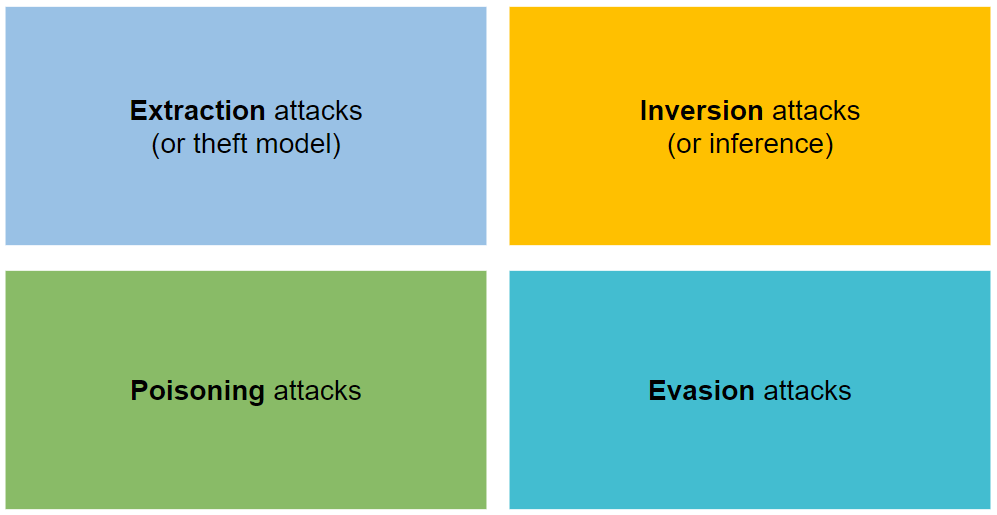
It is organized into four types of attacks: extraction, inversion, poisoning and evasion.

Adversarial Machine Learning attacks

🔒 Extraction 🔒

It tries to steal the parameters and hyperparameters of a model by making requests that maximize the extraction of information.

Extraction attack

Depending on the knowledge of the adversary's model, white-box and black-box attacks can be performed.

In the simplest white-box case (when the adversary has full knowledge of the model, e.g., a sigmoid function), one can create a system of linear equations that can be easily solved.

In the generic case, where there is insufficient knowledge of the model, the substitute model is used. This model is trained with the requests made to the original model in order to imitate the same functionality as the original one.

White-box and black-box extraction attacks

⚠️ Limitations ⚠️
  • Training a substitute model is equivalent (in many cases) to training a model from scratch.

  • Very computationally intensive.

  • The adversary has limitations on the number of requests before being detected.

🛡️ Defensive actions 🛡️
  • Rounding of output values.

  • Use of differential privacy.

  • Use of ensembles.

  • Use of specific defenses

    • Specific architectures
    • PRADA
    • Adaptive Misinformation
    • ...
🔗 Useful links 🔗
  • Stealing Machine Learning Models via Prediction APIs
  • Stealing Hyperparameters in Machine Learning
  • Knockoff Nets: Stealing Functionality of Black-Box Models
  • Model Extraction Warning in MLaaS Paradigm
  • Copycat CNN: Stealing Knowledge by Persuading Confession with Random Non-Labeled Data
  • Prediction Poisoning: Towards Defenses Against DNN Model Stealing Attacks
  • Stealing Neural Networks via Timing Side Channels
  • Model Stealing Attacks Against Inductive Graph Neural Networks
  • High Accuracy and High Fidelity Extraction of Neural Networks
  • Poisoning Web-Scale Training Datasets is Practical
  • Polynomial Time Cryptanalytic Extraction of Neural Network Models
  • Prompt-Specific Poisoning Attacks on Text-to-Image Generative Models
  • Awesome Data Poisoning And Backdoor Attacks: A curated list of papers & resources linked to data poisoning, backdoor attacks and defenses against them. stars
  • BackdoorBox: An Open-sourced Python Toolbox for Backdoor Attacks and Defenses. stars
  • Stealing Part of a Production Language Model
  • Hard-Label Cryptanalytic Extraction of Neural Network Models
  • https://www.anthropic.com/news/detecting-and-preventing-distillation-attacks
⬅️ Inversion (or inference) ⬅️

They are intended to reverse the information flow of a machine-learning model.

Inference attack

They enable an adversary to know the model that was not explicitly intended to be shared.

They allow us to know the training data or information as statistical properties of the model.

Three types are possible:

  • Membership Inference Attack (MIA): An adversary attempts to determine whether a sample was employed as part of the training.

  • Property Inference Attack (PIA): An adversary aims to extract statistical properties that were not explicitly encoded as features during the training phase.

  • Reconstruction: An adversary tries to reconstruct one or more samples from the training set and/or their corresponding labels. Also called inversion.

🛡️ Defensive actions 🛡️
도구 다운로드