
Skip to content
KitploitKITPLOIT
StrumentiBlog
Invia
StrumentiBlog
Invia

Strumenti di Hacking, PenTest e Cybersecurity per il tuo Arsenale di Sicurezza!

Kitploit è una directory di strumenti di hacking, cybersecurity e pentesting. Scopri gli ultimi aggiornamenti dei progetti per trovare vulnerabilità, analizzare sistemi, automatizzare i test e rafforzare la tua sicurezza.

··Feed·Contatto·Privacy·© 2026 Kitploit

Directory degli strumenti

Categorie

Vedi tutte le categorie
Loading categories
ShuckNT — ShuckNT is the script of Shuck.sh online service for on-premise use. It is design to dowgrade, convert, dissect and shuck authentication token based on Data Encryption Standard (DES). | Kitploit
Strumenti/GitHubGitHub/yanncam/shucknt
Password CrackingPassword AttacksHash AnalysisCryptographyPenetration TestingAuthentication
GitHubyanncam/shucknt

ShuckNT

ShuckNT is the script of Shuck.sh online service for on-premise use. It is design to dowgrade, convert, dissect and shuck authentication token based on Data Encryption Standard (DES).

Vedi Repository
78111 anno faRevisionato da Kitploit

Più Popolari

Vedi tutti →

Scopri gli strumenti più utilizzati dalla nostra community.

Esplora tutti gli strumenti

Sfoglia la nostra collezione di strumenti

Vedi tutti gli strumenti →
Condividi
Sito web

Shuck.sh

🔐 ShuckNT : shucka l'hash prima di provare a crackarlo | lo script di Shuck.sh

ShuckNT è lo script del servizio online Shuck.sh per l'uso on-premise (provalo online!). È progettato per degradare, convertire, dissezionare e shuckare token di autenticazione basati sul Data Encryption Standard (DES).

Algoritmi / formati supportati:

  • MSCHAPv2
  • NET(NT)LM
  • (LM|NT)HASH
  • PPTP-VPN $99$
  • Tutti con qualsiasi valore di challenge!

ShuckNT si basa sul principio dell'hash shucking per ottimizzare il cracking e lo sfruttamento delle challenge-response.

Il password shucking è un metodo che rimuove gli strati da un hash di password aggiornato, annullando i vantaggi del suo nuovo algoritmo di hashing delle password e riportandolo al suo algoritmo più debole. Il password shucking può essere usato da un aggressore contro vecchie password re-hashate o password pre-hash, consentendogli di rimuovere o "shuckare" il robusto algoritmo di hashing esterno della password.

Da un elenco di token di input, ShuckNT fornisce:

  • L'NT-hash istantaneamente (pronto per il pass-the-hash) grazie a una ricerca intelligente nell'ultimo database di HaveIBeenPwned (se presente);
  • Il token ottimizzato pronto all'uso per Crack.Sh, per pagare meno o nulla se l'NT-hash non viene trovato nel database HIBP;
  • Diversi formati convertiti per provare a crackarli tramite altri strumenti (hashcat, jtr, CloudCracker, ecc.):
    • Modalità Hashcat 5500: per crackare NetNTLMv1 in testo chiaro (risultato imprevedibile, dipende da wordlist, maschere, regole...);
    • Modalità Hashcat 27000: per shuckare NetNTLMv1 in NT-hash (risultato imprevedibile / dipende dalle NT-wordlist...);
    • Modalità Hashcat 14000: per shuckare NetNTLMv1 in chiavi DES e poi in NT-hash (risultato 100% / tempo necessario);
  • Tutti i dettagli della dissezione della challenge-response (PT1/2/3, K1/2/3, CT1/2/3, occorrenze/candidati HIBP, LMresp, NTresp, challenge, ecc.).

🔍 Come funziona?

Dietro lo script di Shuck.sh, ShuckNT è semplicemente una ricerca binaria efficiente e ottimizzata per le collisioni di chiavi DES a partire da un sottoinsieme di NT-hash candidati, di cui gli ultimi due byte sono noti, nel database HIBP in formato binario personalizzato con hash invertiti.

Durante un security assessment (limitato nel tempo), se catturi ~100 NetNTLMv1 (con o senza ESS) tramite uno strumento come Responder, la ricerca degli NT-Hash corrispondenti (se presenti nelle fughe di HIBP) richiede solo pochi secondi tramite Shuck.sh/ShuckNT (~10s).

Lo script di Shuck.sh, ShuckNT, si occupa di semplificare convertendo l'algoritmo crittografico in una forma più debole (senza ESS se possibile, in un formato gratuito per Crack.Sh o direttamente in formato NT-Hash se presente nelle fughe di HIBP). Così una challenge NetNTLMv1-ESS/SSP, PPTP VPN o MSCHAPv2 (a pagamento e dispendiosa in termini di tempo su Crack.Sh) può potenzialmente essere shuckata istantaneamente e gratuitamente!

L'idea iniziale di Shuck.sh/ShuckNT è nata dal desiderio di risparmiare tempo durante i security assessment per i clienti, di non dipendere da un servizio online di terze parti la cui disponibilità non è necessariamente continua e di poter essere localmente autonomi.

🔨 Installazione di ShuckNT / Preparazione del database HIBP

Il processo di installazione consiste in:

  • Ottenere il progetto ShuckNT;
  • Preparare il database HaveIBeenPwned (una sola volta, richiede diversi minuti) (questi passaggi vanno eseguiti in un ambiente Unix/Linux):
    • Scaricare l'ultima versione del database HaveIBeenPwned degli NT-hash ordinati per hash (diversi GB) (link mirror o tramite torrent);
    • Estrarre questo database tramite 7zip;
    • Invertire tutti gli hash di questo database direttamente tramite lo script ShuckNT;
    • Ordinare tutti gli hash invertiti;
    • Convertire questo nuovo database in formato binario direttamente tramite lo script ShuckNT (oppure tramite HIBP_PasswordList_Slimmer del mio amico @JoshuaMart :));
  • Goditi ShuckNT!

Comandi di installazione:

root@kitploit:~
# Install dependencies
apt install p7zip-full php git

# Get ShuckNT tool
git clone https://github.com/yanncam/ShuckNT
cd ShuckNT

# Prepare HaveIBeenPwned database (one time only, takes several minutes)
## Download latest HIBP-DB (can take severals minutes...)
wget https://downloads.pwnedpasswords.com/passwords/pwned-passwords-ntlm-ordered-by-hash-v8.7z
## Extract HIBP-DB (can take severals minutes...)
7z e pwned-passwords-ntlm-ordered-by-hash-v8.7z
## Reverse all hashes (can take severals minutes...)
php shucknt.php -r pwned-passwords-ntlm-ordered-by-hash-v8.txt -t pwned-passwords-ntlm-ordered-by-hash-v8.txt-reversed
## Sort all reversed-hashes (can take severals minutes...)
sort pwned-passwords-ntlm-ordered-by-hash-v8.txt-reversed -o pwned-passwords-ntlm-ordered-by-hash-v8.txt-reversed-sorted
## Convert to binary format (can take severals minutes...)
php shucknt.php -b pwned-passwords-ntlm-ordered-by-hash-v8.txt-reversed-sorted -t pwned-passwords-ntlm-reversed-ordered-by-hash-v8.bin
## Free space to keep only pwned-passwords-ntlm-reversed-ordered-by-hash-v8.bin
rm -f pwned-passwords-ntlm-ordered-by-hash-v8.7z
rm -f pwned-passwords-ntlm-ordered-by-hash-v8.txt
rm -f pwned-passwords-ntlm-ordered-by-hash-v8.txt-reversed
rm -f pwned-passwords-ntlm-ordered-by-hash-v8.txt-reversed-sorted

# Enjoy ShuckNT via commandline, or web http://[HOST]/shucknt.php
php shucknt.php -h

La generazione del database nel formato previsto da ShuckNT va eseguita su un sistema Unix/Linux.

L'uso di ShuckNT con un database valido è stato testato su Windows/Linux con PHP7/8+.

Si prega di notare che ShuckNT utilizza l'estensione PHP-OpenSSL con l'algoritmo DES-ECB. Quindi per le versioni moderne di PHP con OpenSSL3, abilitare il provider legacy.

Checksum per ogni passaggio:

root@kitploit:~
$ sha1sum pwned-passwords-ntlm-*
225a993a908e3d73ffa68859c4f128e17359358e  pwned-passwords-ntlm-ordered-by-hash-v8.7z
4b6c4728c21f64d6a58c7b63d98dcf342c068407  pwned-passwords-ntlm-ordered-by-hash-v8.txt
88094c4a332ecfac9a15c23ba886194d1810b0b2  pwned-passwords-ntlm-ordered-by-hash-v8.txt-reversed
d5486dfbf960f36ff0e1cf313a1b80db5cd4137f  pwned-passwords-ntlm-ordered-by-hash-v8.txt-reversed-sorted
31a5c1b605cca5bcf71196c70f291c05aa3fe86c  pwned-passwords-ntlm-reversed-ordered-by-hash-v8.bin

$ sha256sum pwned-passwords-ntlm-*
ea83d536387e6b149f2e362bf7dfbf521523812611359f47620fd44dae9770ee  pwned-passwords-ntlm-ordered-by-hash-v8.7z
916cfd1772d24f2fe99aa5f37d4a465359c7b6f7d39f45ffbf27deca697b7116  pwned-passwords-ntlm-ordered-by-hash-v8.txt
76f9e101801dfc44489cad4edec5f14d634c2b4676bb9ffbc7e9968c9a5356a5  pwned-passwords-ntlm-ordered-by-hash-v8.txt-reversed
6ee13a35ed88e8073be088a20560cb9fefcc6d08e599241244eaee01dc053a44  pwned-passwords-ntlm-ordered-by-hash-v8.txt-reversed-sorted
ac2f6bf681fbe636b94f3ce3f2b594ef3d0af7671375478db1153874e8a5d873  pwned-passwords-ntlm-reversed-ordered-by-hash-v8.bin

🔥 Dimostrazione / Esempio / Come si usa?

ShuckNT è uno script PHP standalone senza dipendenze. Può essere usato da riga di comando CLI o tramite un Web-Browser.

Script standalone da riga di comando CLI

Aiuto, argomenti e sintassi:

root@kitploit:~
$ php shucknt.php -h
 __ _                _        __  _____
/ _\ |__  _   _  ___| | __ /\ \ \/__   \
\ \| '_ \| | | |/ __| |/ //  \/ /  / /\/
_\ \ | | | |_| | (__|   </ /\  /  / /
\__/_| |_|\__,_|\___|_|\_\_\ \/   \/  v1.0
DES-based authentication token shucker (https://shuck.sh)
@author : ycam | @asafety.fr / @yann.cam

ShuckNT is design to dowgrade, convert, dissect and shuck authentication token based on Data Encryption Standard (DES).
Algorithms / formats supported :
        - NetNTLMv1(-ESS/SSP)
        - MSCHAPv2
        - NET(NT)LM
        - (LM|NT)HASH
        - PPTP-VPN $99$
        - All with any challenge value!

ShuckNT rely on "hash shucking" principle to optimize challenge-response cracking and exploitability.

From a list of input tokens, ShuckNT provides :
- The NT-hash instantly (pass-the-hash ready) through a smart-research in the HaveIBeenPwned latest database (if present);
- The Crack.Sh ready-to-use optimized token, to pay less or nothing if NT-hash not found in HIBP-DB;
- Several converted formats to try to crack them via other tools (hashcat, jtr, CloudCracker, etc.) :
        - Hashcat mode 5500 : to crack NetNTLMv1 to plaintext (unpredictable result, depend on wordlists, masks, rules...);
        - Hashcat mode 27000: to shuck NetNTLMv1 to NT-hash (unpredictable result / depend on NT-wordlists...);
        - Hashcat mode 14000: to shuck NetNTLMv1 to DES-keys then NT-hash (100% result / time needed);
- All the details of the dissection of the challenge-response (PT1/2/3, K1/2/3, CT1/2/3, HIBP occurences/candidates, LMresp, NTresp, challenges, etc.).

Use '-h' to print help.

usage: php shucknt.php  [-h] [-f tokens.txt] [-i 'tokenValue'] [-w wordlist.bin] [-o json|stdout|web] [-v]
                        [-r input_wordlist.txt] [-b input_wordlist_reversed_sorted.txt] [-r output_wordlist] [-j]

Arguments details:

        -h                      Print this help
        -f tokens.txt           Input tokens file, one per line.
        -i 'tokenValue'         Inline input token from stdin.
        -w wordlist.bin         Specific binary-reversed-sorted-wordlist to use.
        -o json|stdout|web      Commandline output in json, stdout or web format.
        -v                      Verbosity for stdout output format only.
        -r input_wordlist.txt   Input wordlist file to be reversed.
        -b input_wordlist.txt   Input reversed-sorted-wordlist file to be binarized.
        -r output_wordlist      Output file for reversal or binarization.
        -j                      Do not display header (for json output).

These are common ShuckNT commands used in various situations:

        # Shuck tokens from an input file to stdout with verbosity:
        php shucknt.php -f tokens.txt -w pwned-passwords-ntlm-reversed-ordered-by-hash-v8.bin -v

        # Shuck token from stdin to json output:
        php shucknt.php -i '$99$1a7F1qr2HihoXfs/56u5XMdpDZ83N6hW/HI=' -w pwned-passwords-ntlm-reversed-ordered-by-hash-v8.bin -o json -j

        # Shuck token from stdin to light stdout (use default wordlist defined as constant in script):
        php shucknt.php -i 'ycam::ad:DEADC0DEDEADC0DE00000000000000000000000000000000:70C249F75FB6D2C0AC2C2D3808386CCAB1514A2095C582ED:1122334455667788'

        # Reverse HIBPDB to output file:
        php shucknt.php -r pwned-passwords-ntlm-ordered-by-hash-v8.txt -t pwned-passwords-ntlm-ordered-by-hash-v8.txt-reversed

        # Binarize HIBPDB already reversed and sorted to output file:
        php shucknt.php -b pwned-passwords-ntlm-ordered-by-hash-v8.txt-reversed-sorted -t pwned-passwords-ntlm-reversed-ordered-by-hash-v8.bin

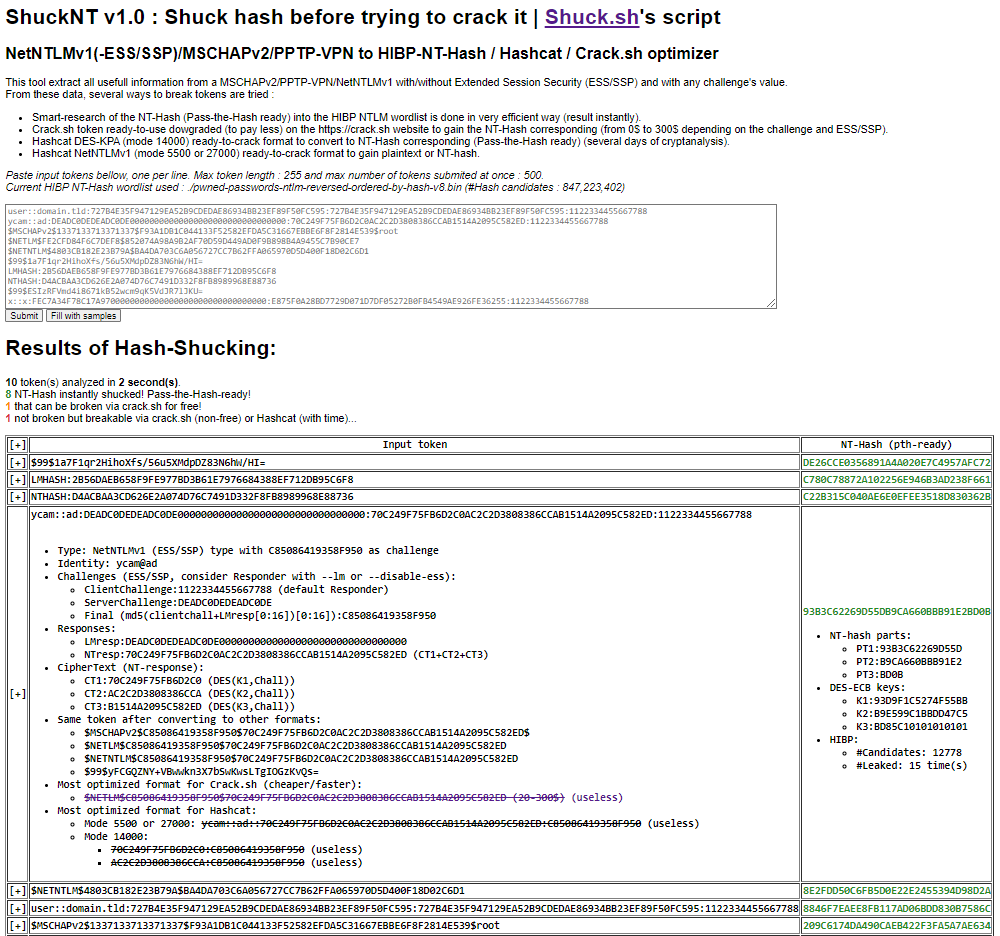
Shucka istantaneamente un token di autenticazione NetNTLMv1 con ESS/SSP nel suo NT-hash corrispondente, da stdin (con database HIBP predefinito) e output dettagliato:

root@kitploit:~
$ php shucknt.php -i 'ycam::ad:DEADC0DEDEADC0DE00000000000000000000000000000000:70C249F75FB6D2C0AC2C2D3808386CCAB1514A2095C582ED:1122334455667788' -v
[...]
1 hashes-challenges analyzed in 0 seconds, with 1 NT-Hash instantly broken for pass-the-hash and 0 that can be broken via crack.sh for free.

[INPUT] ycam::ad:DEADC0DEDEADC0DE00000000000000000000000000000000:70C249F75FB6D2C0AC2C2D3808386CCAB1514A2095C582ED:1122334455667788
        [USERNAME] ycam
        [DOMAIN] ad
        [LMRESP] DEADC0DEDEADC0DE00000000000000000000000000000000
        [NTRESP] 70C249F75FB6D2C0AC2C2D3808386CCAB1514A2095C582ED
                [CT1] 70C249F75FB6D2C0
                [CT2] AC2C2D3808386CCA
                [CT3] B1514A2095C582ED
        [ESS] YES
                [CLIENTCHALL] 1122334455667788
                [SERVERCHALL] DEADC0DEDEADC0DE
        [CHALLENGE] C85086419358F950
        [NTHASH-SHUCKED] 93B3C62269D55DB9CA660BBB91E2BD0B
                [HIBP-CANDIDATES] 12778
                [HIBP-OCCURENCE] 15
                [PT1] 93B3C62269D55D
                [PT2] B9CA660BBB91E2
                [PT3] BD0B
                [K1] 93D9F1C5274F55BB
                [K2] B9E599C1BBDD47C5
                [K3] BD85C10101010101
        [CRACK.SH-TOKEN] $NETLM$C85086419358F950$70C249F75FB6D2C0AC2C2D3808386CCAB1514A2095C582ED (20-300$)
        [FORMAT-NETNTLMV1-NO-ESS] ycam::ad::70C249F75FB6D2C0AC2C2D3808386CCAB1514A2095C582ED:C85086419358F950
        [FORMAT-MSCHAPV2] $MSCHAPv2$C85086419358F950$70C249F75FB6D2C0AC2C2D3808386CCAB1514A2095C582ED$
        [FORMAT-NET(NT)LM] $NETLM$C85086419358F950$70C249F75FB6D2C0AC2C2D3808386CCAB1514A2095C582ED
        [FORMAT-PPTP] $99$yFCGQZNY+VBwwkn3X7bSwKwsLTgIOGzKvQs=

Shucka istantaneamente molti token di autenticazione dei formati supportati nei corrispondenti NT-hash, da un file di input (con database HIBP specificato) e output semplice:

root@kitploit:~
$ php shucknt.php -f tokens-samples.txt -w pwned-passwords-ntlm-reversed-ordered-by-hash-v8.bin
[...]
10 hashes-challenges analyzed in 3 seconds, with 8 NT-Hash instantly broken for pass-the-hash and 1 that can be broken via crack.sh for free.

[INPUT] $99$1a7F1qr2HihoXfs/56u5XMdpDZ83N6hW/HI=
        [NTHASH-SHUCKED] DE26CCE0356891A4A020E7C4957AFC72

[INPUT] LMHASH:2B56DAEB658F9FE977BD3B61E7976684388EF712DB95C6F8
        [NTHASH-SHUCKED] C780C78872A102256E946B3AD238F661

[INPUT] NTHASH:D4ACBAA3CD626E2A074D76C7491D332F8FB8989968E88736
        [NTHASH-SHUCKED] C22B315C040AE6E0EFEE3518D830362B

[INPUT] ycam::ad:DEADC0DEDEADC0DE00000000000000000000000000000000:70C249F75FB6D2C0AC2C2D3808386CCAB1514A2095C582ED:1122334455667788
        [NTHASH-SHUCKED] 93B3C62269D55DB9CA660BBB91E2BD0B

[INPUT] $NETNTLM$4803CB182E23B79A$BA4DA703C6A056727CC7B62FFA065970D5D400F18D02C6D1
        [NTHASH-SHUCKED] 8E2FDD50C6FB5D0E22E2455394D98D2A

[INPUT] user::domain.tld:727B4E35F947129EA52B9CDEDAE86934BB23EF89F50FC595:727B4E35F947129EA52B9CDEDAE86934BB23EF89F50FC595:1122334455667788
        [NTHASH-SHUCKED] 8846F7EAEE8FB117AD06BDD830B7586C

[INPUT] $MSCHAPv2$1337133713371337$F93A1DB1C044133F52582EFDA5C31667EBBE6F8F2814E539$root
        [NTHASH-SHUCKED] 209C6174DA490CAEB422F3FA5A7AE634

[INPUT] $NETLM$FE2CFD84F6C7DEF8$852074A98A9B2AF70D59D449AD0F9B898B4A9455C7B90CE7
        [NTHASH-SHUCKED] 0A42BC909E226C6F8FFCBAA6AB0DA43D

[INPUT] $99$ESIzRFVmd4i8671kB52wcm9qK5VdJR7lJKU=
        [CRACK.SH-TOKEN] NTHASH:BCEBBD64079DB0726F6A2B955D251EE57D6DD8A109D77A0D (0$)

[INPUT] x::x:FEC7A34F78C17A9700000000000000000000000000000000:E875F0A28BD7729D071D7DF05272B0FB4549AE926FE36255:1122334455667788
        [CRACK.SH-TOKEN] $NETLM$1A6A5C911D8A4DF2$E875F0A28BD7729D071D7DF05272B0FB4549AE926FE36255 (20-300$)

Shucka token con solo output JSON:

root@kitploit:~
$ php shucknt.php -f tokens-samples.txt -o json -j
[...]
    {
        "type": "NetNTLMv1 (ESS\/SSP)",
        "description": "NetNTLMv1 (ESS\/SSP) type with C85086419358F950 as challenge",
        "token": "ycam::ad:DEADC0DEDEADC0DE00000000000000000000000000000000:70C249F75FB6D2C0AC2C2D3808386CCAB1514A2095C582ED:1122334455667788",
        "user": "ycam",
        "domain": "ad",
        "lmresp": "DEADC0DEDEADC0DE00000000000000000000000000000000",
        "ntresp": "70C249F75FB6D2C0AC2C2D3808386CCAB1514A2095C582ED",
        "ct1": "70C249F75FB6D2C0",
        "ct2": "AC2C2D3808386CCA",
        "ct3": "B1514A2095C582ED",
        "ess": true,
        "clientchallenge": "1122334455667788",
        "serverchallenge": "DEADC0DEDEADC0DE",
        "challenge": "C85086419358F950",
        "deskeys": {
            "k1": "93D9F1C5274F55BB",
            "k2": "B9E599C1BBDD47C5",
            "k3": "BD85C10101010101"
        },
        "nthash": "93B3C62269D55DB9CA660BBB91E2BD0B",
        "pt1": "93B3C62269D55D",
        "pt2": "B9CA660BBB91E2",
        "pt3": "BD0B",
        "reversePt3": "B0DB",
        "HIBPcountCandidates": 12778,
        "HIBPoccurence": 15,
        "crackshToken": "$NETLM$C85086419358F950$70C249F75FB6D2C0AC2C2D3808386CCAB1514A2095C582ED (20-300$)",
        "h4m14000": "echo \"70C249F75FB6D2C0:C85086419358F950\">14000.hash;echo \"AC2C2D3808386CCA:C85086419358F950\">>14000.hash;hashcat -m 14000 -a 3 -1 charsets\/DES_full.charset --hex-charset 14000.hash ?1?1?1?1?1?1?1?1",
        "h4m5500": "echo \"ycam::ad::70C249F75FB6D2C0AC2C2D3808386CCAB1514A2095C582ED:C85086419358F950\">5500.hash;hashcat -m 5500 -a 3 5500.hash ?a?a?a?a?a --increment",
        "h4m27000": "echo \"ycam::ad::70C249F75FB6D2C0AC2C2D3808386CCAB1514A2095C582ED:C85086419358F950\">27000.hash;hashcat -m 27000 -a 0 27000.hash nthash-wordlist.txt"
    }
[...]

Script standalone per Web-Browser

Ospita ShuckNT su un server web (Apache, Nginx, ecc.) con supporto a PHP 7/8+:

ShuckNTweb

🧰 Per approfondire...

Il servizio online Shuck.sh, che implementa lo strumento ShuckNT, fornisce molti dettagli e una FAQ.

Un Generatore dinamico e on-the-fly è disponibile online: a partire da una password in chiaro o da un NT-hash consente di osservare i meccanismi dell'algoritmo di generazione dei token di autenticazione (NetNTLMv1(-ESS/SSP), MSCHAPv2, PPTP-VPN, ecc.).

Infine, un Convertitore dinamico e on-the-fly è anch'esso disponibile online: a partire da un token di autenticazione (NetNTLMv1(-ESS/SSP), MSCHAPv2, PPTP-VPN, ecc.) consente di mostrare in dettaglio la sua dissezione e persino di ottenere l'NT-hash corrispondente se vengono fornite le chiavi DES K1 e K2 (dopo un attacco DES-KPA, ad esempio).

🍻 Crediti

  • Grazie a Crack.sh per il loro eccellente servizio online, che resta essenziale!
  • Grazie anche a Troy Hunt di HaveIBeenPwned per aver sensibilizzato costantemente sulle fughe di password.
  • Grazie a tutta la community di Hashcat, per le loro entusiasmanti ricerche, strumenti e tecniche!
  • Grazie a zarbibi, per l'aiuto quando le operazioni binarie mi facevano venire il mal di testa.
  • Saluti a tutto il team Le££e :)
Scarica lo strumento