
Analizzatore di regole YARA per migliorare qualità e prestazioni delle regole
Analizzatore di regole YARA per migliorare la qualità e le prestazioni delle regole
Le regole YARA possono essere sintatticamente corrette ma ancora disfunzionali. yaraQA cerca di trovare e segnalare questi problemi all'autore o al manutentore di un set di regole YARA.
I problemi che yaraQA cerca di rilevare sono, ad esempio:
2 of them nella condizione)$ = "\\Debug\\" fullword)$ = "AA"; possono essere esclusi dall'analisi usando --ignore-performance)Ho intenzione di estendere il set di test nel tempo. Ogni versione minore includerà nuove funzionalità o nuovi test.
pip install -r requirements.txt
usage: yaraQA.py [-h] [-f yara files [yara files ...]] [-d yara files [yara files ...]] [-o outfile] [-b baseline] [-l level]
[--ignore-performance] [--debug]
YARA RULE ANALYZER
optional arguments:
-h, --help show this help message and exit
-f yara files [yara files ...]
Path to input files (one or more YARA rules, separated by space)
-d yara files [yara files ...]
Path to input directory (YARA rules folders, separated by space)
-o outfile Output file that lists the issues (JSON, default: 'yaraQA-issues.json')
-b baseline Use a issues baseline (issues found and reviewed before) to filter issues
-l level Minium level to show (1=informational, 2=warning, 3=critical)
--ignore-performance Suppress performance-related rule issues
--debug Debug output
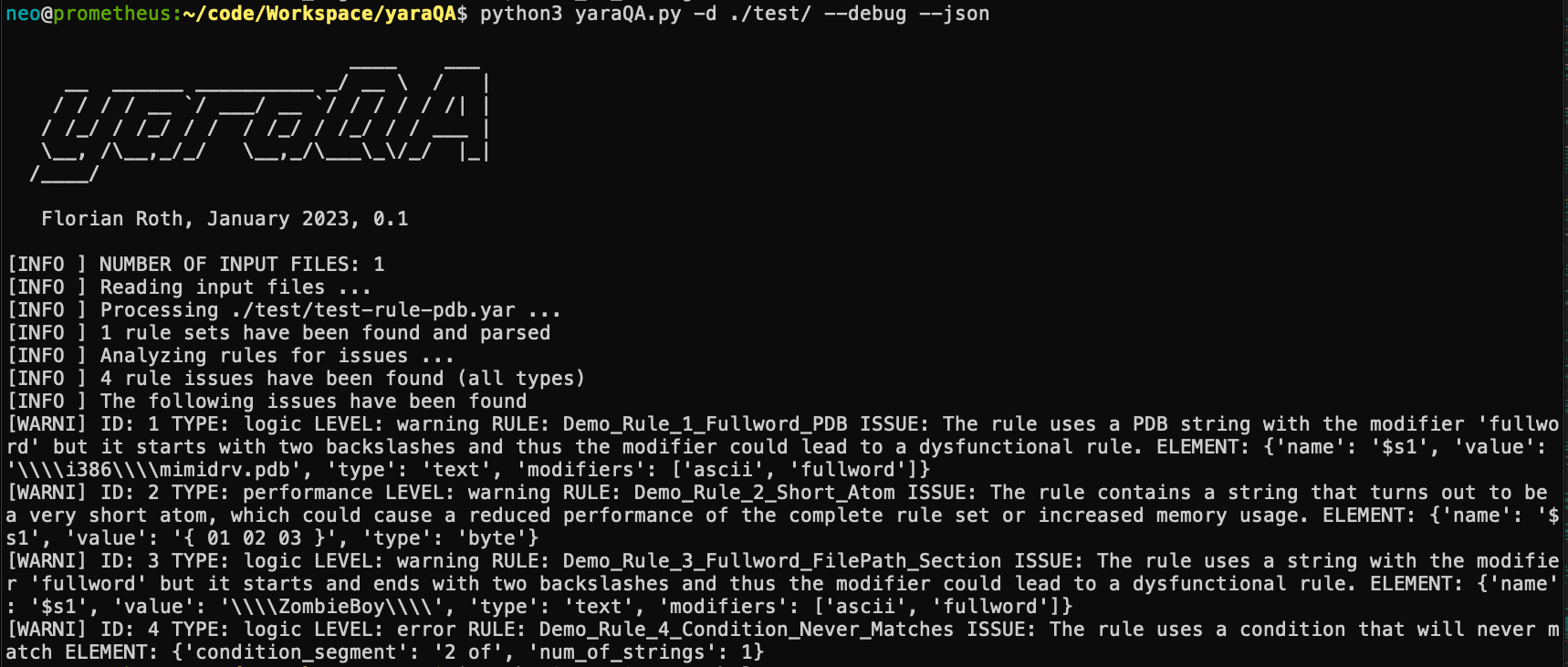
python3 yaraQA.py -d ./test/
Sopprimi tutti i problemi di prestazioni e mostra solo i problemi di rilevamento/logica.
python3 yaraQA.py -d ./test/ --ignore-performance
Sopprimi tutti i problemi di tipo informativo
python3 yaraQA.py -d ./test/ -level 2
Usa una baseline per vedere solo i nuovi problemi (non quelli che hai già revisionato). Il file baseline è un vecchio output JSON di uno stato revisionato.
python3 yaraQA.py -d ./test/ -b yaraQA-reviewed-issues.json
Regole di esempio con problemi si trovano nella cartella ./test.
yaraQA scrive i problemi rilevati in un file chiamato yaraQA-issues.json per impostazione predefinita.
Questo elenco mostra un esempio dell'output generato da yaraQA in formato JSON:
[
{
"rule": "Demo_Rule_1_Fullword_PDB",
"id": "SM1",
"issue": "The rule uses a PDB string with the modifier 'wide'. PDB strings are always included as ASCII strings. The 'wide' keyword is unneeded.",
"element": {
"name": "$s1",
"value": "\\\\i386\\\\mimidrv.pdb",
"type": "text",
"modifiers": [
"ascii",
"wide",
"fullword"
]
},
"level": "info",
"type": "logic",
"recommendation": "Remove the 'wide' modifier"
},
{
"rule": "Demo_Rule_1_Fullword_PDB",
"id": "SM2",
"issue": "The rule uses a PDB string with the modifier 'fullword' but it starts with two backslashes and thus the modifier could lead to a dysfunctional rule.",
"element": {
"name": "$s1",
"value": "\\\\i386\\\\mimidrv.pdb",
"type": "text",
"modifiers": [
"ascii",
"wide",
"fullword"
]
},
"level": "warning",
"type": "logic",
"recommendation": "Remove the 'fullword' modifier"
},
{
"rule": "Demo_Rule_2_Short_Atom",
"id": "PA2",
"issue": "The rule contains a string that turns out to be a very short atom, which could cause a reduced performance of the complete rule set or increased memory usage.",
"element": {
"name": "$s1",
"value": "{ 01 02 03 }",
"type": "byte"
},
"level": "warning",
"type": "performance",
"recommendation": "Try to avoid using such short atoms, by e.g. adding a few more bytes to the beginning or the end (e.g. add a binary 0 in front or a space after the string). Every additional byte helps."
},
{
"rule": "Demo_Rule_3_Fullword_FilePath_Section",
"id": "SM3",
"issue": "The rule uses a string with the modifier 'fullword' but it starts and ends with two backslashes and thus the modifier could lead to a dysfunctional rule.",
"element": {
"name": "$s1",
"value": "\\\\ZombieBoy\\\\",
"type": "text",
"modifiers": [
"ascii",
"fullword"
]
},
"level": "warning",
"type": "logic",
"recommendation": "Remove the 'fullword' modifier"
},
{
"rule": "Demo_Rule_4_Condition_Never_Matches",
"id": "CE1",
"issue": "The rule uses a condition that will never match",
"element": {
"condition_segment": "2 of",
"num_of_strings": 1
},
"level": "error",
"type": "logic",
"recommendation": "Fix the condition"
},
{
"rule": "Demo_Rule_5_Condition_Short_String_At_Pos",
"id": "PA1",
"issue": "This rule looks for a short string at a particular position. A short string represents a short atom and could be rewritten to an expression using uint(x) at position.",
"element": {
"condition_segment": "$mz at 0",
"string": "$mz",
"value": "MZ"
},
"level": "warning",
"type": "performance",
"recommendation": ""
},
{
"rule": "Demo_Rule_5_Condition_Short_String_At_Pos",
"id": "PA2",
"issue": "The rule contains a string that turns out to be a very short atom, which could cause a reduced performance of the complete rule set or increased memory usage.",
"element": {
"name": "$mz",
"value": "MZ",
"type": "text",
"modifiers": [
"ascii"
]
},
"level": "warning",
"type": "performance",
"recommendation": "Try to avoid using such short atoms, by e.g. adding a few more bytes to the beginning or the end (e.g. add a binary 0 in front or a space after the string). Every additional byte helps."
},
{
"rule": "Demo_Rule_6_Condition_Short_Byte_At_Pos",
"id": "PA1",
"issue": "This rule looks for a short string at a particular position. A short string represents a short atom and could be rewritten to an expression using uint(x) at position.",
"element": {
"condition_segment": "$mz at 0",
"string": "$mz",
"value": "{ 4d 5a }"
},
"level": "warning",
"type": "performance",
"recommendation": ""
},
{
"rule": "Demo_Rule_6_Condition_Short_Byte_At_Pos",
"id": "PA2",
"issue": "The rule contains a string that turns out to be a very short atom, which could cause a reduced performance of the complete rule set or increased memory usage.",
"element": {
"name": "$mz",
"value": "{ 4d 5a }",
"type": "byte"
},
"level": "warning",
"type": "performance",
"recommendation": "Try to avoid using such short atoms, by e.g. adding a few more bytes to the beginning or the end (e.g. add a binary 0 in front or a space after the string). Every additional byte helps."
},
{
"rule": "Demo_Rule_6_Condition_Short_Byte_At_Pos",
"id": "SM3",
"issue": "The rule uses a string with the modifier 'fullword' but it starts and ends with two backslashes and thus the modifier could lead to a dysfunctional rule.",
"element": {
"name": "$s1",
"value": "\\\\Section\\\\in\\\\Path\\\\",
"type": "text",
"modifiers": [
"ascii",
"fullword"
]
},
"level": "warning",
"type": "logic",
"recommendation": "Remove the 'fullword' modifier"
}
]
