 mziqudhd92/honeypot-auditor
Does This Look Like An Honeypot? (DTLLAH) Multi-protocol CLI that fingerprints whether a target IP behaves like a low-interaction honeypot — Shodan Honeyscore, active auth/state probes, and a weighted score.

.______________________________________________________________________________.
|  :: H-AUDITOR :: v0.9.5 :: "DIALING IN... CARRIER DETECTED" ::                |
|------------------------------------------------------------------------------|
|  "warez? nah. headers. we trade banners, not bins."                          |
|  "if it answers any password, it ain't production — it's a lure."            |
|  "respect the sysop. probe only what you own. leave no STOR behind."         |
|______________________________________________________________________________|




Site (BBS / NFO): https://mziqudhd92.github.io/honeypot-auditor/
Agents / AEO: llms.txt · agents.md
  ▄▄▄▄▄▄▄▄▄▄▄▄▄▄▄▄▄▄▄▄▄▄▄▄▄▄▄▄▄▄▄▄▄▄▄▄▄▄▄▄▄▄▄▄▄▄▄▄▄▄▄▄▄▄▄▄▄▄▄▄▄▄▄▄▄▄▄▄▄▄▄▄
  █  >>> LIVE DEMO · 3 HOST LAB TOUR · -v / --deep / SILENT-ACCEPT <<<     █
  ▀▀▀▀▀▀▀▀▀▀▀▀▀▀▀▀▀▀▀▀▀▀▀▀▀▀▀▀▀▀▀▀▀▀▀▀▀▀▀▀▀▀▀▀▀▀▀▀▀▀▀▀▀▀▀▀▀▀▀▀▀▀▀▀▀▀▀▀▀▀▀▀

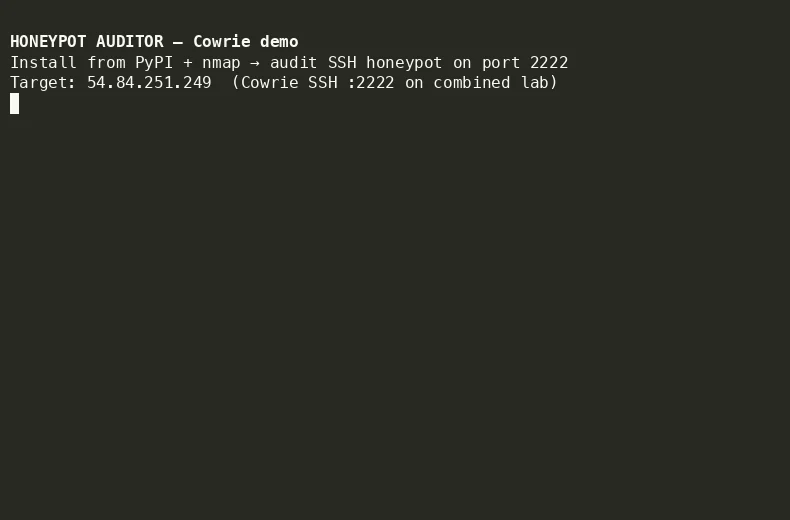
  "three hosts, three lenses: KEX facade with -v, deep on the buffet,
   silent-accept on the tarpit. same fingerprinter — different tells."
                                              — lab tour · authorized only
.------------------------------------------------------------------------------.
|  NFO · READ BEFORE YOU DIAL                                                  |
|------------------------------------------------------------------------------|
|  Authorized targets ONLY. Lab boxes. Decoys you own. Sensors you run.        |
|  Permission on paper (or in ticket).                                         |
|                                                                              |
|  Scanning random /16 because Shodan said "interesting" = YOU are the bait.   |
|                                                                              |
|  TYPE ...... Multi-Protocol Decoy Fingerprinter / Lab Util                   |
|  PLATFORM .. Linux · macOS · Windows (Python 3.10+)                          |
|  LICENSE ... MIT · spread the sauce · keep the copyright                     |
|  PYPI ...... pypi.org/project/honeypot-auditor                               |
|  REPO ...... github.com/mziqudhd92/honeypot-auditor                          |
'------------------------------------------------------------------------------'
Honeypot Auditor — a CLI that asks one rude question:
Does this IP behave like a low-interaction honeypot, or like something that might actually bill someone for downtime?
Passive intel (Shodan Honeyscore when you pass a key, or explicitly selected providers) plus active, non-destructive probes across the usual decoy faces. Outputs a weighted Honeyscore (0–100%), Rich console table, versioned JSON report, or SARIF 2.1.0.
Not exploits. Not exfil. Banner/state/auth semantics. The kind of stuff that
made Cowrie sweat in '09 and still catches clones in '26.
  [ BASIC ]  passive intel · Nmap NSE · SSH/Telnet/SMB/FTP/POP3/IMAP/HTTP/Redis/MQTT/SNMP/Elasticsearch/SMTP/VNC/SIP
  [ DEEP  ]  shell semantics · OS coherence · HASSH · TCP stack · FSM fuzz
             · co-tenancy buffet detect · latency · latency-under-load · egress bait
             (flag: --deep · more intrusive · same authorization rules)
"elite? nah. just consistent timeouts and a honest --confirm-authorized."
  ┌─ USERS · PyPI (public index — no pip config voodoo) ─────────────────────┐
  │  python3 -m venv .venv && source .venv/bin/activate   # recommended      │
  │  pip install honeypot-auditor                                            │
  │  pip install "honeypot-auditor[full]"    # + nmap impacket shodan scapy   │
  │  honeypot-auditor --version                                              │
  └──────────────────────────────────────────────────────────────────────────┘
| Install | Unlocks |
|---|---|
pip install honeypot-auditor | Core probes (Paramiko + Requests + Rich + figlet header) |
pip install "honeypot-auditor[full]" | + Nmap integration · SMB/Impacket · Shodan SDK · Scapy · deep telnet |
SHODAN_API_KEY or --shodan-key enables Shodan OSINT (opt-in — not queried otherwise). [full] only installs the client lib.
The Nmap executable is a separate trusted system installation.
Windows PowerShell uses py -m venv .venv followed by .\.venv\Scripts\Activate.ps1.
Raw-socket probes can require Npcap and an elevated terminal; unavailable capabilities are reported and skipped.
First dial-in:
honeypot-auditor --help          # -h, --help, or /help (BBS figlet header)
honeypot-auditor --target 127.0.0.1
  ┌─ DEVELOPERS · from source ───────────────────────────────────────────────┐
  │  git clone https://github.com/mziqudhd92/honeypot-auditor.git            │
  │  cd honeypot-auditor && python3 -m venv .venv && source .venv/bin/activate│
  │  pip install -e ".[full,dev,security]"                                   │
  │  make test-cov && make lint && make security                             │
  └──────────────────────────────────────────────────────────────────────────┘
No pip install (git checkout — install minimal deps once):
pip install -r requirements.txt    # or: pip install rich paramiko requests
python3 honeypot-auditor.py --help
python3 honeypot-auditor.py --target 127.0.0.1
pyfiglet / rich-argparse are optional for the script path (plain header + stdlib help if missing). Full probes need pip install -e ".[full]".
Release maintainers → docs/PUBLISHING.md
# local lab · default probes IANA + docker/lab ports (22 and 2222, 80 and 8081, …)
honeypot-auditor --target 127.0.0.1

# go deep · six extra detection axes · still no exploits
honeypot-auditor --target 127.0.0.1 --deep

# internet-facing target · need explicit ack + Shodan key if you want intel
honeypot-auditor --target 203.0.113.10 --confirm-authorized

# named passive-intel provider · runs only when explicitly selected
HONEYPOT_AUDITOR_INTEL_EXAMPLE_KEY=... honeypot-auditor --target 203.0.113.10 \
  --intel-provider example --confirm-authorized

# SSH 22 only (does not scan the rest of the preset)
honeypot-auditor --target 203.0.113.10 -p 22 --confirm-authorized

# subnet sweep · IPv4 CIDR up to /24 (254 hosts) · parallel by default
honeypot-auditor --target 192.168.1.0/24 --scan-concurrency 16 \
  --confirm-authorized
# subnet JSON → honeypot-audit-subnet-192.168.1.0_24.json (summary + per-host reports)

# benchmark lab · cowrie + dionaea in docker
./scripts/benchmark-lab.sh
Honeyscore adds triggered category weights. Different categories stack
(e.g. static 20% + state 25% = 45%). Extra hits inside the same category add
+7.5% each (cap +15%). High-fidelity tells (fidelity: high|decisive, e.g.
ssh.kex_facade, pop3.auth_failed_blanket) award a +15% high-signal bonus.
Multi-protocol corroboration — when basic tells fire on more than one protocol, each protocol beyond the first adds +5%, capped at +35%. Example: telnet static + ftp state → 20 + 25 + 5 = 50% Suspected. Deny-all buffets with ≥5 protocol lures can also trigger co-tenancy (15%) once another tell corroborates.
Scoped Honeyscore (-p) — on a single-port audit, a normalized score is reported
alongside the global score:
scoped = (category_total + bonuses) / (in-scope weights × 100) × 100.
Threat level uses max(global, scoped). Fired tells below 30% never read as
Likely Real Host — they surface as Inconclusive (Low-confidence anomalies detected).
Pass -v / --verbose for the full calculation: hit counts, intra-category bonuses,
score/scoped formulas, fidelity, and the per-protocol matrix. See docs/SCORING.md.
  ╭──────────────────────────┬────────╮
  │ CATEGORY                 │ WEIGHT │
  ├──────────────────────────┼────────┤
  │ Passive intel            │  25%   │
  │ Arbitrary auth           │  30%   │
  │ State non-persistence    │  25%   │
  │ Static signature         │  20%   │
  │ Co-tenancy               │  15%   │
  ╰──────────────────────────┴────────╯

  INTRA-CATEGORY: +7.5% per extra hit in the same category (cap +15%)
  HIGH-SIGNAL:    +15% when any triggered indicator has fidelity high|decisive
  CORROBORATION:  +5% per extra protocol with a basic-strategy hit (max +35%)

  --deep ADDS (on top of basic):
  ┌──────────────────────────┬────────┐
  │ behavior                 │  18%   │
  │ coherence                │  15%   │
  │ stack_fingerprint        │  12%   │
  │ proto_conformance        │  12%   │
  │ temporal                 │  10%   │
  └──────────────────────────┴────────┘

  VERDICT BANDS (effective = max(global, scoped) when scoped applies):
    [##########----------]  < 30% + hits   INCONCLUSIVE (anomalies)
    [##########----------]  < 30% + clean  LIKELY REAL HOST
    [################----]  30-59%         SUSPECTED HONEYPOT
    [####################]  >= 60%         CONFIRMED HONEYPOT
The protocol table’s Strategies column counts only the three probe strategies per face (up to 3). Shodan and co-tenancy are host-level. Co-tenancy will not fire alone on multi-lure research stacks.
  -h, --help, /help          show options (figlet H-AUDITOR header + Rich help)
  --version                  print version and exit
  --target HOST              IP, hostname, or IPv4 CIDR (max /24)
  --scan-concurrency N       parallel hosts for CIDR scans (default 8; Shodan skipped)
  --preset both              IANA + lab ports (default: SSH 22 and 2222, …)
  --preset iana              well-known ports only (22, 80, 445, …)
  --preset docker-research   lab ports only (2222, 8081, 1445, …)
  -p, --port 22              only these TCP ports (nmap-style; 22,2222 or -p 22 -p 80)
  --ports ssh=2222,http=8081 per-protocol override (map unused protos to =9)
  --shodan-key KEY           enable Shodan (or env SHODAN_API_KEY); opt-in only
  --intel-provider NAME      opt in to a named passive-intel plugin (repeatable)
  --intel-key NAME=KEY       provider key; prefer HONEYPOT_AUDITOR_INTEL_<NAME>_KEY
  --output report.json       JSON path (subnet default: honeypot-audit-subnet-<cidr>.json)
  --confirm-authorized       REQUIRED if any scanned IP is public
  -v, --verbose              score formula, hits/intra, scoped math, matrix, indicators
  -n, --with-nmap            run Nmap -sV / NSE phase (slow; off by default)
  --deep                     advanced six-axis probes
  --safe-mode                handshake-only; disables deep shell/path probes
  --profile audit|blend       probe profile (default audit; blend=mimesis OPSEC)
  --proxy socks5h://host:port  SOCKS5 egress (remote DNS enforced)
  --passive-first            passive intel before active; skip active when score high
  --osint-only               passive intel only — no TCP probes
  --passive-first-confirm    after high passive / osint-only, run safe-mode active verify
  --dual-stack               resolve A+AAAA and compare IPv4 vs IPv6
  --jitter 0.3               fraction of timeout as max random delay (authorized OPSEC)
  --jitter-ms 50-500         random delay range in ms before each probe (authorized OPSEC)
  --max-concurrent 32        global socket concurrency budget
  --seed N                   RNG seed for blend profile
  --preset deception-audit   blue-team QA preset (both ports + --deep)
  --format json|sarif        report format (default json)
  --output-nmap-exclude path append IP when Honeyscore >= 60
  check-sig PATH             validate declarative signature pack offline
  --timeout SECS             socket timeout (default 3)
21 protocol engines in the current version. Each uses up to 3 probe strategies (arbitrary auth · state non-persistence · static signature). The Strategies column is how many of those three are active for that protocol in this release — not Shodan, co-tenancy, or individual indicator checks (45 active strategy slots across all protocols).
Default preset (--preset both) probes IANA well-known ports and common
lab/docker aliases on the same faces. Override ports with -p / --ports.
Closed faces are skipped, not scored.
| Protocol | Default ports (iana · lab) | Strategies |
|---|---|---|
| SSH | 22 · 2222 | 3 |
| Telnet | 23 · 2323 | 3 |
| FTP | 21 · 2121 | 3 |
| SMTP | 25 · 2525 | 3 |
| POP3 | 110 · 1110 | 3 |
| IMAP | 143 · 1143 | 3 |
| Redis | 6379 · 6379 | 3 |
| MQTT | 1883 · 11883 | 3 |
| SNMP | 161 · 1161 (UDP) | 2 |
| Elasticsearch | 9200 · 19200 | 1 |
| SMB | 445 · 1445 | 2 |
| VNC | 5900 · 5000 | 2 |
| MySQL | 3306 · 3306 | 2 |
| Postgres | 5432 · 5432 | 2 |
| RDP | 3389 · 3389 | 2 |
| MSSQL | 1433 · 1433 | 2 |
| MongoDB | 27017 · 27017 | 2 |
| HTTP | 80 / 443 · 8081 | 1 |
| SIP | 5060 · 5060 | 1 |
| Git | 9418 · 9418 | 1 |
| HTTP proxy | 3128 · 8080 | 1 |
-p maps well-known extras the same way: 443/8443 → HTTP (TLS), 8080/3128 → HTTP proxy, 139 → SMB, 993/1993 → IMAP (TLS/IMAPS), 8883/18883 → MQTT (TLS/MQTTS), 161/1161/10161 → SNMP (UDP), 9200/19200 → Elasticsearch, 5061 → SIP, 5000/5901 → VNC. Unknown numbers are probed as SSH.
The POP3 engine checks response framing, pre-authentication state boundaries (STAT), optional CAPA sampling, identical auth-failed -ERR blankets, stock lure banners, unknown-command handling, and repeated synthetic logins. It never lists, reads, retrieves, or deletes mail; see RFC 1939 and RFC 2449 (CAPA).
The IMAP engine pairs with POP3 for Exchange/mail skins (qeeqbox, OpenCanary-class): RFC 3501 greetings (* OK / * PREAUTH / * BYE), pre-auth SELECT bypass (LIST OK alone not scored), CAPABILITY-gated auth-failed NO/BAD blankets, stock Exchange lure greetings, unknown-command handling, and repeated synthetic LOGIN with LOGOUT cleanup. Ports 993 and lab 1993 use implicit TLS (IMAPS); STARTTLS on 143 is out of scope. It never reads, deletes, or modifies mailboxes. See docs/IMAP.md and RFC 3501.
The SNMP engine speaks community SNMPv1/v2c over UDP and scores RFC non-compliance (any-community GetResponse, request-id mismatch, invalid version facade, success on missing OID, BER framing, stock sysDescr, GetNext stubs, wrong sysObjectID/sysUpTime ASN.1 types, OID-name mismatches, canned identical replies). Never sends SetRequest or walks. See docs/SNMP.md, RFC 1157, and RFC 3416.
The Redis engine speaks RESP on TCP/6379 with protocol non-compliance detection: dual random AUTH (decisive when both +OK), reconnect key persistence + DBSIZE coherence, plus split static tells (PING stub, COMMAND/EVAL/CONFIG stubs, frozen INFO, redis-cli HELP, missing/mismatched ECHO/SELECT, OpenCanary AUTH+NOAUTH wall, TYPE/INCR facades, wrong-arity GET, QUIT zombie). Never sends FLUSHALL/FLUSHDB/CONFIG SET/SCRIPT LOAD; probe keys use an hpaudit_ prefix and are deleted. See docs/REDIS.md and the Redis protocol spec.
The Elasticsearch engine speaks the HTTP JSON API on 9200 / lab 19200 and scores API non-compliance under static_signature only (root framing, stock cluster metadata/uuid, missing-index 200, unknown-path root facade, DELETE/PUT/HEAD method stubs, /_cluster/health and /_cat/health shape facades, non-JSON Content-Type, X-Elastic-Product mismatch). Never creates indices, bulks, or searches real data. Strategies and probe flow: docs/ELASTICSEARCH.md.
The MQTT engine speaks OASIS MQTT v3.1.1 with behavioral honeypot detection (not banner IOCs): dual synthetic CONNECT credentials when anonymous is rejected, SUBSCRIBE-without-CONNECT, two-client pub/sub bus canary (granted SUBACK + poll window), hollow session_present resume, keep-alive zombie sockets (PINGRESP-after-expiry only; lab-oriented), plus conformance checks (protocol-name facade, empty clientId + clean_session=0, QoS1 PUBACK packet-id, PINGRESP). Ports 8883 and lab 18883 use implicit TLS (MQTTS). It never publishes retained traffic or Will messages. See docs/MQTT.md and the MQTT 3.1.1 specification.
--deep adds cross-protocol axes (shell semantics, HASSH/TCP stack, FSM fuzz, co-tenancy, serial + concurrent-load latency) on top of the basic strategies above. Passive-intel providers and Nmap NSE (-n) are optional layers, not protocol engines.
make install && make test-cov && make lint && make security
docker compose -f deploy/docker-compose.benchmark.yml up -d
./scripts/benchmark-lab.sh
Re-record the animated demos → docs/demo/README.md
Contributing → CONTRIBUTING.md
This tool asks: "Is that IP a honeypot?" (attacker / CTI view)
UHBS asks: "How good is your decoy?" (builder / lab UHQS grade · Modules A–F · 36 protocols)
Same neighborhood. Different door. Use both if you build deception for a living. Use this one if you just need a fast external fingerprint.
  Proper respect to:
    Cowrie · Dionaea · Conpot · the old Kippo crew
    UHBS lab rats · CyberHalluciNet purple-team night shift
    Shodan · Salesforce HASSH · everyone who ever typed USER anonymous
    BBS sysops who ran 9600 baud file areas for "utilz"
    and the three people who still read NFO files in 2026
    @fusiontechstrategies — POP3, intel plugins, scoring/SARIF, Windows+security CI (v0.7.0)

  NO GREETS TO:
    script kiddies scanning /0
    vendors who call Cowrie "AI-powered threat intelligence"
    anyone who STORs malware on decoys then writes a LinkedIn post about it
"greetz to the elite · no greetz to the lame · hang up clean."
Defensive research. Authorized testing. Lab sandboxes. Your sensors. Your tickets.
Do not point this at infrastructure you don't own or haven't been cleared to test.
Vuln reports → SECURITY.md
.------------------------------------------------------------------------------.
|  h0n3yp0t 4ud1t0r · v0.9.5 · spread headers not malware · EOF · NO CARRIER   |
'------------------------------------------------------------------------------'
