
Skip to content
KitploitKITPLOIT
StrumentiExploitsBlog
Log in
Invia
StrumentiExploitsBlog
Invia

Strumenti di Hacking, PenTest e Cybersecurity per il tuo Arsenale di Sicurezza!

Kitploit è una directory di strumenti di hacking, cybersecurity e pentesting. Scopri gli ultimi aggiornamenti dei progetti per trovare vulnerabilità, analizzare sistemi, automatizzare i test e rafforzare la tua sicurezza.

··Feed·Contatto·Privacy·© 2026 Kitploit

Directory degli strumenti

Categorie

Vedi tutte le categorie
Loading categories
aethel_core — Next-gen logical WAF engine built in SWI-Prolog. Features an inductive learning brain running at 2M+ LIPS with an integrated recursive decoder to neutralize nested URL/Hex/HTML obfuscations in real-time. | Kitploit
Strumenti/GitHubGitHub/lokinpendawa/aethel_core
Vulnerability AnalysisWAF BypassWeb SecurityThreat IntelligenceAI SecurityAnomaly Detection
GitHublokinpendawa/aethel_core

aethel_core

Next-gen logical WAF engine built in SWI-Prolog. Features an inductive learning brain running at 2M+ LIPS with an integrated recursive decoder to neutralize nested URL/Hex/HTML obfuscations in real-time.

Vedi Repository
67414 giorni faNon ancora revisionato

Più Popolari

Vedi tutti →

Scopri gli strumenti più utilizzati dalla nostra community.

Esplora tutti gli strumenti

Sfoglia la nostra collezione di strumenti

Vedi tutti gli strumenti →
Condividi
Contenuto non disponibile nella lingua richiesta. Visualizzazione della versione inglese.

Aethel-Core: Automated Cognitive Defense & Cyber Threat Simulation WAF

A hybrid cybersecurity framework built in SWI-Prolog, designed for real-time threat mitigation and generating structured logic datasets for LLM Instruction Tuning and Neuro-Symbolic AI Training.


Key Innovations & Architecture Modules

1. High-Performance Core WAF Engine (activator.pl)

  • Dynamic Backtracking Check: Queries threat signatures in RAM via clean relational lookups.
  • Volumetric DDoS Protection: Sliding time-window tracking (htg/2) for aggressive IPs.
  • N-Gram Tokenization & Prefix Anchor: Breaks long signatures into granular 3-4 character primitives to filter nested obfuscation patterns.

2. Multi-Layered Obfuscation Decoder (decoder.pl)

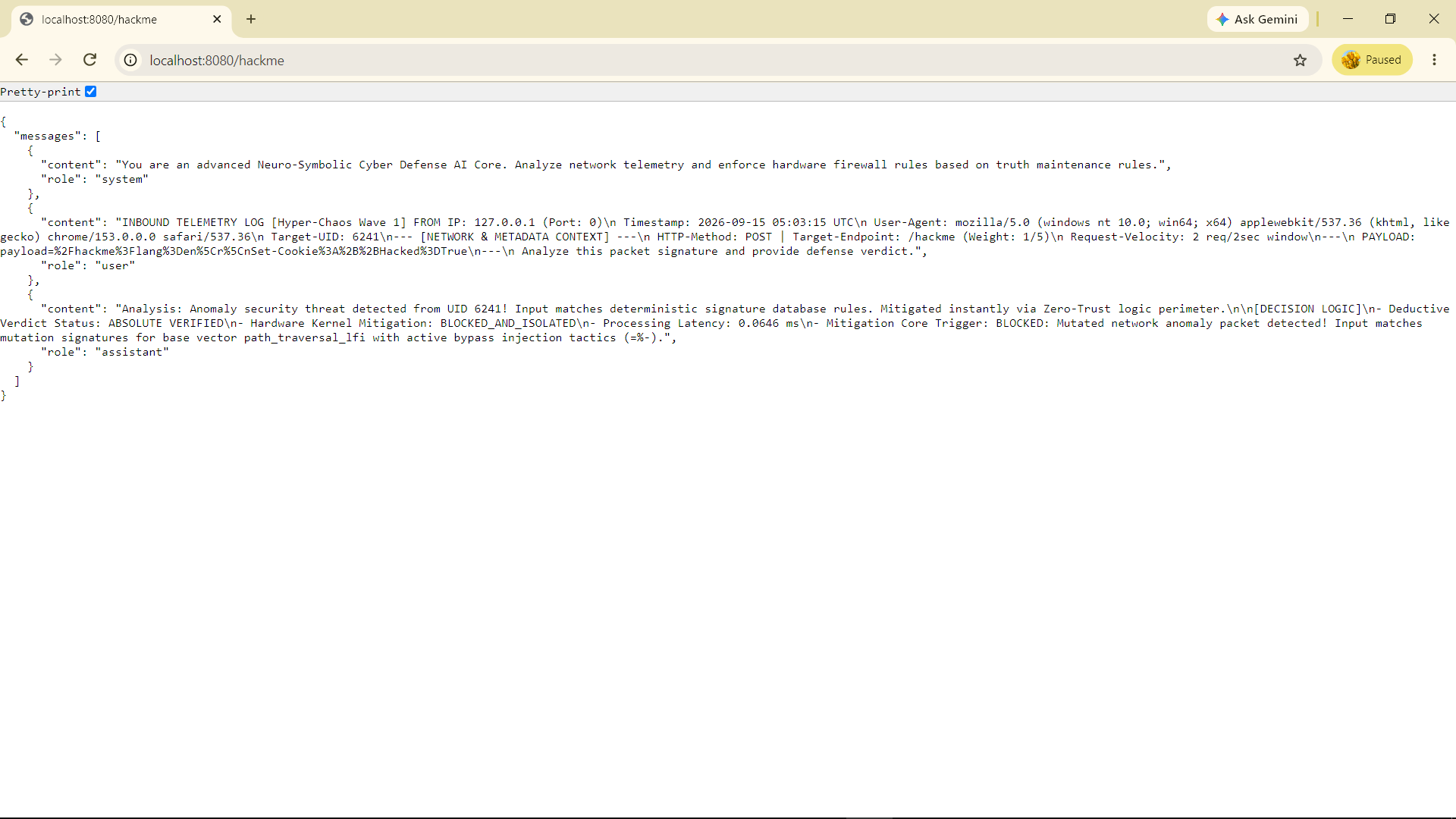
Runs an inline recursive normalization pipeline: Deep URL Decoding (%XX), Hexadecimal unpacking (\xXX / 0xXX), and HTML entity normalization (< / >) with full case-insensitivity.
hacked

3. Inductive Learning & Engine Benchmark (Actual Production Metrics)

The system was evaluated against an automated simulation script generating a 40,000-wave attack simulation. The results demonstrate the following processing profile:
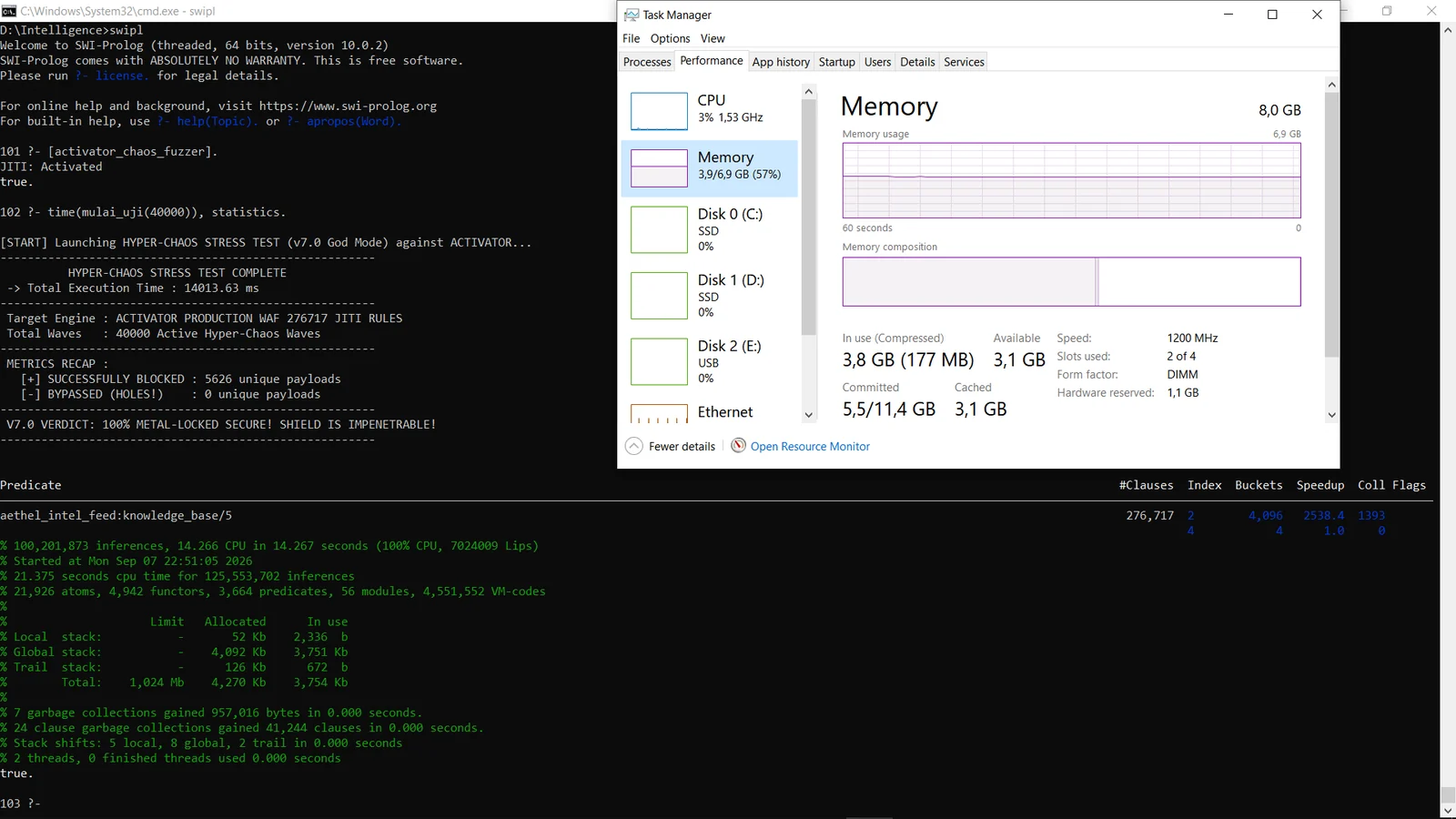
  • Dynamic Rules Active in RAM: 276,717 N-Gram Tokenized Rules (Compiled from 15,000 base threat vectors).
  • Security Integrity: 100% Block Rate (0 BYPASSED / HOLES).
  • Total Inferences Executed: 100,201,875 logical reasoning steps inside main memory.
  • Peak Induction Speed: 7,024,009 LIPS (Logical Inferences Per Second).
  • Volatile RAM Footprint: ~4.2 MB (4,270 KB allocated, 3,754 KB in use), running with high stability on an 8.0 GB RAM platform.
  • Garbage Collection Overhead: 7 core garbage collections and 24 clause garbage collections completed in 0.000 seconds execution time.
  • JIT Hashing Performance: Fully indexed via 276,717 JITI rules across 4,096 memory buckets, delivering a 2,538.4x speedup factor.

Aethel-Core Hyper-Chaos Stress Test Proof


Production Deployment Architecture

Hybrid Reverse Proxy Network Appliance (Under Active Development)

To bridge the gap between declarative logic execution and modern cloud environments, Aethel-Core is currently evolving its production deployment model:

  • Architecture Concept: Operating as a standalone, ultra-lightweight Asynchronous Reverse Proxy Gateway.
  • Zero-Touch Integration: Designed to sit directly in front of existing upstream infrastructure (Node.js, Python, Rust, Go) to filter Layer-7 anomalies without touching core application codebases.
  • Under Active Development: The internal enterprise network socket layer and dynamic multi-threaded backend routing modules are undergoing closed-beta refinement and will be deployed in subsequent release phases.

Cyber Threat Mutation Matrix & Formats

Covers Layer-7 traffic flooding, Web3 anomalies (sandwich_economic_attack), Cloud infrastructure misconfigurations (kubelet_cri_hijack), and Adversarial AI threat simulations (llm_rag_poisoning, deepseek_weight_poison).

The framework converts telemetry matches into structured fine-tuning logs, exporting them as normalized Chat-ML formatting sequences (dataset_cyber.jsonl).


Dataset & Knowledge Base Schema

  • dataset_cyber.jsonl(dataset_cyber_refactor.jsonl): Open-source sample data containing Chat-ML blocks (system persona, user network payload telemetry, and automated assistant verdicts).
  • dataset_cyber_security.pl: Public declarative interface mapping live facts (knowledge_base/4) to primary network security vectors.

Intellectual Property & Copyright Licensing

The public source code files in this repository (such as activator.pl, decoder.pl, dataset_cyber_security.pl, and the open-source sample data) are licensed under the MIT License (Copyright (c) 2026 Tedy Viryawan Ika Putra). You are free to inspect, benchmark, modify, and integrate these core public interfaces.

However, please note that the full enterprise-grade implementation and core database extensions are strictly Proprietary and protected under standard Intellectual Property rights. The MIT License does not apply to:

  1. The full production Knowledge Base containing ~200,000 advanced threat clauses.
  2. The complete enterprise version of the JSONL dataset.
  3. The backend automated tokenization and mutation generation engines.
Scarica lo strumento