Skip to content
KitploitKITPLOIT
StrumentiExploitsBlog
Log in
Invia
StrumentiExploitsBlog
Invia

Strumenti di Hacking, PenTest e Cybersecurity per il tuo Arsenale di Sicurezza!

Kitploit è una directory di strumenti di hacking, cybersecurity e pentesting. Scopri gli ultimi aggiornamenti dei progetti per trovare vulnerabilità, analizzare sistemi, automatizzare i test e rafforzare la tua sicurezza.

FeedContattoPrivacy© 2026 Kitploit

Directory degli strumenti

Categorie

Vedi tutte le categorie
Loading categories
offensive-ai-compilation — Una lista curata di risorse utili che coprono l'AI Offensiva. | Kitploit
Strumenti/GitHubGitHub/jiep/offensive-ai-compilation
OSINT (Open Source Intelligence)PhishingPenetration TestingMachine LearningPaper e RicercaRisorse CurateSicurezza dell'IAAttacco AvversarioTop in Paper e Ricerca n.10
1.4k1769117 giorni faRevisionato da Kitploit
Condividi
GitHub
jiep/offensive-ai-compilation

offensive-ai-compilation

Una lista curata di risorse utili che coprono l'AI Offensiva.

Vedi RepositorySito web
Contenuto non disponibile nella lingua richiesta. Visualizzazione della versione inglese.

Offensive AI Compilation

A curated list of useful resources that cover Offensive AI.

📁 Contents 📁

  • 🚫 Abuse 🚫
    • 🧠 Adversarial Machine Learning 🧠
      • ⚡ Attacks ⚡
        • 🔒 Extraction 🔒
          • ⚠️ Limitations ⚠️
          • 🛡️ Defensive actions 🛡️
          • 🔗 Useful links 🔗
        • ⬅️ Inversion (or inference) ⬅️
          • 🛡️ Defensive actions 🛡️
          • 🔗 Useful links 🔗
        • 💉 Poisoning 💉
          • 🔓 Backdoors 🔓
          • 🛡️ Defensive actions 🛡️
          • 🔗 Useful links 🔗
        • 🏃‍♂️ Evasion 🏃‍♂️
          • 🛡️ Defensive actions 🛡️
          • 🔗 Useful links 🔗
      • 🛠️ Tools 🛠️
        • ART
        • Cleverhans
  • 🔧 Use 🔧
    • 🕵️‍♂️ Pentesting 🕵️‍♂️
    • 🦠 Malware 🦠
    • 🗺️ OSINT 🗺️
    • 📧 Phishing 📧
    • 👨‍🎤 Generative AI 👨‍🎤
      • 🔊 Audio 🔊
        • 🛠️ Tools 🛠️
        • 💡 Applications 💡
        • 🔎 Detection 🔎
      • 📷 Image 📷
        • 🛠️ Tools 🛠️
        • 💡 Applications 💡
        • 🔎 Detection 🔎
      • 🎥 Video 🎥
        • 🛠️ Tools 🛠️
        • 💡 Applications 💡
        • 🔎 Detection 🔎
      • 📄 Text 📄
        • 🛠️ Tools 🛠️
        • 🔎 Detection 🔎
        • 💡 Applications 💡
    • 📚 Misc 📚
  • 📊 Surveys 📊
  • 🗣 Contributors 🗣
  • ©️ License ©️

🚫 Abuse 🚫

Exploiting the vulnerabilities of AI models.

🧠 Adversarial Machine Learning 🧠

Adversarial Machine Learning is responsible for assessing their weaknesses and providing countermeasures.

⚡ Attacks ⚡

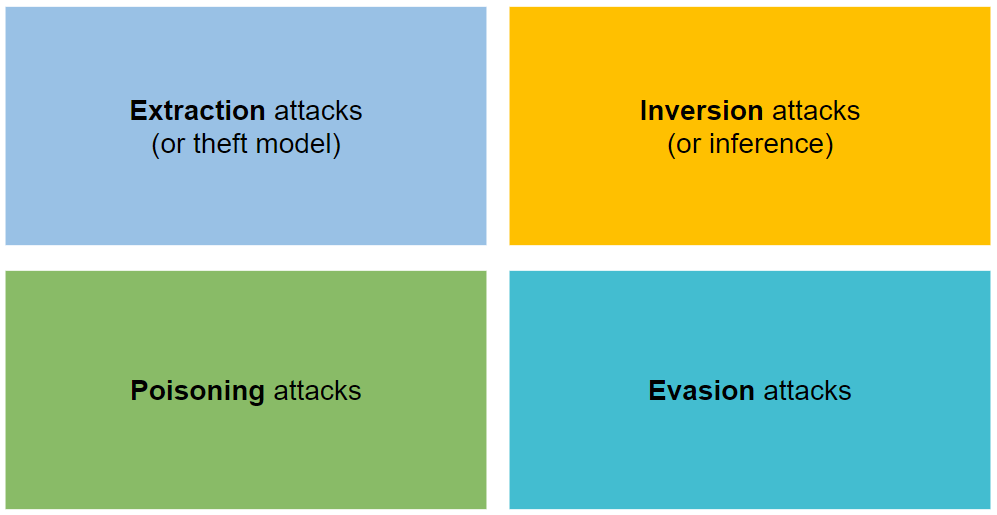
It is organized into four types of attacks: extraction, inversion, poisoning and evasion.

Adversarial Machine Learning attacks

🔒 Extraction 🔒

It tries to steal the parameters and hyperparameters of a model by making requests that maximize the extraction of information.

Extraction attack

Depending on the knowledge of the adversary's model, white-box and black-box attacks can be performed.

In the simplest white-box case (when the adversary has full knowledge of the model, e.g., a sigmoid function), one can create a system of linear equations that can be easily solved.

In the generic case, where there is insufficient knowledge of the model, the substitute model is used. This model is trained with the requests made to the original model in order to imitate the same functionality as the original one.

White-box and black-box extraction attacks

⚠️ Limitations ⚠️
  • Training a substitute model is equivalent (in many cases) to training a model from scratch.

  • Very computationally intensive.

  • The adversary has limitations on the number of requests before being detected.

🛡️ Defensive actions 🛡️
  • Rounding of output values.

  • Use of differential privacy.

  • Use of ensembles.

  • Use of specific defenses

    • Specific architectures
    • PRADA
    • Adaptive Misinformation
    • ...
🔗 Useful links 🔗
  • Stealing Machine Learning Models via Prediction APIs
  • Stealing Hyperparameters in Machine Learning
  • Knockoff Nets: Stealing Functionality of Black-Box Models
  • Model Extraction Warning in MLaaS Paradigm
  • Copycat CNN: Stealing Knowledge by Persuading Confession with Random Non-Labeled Data
  • Prediction Poisoning: Towards Defenses Against DNN Model Stealing Attacks
  • Stealing Neural Networks via Timing Side Channels
  • Model Stealing Attacks Against Inductive Graph Neural Networks
  • High Accuracy and High Fidelity Extraction of Neural Networks
  • Poisoning Web-Scale Training Datasets is Practical
  • Polynomial Time Cryptanalytic Extraction of Neural Network Models
  • Prompt-Specific Poisoning Attacks on Text-to-Image Generative Models
  • Awesome Data Poisoning And Backdoor Attacks: A curated list of papers & resources linked to data poisoning, backdoor attacks and defenses against them. stars
  • BackdoorBox: An Open-sourced Python Toolbox for Backdoor Attacks and Defenses. stars
  • Stealing Part of a Production Language Model
  • Hard-Label Cryptanalytic Extraction of Neural Network Models
  • https://www.anthropic.com/news/detecting-and-preventing-distillation-attacks
⬅️ Inversion (or inference) ⬅️

They are intended to reverse the information flow of a machine-learning model.

Inference attack

They enable an adversary to know the model that was not explicitly intended to be shared.

They allow us to know the training data or information as statistical properties of the model.

Three types are possible:

  • Membership Inference Attack (MIA): An adversary attempts to determine whether a sample was employed as part of the training.

  • Property Inference Attack (PIA): An adversary aims to extract statistical properties that were not explicitly encoded as features during the training phase.

  • Reconstruction: An adversary tries to reconstruct one or more samples from the training set and/or their corresponding labels. Also called inversion.

🛡️ Defensive actions 🛡️
Scarica lo strumento

Più Popolari

Vedi tutti →

Scopri gli strumenti più utilizzati dalla nostra community.

Nessun dato di popolarità ancora.

Esplora tutti gli strumenti

Sfoglia la nostra collezione di strumenti

Vedi tutti gli strumenti →