 betterdb-inc/monitor
Real-time monitoring and slowlog analysis for Valkey and Redis databases with anomaly detection, ACL auditing, and Prometheus metrics export.

# BetterDB Monitor
[](https://hub.docker.com/r/betterdb/monitor)
[](https://hub.docker.com/r/betterdb/monitor/tags)
[](https://artifacthub.io/packages/search?repo=betterdb-monitor)
[](https://www.npmjs.com/package/@betterdb/monitor)
[](https://www.npmjs.com/package/@betterdb/monitor)
[](https://github.com/betterdb-inc/monitor/actions/workflows/api-tests.yml)
[](LICENSE)
[](https://valkey.io)
[](https://redis.io)
**The monitoring layer that Valkey deserves.**
BetterDB persists what Valkey throws away - slowlogs, command patterns, client activity, anomaly signals - so you can debug what happened at 3am, not just what's happening now. Built for Valkey 8.x with native support for COMMANDLOG, CLUSTER SLOT-STATS, and per-thread I/O metrics. Redis 6+ compatible for everything else.
[Website](https://betterdb.com) | [Docker Hub](https://hub.docker.com/r/betterdb/monitor) | [npm](https://www.npmjs.com/package/@betterdb/monitor) | [Documentation](https://docs.betterdb.com) | [Blog](https://betterdb.com/blog)
BetterDB is built by [BetterDB Inc.](https://betterdb.com), a public benefit company operating under the [OCV Open Charter](https://github.com/OpenCoreVentures/ocv-public-benefit-company).
## Quick Start (Docker)
```bash
docker run -d --name betterdb -p 3001:3001 betterdb/monitor:latest
```
Point your browser to `http://localhost:3001`. To monitor a specific instance:
```bash
docker run -d \
--name betterdb \
-p 3001:3001 \
-e DB_HOST=your-valkey-host \
-e DB_PORT=6379 \
-e DB_PASSWORD=your-password \
betterdb/monitor:latest
```
> **Connecting to a database on your host machine?** Inside the container
> `localhost` is the container itself, not your host — so use
> `host.docker.internal` as the database host. On **Docker Desktop
> (macOS/Windows)** it works out of the box; on **Linux** add
> `--add-host=host.docker.internal:host-gateway` to the `docker run` command so
> the name resolves. The dashboard's one-click "connect to local instance"
> button auto-detects this and pre-fills the right host for you.
Two image variants are published, both multi-arch (`linux/amd64`, `linux/arm64`):
| Tag | What it is |
|-----|------------|
| `latest`, `X.Y.Z-no-ai` | Default image - every monitoring feature included, without the dependencies for the experimental local-LLM AI Helper |
| `X.Y.Z` | Adds the experimental AI Helper (bring your own Ollama; disabled by default via `AI_ENABLED`) |
See [Docker Production Deployment](#docker-production-deployment) for persistent storage, custom ports, licensing, and air-gapped setups.
## Quick Start (Kubernetes / Helm)
```bash
helm repo add betterdb https://docs.betterdb.com/charts
helm repo update
helm install betterdb-monitor betterdb/betterdb-monitor \
--namespace betterdb --create-namespace \
--set db.host=my-valkey.default.svc.cluster.local \
--set db.password=yourpassword
```
Then `kubectl port-forward -n betterdb svc/betterdb-monitor 3001:3001` and open `http://localhost:3001`, or enable the chart's ingress. PostgreSQL-backed history, bring-your-own Secrets, and air-gapped licensing are all covered in the [Kubernetes guide](https://docs.betterdb.com/kubernetes) and the [chart README](https://github.com/betterdb-inc/monitor/blob/master/charts/betterdb-monitor/README.md).
## Quick Start (CLI)
Run BetterDB Monitor without Docker:
```bash
npx @betterdb/monitor
```
On first run, an interactive setup wizard guides you through database connection, storage backend (SQLite, PostgreSQL, or in-memory), and server settings. Configuration is saved to `~/.betterdb/config.json`.
```bash
npm install -g @betterdb/monitor # global install
betterdb --setup # re-run setup wizard
betterdb --port 8080 # override server port
betterdb --db-host 1.2.3.4 # override database host
betterdb --help # all options
```
Requires Node.js >= 20.0.0 and a Valkey or Redis instance to monitor. For SQLite storage, also `npm install -g better-sqlite3`.
## What You Get
### See everything, keep everything
- **Historical analytics** - query slowlogs, command patterns, client activity, and latency across any time range. The data that used to disappear after a log rotation.
- **COMMANDLOG support** - Valkey 8.1+ exclusive. Large requests and large replies, not just the slow ones.
- **MONITOR capture sessions** - record real traffic on demand: live tail, filter, replay, export to JSON/CSV, and cross-reference against connection history.
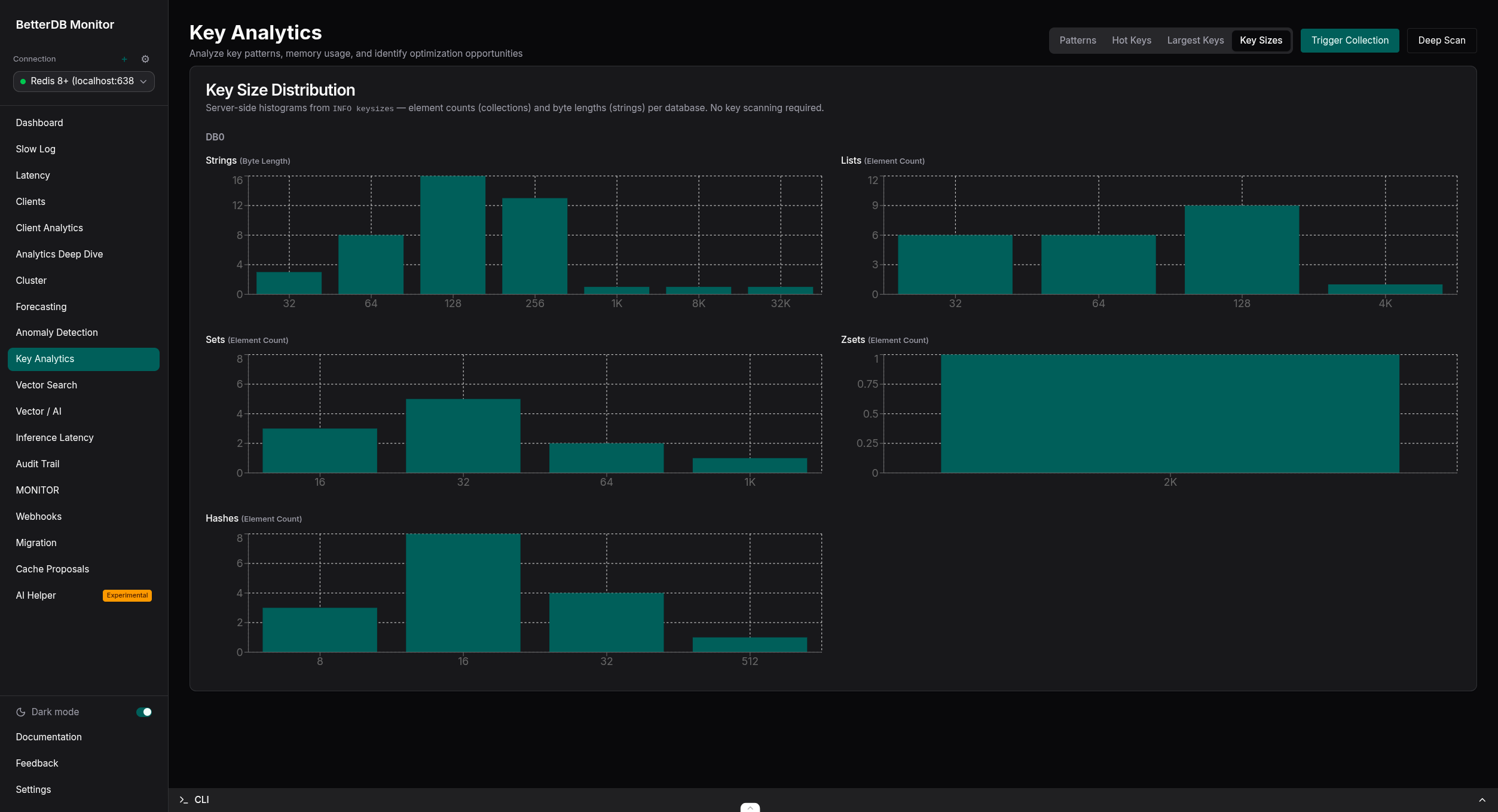
- **Hot key tracking** - top keys by access frequency with rank movement over time. Key Analytics (Pro, free in early access) adds type, TTL, and size distributions from live sampling.
- **Cluster visibility** - topology graphs, SLOT-STATS heatmaps, per-slot CPU and key distribution.
- **Cluster auto-registration** - a cluster connection can auto-register every node as its own monitored connection, kept in sync as the cluster scales. See [docs/cluster-auto-registration.md](https://github.com/betterdb-inc/monitor/blob/master/docs/cluster-auto-registration.md).
- **CPU & I/O thread metrics** - per-thread visibility that no Redis tool can provide.
- **Client analytics** - see exactly which service is responsible for what, attributed by client name and pattern.
- **ACL audit trail** - track who accessed what, persisted for compliance and post-incident debugging.
### Understand and act
- **Anomaly detection** (Pro, free in early access) - automatic baseline learning with correlated events and plain-English diagnoses. 20+ detectors, no manual thresholds.
- **Capacity forecasting** - projected time-to-ceiling for memory, ops/sec, CPU, and fragmentation.
- **Webhooks** - HMAC-signed alert deliveries with retries and a full delivery log.
- **Live migration** - move between Redis and Valkey with a three-phase analysis, execution, and validation workflow.
### Built for the AI era
- **Vector search observability** - FT.SEARCH ops/sec and latency with per-index health for [valkey-search](https://github.com/valkey-io/valkey-search) and RediSearch. See [docs/vector-ai](https://github.com/betterdb-inc/monitor/blob/master/docs/vector-ai/README.md).
- **Inference latency** - p50/p95/p99 per index, with SLA breach alerts (Pro, free in early access).
- **Semantic cache intelligence** (Pro, free in early access) - hit-rate health, similarity-threshold recommendations, and an approve/reject proposal workflow. Agent memory observability included.
- **AI traces** - OTLP span waterfalls from your AI application, correlated with the live Valkey state underneath each request. See [docs/opentelemetry.md](https://github.com/betterdb-inc/monitor/blob/master/docs/opentelemetry.md).
### Plugs into everything
- **MCP server** - 60 tools for Claude Code, Cursor, or any MCP client via [`@betterdb/mcp`](https://github.com/betterdb-inc/monitor/blob/master/packages/mcp).
- **Prometheus endpoint** - 100+ `betterdb_*` metrics. See [docs/prometheus-metrics.md](https://github.com/betterdb-inc/monitor/blob/master/docs/prometheus-metrics.md).
- **OpenTelemetry** - ingest OTLP traces, and mirror metrics and events to any OTLP backend. See [docs/opentelemetry.md](https://github.com/betterdb-inc/monitor/blob/master/docs/opentelemetry.md).
- **REST API** - everything in the UI is an API call, documented via OpenAPI.
## Access Your Data Your Way
| Interface | Details |
|-----------|---------|
| Web UI | `http://localhost:3001` |
| MCP server | `npx @betterdb/mcp` (stdio) - create a token under Settings → MCP Tokens (required on cloud, optional on self-hosted) |
| Prometheus | `http://localhost:3001/api/prometheus/metrics` |
| REST API (OpenAPI) | `http://localhost:3001/docs` |
| Health check | `http://localhost:3001/api/health` |
> **Note**: In production builds (Docker, CLI) API routes are served under the `/api` prefix. In local development (`pnpm dev`) there is no prefix - e.g. `http://localhost:3001/health`.
## Supported Databases
| Database | Minimum Version | Supported Features |
|----------|----------------|-------------------|
| **Valkey** | 8.0+ | All features including COMMANDLOG (8.1+) and CLUSTER SLOT-STATS |
| **Redis** | 6+ | All features except the Valkey-exclusive COMMANDLOG and CLUSTER SLOT-STATS |
The backend uses a unified adapter over the wire-compatible `iovalkey` client and auto-detects Valkey vs Redis from the `INFO` response (`DB_TYPE=auto`). Capabilities like COMMANDLOG and SLOT-STATS are detected per version, and the UI gracefully degrades when a feature isn't available.
Managed services are supported too - guides for AWS ElastiCache, MemoryDB, Redis Cloud, and Upstash live in [docs/providers](https://github.com/betterdb-inc/monitor/blob/master/docs/providers), and [`@betterdb/agent`](https://github.com/betterdb-inc/monitor/blob/master/packages/agent) reaches VPC-only instances over an outbound WebSocket.
## Docker Production Deployment
The Docker image contains the monitoring application (backend + frontend). It requires:
1. A Valkey/Redis instance to monitor
2. A PostgreSQL instance for data persistence (or use memory storage)
### Run with PostgreSQL Storage
```bash
docker run -d \
--name betterdb-monitor \
-p 3001:3001 \
-e DB_HOST=your-valkey-host \
-e DB_PORT=6379 \
-e DB_PASSWORD=your-password \
-e STORAGE_TYPE=postgres \
-e STORAGE_URL=postgresql://user:pass@postgres-host:5432/dbname \
betterdb/monitor
```
### Run on Custom Port
Set the `PORT` environment variable and match the `-p` mapping:
```bash
docker run -d \
--name betterdb-monitor \
-p 8080:8080 \
-e PORT=8080 \
-e DB_HOST=your-valkey-host \
betterdb/monitor
```
### Run with Host Network (Access localhost services)
If your Valkey and PostgreSQL are running on the same host:
```bash
docker run -d \
--name betterdb-monitor \
--network host \
-e DB_HOST=localhost \
-e DB_PORT=6380 \
-e DB_PASSWORD=devpassword \
-e STORAGE_TYPE=postgres \
-e STORAGE_URL=postgresql://dev:devpass@localhost:5432/postgres \
betterdb/monitor
```
### Environment Variables
| Variable | Required | Default | Description |
|----------|----------|---------|-------------|
| `DB_HOST` | Yes | `localhost` | Valkey/Redis host to monitor |
| `DB_PORT` | No | `6379` | Valkey/Redis port |
| `DB_PASSWORD` | No | - | Valkey/Redis password |
| `DB_USERNAME` | No | `default` | Valkey/Redis ACL username |
| `DB_TYPE` | No | `auto` | Database type: `auto`, `valkey`, or `redis` |
| `DB_TLS` | No | `false` | Set to `true` to connect to the monitored database over TLS (required by managed providers such as Aiven or ElastiCache Serverless) |
| `STORAGE_TYPE` | No | `memory` | Storage backend: `memory` or `postgres` |
| `STORAGE_URL` | Conditional | - | PostgreSQL connection URL (required if `STORAGE_TYPE=postgres`) |
| `STORAGE_SSL_CA` | No | - | Path (or trusted HTTPS URL) to a CA cert used to verify the PostgreSQL server. For managed providers with their own CA (e.g. Aiven), supply the project CA here for full chain + hostname verification. Takes precedence over `STORAGE_SSL_NO_VERIFY` |
| `STORAGE_SSL_NO_VERIFY` | No | `false` | Connect to PostgreSQL over TLS **without** verifying the server certificate (encrypted but not authenticated). Convenience for managed providers that present their own CA and force `sslmode=require` when you can't supply `STORAGE_SSL_CA`. Prefer `STORAGE_SSL_CA` in production |
| `PORT` | No | `3001` | Application HTTP port |
| `NODE_ENV` | No | `production` | Node environment |
| `ANOMALY_DETECTION_ENABLED` | No | `true` | Enable anomaly detection |
| `ANOMALY_PROMETHEUS_INTERVAL_MS` | No | `30000` | Prometheus summary update interval (ms) |
| `BETTERDB_LICENSE_KEY` | No | - | Online license key (Pro/Enterprise), validated over the network |
| `BETTERDB_OFFLINE_LICENSE_FILE` | No | - | Path to a signed offline license `.jwt` for **air-gapped** hosts (see below) |
| `BETTERDB_OFFLINE_LICENSE` | No | - | Offline license token as an inline JWT string |
| `BETTERDB_DATA_DIR` | No | `/app/data` | Directory for persisted license state (mount a writable volume) |
| `ENCRYPTION_KEY` | No | - | Key (min 16 chars) used to envelope-encrypt stored connection passwords and SSH tunnel secrets at rest. Without it, secrets are stored in plaintext |
| `BETTERDB_SSH_KEY_DIR` | No | - | Directory that server-side SSH private keys must live in. Enables the "server file path" key source for [SSH tunnels](#ssh-tunnels); a connection's key path must resolve inside it. Unset disables file-based keys (inline pasted keys still work) |
| `BETTERDB_TELEMETRY` | No | `true` | Set `false` to disable anonymous telemetry |
Full reference, including AI, webhook tuning, and health-gate thresholds: [docs/configuration.md](https://github.com/betterdb-inc/monitor/blob/master/docs/configuration.md). For OTLP trace ingest and metrics/event export, see [docs/opentelemetry.md](https://github.com/betterdb-inc/monitor/blob/master/docs/opentelemetry.md).
### SSH Tunnels
Connections can reach a database through an SSH bastion/jump host instead of connecting directly — useful for Valkey/Redis in a private subnet, ElastiCache, or MemoryDB. Enable **Connect via SSH tunnel** when adding a connection and provide the SSH host, port, and username. A single hop is supported.
Authentication is either a password or a private key. Private keys come from one of two sources:
- **Paste key** (inline): the PEM key content is submitted with the connection. It is stored encrypted at rest **only when `ENCRYPTION_KEY` is set** (envelope encryption); without that key it is stored in plaintext, like connection passwords. Works everywhere, including managed/cloud deployments.
- **Server file path**: the key already lives on the monitor server's filesystem and is referenced by path. This requires setting the `BETTERDB_SSH_KEY_DIR` environment variable to the directory holding the allowed keys, and the referenced path must resolve inside it, so the API can never be coerced into reading arbitrary files. Leave `BETTERDB_SSH_KEY_DIR` unset to disable this option.
Optionally pin the SSH server's **host key fingerprint** (`SHA256:...`) on the connection; when set, the tunnel is refused unless the server presents a matching key, preventing man-in-the-middle attacks on the bastion path. Left blank, the server identity is not verified (a warning is logged).
The tunnel forwards to the database over `127.0.0.1`; when TLS is enabled the certificate is still validated against the real database hostname. Set `ENCRYPTION_KEY` so SSH passwords, key passphrases, and inline keys are encrypted at rest.
**Known limitation — cluster/Sentinel topologies:** only the connection you configure is tunnelled. Cluster and Sentinel monitoring fan out to the other nodes using the addresses those nodes advertise (`CLUSTER NODES` / Sentinel), and those per-node connections are made directly, not through the tunnel. If the other nodes are only reachable via the bastion (e.g. ElastiCache/MemoryDB in a private subnet), per-node views will be unavailable. Use SSH tunnels for single-node/primary monitoring, or place the monitor where it can reach the cluster nodes directly.
### Licensing & Air-Gapped Support
BetterDB Monitor unlocks Pro/Enterprise features in one of two ways, depending on
whether the host has internet access:
- **Online license key** - set `BETTERDB_LICENSE_KEY`. The monitor validates it
against `betterdb.com` and caches a locally-verified **signed token**, so your
tier keeps working through short outages and restarts.
- **Offline / air-gapped license token** - for hosts with **no internet access at
all** (see below).
#### How air-gapped licensing works
Every entitlement is a **signed RS256 JWT**. The monitor verifies it **locally**
against public keys embedded in the image - it never has to reach a license server
to trust a token. So an air-gapped host can run paid tiers with zero connectivity:
1. On an internet-connected machine, sign in at
[betterdb.com/account/licenses](https://www.betterdb.com/account/licenses) and
**download your offline license token** (`.jwt`, Pro/Enterprise). It contains no
secrets and can't be tampered with - any edit breaks the signature.
2. Transfer it to the air-gapped host however you like (USB, config management, a
Docker/Kubernetes secret mount).
3. Provide it via `BETTERDB_OFFLINE_LICENSE_FILE` (path), `BETTERDB_OFFLINE_LICENSE`
(inline string), or paste it in the UI under **Settings → License → "Air-gapped
environment? Activate an offline license."**
When an offline token is configured and **no** `BETTERDB_LICENSE_KEY` is set, the
monitor makes **zero outbound requests** - license checks, telemetry, and update
pings are all disabled. It runs the granted tier until the token expires (perpetual
licenses re-download yearly), then reverts to Community.
```bash
# fully offline - no network required
docker volume create betterdb-data
docker run --rm -v betterdb-data:/d alpine chown 1001:1001 /d # volume writable by UID 1001 (one-time)
docker run -d --name betterdb-monitor -p 3001:3001 \
-e DB_HOST=your-valkey-host -e DB_PORT=6379 -e DB_PASSWORD=your-password \
-v /path/to/betterdb-license.jwt:/run/secrets/betterdb-license.jwt:ro \
-e BETTERDB_OFFLINE_LICENSE_FILE=/run/secrets/betterdb-license.jwt \
-v betterdb-data:/app/data \
betterdb/monitor
```
Verify with `GET /api/license/status` → `source: offline-token`, `mode: offline`,
`airGapped: true`.
> **Persistence:** mount a writable volume at `/app/data` so the offline license and
> the online outage-grace token survive restarts. The container runs as **UID 1001**,
> so a freshly-created volume must be `chown`ed to it (shown above) - otherwise
> persistence fails with `EACCES … license.jwt`.
For the full flow, verification precedence, and key-rotation runbook see
**[Offline & Air-Gapped Licenses](https://github.com/betterdb-inc/monitor/blob/master/docs/offline-licenses.md)** and the
**[Configuration reference](https://github.com/betterdb-inc/monitor/blob/master/docs/configuration.md#license-configuration)**.
### Docker Image Details
- **Base Image**: `node:20-alpine`
- **Compressed size**: ~360MB (`latest` / `-no-ai`) / ~640MB (versioned image with the experimental AI Helper's local-LLM dependencies)
- **Platforms**: `linux/amd64`, `linux/arm64`
- **Contains**: Backend API + Frontend static files (served by Fastify)
- **Excluded**: SQLite support (use PostgreSQL or Memory storage)
### Container Operations
```bash
docker logs -f betterdb-monitor # follow logs
docker stop betterdb-monitor # stop
docker rm betterdb-monitor # remove
```
## Storage Backends
BetterDB Monitor persists audit trail, analytics, captures, and anomaly data to one of four backends:
| Backend | Use case | Notes |
|---------|----------|-------|
| `memory` | Testing, ephemeral environments | Default in Docker; all data lost on restart |
| `postgres` | Production | `STORAGE_TYPE=postgres` + `STORAGE_URL=postgresql://user:pass@host:port/db` |
| `turso` | Production / serverless SQLite | `STORAGE_TYPE=turso` + `STORAGE_URL=libsql://...` + `STORAGE_AUTH_TOKEN`; works in Docker |
| `sqlite` | Local development / CLI | Native module stripped from the `latest` Docker image; `STORAGE_SQLITE_FILEPATH` optional |
## Prometheus Metrics
Metrics are exposed at `GET /api/prometheus/metrics` in Prometheus text format: ACL audit, client connections, slowlog/commandlog patterns, memory, throughput, keyspace, replication, cluster slot stats, and Node.js runtime metrics - all prefixed `betterdb_`.
```yaml
scrape_configs:
- job_name: 'betterdb-monitor'
metrics_path: '/api/prometheus/metrics'
static_configs:
- targets: ['your-monitor-host:3001']
```
Full metric reference: [docs/prometheus-metrics.md](https://github.com/betterdb-inc/monitor/blob/master/docs/prometheus-metrics.md) and [docs/prometheus-integration.md](https://github.com/betterdb-inc/monitor/blob/master/docs/prometheus-integration.md).
## Development
### Project Structure
```
betterdb-monitor/
├── apps/
│ ├── api/ # NestJS backend (Fastify)
│ └── web/ # React frontend (Vite)
├── packages/ # Published packages (see below)
├── docs/ # Documentation site (Jekyll)
├── docker-compose.yml # Local Valkey (port 6380) and Redis (port 6382) for testing
└── package.json # Workspace root
```
### Packages
This monorepo ships several standalone packages. See [`packages/`](https://github.com/betterdb-inc/monitor/blob/master/packages) for the full list.
| Package | Language | Registry |
|---|---|---|
| [`@betterdb/monitor`](https://github.com/betterdb-inc/monitor/blob/master/packages/cli) | TypeScript | [npm](https://www.npmjs.com/package/@betterdb/monitor) |
| [`@betterdb/mcp`](https://github.com/betterdb-inc/monitor/blob/master/packages/mcp) | TypeScript | [npm](https://www.npmjs.com/package/@betterdb/mcp) |
| [`@betterdb/agent`](https://github.com/betterdb-inc/monitor/blob/master/packages/agent) | TypeScript | [npm](https://www.npmjs.com/package/@betterdb/agent) |
| [`@betterdb/semantic-cache`](https://github.com/betterdb-inc/monitor/blob/master/packages/semantic-cache) | TypeScript | [npm](https://www.npmjs.com/package/@betterdb/semantic-cache) |
| [`betterdb-semantic-cache`](https://github.com/betterdb-inc/monitor/blob/master/packages/semantic-cache-py) | Python | [PyPI](https://pypi.org/project/betterdb-semantic-cache/) |
| [`@betterdb/agent-cache`](https://github.com/betterdb-inc/monitor/blob/master/packages/agent-cache) | TypeScript | [npm](https://www.npmjs.com/package/@betterdb/agent-cache) |
| [`betterdb-agent-cache`](https://github.com/betterdb-inc/monitor/blob/master/packages/agent-cache-py) | Python | [PyPI](https://pypi.org/project/betterdb-agent-cache/) |
| [`cache-benchmark`](https://github.com/betterdb-inc/monitor/blob/master/packages/cache-benchmark) | Python | Replay harness for benchmarking semantic caches |
### Tech Stack
- **Backend**: NestJS with Fastify adapter, `iovalkey` for Valkey/Redis connections, TypeScript strict mode. Port **3001**.
- **Frontend**: React + TypeScript, Vite, TailwindCSS, Recharts. Dev server on port **5173**.
- **Monorepo**: pnpm workspaces + Turborepo.
### Local Setup
Prerequisites: Node.js >= 20.0.0, pnpm >= 9.0.0, Docker.
```bash
pnpm install
cp .env.example .env
pnpm docker:dev # local Valkey (6380) and Redis (6382)
pnpm dev # web on :5173, api on :3001
```
To connect to Redis instead of Valkey, set `DB_PORT=6382` in `.env`.
```bash
pnpm dev:api # API only
pnpm dev:web # frontend only
pnpm docker:dev:down # stop local databases
pnpm build # production build
pnpm test # API tests
```
Docker image builds:
```bash
pnpm docker:build # local build
pnpm docker:publish # multi-arch build & push (requires buildx)
```
### Adding New Features
1. Add new endpoints in `apps/api/src/`
2. Add corresponding API calls in `apps/web/src/api/`
3. Add shared types in `packages/shared/src/types/`
### Code Style
- TypeScript strict mode, explicit return types, no `any`
- ESLint + Prettier configured
## License
- Content under `docs/` is licensed under CC BY-SA 4.0.
- Content under `proprietary/` is covered by a commercial license (see `proprietary/LICENSE`). These features are free during early access.
- Everything else is [MIT](https://github.com/betterdb-inc/monitor/blob/master/LICENSE).