
laravel-threat-detection v1.3.1
Passive Laravel middleware that detects and logs SQL injection, XSS, RCE, bot scanners, and 175+ attack patterns. Features a built-in dashboard, Slack alerts, REST API, and geo-enrichment. IDS, not WAF.





Laravel Threat Detection
Security monitoring and attack logging for Laravel. Detect and log SQL injection,
XSS, RCE, directory traversal, bot scanners and /wp-admin-style recon probes —
every hostile request recorded to your database with full application context.
It's an IDS, not a WAF: it never blocks, filters, or modifies a request.
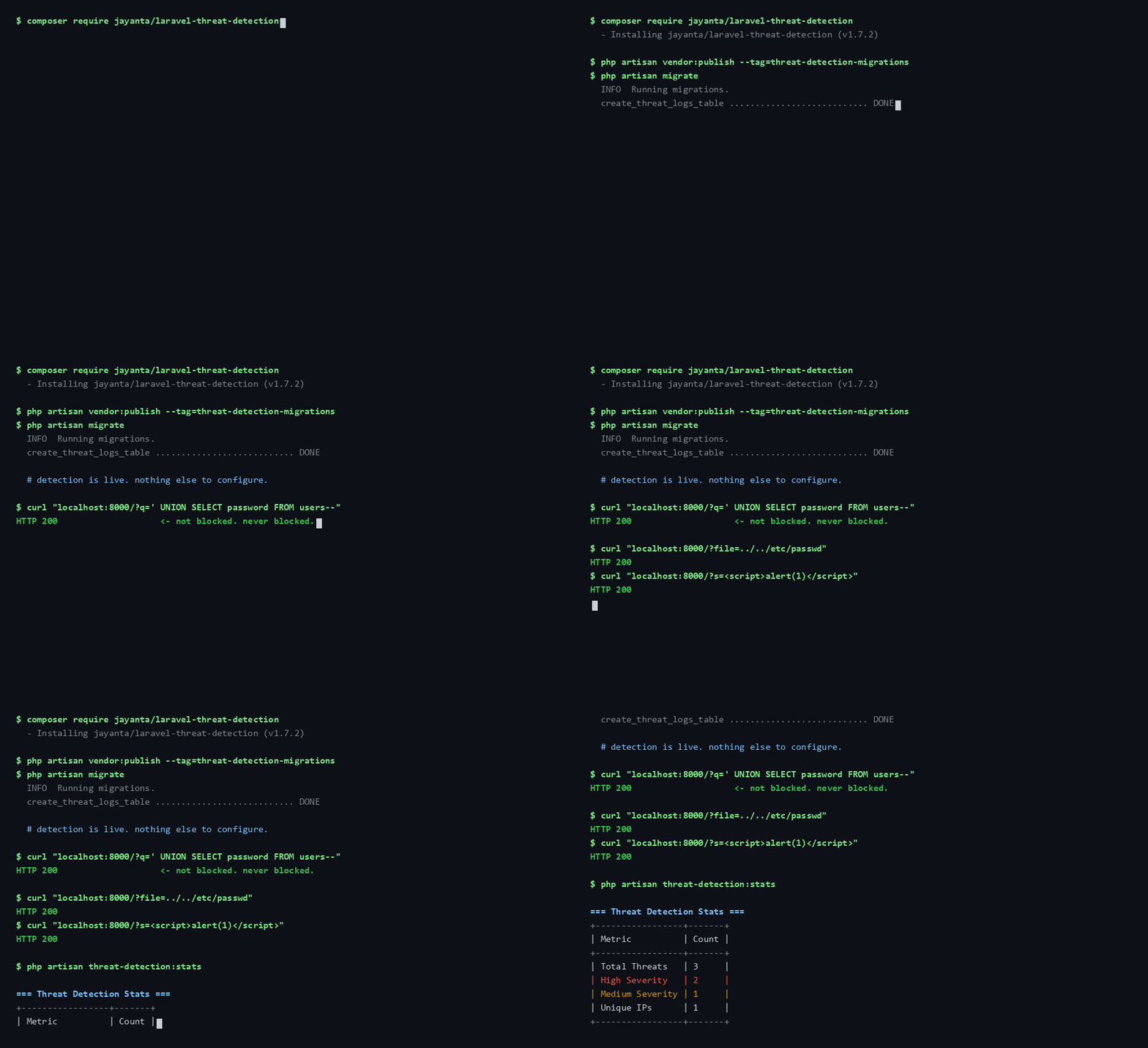
Are you here because you saw something like this?
GET /wp-admin/setup-config.php          404   — on a site that isn't WordPress
GET /.env                               404   — someone wants your database password
GET /?id=1' UNION SELECT password FROM  200   — SQL injection against a real route
GET /phpmyadmin/index.php               404   — scanning for an admin panel
Those requests are already reaching your Laravel app. Your access log shows the URL and the status code, and nothing else — not the decoded payload, not which of your routes was targeted, not whether the same IP has tried forty other things this hour.
This package answers those questions. Drop it into any Laravel 10–13 app and it starts scanning every HTTP request against 150+ attack patterns, scoring each match by confidence and writing it to your database — with a built-in dashboard, Slack alerts, geo-enrichment, and fail2ban/blocklist exports. No request is ever blocked. Think security camera, not a lock: it shows you exactly who's probing your routes, how often, and with what techniques.
Extracted from a production app and battle-tested on real traffic. 1,800+ tests, no runtime dependencies beyond Laravel itself, and no internet connection required for detection.
Upgrading? See UPGRADING.md. Contributing? See CONTRIBUTING.md.
Get started in under a minute
composer require jayanta/laravel-threat-detection
php artisan vendor:publish --tag=threat-detection-migrations
php artisan migrate
Then add the middleware to your web group (one line in bootstrap/app.php on Laravel 11+,
or app/Http/Kernel.php on Laravel 10) — full snippet in Quick Start below.
That's it; detection is live.
php artisan threat-detection:doctor # confirms it is actually recording
Where it fits: IDS vs WAF vs edge
This package is a passive, application-level IDS — it watches and records, it doesn't block. It's meant to sit alongside a WAF or edge service, not replace one. Each layer sees something the others can't:
| This package (app IDS) | WAF (mod_security, Cloudflare WAF) | Edge / CDN (Cloudflare) | |
|---|---|---|---|
| Blocks malicious requests | ❌ logs only | ✅ | ✅ |
| Full app context (exact route, decoded payload, authenticated user) | ✅ | ⚠️ partial | ❌ |
| Built-in dashboard + threat log in your DB | ✅ | ⚠️ varies | ⚠️ edge only |
| App-specific detections (e.g. Aadhaar / PAN / IFSC PII) | ✅ custom patterns | ❌ | ❌ |
| Works offline / no external service | ✅ | ⚠️ depends | ❌ |
| Stops traffic before it reaches your app | ❌ | ✅ edge | ✅ |
| Setup | one composer require | medium–high | low–medium |
| Cost | free, MIT | varies | free tier + paid |
The short version: an edge/WAF is your lock on the door; this is the security camera inside, with the app context to tell you exactly what's being tried on which route, by whom, and how often. Use it to feed real decisions — fail2ban bans, rate limits, geo-blocking — with data your edge layer never sees.
What it deliberately is NOT
- Not a WAF. It never blocks, filters, or modifies a request. Use Cloudflare, mod_security, or a real WAF for enforcement. (No edge layer to hand off to? The operator-side helpers expose the package's decisions so you can write your own five-line blocking middleware — the enforcement code stays yours, not the package's.)
- Not a replacement for secure coding. Parameterized queries, input validation, and output escaping are your actual defenses. This package assumes your code is already secure and gives you visibility, not protection.
- Not an edge service. If you can put Cloudflare in front, do — then add this for the application-level detail edge services can't see.
- Not a complete detector, and it can't be. Pattern matching catches attacks that look like known attacks. A novel technique, or a familiar one rewritten enough, will pass through unlogged — and you will not be told that it did. Silence here means "nothing matched", never "nothing happened". Where it earns its place is the high-volume, low-effort traffic that makes up most of what actually hits a public Laravel app: scanners, recon probes, off-the-shelf injection strings, credential sprays. Treat a quiet log as an absence of evidence, not evidence of absence.
Expect it to flag your own content on day one
An untuned install fires on legitimate content, and you should know that before
you install rather than after. These are measured, not hypothetical. The rows
below are a sample of the floor pinned by
LegitimateTrafficCorpusTest;
each one lists everything that request logs, and
ReadmeNoiseFloorTest fails the
build if any row stops matching what the suite measures for it.