
Packet-Sniffer v6.0.0
Raw socket-based network packet sniffer that captures and disassembles TCP/IP packets from network interfaces for security analysis and educational use.
RootWire




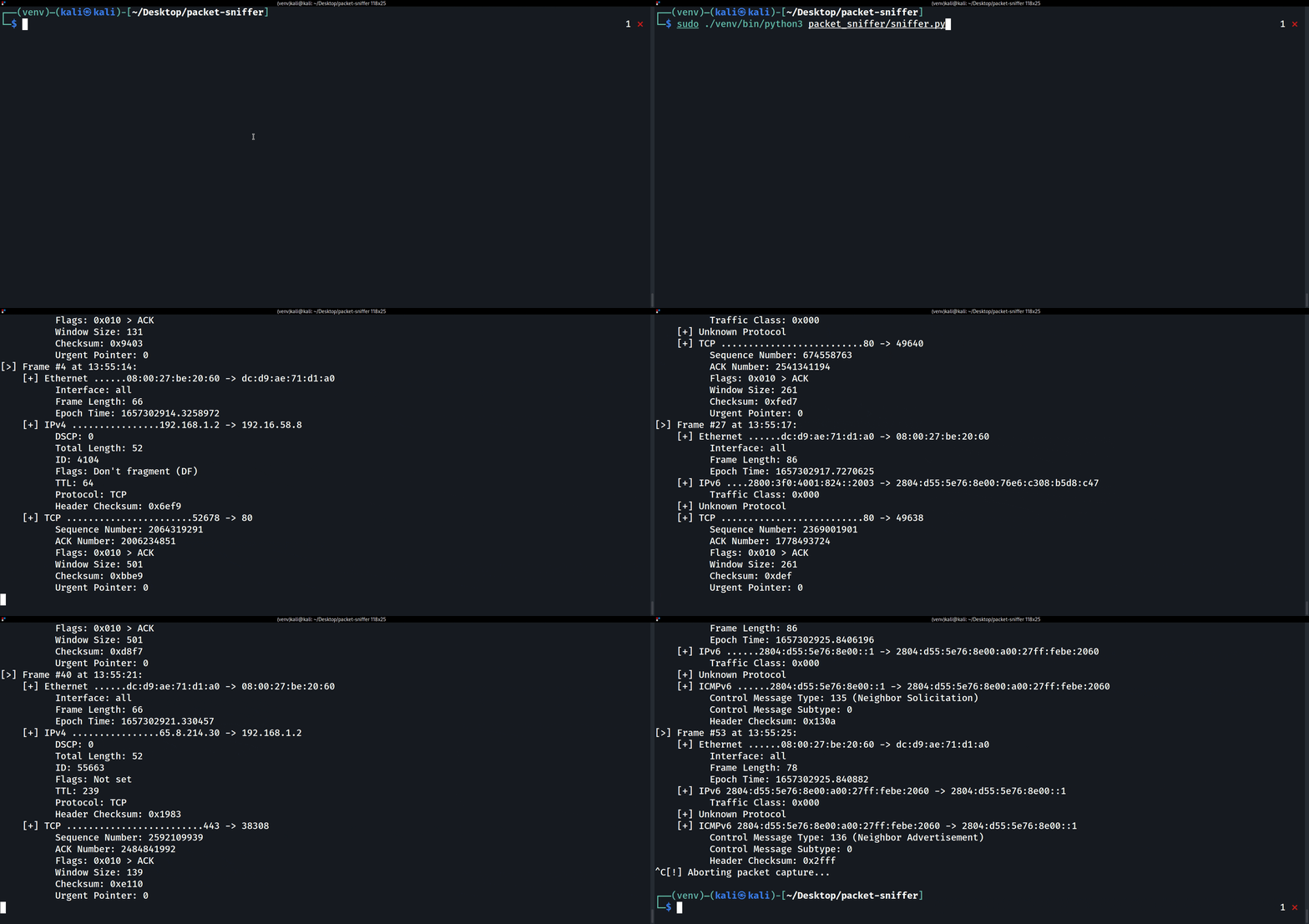
A network traffic monitor for GNU/Linux — formerly known as Packet-Sniffer. Frames are captured from one or more network interfaces with a raw socket, timestamped by the kernel itself, decoded layer by layer with the NETProtocols library, and rendered live, written to nanosecond-precision pcap, or streamed as JSON:
[>] Frame #4 at 15:42:07 (wlan0, 74 bytes)
    [+] Ethernet 3c:7c:3f:1a:be:22 -> 9c:1e:95:aa:01:5f
        EtherType: IPv4
    [+] IPv4 192.168.1.96 -> 142.250.79.78
        TTL: 64 | Flags: Don't fragment (DF) | Total Length: 60 | ID: 39754
        Protocol: TCP | Checksum: 0x2b51
    [+] TCP 51888 -> 443
        Flags: 0x002 (SYN) | Seq: 3598801521 | Ack: 0
        Window: 64240 | Checksum: 0x2008
        Options: Maximum Segment Size (1460), SACK Permitted, Timestamps (3644437524, 0), No-Operation, Window Scale (7)
Every protocol NETProtocols decodes on its own has a renderer of its
own, from Ethernet to BGP, STUN and VXLAN (see the
table below), and HTTP joins them when you ask for
it with --decode-as. Checksums are verified against a recomputation
and flagged inline when they disagree. Malformed, truncated or hostile
frames are diagnosed, never fatal: the capture survives whatever the
network delivers.
What it decodes
| Layer | Protocol | What the screen shows |
|---|---|---|
| Link | Ethernet, 802.1Q VLAN (nested QinQ too) | addresses, EtherType; each tag's VID, PCP and DEI |
| Link | IEEE 802.2 LLC, SNAP | DSAP/SSAP by name, control format; OUI and PID (as an EtherType where the OUI makes it one); Novell raw 802.3 |
| Link | LLDP, CDP | the neighbor's chassis/device ID, port, TTL, system name and description, platform, software, capabilities and addresses |
| Link | STP, RSTP | root and bridge IDs, path cost, port, flags (an RST BPDU's role and proposal/agreement handshake) and timers |
| Link | MPLS | the label stack, top first: label (special-purpose ones by name), traffic class, TTL, bottom of stack |
| Network | ARP | the who-has / is-at summary, sender and target |
| Network | IPv4 | TTL, flags, length, ID, decoded options, fragments |
| Network | IPv6 and its extension headers | Hop-by-Hop, Destination Options, Routing, Fragment (an MLD report renders its whole chain) |
| Network | ICMPv4, ICMPv6 | the enclosing addresses, type and code, and Neighbor Discovery targets and link-layer options |
| Network | IGMP | message type, group, every v3 group record |
| Tunnels | GRE, IP-in-IP | encapsulated protocol and optional fields; the inner packet renders as its own layers |
| Tunnels | VXLAN | VNI and flags (set reserved bits noted); the inner Ethernet frame renders in full |
| Tunnels | IPsec ESP, AH (IPv4 and IPv6) | SPI and sequence number; the protected size (ESP), or what AH protects, tunnel mode named, and the ICV's size |
| Transport | TCP, UDP | ports, flags, sequence numbers, window, decoded TCP options |
| Transport | SCTP | verification tag and the chunk types in wire order with their flags |
| Routing | OSPFv2 | Hello timers and DR/BDR election, Database Description, LSA requests, updates and acknowledgments, authentication |
| Routing | RIP v1/v2 | routes with metrics and next hops, whole-table requests, authentication entries |
| Routing | BGP | OPEN, UPDATE (withdrawals, path attributes, NLRI), NOTIFICATION, one section per message |
| Routing | PIM v2 | Hello options, Register, Register-Stop, Join/Prune groups and sources, Assert |
| Redundancy | VRRP v2/v3, HSRP | virtual router or group, priority (resignation and address owner named), virtual addresses, timers, clear-text authentication |
| Application | DNS (UDP and TCP), DHCP | every question and answer with decoded RDATA; DHCP message type, client MAC, addresses, options |
| Application | TLS | one line per record; a ClientHello's version, SNI, cipher-suite count and extensions — or, for a ClientHello split across segments (never reassembled), the SNI alone, when its first segment holds it |
| Application | NTP | mode, stratum, Reference ID or kiss code, timestamps, extension fields, MAC |
| Application | TFTP | the request's filename, mode and options; DATA/ACK blocks; ERROR code and message; OACK options |
| Application | RADIUS | code, identifier, Authenticator, User-Name and the other text attributes, addresses and numbers (passwords by size only) |
| Application | STUN | method and class, mapped addresses, ERROR-CODE, SOFTWARE, unknown attributes, MESSAGE-INTEGRITY's presence |
| Application | HTTP/1.x (with --decode-as) | start line, Host, User-Agent and the other triage fields, body framing and size, and the framing anomalies request smuggling rests on |
Checksums verified: IPv4, ICMPv4, ICMPv6, IGMP, GRE (when present),
TCP, UDP, SCTP (CRC32c), VRRP, PIM, OSPF and every OSPF LSA's LS
checksum, CDP, and the STUN FINGERPRINT. A mismatch shows inline as
Checksum: 0x0000 [!] mismatch (expected 0x1a2b) — a real signal for
corrupted or spoofed traffic. Inside a tunnel the inner IP header is
used, behind an IPv6 Routing header the route's final destination, and
Ethernet padding never reaches the sum; a non-reassembled fragment is
not checked, since its checksum covers a datagram RootWire never
rebuilds. Authenticators that need a key (AH's ICV, RADIUS's
Authenticator, STUN's MESSAGE-INTEGRITY, an OSPF digest) are shown,
never verified.
Installation
pipx install rootwire # or: uv tool install rootwire
Or run from a clone with uv:
git clone https://github.com/EONRaider/RootWire.git
cd RootWire
uv sync
Usage
usage: rootwire [-h] [-i INTERFACE] [-r FILE] [-w FILE]
                [--filter NAME_OR_EXPR] [--decode-as TABLE=KEY:CLASS] [--json]
                [-d] [--version]

Monitor network traffic: capture Ethernet frames from an interface (or replay
them from a pcap file), decode their protocol stack and render each frame.