
Skip to content
KitploitKITPLOIT
HerramientasExploitsBlog
Log in
Enviar
HerramientasExploitsBlog
Enviar

¡Herramientas de Hacking, PenTest y Ciberseguridad para tu Arsenal de Seguridad!

Kitploit es un directorio de herramientas de hacking, ciberseguridad y pentesting. Descubre las últimas actualizaciones de proyectos para encontrar vulnerabilidades, analizar sistemas, automatizar pruebas y fortalecer tu seguridad.

FeedsContactoPrivacidad© 2026 Kitploit

Directorio de Herramientas

Categorías

Ver todas las categorías
Loading categories
AperiSolve — Automated steganalysis platform that detects hidden data in images using 16 parallel analyzers, bit-layer visualization, and an in-app wiki for CTF and forensic investigations. | Kitploit
Herramientas/GitHubGitHub/zeecka/aperisolve
ForensicsSteganographyCryptographyCTFLearning & Education
GitHubzeecka/aperisolve

AperiSolve

Automated steganalysis platform that detects hidden data in images using 16 parallel analyzers, bit-layer visualization, and an in-app wiki for CTF and forensic investigations.

Ver Repositorio
834101204hace 1 díaRevisado por Kitploit
Compartir
Sitio web
Contenido no disponible en el idioma solicitado. Mostrando versión en inglés.

Aperi'Solve

Website CI Lint Docker Python Version Ruff uv ty License GitHub Issues GitHub Pull Requests Last Commit Contributors Rawsec's CyberSecurity Inventory

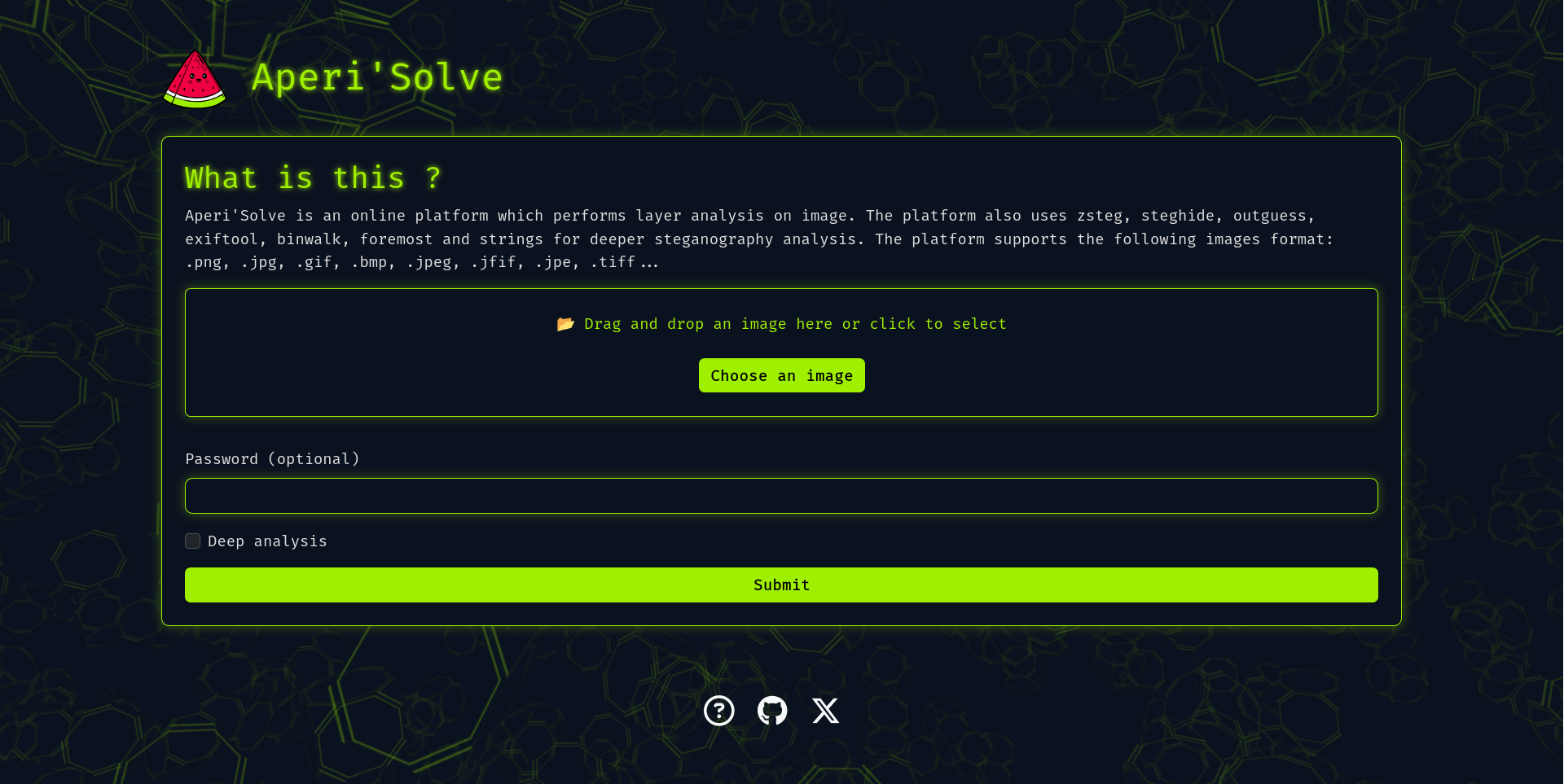
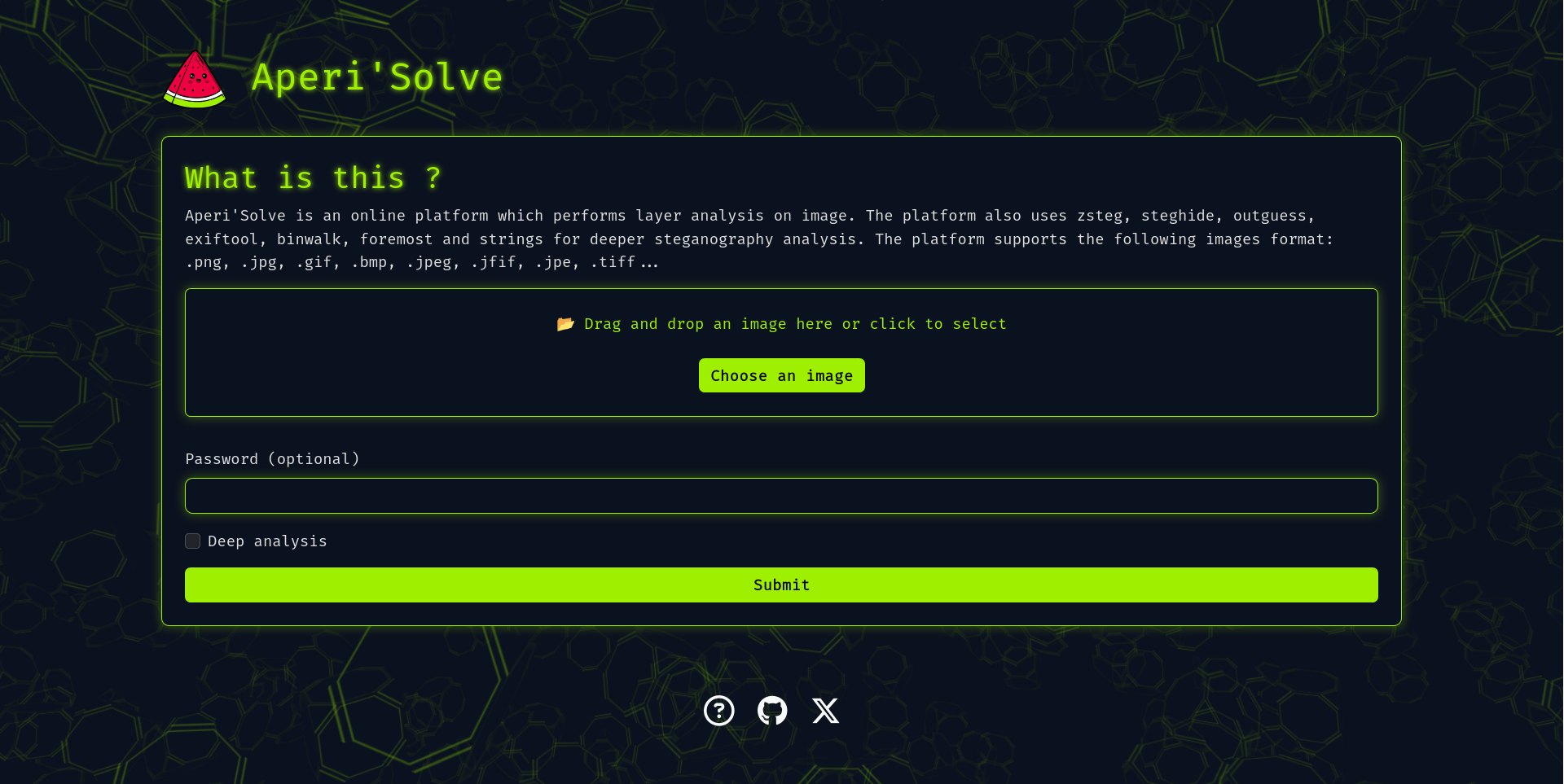
Aperi'Solve screenshot

Try it now: https://www.aperisolve.com

Support Aperi'Solve:

Sponsor Aperi'Solve on GitHub

Aperi'Solve is an open-source steganalysis web platform that performs automated analysis on images to detect and extract hidden data using common steganography tools and techniques.

Key features

  • Visualize each bit layer (LSB and other layers) per image channel (R/G/B/Alpha).
  • Color remapping (random palette remaps with 8 generated variants)
  • Runs 16 analyzers in parallel and displays their output, with per-tool success/no-result badges and one-click download of extracted files:
    • binwalk (embedded archives)
    • exiftool (metadata and geolocation)
    • file (MIME type and format detection)
    • GraphicsMagick identify (image info & properties)
    • foremost (carved files)
    • jsteg (JPEG LSB extraction)
    • jpseek / jphide (JPEG steganography extraction, with password)
    • openstego (extraction with password)
    • outguess (extraction with password, deep analysis)
    • pcrt (PNG check & repair)
    • pngcheck
    • steghide (extraction with password)
    • stegoveritas (image transforms on deep analysis, frames of animated GIF/APNG)
    • strings
    • zsteg (LSB text/data extraction)
  • In-app wiki (/wiki): a HackTricks-style steganography handbook — a triage methodology, a decision-tree cheatsheet, technique pages per medium (image, audio, text, files), and a guide per analyzer, all authored as Markdown.
  • Internationalization: UI available in English, French, Spanish, German, Russian, Chinese and Portuguese under language-prefixed URLs (/fr/, /es/, …).
  • "Ask AI" panel on the result page: send the analysis results and images straight from your browser to your own LLM provider (bring your own key) for a verdict on what is hidden and what to try next. Two checkboxes pick what the model gets: the images (on by default) and a text matrix of every image's pixel values (off by default; native resolution, so text-only models can read LSB data too). The matrix comes from the browser's image decoder: it is exact for opaque pixels of a PNG/BMP/GIF, but a semi-transparent pixel can be off by one in a colour channel (the canvas stores premultiplied alpha), the RGB under a fully transparent pixel reads 0, and JPEG depends on the decoder.
  • MCP server at https://www.aperisolve.com/mcp (docs/mcp.md): lets Claude, Cursor or any MCP client upload a file and read its analysis.
  • Worker queue architecture for offloading heavy/slow analyzers (Redis + background workers).
  • Content-addressed result cache, HTTP caching, and per-endpoint rate limiting.
  • Results stored temporarily for later browsing and download, then cleaned up automatically by a scheduled job.

Adding an analyzer

Adding an analyzer is a single file: subclass SubprocessAnalyzer, set a few class attributes (name, has_archive, needs_password, deep_only, display_order), and install the tool in the Dockerfile. The worker run list, download allow-list, and frontend order are all derived automatically. See docs/adding-analyzer.md.

Quick start (Docker)

In case you want to host your own version of https://www.aperisolve.com/.

Required: Docker + Docker Compose.

git clone https://github.com/Zeecka/AperiSolve.git
cd AperiSolve
cp .env.example .env
docker compose up -d

Then browse url: http://localhost:5000/

Ads and analytics are disabled by default; every integration (CUSTOM_EXTERNAL_SCRIPT, GOOGLE_ADS_TXT, SITE_BASE_URL, Sentry) is opt-in via environment variables documented in .env.example. The app never injects ad markup itself: CUSTOM_EXTERNAL_SCRIPT loads the AdSense script and placement is left to Auto ads.

Architecture

The stack runs as Docker Compose services:

  • web — Flask app served by gunicorn (Jinja templates + vanilla JS frontend).
  • worker — an RQ worker that runs the analyzers for each submission, fanning out to one thread per tool.
  • cron — an RQ cron scheduler that runs the retention cleanup off the request path.
  • initdb — a one-shot service that creates the tables and pre-fills the IHDR CRC recovery database.
  • postgres — stores image metadata and submission status.
  • redis — RQ broker (DB 0) and rate-limiter storage (DB 1).
  • rqdashboard — queue monitoring, bound to localhost:9181.

This separation keeps heavy tools (binwalk, foremost, zsteg, etc.) isolated and avoids blocking the web worker. Identical submissions are deduplicated by a content hash, and derived images are cached with long-lived immutable HTTP headers, so repeat traffic is cheap.

Documentation

  • docs/adding-analyzer.md — add a new analyzer.
  • docs/deploy.md — the tag-driven production deploy flow.
  • docs/mcp.md — the MCP endpoint: client setup, tool reference, quotas.
  • CONTRIBUTING.md — dev setup, tests, wiki pages, and translations.

Testing

uv sync --extra dev
uv run pytest -q            # unit tests (no services needed)

# end-to-end analyzer tests through the running app:
docker compose -f compose.dev.yml up -d
uv run pytest tests/test_webapp_analyzers.py -v

Roadmap

See Issues.

Contributing

See CONTRIBUTING.md.

Security

Descargar herramienta

Más Populares

Ver todos →

Descubre las herramientas más usadas por nuestra comunidad.

  • 1

    OsintHunter

    letox4/osinthunter

    🎯 El kit de herramientas OSINT definitivo: grafo de investigación, puntuación de confianza, familias de alias, mapa, línea de tiempo e informes. 49 módulos, más de 400 sitios, sin necesidad de claves API.

    911
  • 2

    ghostlock-app

    yukonga/ghostlock-app

    # Aplicación de Ejecución con un Solo Toque GhostLock (CVE-2026-43499)

    548
  • 3

    redforge

    cybersecurity91/redforge

    Kit de herramientas de red team del lado del navegador con 102 herramientas offline para reconocimiento, generación de payloads, ataques de credenciales, criptografía, codificación y elaboración de informes de compromiso.

    366
  • 4

    ARTEX

    baarai/artex

    Plataforma de pruebas de penetración autónoma multiagente basada en LLM con agentes planificadores/trabajadores, grafos de activos y de exploración, registro de tráfico MITM y reevaluación de vulnerabilidades.

    362
  • 5

    looking-glass

    anonghosty/looking-glass

    Plataforma CSIRT que ingiere informes de Shadowserver en MongoDB y los reproduce como mapas interactivos, análisis, hallazgos, avisos y paneles ejecutivos.

    311
  • 6

    CyberStrikeAI

    ed1s0nz/cyberstrikeai

    El sistema de acción para la ciberseguridad nativa de IA—donde la intención se convierte en ejecución gobernada, la evidencia se convierte en memoria operativa y cada operación mejora la siguiente.

    287

Explora todas las herramientas

Explora nuestra colección de herramientas

Ver todas las herramientas →